Annual Fall Conference on Teaching and Learning
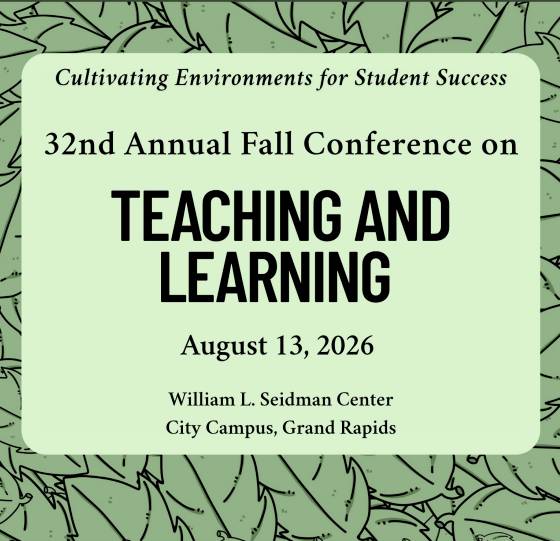
31st Annual Fall Conference on Teaching and Learning (2025)

Text laying over web

Thank you for joining us at the 31st Annual Fall Conference on Teaching and Learning! 

Thursday, August 14, 2025

8:00am - 3:30pm 

 L.V. Eberhard Center (EC)

Robert C.Pew Grand Rapids Campus (City Campus)


Missed the conference? Want to know more? 

View Recordings and Shared Materials

MORNING KEYNOTE - DR. PETER FELTEN

Man in blue sweater standing in front of trees smiling

Dr. Peter Felten 


Connections Are Everything: How Relationships Drive Student Success

Keynote Presentation: Dr. Peter Felten

The classroom – whether physical, virtual, or hybrid – can be a place where students thrive if we design for learning and connection. With the rise of generative AI, human interactions are even more important for motivation, trust, well-being, and meaning-making. In this interactive session we will explore research on how intentional academic interactions offer flexible, scalable, and humane approaches to ensuring that all students experience welcome and care, become inspired to learn, and explore big questions about meaning and purpose. We also will consider how meaningful professional relationships contribute to faculty and staff well-being.

Professor Peter Felten is a professor of History, Executive Director of the Center for Engaged Learning, and Assistant Provost for Teaching and Learning at Elon University. He has published seven books about undergraduate education, including Relationship-Rich Education: How Human Connections Drive Success in College (Johns Hopkins University Press, 2020) co-authored with Leo M. Lambert, and  Connections are Everything: A College Student’s Guide to Relationship-Rich Education (Johns Hopkins University Press, 2023) co-authored by Isis Artze-Vega, Leo Lambert, and Oscar Miranda Tapia – with an open access online version free to all readers. His next book, The SoTL Guide: [Re]Orienting the Scholarship of Teaching and Learning, is co-authored by Nancy Chick and Katarina Mårtensson, and will be published in October 2025. He is on the advisory board of the National Survey of Student Engagement (NSSE) and is a fellow of the Gardner Institute.

MORNING CONCURRENT SESSIONS

Faculty and Staff Led Concurrent Sessions

Bradford Dykes (CLAS Voyage), Rachel Campbell (CLAS Voyage), Dana Hebreard (CLAS Center for Experiential Learning), Rachel Becklin (Career Center), and Lisa Knapp (Career Center)

There often appears a disconnect between students goals of attending college to get a career and faculties desires to develop a liberally educated person. To quote the mid 2000s Old El Paso hard and soft tacos commercial, Why don't we have both? In this session, we will discuss career connected skills and dispositions from national organizations and how they have been integrated into courses. Participants should come prepared to integrate one or more of these outcomes into their courses. 

Theme: Teaching Refresh 


EC 612
Quinton Quagliano (Psychology)

Attendance at in-person class meetings is valuable to a student's education, but there is also a vast variety of reasons and circumstances that lead to students' absences. Physical/mental health, disability, complex home life, and other situations may all complicate students' ability to arrive at our courses. This session will discuss strategies for refining how we emphasize equity-minded attendance and access to materials, while also recognizing the tensions and difficulties that arise when adopting a more permissive attendance structure.


Theme: Equity-Minded Approaches 


EC 515
Carol Wilson-Tiesma (Modern Languages and Literatures) and Arya Jadhav (Computing) 

Despite the growing research demonstrating the negative effects of shame on cognition, working memory, and retention, aspects of the educational system continue to inadvertently--and sometimes intentionally--use shame as a motivator. In this workshop, we will explore how to move from triggering feelings of shame and its detrimental effects to inspiring intrinsic motivation in our students. The hope is to have a lively discussion on how to cultivate a shame-free atmosphere in the classroom while achieving our teaching goals. Attendees will leave with tools and guidelines to create a welcoming and learner-friendly environment.


Theme: Teaching Refresh 

EC 514
Jay Knight (Nursing), and Jennie Knight (Executive Director GR LGBTQ+ Healthcare Consortium)

Attendees in this session explore how to get back to the art of having respectful conversations about potentially polarizing differences and move to a space of respect as the default vs. earned. Using potentially divisive topics such as crunchy vs. creamy peanut butter participants develop skills to depolarize and connect with others to seek to understand.


Theme: Equity-Minded Approaches 

EC 511
Suhila Sawesi (Computing)

This session introduces a human-centered precision learning model designed to support diverse, interdisciplinary, and international graduate students. Using the five rights framework right content, student, time, method, and relationship, we explore culturally aware teaching strategies and practical applications. The session highlights how tools like large language models (LLMs), inclusive pedagogy, and responsive feedback can help educators better meet student needs, foster belonging, and strengthen engagement in AI integrated, equity-minded classrooms.


Theme: Equity-Minded Approaches 

EC 310
Tim Mohnkern (Student Accessibility Resources) and Maya Hobscheid (University Library)

Access benefits everyone, but it’s essential for students with disabilities. Join staff from the University Library and Student Accessibility Resources to deepen your understanding of the faculty role in accessible instruction. Explore tips for digital accessibility, Blackboard Ally, Universal Design, decoding accommodation memos, and providing access with minimal stress.


Theme: Equity-Minded Approaches 

EC 611
Raymond Higbea (School of Community Leadership and Development - CECI)

I will demonstrate how to use Blackboard AI tools to enhance classroom equity. Specifically, I will demonstrate how using the Socratic Questioning and Role Playing tools provide students the opportunity to think deeply and critically.


Theme: Equity-Minded Approaches 

EC 312
Monica Harris (Teaching and Learning - CECI)

This session will explore effective teaching practices to support college students with disabilities, focusing on inclusive strategies that foster a welcoming and accessible classroom environment. Attendees will learn about Universal Design for Learning (UDL), common accommodations, assistive technologies, and practical approaches for engaging students with various disabilities. Information on the importance of collaborating with the student and disability services will be shared, as well as emphasizing how small changes can significantly enhance student success and inclusion in higher education.


Theme: Equity-Minded Approaches 

EC 512
Lindsay Ellis (English; Director of SWS)

As we design courses to maximize student learning of content, low-stakes writing tasks are a powerful tool to strengthen working and long-term memory.  These "writing to learn" activities can have a central place in SWS (Supplemental Writing Skills) courses alongside explicit instruction in "learning to write" with and without generative AI tools. The proliferation of AI tools makes it all the more necessary for instructors to insist on some student-generated writing to strengthen learners' understanding and neural pathways (like lifting weights to strengthen muscles). This session will feature University Writing Skills Committee members sharing their Generative AI Use policies.  We will share models of Generative AI Use syllabus statements and writing assignments that clarify how AI may or may not be used while writing to learn and learning to write. 


Theme: Teaching Refresh 

EC 614
Matthew Roberts (eLearning Technologies)

Generative artificial intelligence might benefit education, but it can cause great harm as well, threatening the sense of community and trust that faculty work so hard to build. Faculty use of AI creates confusion and antagonism when learners themselves are prohibited from using it. Differential access to paid AI and differences over its moral and ethical problems can sow tension between fellow learners. This session suggests addressing these challenges through transparency and purposeful discussion about the nature of learning itself.


Theme: Equity-Minded Approaches 

AFTERNOON LIGHTNING ROUNDTABLE SESSIONS

Faculty and Staff Led Roundtable Sessions

Table 9
Chelsea Ridge (Mathematics)

As a newer faculty member, finding a syllabus that checks all the boxes (communicates the value that students bring to the classroom, my expectations for a rewarding semester and the university required content to name a few) can be a challenge. Join me to chat about the challenges and successes we have had in this space. Resources will be shared as well.


Theme: Relationship-Rich Education 

Table 4
Pinar Ustel (Sociology)

Many students who demonstrate a visible level of engagement (for instance, by consistently attending classes) struggle with starting or completing assignments, even with flexible deadlines. Last semester, I supported my students' completion of late assignments by scheduling in-person co-working times, during which I got to know them, answered their questions whenever they felt stuck, and made progress on my work. This session explores parallel work as a means to foster relationships with our students and set them up for success.


Theme: Relationship-Rich Education

Table 5
Laila McCloud (Educational Leadership and Counseling) and Mara Spears (Groundswell Stewardship Initiative)

Discover how to bring the 2025 Teach-In into your classroom-no matter the subject or level. Join members of the Teach-In planning committee to explore student engagement strategies and learn how to make the most of this campus-wide event.


Theme: Engaging Ideas

Table 12
Leigh Rupinski (University Libraries) and Andrea Van Dyke (University Libraries)

Empowering educational experiences are at the core of Lemmen Library and Archives instruction program. We will discuss the kinds of materials available at Lemmen and provide examples of instruction sessions and possible assignment designs across disciplines. Instructors are encouraged to consider how their students can benefit from hands-on work with primary source materials. We also want to facilitate building collections at Lemmen Library that meet faculty needs and create opportunities for student engagement.


Theme: Engaging Ideas 

Table 2
Sarah Chase (LEFT - CECI)

Growing research supports gamification, multimodal engagement, and low-stakes opportunities for students to practice professional skills. I will share student examples and iterations of assignment guidelines and rubrics for multimodal journaling, which connected assigned readings to students' practical experience and potential future action. Not sure if this type of assignment really applies to you? I will also share similar reflective assignments used in past courses to support your brainstorming in ways that can be tailored to GVSU resources and your course.


Theme: My Favorite Assignment or Assessment 

Table 11
Dawn Brackmann (SCB Management)

Enhance engagement, empower learning, and equip students for success! Faculty have the opportunity to share innovative strategies for boosting student engagement, creating experiential learning opportunities, and fostering online academic success whether the course is in-person, hybrid, online synchronous, or online asynchronous. We will share ideas for assignments, discussions, video lectures, and group projects that increase student involvement and enhance learning.


Theme: Relationship-Rich Education 

Table 10
Dennis Malaret (Sociology) and Robert Roznowski (Sociology)

Professor Roznowski and Malaret have over the last two years collaborating and sharing ideas as to best ways to engage students and how to tackle with unanticipated contemporary challenges students face today. We would like to generate a group discussion amongst attendees to learn and share strategies and challenges that other instructors have faced. For example: technology and AI, absenteeism, academic skills expectations, and a wide number of mental health issues.  We hope to generate an insightful and fruitful conversation.


Theme: Engaging Ideas

Table 1
Ashley Rosener (University Libraries)

Drawing from Berg and Seeber's book, The Slow Professor, and Honoré's, In Praise of Slow, we'll consider what it means to apply practices of slow to our work in the academy.


Theme: Faculty Well-Being 

Table 7
Maggie Goss (Pew FTLC), Rachel Campbell (CLAS Voyage; Sociology), Bradford Dykes (CLAS Voyage; Statistics)

Interested in getting your students to think actively about their experience, learning, and decision-making in your course? Try reflection! We will share the range of ways reflection can be undertaken, how it benefits students, and some different modalities and techniques that can be used to incorporate reflection. Participants will leave this session with resources to integrate reflection in their classes.


Theme: My Favorite Assignment or Assessment

Table 6
Karen Gipson (Physics), Takeelia Garrett (Student Ombuds; Interdisciplinary Studies), and  Hannah Seidel (Music, Theatre, and Dance)

This roundtable will offer two brief trauma-sensitive mindfulness practices to support wellbeing and provide scripts that participants can use in their personal practice and possibly also their work with students. Information about other resources, such as Workday Learning courses on mindfulness for GVSU faculty and staff (offered by two of the table facilitators), will also be shared. The remainder of the time will be roundtable discussion.
 

Theme: Faculty Well-Being 

Table 3
Filiz Dogru (Mathematics)

As AI tools rapidly enter classrooms and research spaces, many academics feel uncertain or overwhelmed. This talk offers a calm, practical approach to navigating AI in higher education. We’ll address common fears, clarify what AI can—and can’t—do, and explore strategies for using it ethically and effectively. From enhancing teaching and streamlining research to supporting student learning, we’ll look at real-world examples of AI in action. The session will emphasize how faculty can stay grounded, curious, and in control, turning change into opportunity through informed engagement and open dialogue.


Theme: Teaching and AI 

Table 8
Arya Jadhav (Computing) and Carol Wilson Tiesma (Modern Languages and Literatures) 

As AI tools reshape education, we must ask not just how to integrate them, but who they serve. This lightning session offers an equity-focused lens on AI in learning environments, emphasizing cognitive diversity and learner agency. Using the Distributed Atrophy model and a live case study in language learning, we’ll explore design strategies that preserve memory, meaning, and self-trust. Attendees will leave with practical tools to support reflection-rich, cognitively inclusive teaching in AI-augmented classrooms.


Theme: Teaching and AI 


SCHEDULE

Time

Agenda

8 a.m.

Breakfast Available 

8:30 – 9 a.m.

Welcome Remarks

9 – 10:30 a.m.

Morning Keynote Presentation by Dr. Peter Felten - "Connections Are Everything: How Relationships Drive Student Success"

10:45  – 11:45 a.m.

Faculty and Staff-led Concurrent Sessions: Teaching Excellence & Experiential Sessions 

12 – 1 p.m.

Lunch and Book Raffle Winner Announcement 

1 – 2:30 p.m.

Faculty and Staff-led Lightning Roundtable Discussions 

2:30  – 3:30p.m. 

Closing Keynote Presentation by Dr. Jennifer Drake, Provost and Executive Vice President for the Division of Academic Affairs, and Dr. B. Donta Truss, Vice President for Enrollment Development and Educational Outreach - "Who They Are and the Stories They Carry: Narratives of Today's First-Year Students"

BOOK RAFFLE

The following books are not only wonderful resources, but will also be raffled during the 2025 Fall Conference on Teaching and Learning and added to the Pew FTLC Library (068 JHZ). To the extent possible, these books will also be made available in eBook form through University Libraries.

Book Title

Author

Access through GVSU Library

The Power of Mattering: How Leaders Can Create a Culture of Significance (2025)

Zach Mercurio

Access the ebook via the GVSU Library

Liberating the Classroom: Healing and Justice in Higher Education (2025)

Teresa Hicks Petersen

Access the ebook via the GVSU Library

Relationship Rich Education: How Human Connections Drive Success in College (2020)

Peter Felten & Leo M. Lambert

Access the ebook via the GVSU Library

Write Like You Teach: Taking Your Classroom Skills to a Bigger Audience (2025)

James Lang

Access the ebook via the GVSU Library

A Pedagogy of Kindness (2024)

Catherine Denial

Access the ebook via the GVSU Library

The Opposite of Cheating: Teaching for Integrity in the Age of AI (2024)

Tricia Bertram Gallant & David A. Rettinger

Access the ebook via the GVSU Library

More Than Words: How to Think About Writing in the Age of AI (2025)

John Warner

Access the ebook via the GVSU Library

The Anxious Generation: How the Great Rewiring of Childhood is Causing an Epidemic of Mental Illness (2024)

Jonathan Haidt 

Access the ebook via the GVSU Library

Leading Toward Liberation: How to Build Cultures of Thriving in Higher Education (2025)

Annemarie Caño 

Access the ebook via the GVSU Library

Past Conferences on Teaching & Learning


Page last modified August 20, 2025