
Pace Initiative for Connecting Mind and Health
Purpose
This Pew FTLC initiative seeks to ground well-being, health, and mental health in disciplinary coursework and services to students.
The Pace Initiative for Connecting Mind and Health was named in honor of Dr. Diana Pace, former Director of the GVSU Counseling Center and Associate Dean of Students, in recognition of her significant contribution to a culture of well-being, health, and mental health at GVSU.
How does it work?
- Grounded in disciplinary expertise, faculty members partner with campus and community experts to bring topics of well-being, health, and mental health to the classroom in Pace Course Modules, embedded into existing courses.
- Beyond the meaningful connections created by faculty, staff, and students, academic learning becomes aligned with growth and development of the whole person in and out of the classroom.
- Through the readings, presentations, and discussions led by faculty and campus professionals, coursework incorporates disciplinary knowledge related to topics of well-being, health, and mental health. Courses can extend this work to include community engagement.
- The design, implementation, and reflection upon this work is done in community.
Who Benefits?
- Integrating personal reflection of well-being, health, and mental health into academic contexts has the potential to cultivate student identity development, knowledge, and life skills impacting their lives personally and professionally as community members and leaders.
- Faculty and Staff accepted into the program have the benefit of a community actively engaged in sharing and expanding their pedagogical approaches and practices. This includes creative humanistic strategies for growth and development of students beyond the confines of course content and student support.
Pace Initiative Components
2026-2027 Pace Student Mental Health Summit
The GVSU Student Mental Health Summit, hosted by the Pace Initiative for Student Mental Health and sponsored by the Pew FTLC, will take place on January 26, 2027, from 1:00-4:00 p.m. in the Kirkhof Center in Allendale. This event brings together faculty, students, and staff to explore strategies for enhancing mental health support on campus. More information is coming soon!
Two Components of the Pace Initiative
The Pace Initiative has two components:
- Pace Initiative Associates, who participate in monthly Conversation Groups to discuss issues related to health, mental health, and well-being.
- In addition, for faculty the opportunity exists to propose, design, implement and reflect upon a Pace Course Module in their existing course. Likewise, Staff are also eligible to follow this process toward a change or intervention in their own work area, in collaboration with their colleagues and supervisors through a Pace Support Design.
Pace Components
Faculty Pace Course Module Creators
FACULTY PACE COURSE MODULE CREATORS
Module Design Workshops will be scheduled separately according to interest and availability.
The Pace Faculty Course Module Objectives are:
- Connect academic and disciplinary knowledge to personal well-being, health, and mental health.
- Create connections between faculty, staff, and students
- Cultivate identity development, knowledge, and life skills related to well-being, health, and mental health
Pace Student Support Designers
PACE STUDENT SUPPORT DESIGNERS
Pace Staff Student Support Design Workshops will be scheduled according to interest and availability.
Pace Student Support Designers Objectives:
- Create or revise a process or procedure that is attuned and supportive to student health, mental health, and well-being.
- Coordinate the possibility and implementation of this change with colleagues and supervisors.
- Reflect and evaluate the process with colleagues and supervisors.
Pace Module Highlights
Managing Emotional States of Research

Managing Emotional States of Research
YouTube Video
Created by Emily Frigo, Maya Hobscheid & Samantha Minnis
This video discusses the emotional aspects of research, the emotional reactions to doing research, and strategies for self care and getting help.
Get chat, text, or email help at www.gvsu.edu/library.
Make an appointment with a research consultant at www.gvsu.edu/library/km.
Make an appointment with a librarian at https://www.gvsu.edu/library/find-a-subject-specialist-135.htm
Using Your Campus to Support Your Well-Being
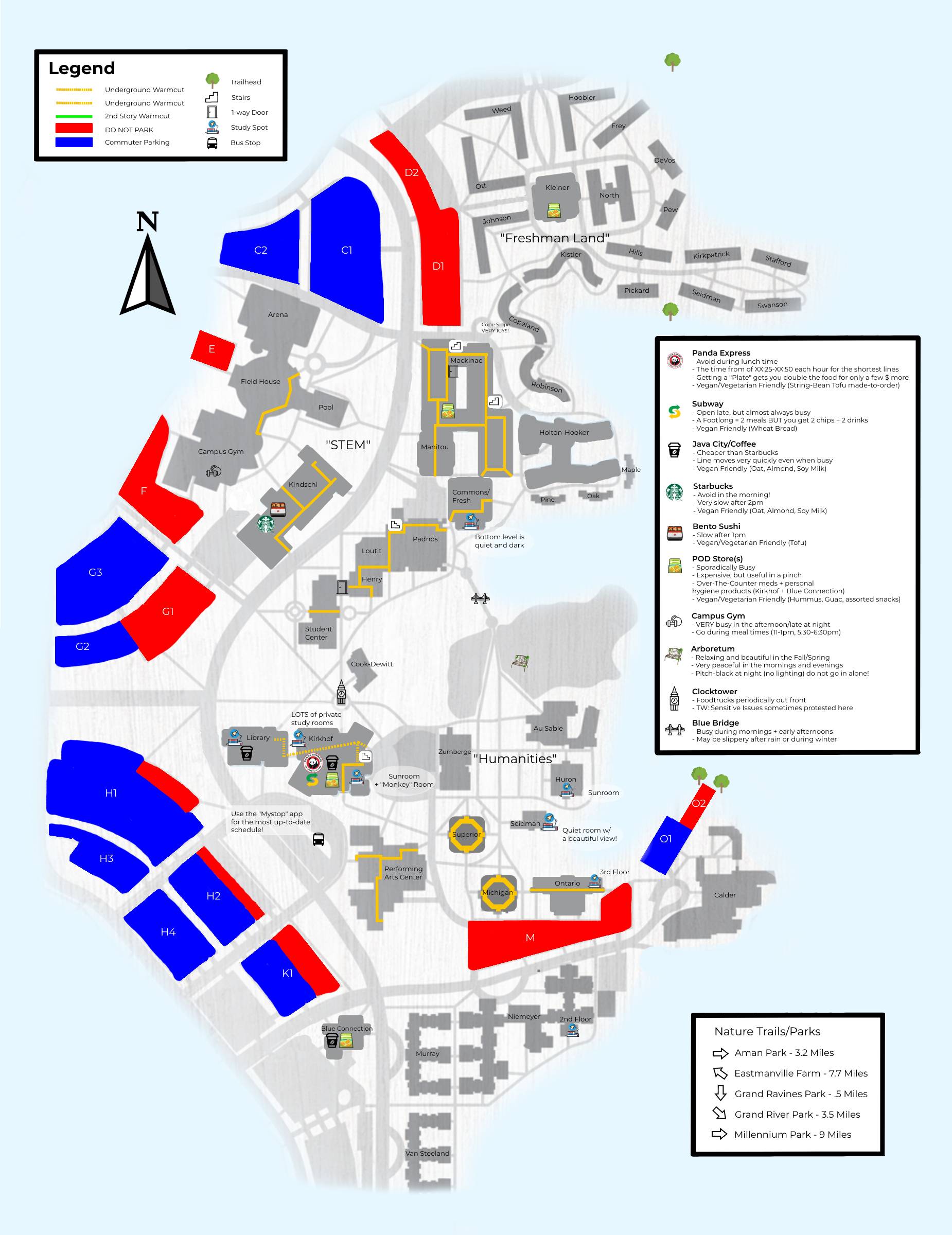
In winter 2023, Dr. Kristin Hedges' Anthropology Capstone studied the topic of stress and anxiety. In collaboration with the GSVU University Counseling Center and the GVSU FTLC Pace Initiative, students focused on application of anthropological knowledge to solve social problems. Student projects were disseminated to the Counseling Center and the Faculty Teaching and Learning Center to assist with understanding and improving ways to reduce our students' stress and anxiety.
[1701285556].jpg)
Pace Associates
Pace Associates
Annual applications will be solicited for faculty and staff to join the initiative as Pace Associates. All are eligible.
Participation as Faculty Course Module Creators or Staff Student Support Designers is optional.
Faculty Course Module Creators
- Following participation in Pace Orientation/Safety training, faculty may elect to design one or more modules related to student well-being, health, or mental health to be integrated into their course.
- Course Module design workshops are scheduled based on interes.
- Upon completion of design, proposal, implementation and reflection, faculty are eligible for a stipend granted by the Pew FTLC.
Pace Staff Student Support Designers
- Following participation in Pace Orientation/Safety training, staff are encouraged to create or revise a process or procedure that is attuned and supportive to student health, mental health and well-being.
- This work is intended to be done in Pace workshops based on interest.
- This work is designed in coordination with the possibility of implementation with colleagues and supervisors.
- Upon completion, staff will reflect and evaluate the process with colleagues and supervisors.
2025-2026 Pace Associates
-
Katie Barnhart (School of Interdisciplinary Health)
-
Elizabeth Davis (Nursing)
-
Michelle DeWitt (Chemistry)
-
Karen Gipson (Physics)
-
Kristen Hedges (Anthropology)
-
Tonisha Jones (Criminology & Criminal Justice)
-
Mikaela Walburg (University Counseling Center)
-
Katie Perschbacher (Dean of Students Office)
-
Karen Ruedinger (Seidman College of Business)
-
Guin Thompson (Visual & Media Arts)
-
Elizabeth Vendal (Office of Civil Rights and Title IX)
-
Adrienne Wallace (School of Communications)
Fall 2026 Meeting Schedule
Join us for a meeting and connect with staff and faculty across the university dedicated to improving mental health resources in the classroom and centers
- September 21, 2026 from 10am–11am; via Zoom
- October 19, 2026 from 10am–11am; via Zoom
- November 9, 2026 from 10am–11am; via Zoom
- December 7, 2026 from 10am-11am; In-person Valley Campus
FALL 2026 Discussion Topics
We believe in constant learning and sharing resources to discuss and grow. Check out our monthly discussion!
September - JED Higher Education Faculty Guide
October - 5 Things to Look for on a College Campus that Benefit Mental Health
November - The Crack Up
December - Where and With Whom Does a Brief Social-belonging Intervention Promote Progress in College
Interested in working with our associates? Email us!
Pace Initiative Grants
PACE INITIATIVE GRANTS
Pace Faculty Associates can apply for grants of up to $500 to support class-related activities that strengthen a culture of well-being in their courses. Events or activities funded by these grants could include honorariums for guest speakers, wellness activities costs, field trips, materials that support health and well-being, or activities designed to foster attention to well-being—physical, mental, spiritual, or otherwise—both within and outside of the classroom, extending students' understanding of course material and how it relates to their larger life experience.
Interested?
For more information, please contact Patty Stow Bolea, School of Social Work and Pew FTLC Faculty Fellow.

DR. DIANA PACE
Emerita. B.A., Duke University; M.A., Ph.D., University of North Dakota
The Pace Initiative for Connecting Mind and Health was named in honor of Dr. Diana Pace, former Director of the GVSU Counseling Center and Associate Dean of Students, in recognition of her significant contribution to a culture of well-being, health, and mental health at GVSU.
Dr. Pace joined Grand Valley in 1976 as a psychologist. She has served as director of the Counseling and Career Development Center from 1985 until moving into her role in 2003 as the Dean of Students. She made many contributions to GVSU while in leadership, including the establishment of a mediation and conflict resolution program, numerous publications, and earned a Lifetime Achievement Award for her advocacy for the rights of women on campus.
This program is modeled after the Georgetown University Engelhard Project for Connecting Life and Learning.