


The University Assessment Committee is the standing committee of the University Academic Senate that supports and promotes program- and unit-level assessment at GVSU. The committee meets in full session biweekly during the academic year (Mondays, 3:00 - 5:00 p.m.).
In addition to the biweekly meetings, UAC members meet in small groups to review and provide feedback on assessment report updates from 1/4 of university programs every semester. The UAC has recently updated assessment planning and reporting processes, and adapted GVAssess to better display and collect reporting. For additional information, view the Roles and Responsibilities page of our website.
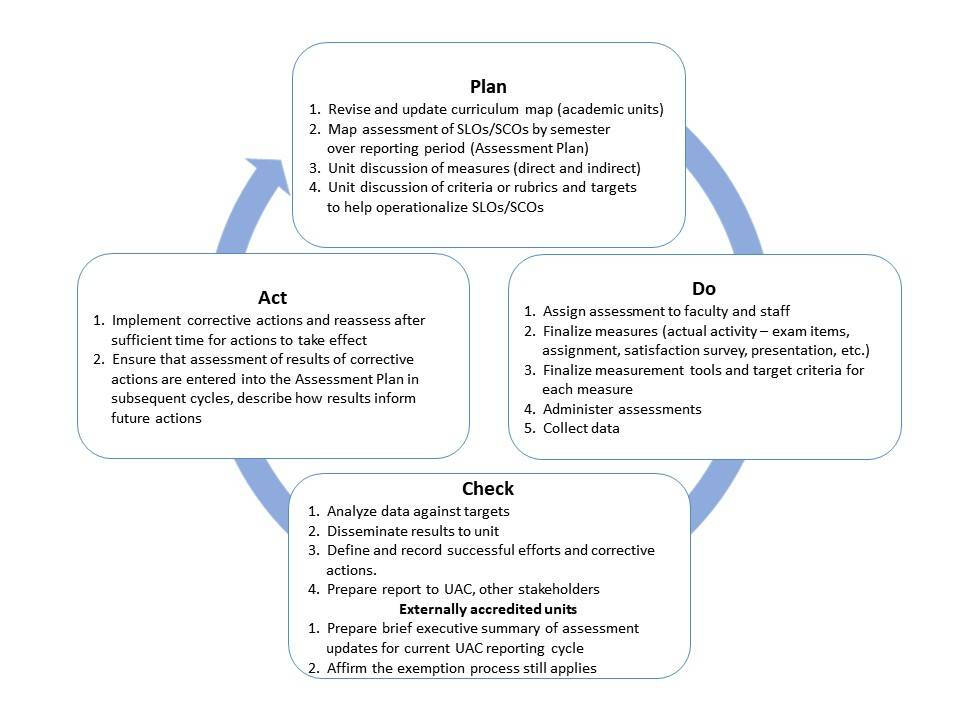
UAC has adopted a “PDCA-model” – Plan, Do, Check, Act – based on quality control processes. Program assessment plans and reporting will be structured around the four steps of this model.
The assessment model allows programs to demonstrate continuous improvement and advocate for program needs. It is a framework for good assessment practices; these are valid, reliable, and meaningful practices that document authentic student learning or engagement with co-curricular programming. Under this model, programs will:
PLAN - Units identify key student learning or student-centered outcomes that align with disciplinary knowledge, skills and dispositions. Consider strategic planning initiatives from the unit, college, or university that complement disciplinary outcomes, as appropriate.
DO - The do step involves finalizing assessment tools and criteria, assigning assessment to faculty and staff, administering the assessment and collecting the data. Units enter data each semester, or year, as appropriate for their plan. This information is entered into GVAssess.
CHECK - The check step involves analyzing the data, sharing results, determining next steps, and preparing a report for UAC and other stakeholders.
ACT - The act step involves ensuring that the next steps are implemented and tracked during subsequent assessments of each SLO/SCO and measure. As part of the act step, units may choose to retire SLOs/SCOs and add new ones. A short rationale should be noted in the report to explain retired or discontinued SLOs/SCOs; it is best practice to assess and report on a particular SLO/SCO at least twice before retiring or discontinuing the outcome. Measures may be adjusted at any time, units are asked to explain changes in response to analysis questions in the report.
Assessment at GVSU encompasses several overlapping areas:
- Program Review: Program review is accomplished through a combination of internal self-study with resource analysis, student outcomes assessment, accreditation reporting (where applicable), and external program review.
- Course Assessment: Assessment in each GVSU course is guided by a common syllabus of record (SOR, available on Bb) that defines a core set of learning objectives that will be taught and assessment methods that will be employed regardless of which section, semester, year, or instructor teaches the course.
- Student Outcomes Assessment:
- Student learning outcomes (SLOs) describe fundamental competencies students should know or be able to demonstrate upon completion of an academic programs (major, emphasis, certificate program, etc.).
- Student centered outcomes (SCOs) describe the results or products of co-curricular programming.
- Search for student outcomes and view recent reporting by program
- General Education Assessment: The General Education (GE) Program teaches the skills and knowledge needed to intelligently participate in public discourse, which are defined via the Student Learning Outcomes of the GE Program.
- Supplemental Writing Skills Assessment: The Supplemental Writing Skills (SWS) program encourages critical thinking, exploration of values, and self-discovery in courses across the curriculum while emphasizing emphasize the importance of "writing as process" and "writing to learn." Additional information is available from the SWS Program Goals site.
- Self-Study and Strategic Planning: Strategic planning establishes measurable objectives and metrics used to evaluate progress toward achieving strategic plan outcomes.
- External Accreditation Assessment: The 70+ externally accredited undergraduate, graduate, and co-curricular programs at GVSU carry out a wide array of assessment activities in preparation for external review against applicable standards. Externally accredited units also participate in university assessment processes. See the UAC policies page for details.
UAC members review and provide feedback on an average of 71 assessment reports per semester.