GVAdvance
GVAdvance is a website developed in-house at Grand Valley State University. It contains specific tools for reporting, including GVPlan, GVAssess, GVStability, and GVReview. The GVAdvance Guide provides a comprehensive overview of the system and its core features.
The GVAdvance system is accessible by all faculty and staff at GVSU. However, access permissions are required to edit or add information to the system. Please contact Phuong Vo ([email protected]) if you need editing access and/or to update your permissions within GVAdvance.
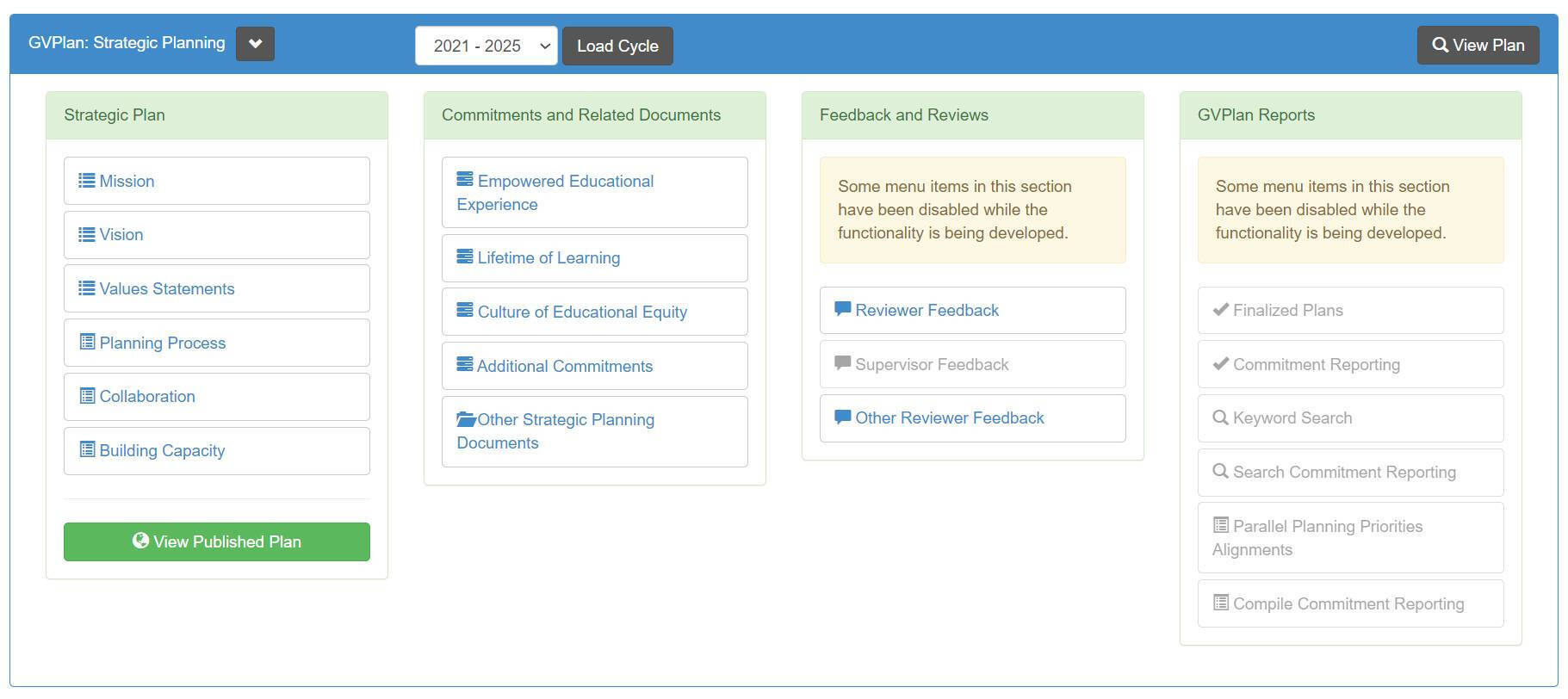
GVPlan: Contains the mission, vision, and associated strategic planning efforts for all divisions, colleges, and units. Key components of the strategic plans and overview of progress reports are viewable publicly on the Strategic Plan Search website.
Users with questions about navigating GVPlan can also refer to the GVPlan Quick Guide and/or the Frequently Asked Questions.
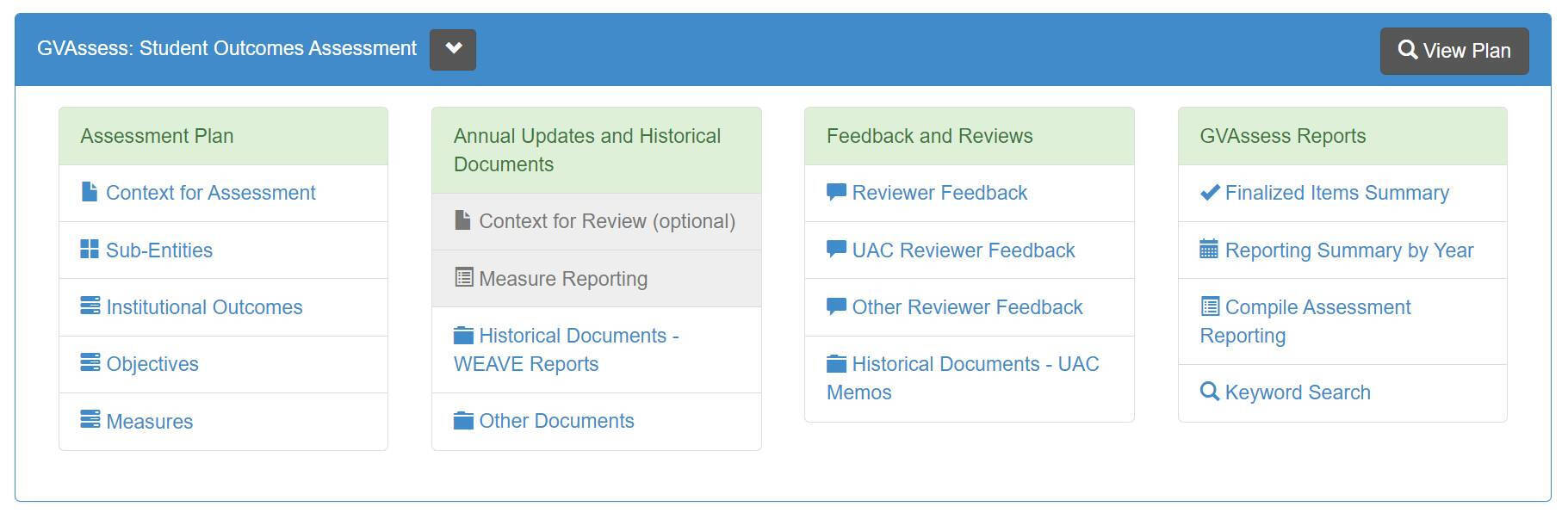
GVAssess: Contains student learning outcomes assessment across all undergraduate and graduate majors, certificates, stand-alone minors, and badges, as well as student-centered outcomes for co-curricular units. It also contains feedback from the University Assessment Committee. Student outcomes for all programs are viewable publicly on the Student Outcomes Search website.
GVAssess was recently redesigned to align with the updated assessment process. For guidance on navigating the new interface, please refer to the GVAssess Quick Guide or watch the instructional video available on this page.
GVAssess Tips
- Manage your labels. Outcomes into GVAssess are displayed for the entire department to allow ‘sharing’ among the degree programs. Because Outcomes are sorted alphabetically by the "Student Outcome Label" in GVAssess, you can use prefix codes to keep related outcomes clustered together throughout the site.
- Example 1: Mathematics uses codes to group outcomes by program: Outcomes A, B, C, and D are general, but ELE-A, ELE-B, SEC-A, and SEC-B are unique to the elementary (ELE) and secondary (SEC) education emphases.
- Example 2: Movement Science uses codes to group by skill-type: Outcomes A-AT and A-SC relate to collaboration (A), while B-AT, B-CES, B-ES, and B-HFI all relate to critical thinking (B).
GVAssess Walkthrough

In this video, the chair of the University Assessment Committee provides guidance on navigating the new GVAssess user interface.
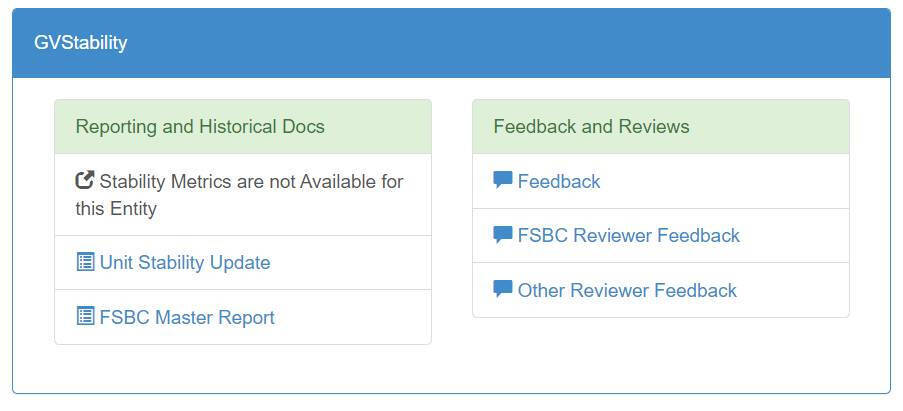
GVStability: Contains enrollment and budget metrics for academic units. The Faculty Salary and Budget Committee (FSBC) uses GVStability to collect and analyze submitted unit stability reports. These reports contain needed metrics that are useful in determining unit health.