


Grace Forthaus defends thesis on Hemlock Woolly Adelgid population dynamics
Published July 28, 2026
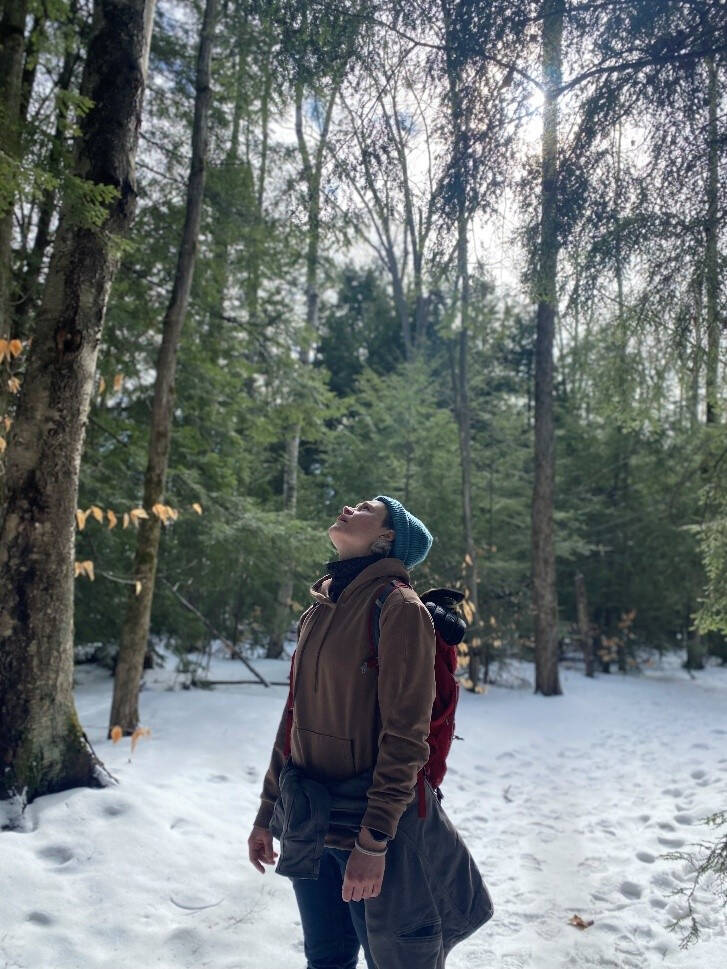
Grace Forthaus successfully defended their thesis on Friday, July 10, 2026, titled “Attack of the Clones: Current and Future Population Dynamics of Hemlock Woolly Adelgid (Adelges tsugae) Populations in Eastern North America.” Their committee included GVSU-AWRI faculty Dr. Charlyn Partridge and Dr. Sean Woznicki, and Dr. Nathan Havill of the U.S. Forest Service.
Hemlock Woolly Adelgid (HWA), a tiny clonal insect introduced from Japan, has been killing Eastern Hemlocks (Tsuga canadensis) since it was first found in the eastern United States in 1951. HWA has continued to spread across eastern North America, threatening the keystone tree species.
Grace collected samples from 140 HWA individuals across six sites in North America and three in Japan. Using low-coverage whole-genome sequencing, Grace analyzed their genetic diversity. The results show that HWA is clonal and lacks the genetic variety that usually helps invasive species adapt to new habitats. They also built habitat suitability models using climate data to predict where HWA might spread in the future. The results from the habitat modeling showed that suitable areas for HWA are increasing, especially along the coastal and northern areas, as temperature and precipitation patterns shift with climate change. HWA populations in North America remain in a genetic bottleneck, showing strong evidence of a single introduction event. Overall, the results from collection, testing, and modeling show that changing climate conditions, along with the ability to reproduce asexually, are helping HWA thrive and expand into northern regions of eastern North America.
To help limit the spread of HWA, people should avoid moving firewood between counties, check their Eastern Hemlocks for signs of infestation, and clean clothes and equipment after visiting infested areas.
After graduation, Grace plans to use applied science in restoration and conservation.