


Mitchell Olszewski defends thesis evaluating E. coli on freshwater fish
Published August 6, 2026
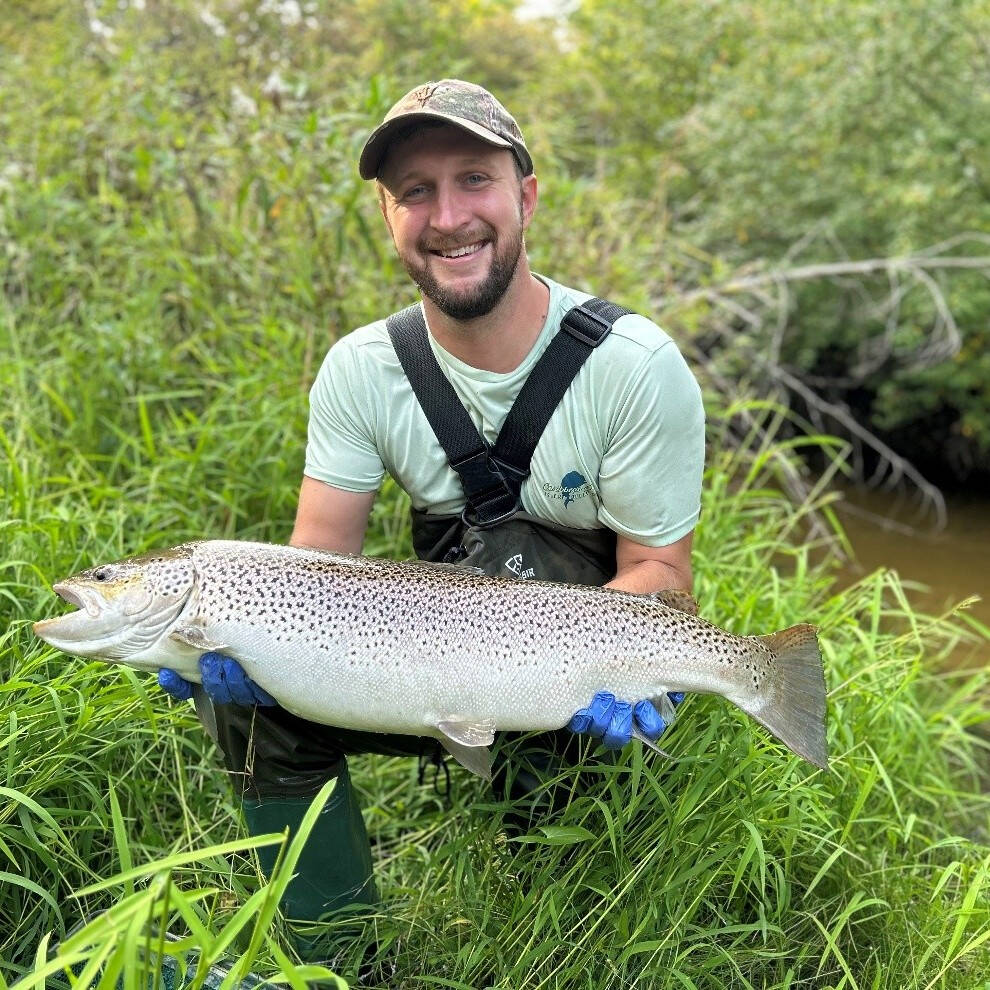
Mitchell Olszewski successfully defended his thesis on Thursday, July 9, 2026, titled “Evaluating E. coli Contamination of the Outer Mucus Layer on Freshwater Fish.” His committee included Dr. Kevin Strychar, Dr. Carl Ruetz, and Dr. Megan Woller-Skar (GVSU Biology).
Mitchell’s research investigated whether the outer mucus layer of freshwater fish serves as a potential vector for Escherichia coli (E. coli), a bacterium commonly used as an indicator of fecal contamination. Although E. coli is a normal inhabitant of the intestines of humans and other animals and often poses little direct public health risk, its presence in bodies of water can indicate fecal contamination. Many Michigan streams regularly exceed the recommended E. coli limits for swimming and other recreational activities. Despite the widespread occurrence of E. coli in freshwater systems, relatively little is known about how this contamination affects fish. To address this knowledge gap, Mitchell and his committee examined whether fish accumulate E. coli on the outer mucus layer of their skin and whether that contamination could be transferred to people through routine fish handling.
Mitchell and his team conducted electrofishing surveys at four west Michigan streams, collecting brown trout (Salmo trutta), creek chub (Semotilus atromaculatus), and mottled sculpin (Cottus bairdii) for analysis. The outer mucus layer of each fish was carefully swabbed, and E. coli concentrations were quantified using the Colilert-18 standard method. This data was paired with detailed water quality and habitat measurements from each stream. Statistical analyses were then used to evaluate relationships between E. coli concentrations on fish and environmental variables that may influence microbial accumulation. Mitchell found that E. coli was present in the outer mucus layer of all three fish species and that the bacteria could be transferred to humans through handling, suggesting that fish may serve as a potential vector for E. coli exposure in contaminated waters. Creek chub consistently exhibited higher E. coli concentrations than brown trout and mottled sculpin, indicating that species-specific ecological and behavioral traits may influence microbial accumulation on the mucus layer. Mitchell's research highlights the value of integrating ecological and microbial assessments to improve contamination monitoring and inform water resource management strategies. His findings also suggest that anglers may face a potential health risk when handling fish from waters with elevated E. coli concentrations, underscoring the importance of understanding pathogen transmission pathways in freshwater ecosystems.