

Logan Clark defends thesis on brown trout movement
Published June 9, 2026
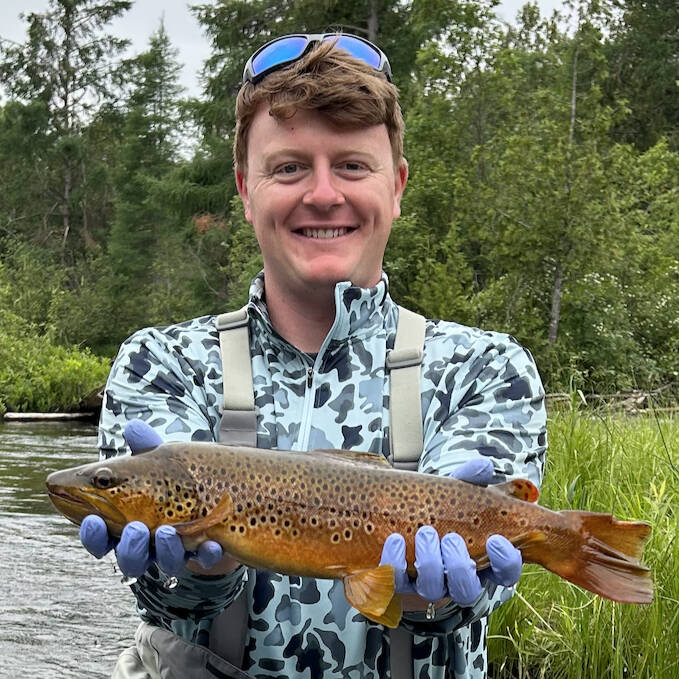
Logan Clark successfully defended his thesis on Thursday, May 14, 2026, titled "In Hot Water: Movement of North Branch Au Sable River Brown Trout During Warm Stream Temperatures". His committee included Drs. Mark Luttenton, Carl Ruetz, and Eric Snyder (GVSU Biology).
Brown trout in the North Branch Au Sable River experience seasonal fluctuations in temperature that expose them to temperatures commonly considered stressful for cold-water salmonids. He tracked 12 brown trout using temperature-sensitive radio-tags to monitor their internal body temperature, determine if they use thermal refuge, and track general movement patterns during July and August of 2025. Logan found that one trout had internal temperatures consistently colder than ambient temperatures. This fish occupied a relatively deep hole that was likely positioned over a cold water spring that provided a thermal refuge throughout the study. In contrast, other fish either abandoned or never occupied a location that provided thermal refuge from warm ambient temperatures. Consequently, most fish had internal body temperatures similar to ambient stream temperatures even when temperatures exceeded 21˚C which is considered stressful for brown trout. Similar to previous movement studies of brown trout on the Au Sable River, most fish remained at a single location, a “homesite”, during most of the study. Fish would move away from their homesite during optimal foraging periods such as the beginning of macroinvertebrate drift (dusk) or high-water events which may provide protection from terrestrial predators and organisms such as terrestrial worms may supplement the trout's food supply. Because brown trout did not move to seek colder water when ambient temperatures became stressful, stream temperature was not a good predictor of trout movement. Rather, low light conditions (overcast or dusk) and elevated water depth were significantly better for predicting when brown trout would move from their homesites. His findings differ from many previous studies on other rivers that have found that trout generally seek thermal refuge (cooler water) during stressful temperature conditions.
After graduation, Logan plans to attend the University of New Brunswick to study alewife passage at a hydroelectric dam and using acoustic telemetry to study Atlantic salmon.