

Josie Kuhlman defends thesis on E. coli at tributary-influenced beaches
Published May 22, 2026
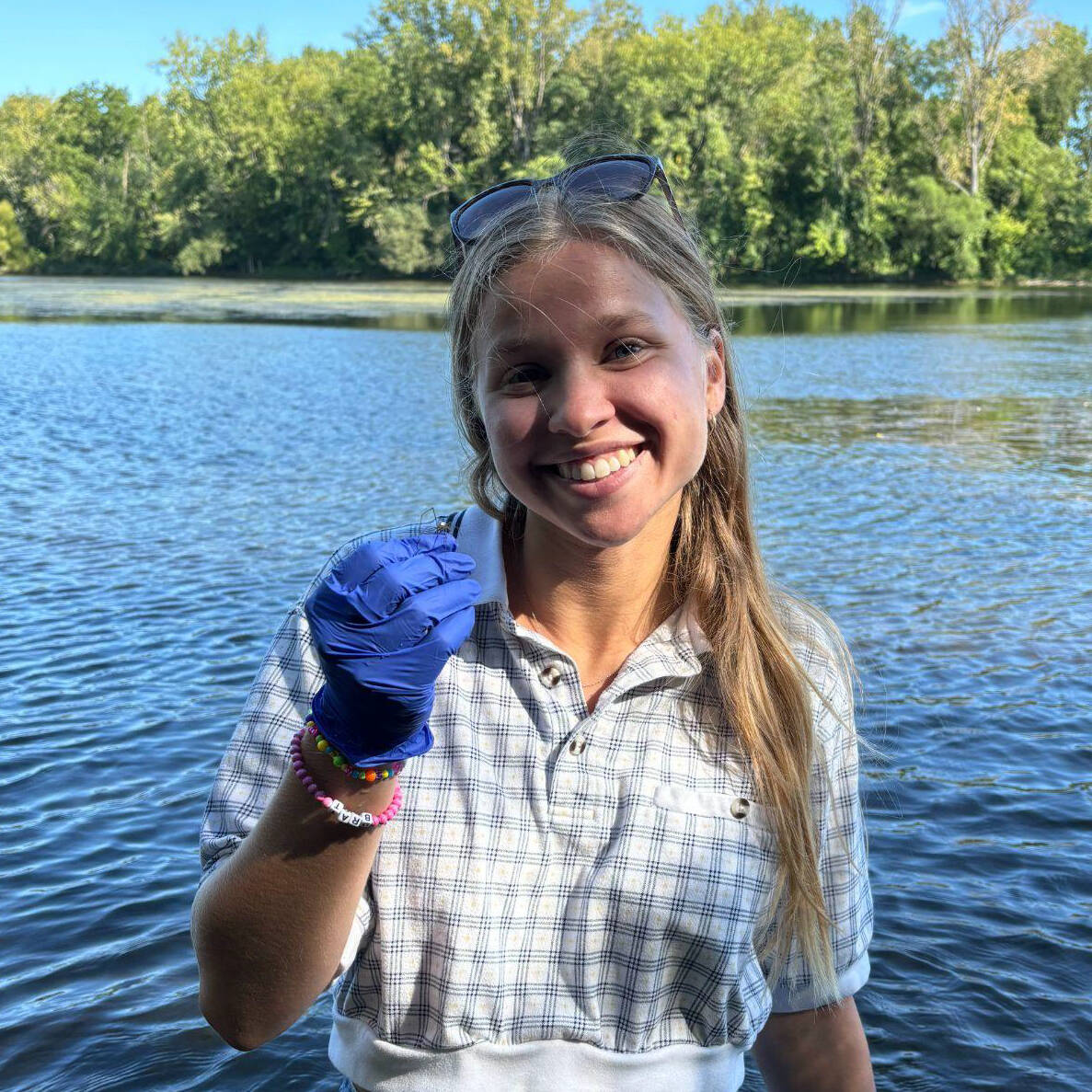
Josie Kuhlman successfully defended her thesis on Wednesday, May 6, titled "E. coli Concentrations in Sand and Water at Tributary-Influenced Lake Michigan Beaches". Her committee included Drs. Ryan Otter, Sean Woznicki, and Charlyn Partridge.
Bacterial contamination of public recreational water and sand can pose a challenge to public health officials, as well as public safety. Escherichia coli (E. coli) can persist in various environments, and can be washed into recreational water or interacted with by beachgoers. Josie’s project investigated the key drivers of this contamination by quantifying E. coli levels in tributaries and creeks that run into Lake Michigan. She also tested E. coli levels in beach sand and lake water, at different depths and locations, using both molecular-based and culture-based methods. She found that creeks contained higher E. coli levels than lake water, and that lake water at shallower depths was higher in E. coli than deeper water. She also found that rural watersheds may pose different human health risks and management challenges than urban watersheds. This information allows us to more thoroughly understand the contamination drivers and potential management needs of beaches with tributary inputs.
After graduating, Josie will be working as an interpreter with the Michigan Department of Natural Resources.