

College of Computing Faculty Secure More Than $2.3 Million in New Funding
Published October 5, 2026 by Sarah Schaible
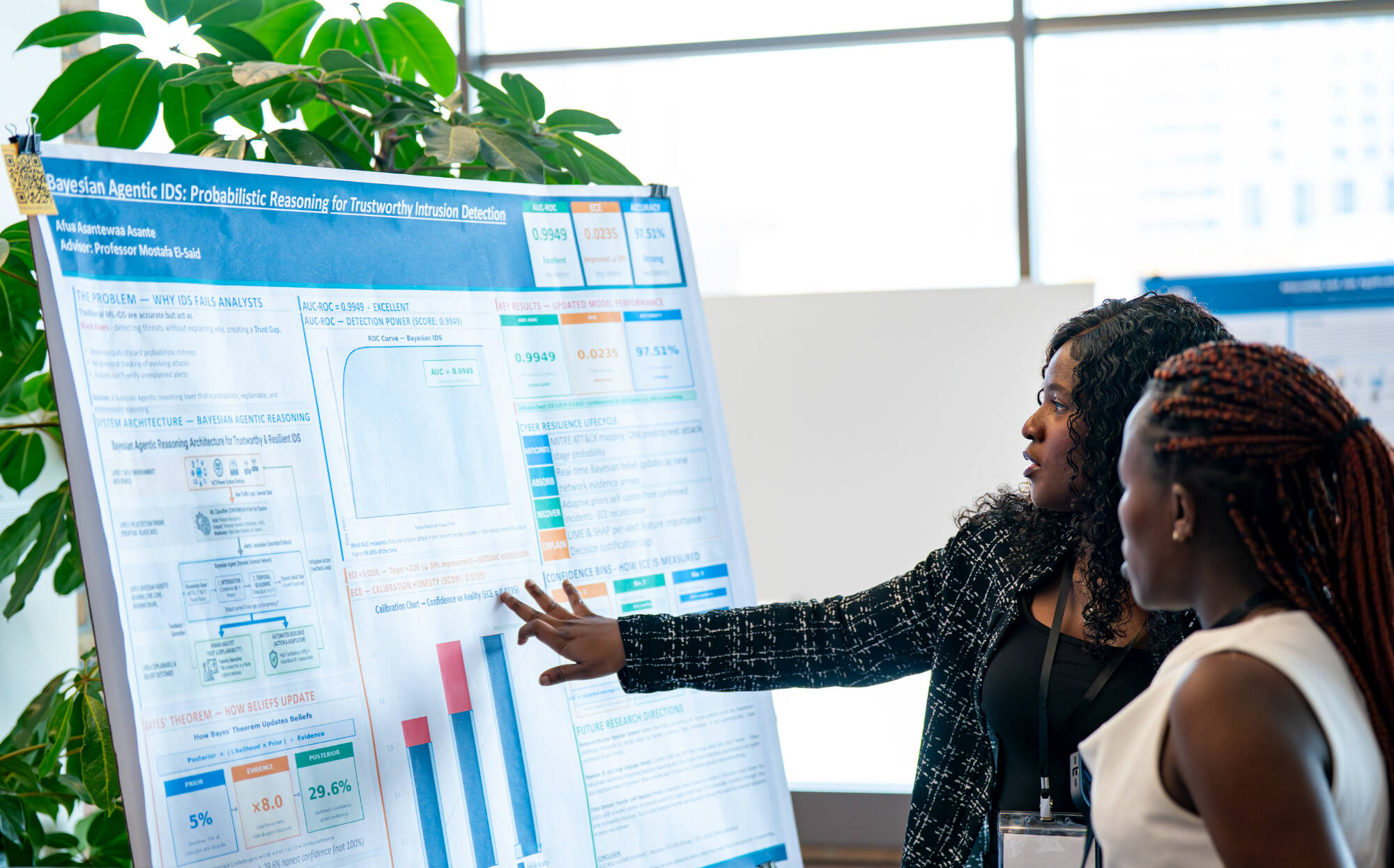
Breaking barriers for eco-centric innovation can only go so far when founded in what is already known. Research is the catalyst in advancement, which is powered by people, technology and funding.
Grand Valley State University (GVSU) College of Computing research projects are gaining momentum due to the passionate faculty and students whose proposals are securing more than $2.3 million in new grants and sponsored projects for the first quarter of fiscal year 2027. Expanding the college’s research enterprise from approximately $200,000 in 2024 with these highly competitive grants enables the tackling of problems that matter to people, industries and communities across West Michigan and beyond.
“The nine most recent awards reflect growing national and industry confidence in GVSU researchers,” said Marouane Kessentini, dean of GVSU College of Computing. “It creates new opportunities for faculty collaboration, student research and partnerships focused on some of today's most pressing challenges in technology. Research helps turn expertise into action by developing technologies, improving accessibility, strengthening cybersecurity, preparing the workforce and addressing challenges that affect people's lives.”
For students, research transforms learning from understanding existing knowledge to helping create new knowledge. Working alongside faculty gives students opportunities to ask questions, test ideas, analyze evidence and develop solutions to problems that do not have easy answers. Faculty increase their capacity to pursue ambitious research, build partnerships and contribute to their fields at a national level through external funding. In sum, GVSU grows as a research enterprise, strengthening the university's academic reputation while attracting talented faculty, creating opportunities for students and expanding relationships with industry, government and community partners.
Among the quarter’s largest awards, Dr. Samah Mansour, the College of Computing’s Graduate Cybersecurity Program Director, received more than $1 million from the National Institute of Standards and Technology (NIST) to support the West Michigan Trustworthy AI Consortium. The award reflects the growing national importance of trustworthy artificial intelligence and GVSU's role in bringing West Michigan expertise to developing and using AI systems that are reliable and trustworthy.
Dr. Paul Fink, Graduate Human-Centered Computing Program Director, received two awards from the National Institutes of Health totaling more than $708,000 for research focused on improving navigation and wayfinding for blind and visually impaired people. His projects include a gamified multisensory training and navigation system and accessibility-aware path selection for wayfinding. Fink also received an industry contract to conduct usability and technology evaluation for BridgeSpace.
Two National Science Foundation awards totaling more than $353,000 will support Kessentini’s work developing research infrastructure for software refactoring, quality and security.
Additional awards include an $81,505 National Security Agency grant awarded to Dr. Andrew Kalafut, Director of the Institute of Cybersecurity Education & Research, to support GVSU’s 2027 GenCyber program; $79,777 in Comcast funding awarded to Dr. Sara Sutton, Assistant Professor in the Department of Information Sciences & Technologies, for research into quantum-aware software-defined network security; and a $61,493 Comcast award to Dr. Erik Fredericks, Associate Professor in the Department of Computer Science, to explore improving network performance through evolutionary computation.
The growth comes alongside the significant philanthropic investment by Van Andel Institute supporting the launch of GVSU’s Applied Research and Innovation Institute (AIRII) and the university’s first Ph.D. program, further expanding opportunities for applied research, collaboration and innovation for biomedical discovery.
Together, these investments are helping build a research culture in which faculty and students can tackle complex problems, collaborate across disciplines and work directly with industry, government and community partners. As the College of Computing grows, so does its opportunity to bring computing expertise to challenges that matter and to prepare students not only to enter a changing technology workforce, but to help shape what comes next. It creates the people, partnerships, knowledge and innovations that can continue to make an impact long after the projects are complete.