

Grand Valley faculty bring math to incarcerated students
When people think about life in prison, their first thoughts may not include joyful mathematical exploration. But two Grand Valley math faculty, Drs. David Austin and Lauren Keough, have been leading math classes for incarcerated students and marveling at the growth they have seen in their students.
Dr. Austin has taught in the Hope-Western Prison Education Program at the Muskegon Correctional Facility while Dr. Keough is leading a course in GVSU’s Bellamy Creek Program at the Bellamy Creek Correctional Facility in Ionia. Both programs are designed to lead students to earn an undergraduate degree, which includes all the requirements that students on campus would be expected to fulfill. This includes mathematics, such as an algebra course like MTH 108/109.
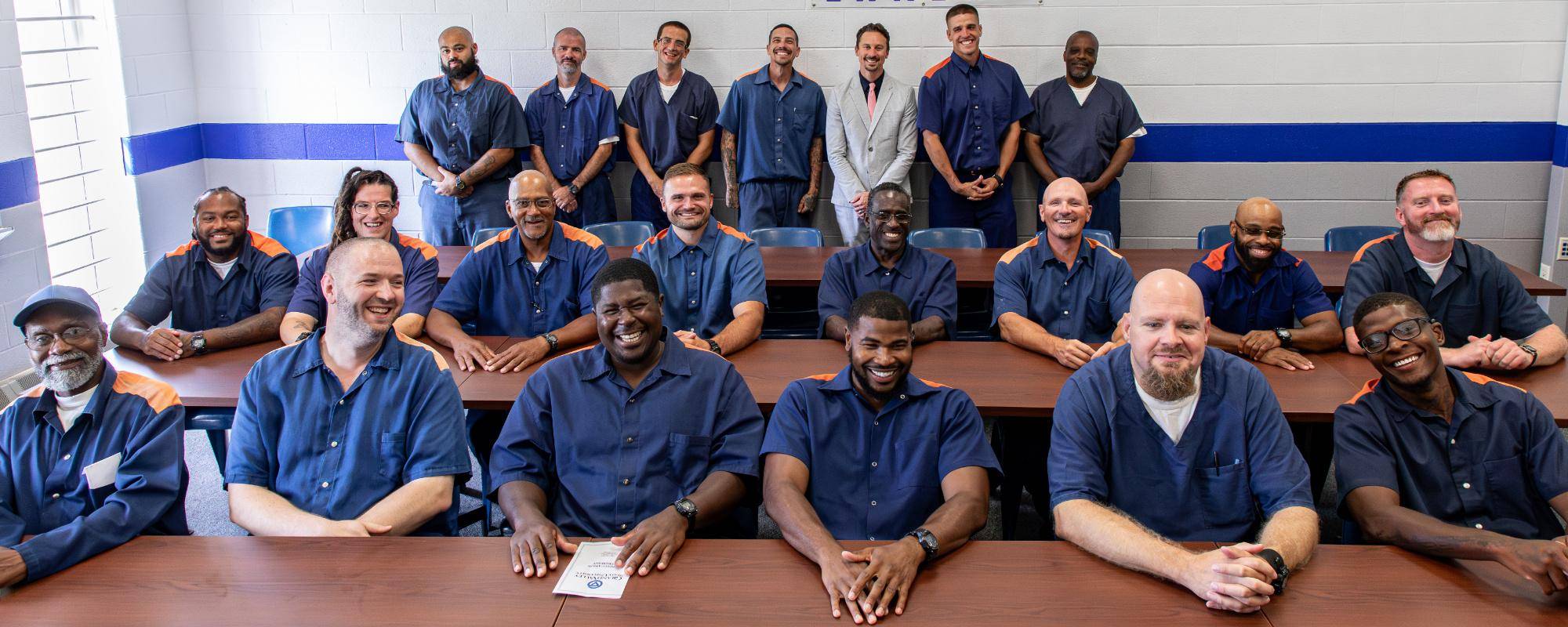
Students in the Bellamy Creek program
Teaching in prison brings some challenges. Being admitted to the facility requires a screening process, which is somewhat more rigorous than airport security, and the types of teaching materials that can be brought in are limited. For instance, laptops and any kind of internet-connected devices are forbidden. While the students are allowed to have graphing calculators, they are not allowed internet access, so communication with students is largely limited to actual class meeting time. It is also not uncommon to arrive at the facility and be denied entry as the facility responds to an unexpected event that happened earlier in the day.
Once inside, however, the classroom looks quite a bit like a typical classroom, and the work with students brings deep rewards. While the incarcerated students are highly motivated, many initially doubt their ability to succeed in a math course, which they view as an obstacle to completing their degree. For some, this doubt comes from negative experiences they previously had with math, while others are concerned since they have not had a math class in up to 30 or 40 years. After explicitly acknowledging these doubts, Drs. Austin and Keough begin to build students’ confidence by providing them with a voice in class and focusing on the strengths that each student brings to the collective work. Building community among the students also develops rich support structures that partially offset the limited contact that faculty have with students.
Classes typically feature active learning with sets of problems that encourage students to explore new ideas, express their understanding, and share their thinking with their peers. Many times, the classroom is buzzing with the students’ energy as they move around the room engaging their fellow classmates in discussions. Their growing curiosity often leads them to ask questions, like “what if we changed this?” that demonstrate deep and authentic mathematical thinking.
Both professors have the students read Francis Su’s Mathematics for Human Flourishing, which presents mathematics as a means to developing traits that contribute to living a rich and full life. As part of the class, students write weekly reflections on readings from the book and how it connects to their own experiences as learners of mathematics. Students frequently describe new opportunities they see for understanding themselves and their earlier lived experiences.
The growth that students demonstrate over the semester is remarkable. This includes growth in their confidence as they learn that they are capable mathematical thinkers and as they begin to see mathematics as a means for making sense of the world around them. They also see that there are different ways of approaching questions in math, and they are often surprised by some of the ideas offered by their peers. In this way, they feel more tightly connected to their community of learners and see themselves as having something of value to offer.
While education leads to lower rates of recidivism, the benefits of prison education spread out beyond the community of incarcerated students. The students often share their learning with peers who are not in the program. As Dr. Austin was being escorted across the yard one day, an incarcerated man approached him and said, “One of your students was telling me about binomial coefficients, and I thought it was so cool. I want to know more!” Research indicates the level of violence drops in correctional facilities that have a higher-education program. In 2019, the Michigan Department of Corrections accounted for 19% of Michigan’s state budget. Studies show that every dollar spent on higher-education in prison results in a savings of five dollars.
When asked why she sought out this experience, Dr. Keough says she believes it is “a duty of mathematicians to change perceptions of math and to bring in people who have historically not been welcomed.” When asked what he himself gained from the experience from teaching in a prison for several years, Dr. Austin said, “I always enjoyed spending time with these men. Their openness to new experiences and to learning reminds me to stay curious in the face of challenges.” Prison education clearly demonstrates the benefits that all of us receive when more people are welcomed into the mathematical community.
More details about the benefits of higher education in prison can be found here and in this talk by Dr. Richard Ray, the former director of the Hope-Western Prison Education Program.