

Lora Bailey receives the Pew Teaching Excellence Award
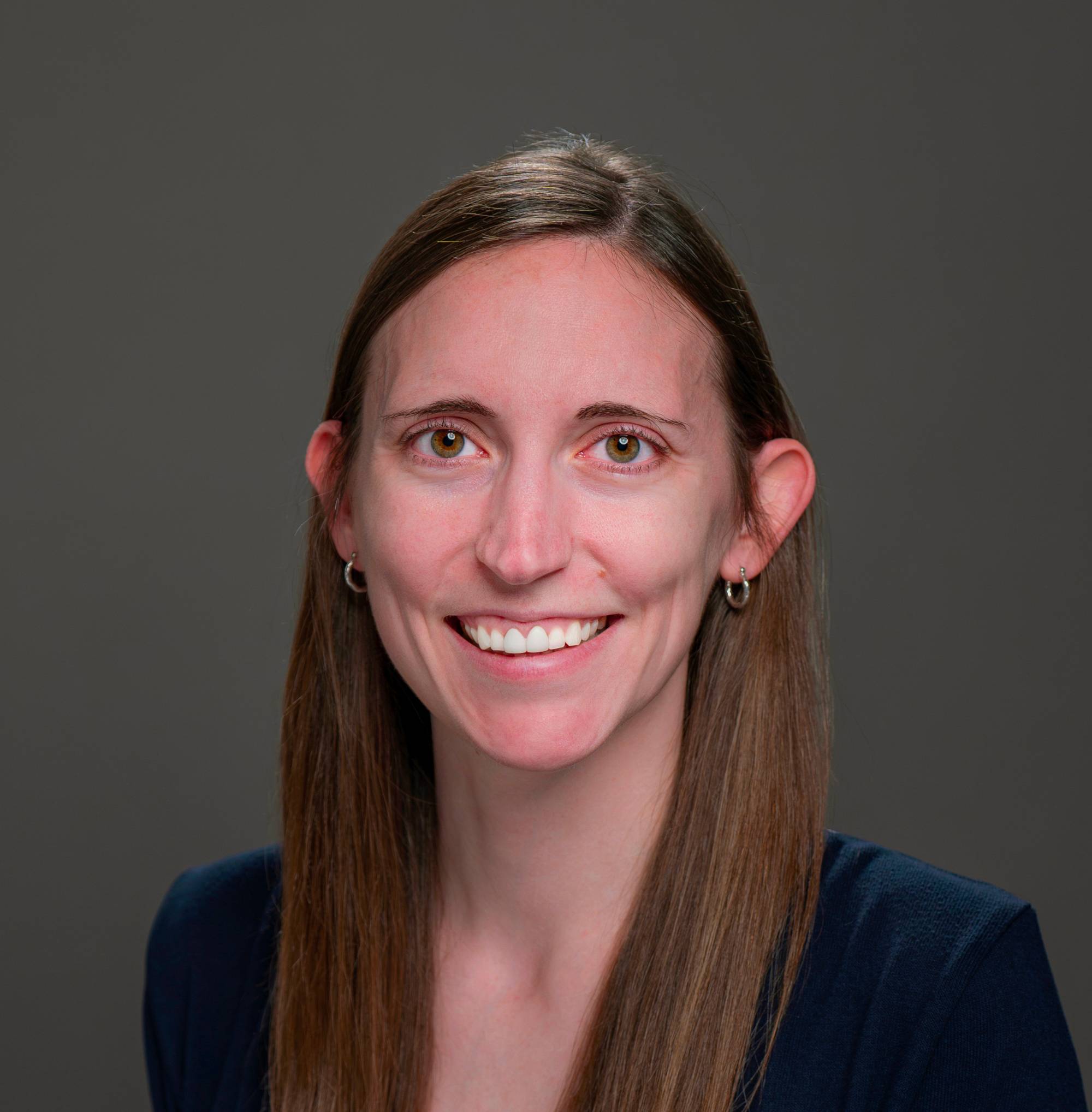
Dr. Lora Bailey has accomplished a lot during her five years at Grand Valley, including teaching a wide variety of classes, developing a course for the Honors College, and supervising many undergraduate research projects. In recognition of all of this work and more, she has been honored with a Pew Teaching Excellence Award.
Dr. Bailey is an applied mathematician whose research covers a wide range of subjects centered around mathematical biology. This expertise, combined with her enthusiasm for introducing meaningful mathematics to students, has led her to bring many authentic applications into her courses. For instance, in the beginning calculus course, Dr. Bailey uses real-world data about tumor growth as a way for students to explore population growth. This provides students with an authentic experience of doing mathematics while they also deepen their understanding of important course concepts. She also wants students to take ownership of their own learning so she frequently has students complete long-term projects that use the course material to explore subjects of interest to the students. This is especially valuable in MTH 305, Mathematical Modeling, which Dr. Bailey has led several times.
Two years ago, Dr. Bailey developed a course for the Honors College that is designed to improve students’ data literacy and critical thinking. Most of the students in Honors 251, Calling Bull, come from other disciplines and are not necessarily used to incorporating mathematical thinking in their efforts to make sense of new information. But this is exactly the point of the course. Students are presented with a variety of scenarios from, say, the media or science, along with claims that are made based on provided information. Students analyze these claims to determine whether they are actually supported by the provided information or whether the provided information may itself be incomplete or biased. In this way, students encounter common ways in which people represent data in a way that supports a hidden agenda, and they develop the ability to approach new information with skepticism and to interrogate claims made with it. Students also learn to communicate their own thinking clearly so that they can form persuasive arguments.
In addition to her excellent work in the classroom, Dr. Bailey has supervised a large number of students in undergraduate research projects. One of the many impressive aspects of this work is Dr. Bailey’s ability to guide students in finding a topic that aligns with their outside interests and that lends itself to a rich mathematical investigation. In a project with Alaina Hogan, a double major in math and dance, a group of subjects included both dancers and non-dancers for whom motion capture equipment was used to record how they performed a sequence of dance moves. Linear algebra then helped the researchers simplify the large dataset so that distinct differences emerged between the dancers and non-dancers.
In another project, a student used math to simulate major league baseball games, which he used as a means to explore the effect that a new set of rules, recently introduced into the game, would have on the length of games. A current student is using differential equations to model the effect that opinion dynamics have on vaccination rates and the spread of certain diseases. In all of these projects, students are exploring real data and using mathematics to draw conclusions about questions that arise from the data.
Dr. Bailey is also a tireless advocate for the usefulness of mathematics and for connecting students with opportunities that help them recognize the important role that math can play in their further studies. Serving as the departmental Recruitment to the Major/Minor Coordinator, Dr. Bailey organizes a series of events, including pizza parties and small group lunches, that introduce students to math faculty and how math could fit into the larger plan of their studies. Through these efforts, the number of students adding a major or minor has significantly increased. These events also serve to build a sense of belonging among students and help faculty get to know their students better.
Beginning her time at Grand Valley in Fall 2020 presented a real challenge as Dr. Bailey worked to juggle a variety of teaching modalities, such as fully online as well as hybrid class structures, while also getting to know Grand Valley students and their expectations and adjust to the new classes she was teaching. Throughout that difficult first year, Dr. Bailey was always positive in looking for solutions to a range of problems and determined to provide the best possible experience for her students. As she has come to know Grand Valley students, she says that she appreciates their attitudes about mathematics, their willingness to embrace new styles of teaching and assessment, and their ability to find fun in exploring new mathematical ideas.
The Pew Teaching Excellence Award is a great way for the university to recognize some of Dr. Bailey’s many contributions to the department and the university. We are grateful to her for bringing her talents, experiences, and enthusiasm to our department every day.