

From Strategy to Code: College of Computing Students Earn Second Place at Atomic Object Games
Published March 23, 2026 by Esther Djan
Two GVSU College of Computing students turned strategy into success at this year’s Atomic Object Games, earning an impressive second-place finish in a fast-paced, AI-driven programming competition. Lavisha Chandivade, a sophomore majoring in Artificial Intelligence with a minor in Cybersecurity, and Sarah Mall, a Computer Science major with a focus on software development, teamed up to take on the challenge—combining classroom knowledge, technical skills, and real-time problem-solving under pressure.
Hosted by Atomic Object, a custom software development company, the competition brings together university students to design artificial intelligence systems capable of playing a given game. Participants are introduced to the challenge at the start of the event and must quickly develop a competitive solution. This year’s challenge centered around the card game Sushi Go!, where players aim to collect the best combinations of sushi cards to maximize their score. While simple at first glance, the game requires strategic thinking, adaptability, and the ability to anticipate future outcomes—making it an ideal test for AI-driven decision-making.
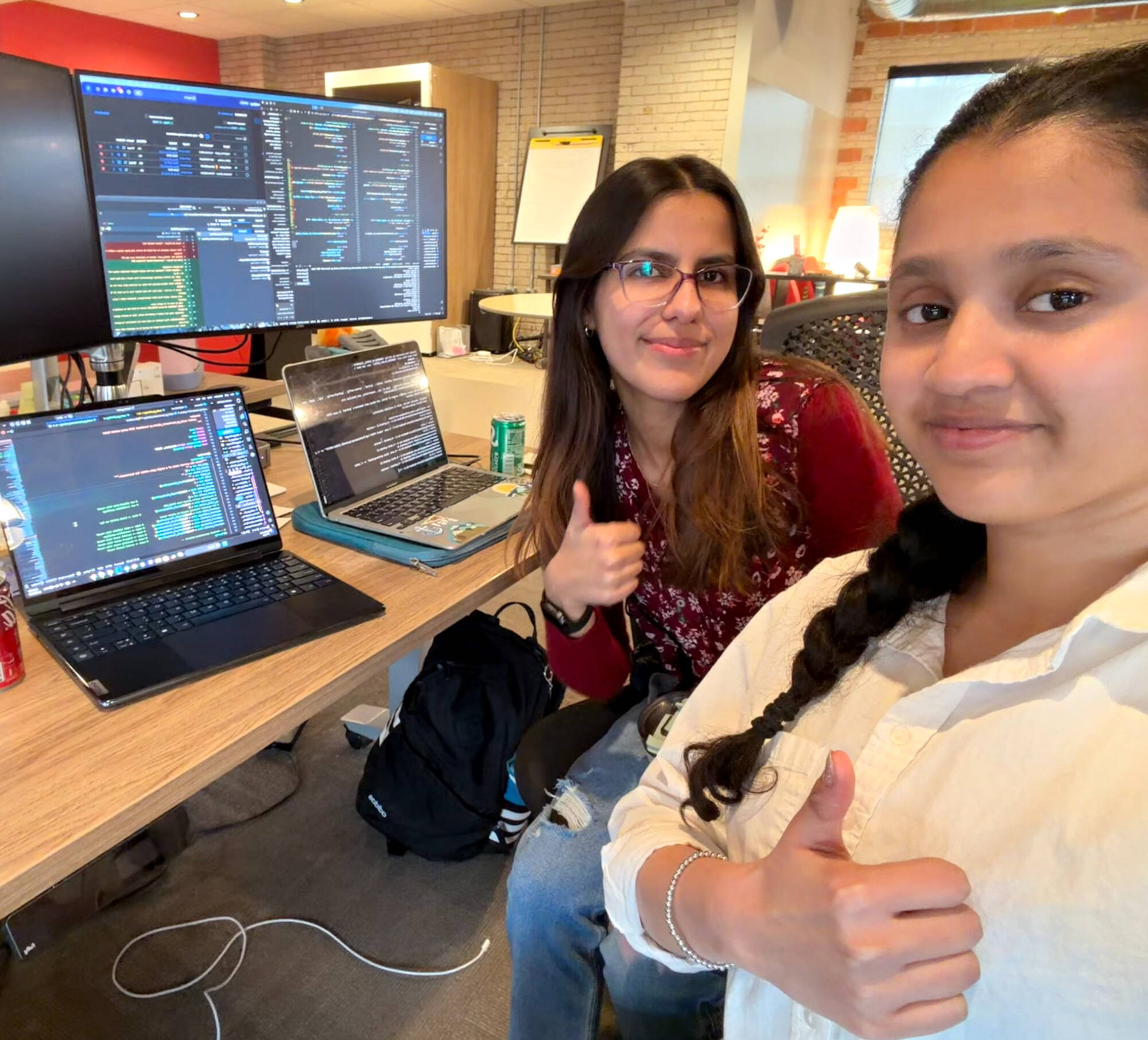
Chandivade and Mall approached the challenge by experimenting with different strategies before combining their strengths into a single, refined solution. Chandivade initially developed a greedy strategy, focusing on selecting the highest-value card available at each turn to maximize immediate points. Meanwhile, Mall explored a more situational and opponent-aware approach, considering what other players might need and prioritizing long-term advantages such as collecting pudding cards for end-of-game bonuses. After testing both approaches independently—and even against each other—they found that each performed well in different scenarios. By merging the two strategies, they created a more balanced and competitive bot capable of adapting to both short-term opportunities and long-term planning.
The process was not without its challenges. At the start of the competition, both students had to quickly learn and understand the rules and scoring system of Sushi Go! before they could even begin coding. Working within a limited timeframe added pressure, requiring them to rapidly translate strategy into functioning code while continuously testing and improving their bot. Despite early uncertainty, their confidence grew with each round. As they advanced through the bracket-style tournament, it became clear that their approach was not only working—but competing at a high level.
Both students emphasized how their time at GVSU helped prepare them for the competition. Courses such as Computer Science II (CIS 163) and Data Structures and Algorithms (CIS 263) provided a strong foundation in algorithm design and problem-solving, while Systems Level Programming (CIS 241) helped them develop experience with tools like Git for collaboration.
Chandivade also highlighted the value of her Introduction to Artificial Intelligence course (CIS 201), which helped her think critically about how algorithms make decisions based on changing inputs. Mall noted that her internship experience as a software developer played a key role in helping her quickly understand code, troubleshoot issues, and iterate on solutions under time pressure.
Finishing in second place was a rewarding moment for both students. What began with uncertainty and nerves turned into confidence as they progressed through each round of the competition. Each win reinforced that their strategies and improvements were working, and by the time they reached the final stages, they realized they were capable of competing at a very high level. Placing second made the hard work, collaboration, and persistence feel worthwhile, while also motivating them to continue improving and aim for first place in future competitions.
Reflecting on the experience, both Chandivade and Mall encourage other undergraduate computing students to take advantage of similar opportunities. Competitions like Atomic Object Games provide a valuable chance to apply classroom knowledge to real-world challenges, collaborate with peers, and develop stronger problem-solving skills. Their advice is to stay calm, work closely with teammates, and continue iterating on ideas, as even small improvements can make a significant difference in competitive programming environments.