

Dr. Geoff Twardokus on Helping Build a Safer Digital Future at GVSU
Published July 29, 2026 by Allison Bazaire
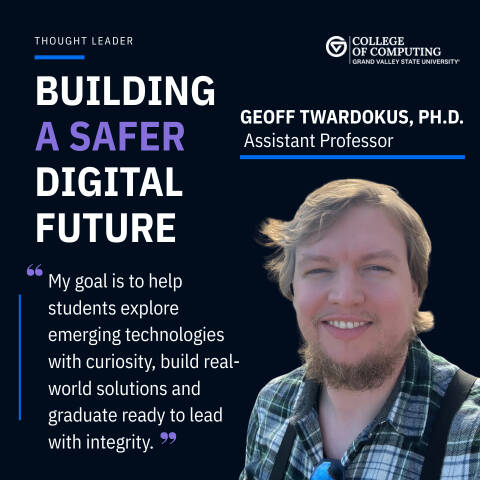
From smartphones and connected vehicles to artificial intelligence and quantum computing, technology is becoming more integrated into everyday life than ever before. As these systems continue to evolve, so does the need to keep them secure.
Assistant Professor Geoff Twardokus joins Grand Valley State University's College of Computing at a time when cybersecurity is expanding beyond protecting computers and networks. His research explores how emerging technologies including connected systems, wireless communications, and quantum computing, can be designed with security in mind from the very beginning.
For Twardokus, the journey into cybersecurity is not a straight line. His journey is driven by curiosity.
A Path Built on Curiosity
After taking a gap year following high school, Twardokus began his academic journey at a community college, earning associate degrees in computer science and mathematics before continuing on to bachelor's, master's, and doctoral degrees.
That nonlinear path continues to shape how he approaches teaching today.
"I believe talented students can take many paths into computing," he says. "I enjoy helping them discover where their interests and abilities can take them."
His research interests evolved similarly..
He first studied cybersecurity because it combined his interests in applied mathematics, cryptography, and civic engagement. Along the way, elective physics courses sparked an interest in wireless communications, which became the focus of his master's research. Later, the rapid advancement of quantum computing opened another new direction.
"What most excites me today is the sheer range of possibilities that quantum computing offers—everything from cryptography to the architecture of the Internet may be affected," Twardokus explains. "I am eager to play a role in the advancement of these areas as quantum technologies continue to evolve."
Looking Beyond Today's Technology
Throughout his career, one theme has remained consistent: understanding how new technologies can be adopted safely and responsibly.
After earning degrees in cybersecurity, as well as electrical and computer engineering, Twardokus worked across industry and academia contributing to projects ranging from secure flight control systems for commercial aircraft to large language model-based tools for human resources and quantum-resistant security for connected vehicles.
One accomplishment he is particularly proud of is the research he conducted with collaborators in Canada and Germany being cited by the National Institute of Standards and Technology (NIST) during the development of post-quantum cryptography standards.
The experience reinforced the importance of anticipating tomorrow's security challenges before they become today's problems.
Preparing Students for What's Next
At GVSU, Twardokus hopes students leave with more than technical expertise.
He wants them to develop the confidence to explore unfamiliar technologies, ask difficult questions, and remain adaptable throughout their careers.
"My best advice is to be curious and push yourself to try different things," he says.
He encourages students not to worry about finding the perfect career path immediately. During the past decade alone, his own work has taken him from building secure flight control systems for commercial aircraft to developing roadway security testbeds at a university and helping build security controls for AI-powered software at a startup.
"There is so much to do in cybersecurity that you can certainly find your place if you do the work to find it," he explains. "I encourage all students to take different courses, read about new ideas, and get hands-on with systems and technology as often as possible until you find what clicks for you."
Empowering Tomorrow's Computing Leaders
As the College of Computing continues to expand into emerging areas of technology, Twardokus sees an opportunity to help students engage directly with the challenges shaping the future.
He plans to establish a research group focused on quantum computing, cybersecurity, and cyber-physical systems while creating new opportunities for students to participate in hands-on research and collaborate with industry.
"I hope my work gives students opportunities to engage directly with emerging technologies through hands-on research and prepares them to become thoughtful, adaptable leaders in the field," he said.
He also hopes to strengthen partnerships that connect the university with industry while helping ensure new technologies are developed responsibly and with the public interest in mind.