

Using AI Starts with Understanding
Published July 17, 2026 by Allison Bazaire
Artificial intelligence is changing faster than most people can learn it.
That creates a challenge for businesses integrating AI into their operations, educators preparing tomorrow's workforce, and students entering careers that may look very different just a few years from now. The challenge isn't simply to build powerful technologies, but to understand how those technologies create value through people.
For John K. Thompson, helping close that knowledge gap has become one of the defining missions of his career.
Beyond the Headlines
Public conversations about artificial intelligence often begin and end with ChatGPT.
According to Thompson, that's understandable, but it leaves out most of the story.
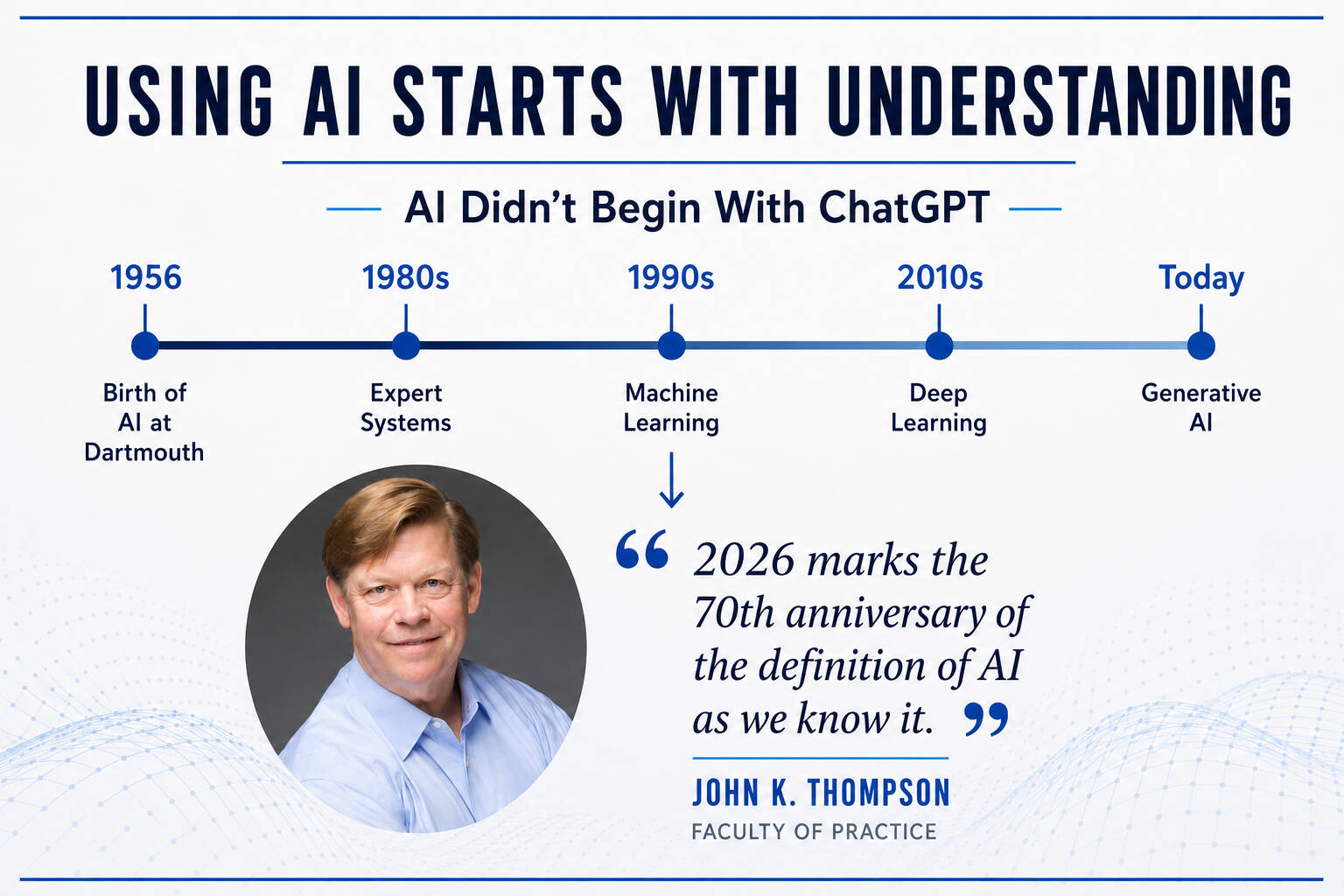
"Most people do not know that we have been working on AI for 70 years," he explains. "AI started in 1956. 2026 marks the 70th anniversary of the definition of AI as we know it."
Thompson is referring to the 1956 Dartmouth Summer Research Project, where the term artificial intelligence was formally introduced and the field began taking shape as its own academic discipline. Since then, AI has evolved through decades of breakthroughs in expert systems, machine learning, neural networks, and deep learning before arriving at today's generative AI revolution. Modern AI is best understood not as a single technology, but as the result of decades of scientific progress building on one another.
"AI is not monolithic. AI is not one type of software, technology, or model. AI is a collection of approaches, and methodologies. We have Predictive AI, Generative AI, Causal AI, and now Physical AI."
Each approach solves different kinds of problems. Together, they represent an ecosystem that continues to evolve at an extraordinary pace.
"AI is a fascinating field that grows, moves, and evolves on a daily basis."
For Thompson, helping people understand those distinctions is more than an academic exercise. Better understanding leads to better decisions. It allows organizations to move beyond hype and begin asking more meaningful questions about where AI creates value and where it does not.
Teaching Beyond the Technical
Throughout his career, Thompson noticed something surprising. The questions about artificial intelligence rarely came from software engineers. They came from executives trying to make strategic decisions, managers responsible for leading teams through change, students preparing for careers that didn't exist a decade ago and educators trying to understand what AI means for the future of learning.
Each audience was asking different questions, but they all shared the same challenge in understanding AI well enough to make informed decisions.
That realization became one of the foundations for Thompson's writing.
Across five books, he has explored topics ranging from analytics leadership and data strategy to causal artificial intelligence, data privacy, and the future of artificial general intelligence. Rather than writing exclusively for researchers, Thompson writes for decision makers. His goal is to help readers understand not just how AI works, but how it changes organizations, industries, and society.
Each book builds on the last, reflecting how the field itself has evolved over the past two decades. Together, they form a practical guide for leaders trying to navigate one of the fastest moving technologies in history.
AI Doesn't Need Better Models. It Needs Better Leaders.
After nearly four decades implementing enterprise AI, Thompson has reached a conclusion that surprises many people.
Successful AI initiatives are rarely limited by technology. They are limited by leadership. "There are a few factors that influence whether an organization will be able to benefit from an AI driven transformation," Thompson explains. The first is executive support. Leaders must understand both the technology and the organizational change required to realize value from AI. The second is collaboration. Operational leaders must commit subject matter experts to work alongside data scientists and AI teams to build solutions that solve real business problems. The third is culture. "If you have these three conditions," Thompson says, "you have a chance to begin to design a project that has the potential to succeed."
Those lessons became the underpinning for his book Building Analytics Teams, which explores how organizations create the leadership, culture, and collaborative environments needed to transform analytics from technical projects into measurable business outcomes.
Closing the AI Knowledge Gap
The gap between access and understanding is one of the defining challenges of the AI era. New tools may be easier to use than ever, but using AI is not the same as understanding its capabilities, limitations, risks, or potential.
That is why Thompson’s work extends across books, classrooms, executive education, and industry conversations. Each offers a different way to help people move beyond surface-level familiarity and develop the judgment needed to make informed decisions about AI.
At GVSU, that philosophy can reach students preparing to enter the workforce, professionals adapting to changing industries, and community members trying to understand how artificial intelligence will affect their lives.
The next chapter of AI will not be shaped only by the people who build the technology. It will also be shaped by the people who decide where it belongs, how it should be used, and what outcomes it should serve.
Thompson's work begins with a simple premise that before people can lead with AI, they must first understand it.