Building the Future of Quantum Computing at GVSU
Published July 24, 2026 by Allison Bazaire
Quantum computing is entering a new era, moving beyond research laboratories and creating opportunities for innovation across academia, industry, and government. To help students prepare for that future, Grand Valley State University's College of Computing continues to invest in faculty whose expertise reflects the technologies shaping tomorrow's workforce.
Assistant Professor Shakil Ahmed joins the College of Computing at a pivotal moment for quantum computing. As the field continues to grow, his research and teaching will help expand opportunities for students while strengthening GVSU's expertise in one of computing's most promising areas.
One of the ways Ahmed introduces quantum computing is with a simple comparison::
"A useful analogy is that a classical computer explores one path at a time, while a quantum computer can explore many possibilities simultaneously for certain types of problems."
When most people hear the words quantum computing, they imagine a technology that's still decades away. Ahmed sees a field that is rapidly evolving and opening new possibilities for research, innovation, and education.
"It's one of the most intellectually exciting areas in computing today," Ahmed said. "What initially drew me to the field was the realization that many problems considered intractable on classical computers may become feasible through quantum algorithms."
He sees a field that is rapidly moving from theory to reality, creating new opportunities for discovery, innovation, and careers that didn't exist just a few years ago. As one of the newest faculty members in Grand Valley State University's College of Computing, Ahmed is helping position students to understand and contribute to one of computing's most exciting frontiers.
"Quantum computing sits at the intersection of computer science, mathematics, physics, and engineering," explains Ahmed. "What initially drew me to the field was the realization that many problems considered intractable on classical computers may become feasible through quantum algorithms."
Amed describes that today, governments, national laboratories, and technology leaders, including IBM, Google, Microsoft, Amazon, and NVIDIA, are making significant investments in quantum technologies. He says that researchers believe quantum computing could eventually transform areas such as drug discovery, advanced materials, cybersecurity, logistics, and optimization by solving problems beyond the practical reach of today's classical computers.
Preparing Students for What's Next
As an assistant professor, Ahmed is teaching undergraduate and graduate courses while building a research program that gives students opportunities to explore quantum computing beyond the classroom. He hopes to develop courses that introduce students to quantum computing, create research opportunities alongside faculty, and engage with partners across academia, government laboratories, and industry.
"My goal is to help establish GVSU as a recognized contributor to quantum computing education and research," says Ahmed. "Ultimately, I want our students to graduate with both the theoretical understanding and practical experience needed to contribute to this emerging field."
For students, the timing couldn't be better.
"I believe today's students are entering the field at exactly the right time," says Ahmed. "Just as artificial intelligence has transformed computing over the last decade, quantum computing is beginning a similar journey."
Rather than specializing in a single discipline, students interested in quantum computing will learn to think across fields. Ahmed encourages students to build strong foundations in mathematics, algorithms, programming, and computer architecture while developing the curiosity and adaptability needed to work in a rapidly evolving discipline.
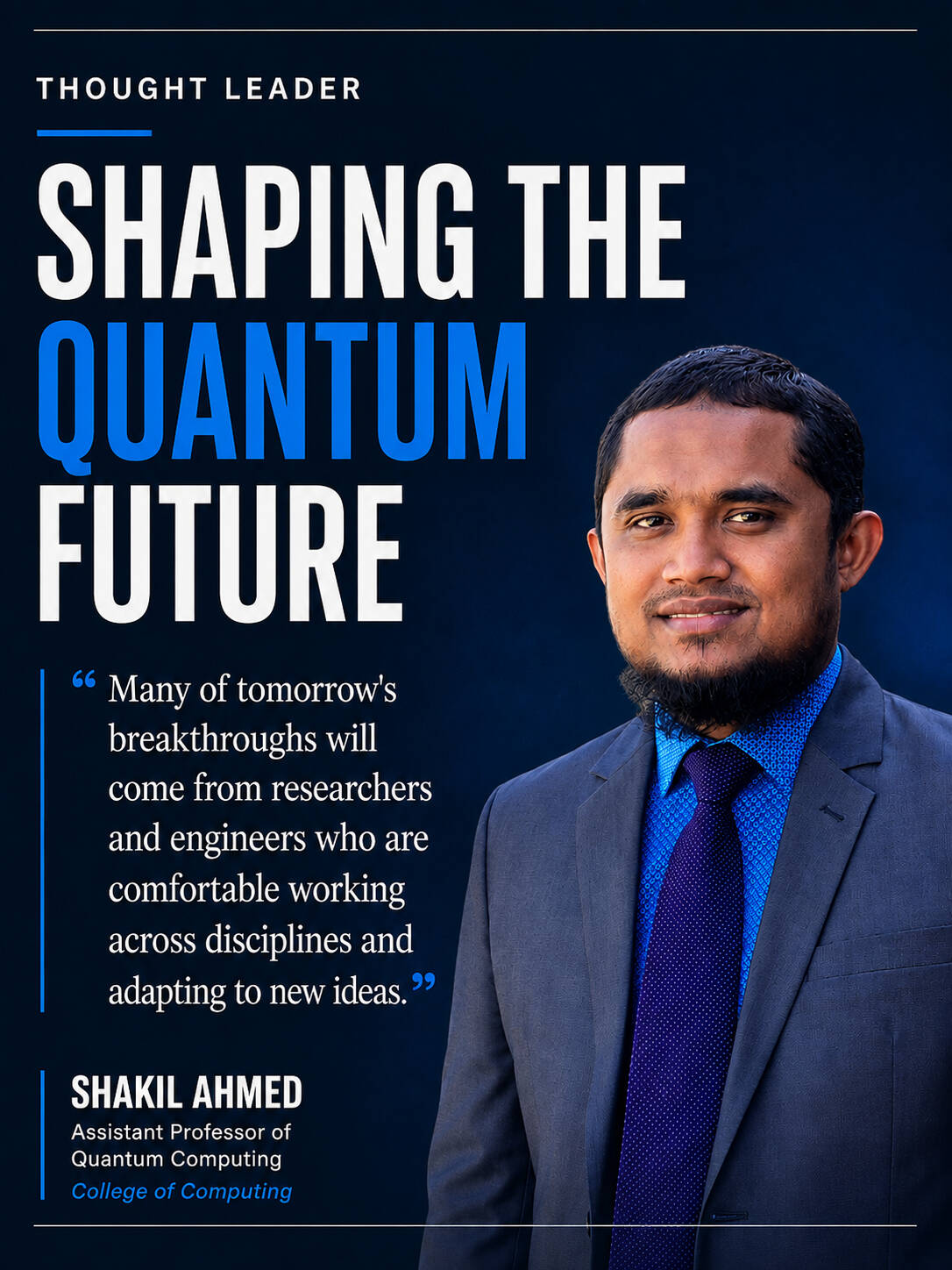
"Equally important are problem-solving, creativity, collaboration, and a willingness to learn continuously," he emphasizes. "Many of tomorrow's breakthroughs will come from researchers and engineers who are comfortable working across disciplines and adapting to new ideas."
Building a Quantum Computing Community
Ahmed sees his role extending well beyond teaching individual courses. His long-term vision is to help create a vibrant quantum computing ecosystem at GVSU where research, innovative teaching, and industry collaboration work together to prepare students for the future.
He hopes to expand research opportunities, develop new curriculum focused on emerging computing technologies, and position GVSU as a destination for students interested in quantum computing and related fields.
More importantly, he wants students to feel empowered to participate in discoveries that could shape the future of technology. "My work is about helping students engage with transformative technologies and participate in research that addresses real-world challenges," Ahmed says.
More Than Research
While Ahmed is passionate about advancing quantum computing, he says the most rewarding part of his career is watching students grow.
"I enjoy mentoring students and supporting their growth," he explains. "Helping students discover their passions, develop critical thinking and research skills, and achieve their academic and career goals is one of the most rewarding aspects of my career."
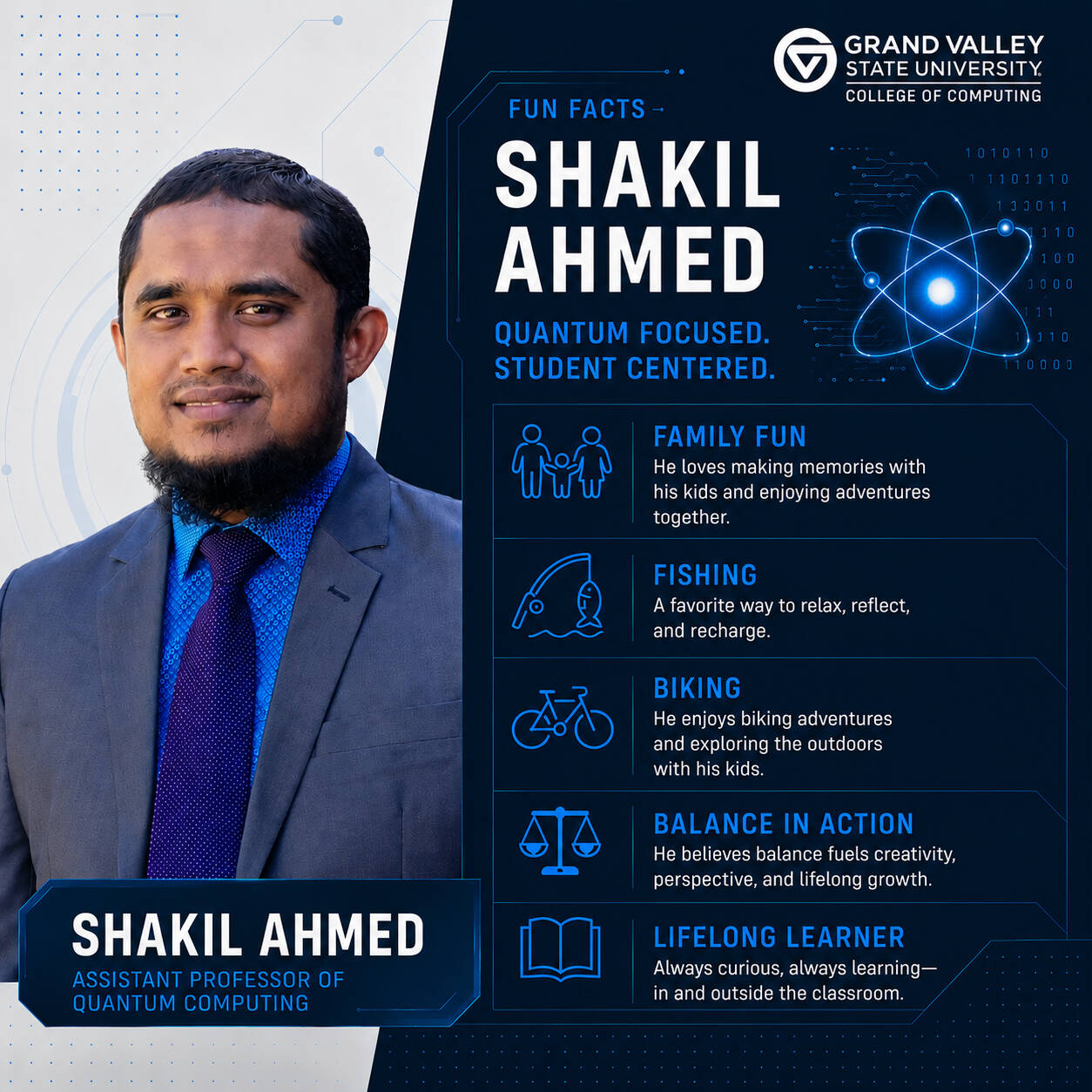
Outside the classroom, Ahmed enjoys spending time with his family and can often be found fishing or biking with his children. These are the activities that help him recharge and remind him of the importance of balancing work, family, and lifelong learning.
As quantum computing moves from promise to practice, Ahmed is optimistic that GVSU students will not simply watch the next revolution in computing unfold; they will help lead it. Through research, interdisciplinary collaboration, and hands-on learning, the College of Computing is laying the foundation today for tomorrow’s quantum workforce.