

GVSU Data Science Student Wins Best Poster for AI Tool That Screens for Sleep Apnea
Published September 25, 2026 by Esther Djan
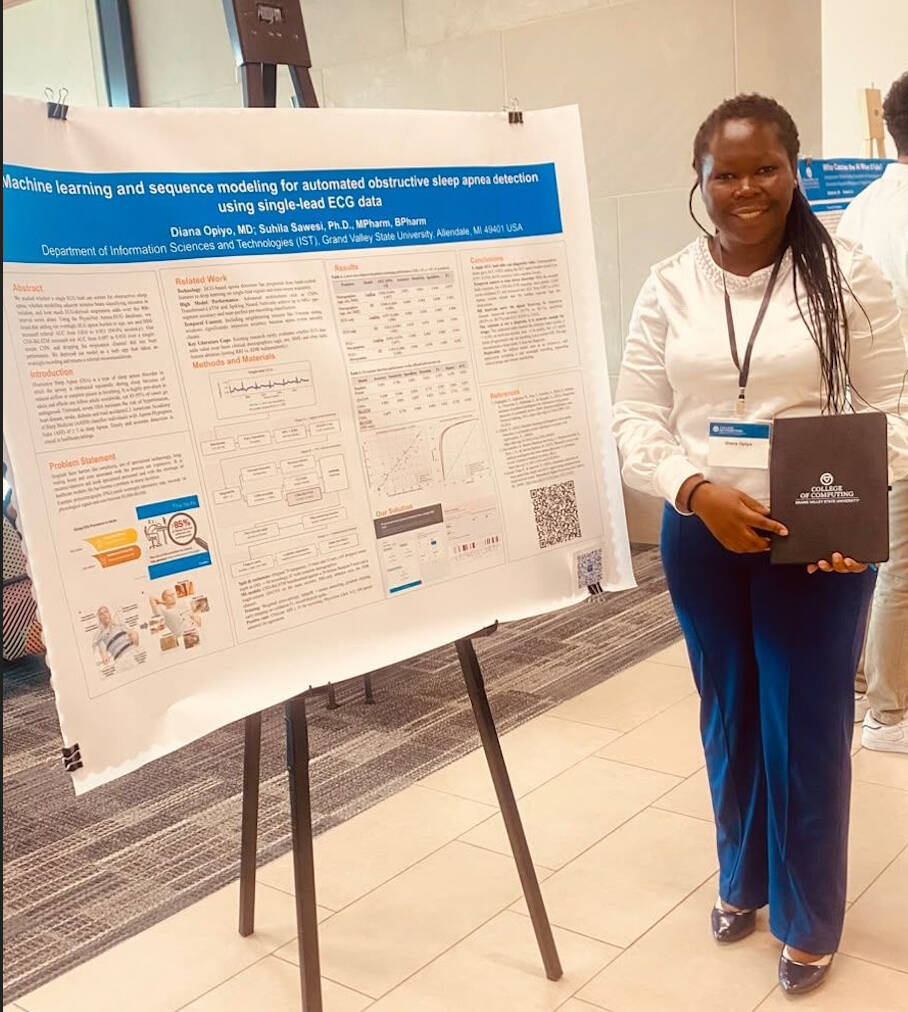
Obstructive sleep apnea is one of the most common sleep disorders in the world, affecting an estimated one billion adults. During sleep, the airway repeatedly collapses and breathing stops, sometimes hundreds of times a night. Sleep apnea can raise the risk of high blood pressure, heart disease, stroke, diabetes and road accidents. Yet between 85%-95% of people with the condition go undiagnosed. Untreated, severe sleep apnea increases the risk of hypertension, heart disease, stroke, diabetes and road accidents.
The reason is not that sleep apnea is hard to recognize but the test is expensive. Diagnosis relies on polysomnography, an overnight study in a sleep laboratory that records around sixteen body signals and costs between $3,000 and $6,000. Trained staff must then score the recording by hand. Waiting lists stretch for months, and in many communities the facilities do not exist.
Diana Opiyo, a graduate student in Data Science and Analytics at Grand Valley State University, asked whether a much simpler signal could help decide who needs a sleep study. Working with Dr. Suhila Sawesi, Associate Professor and Program Director of Health Informatics and Bioinformatics, she focused on a single ECG lead, the heart signal already recorded by hospital monitors, Holter devices and many wearable smartwatches.
Using 70 overnight recordings from the PhysioNet Apnea-ECG database, Opiyo built and compared machine learning and deep learning models, including a sequence model that reads each minute of the night alongside the minutes around it. Combining the model's overnight estimate with age, sex and body mass index, the system correctly identified 97.6% of patients with moderate to severe sleep apnea, with 94% overall accuracy. Her work also showed that letting the model see neighboring minutes clearly improved detection, because apnea events cluster together during the night. She then turned the model into a working web application. A clinician uploads an overnight recording and receives a recommendation on whether a sleep study is needed. The tool is designed for triage, directing scarce sleep laboratory capacity to the patients who need it most and it does not replace diagnosis.
The project won Best Poster at TechWeek Grand Rapids, held at Grand Valley State University on the same day GVSU and Van Andel Institute launched AIRII, their new AI research PhD partnership.
“What stayed with me most were the conversations,” Opiyo said. “So many people told me they or someone they love has sleep apnea and has been waiting months for a study. That is exactly the gap this work is trying to close.” Next, Opiyo plans to test the approach on larger and more diverse patient groups and on data from newer wearable devices.