
Opening New Doors at Bellamy Creek
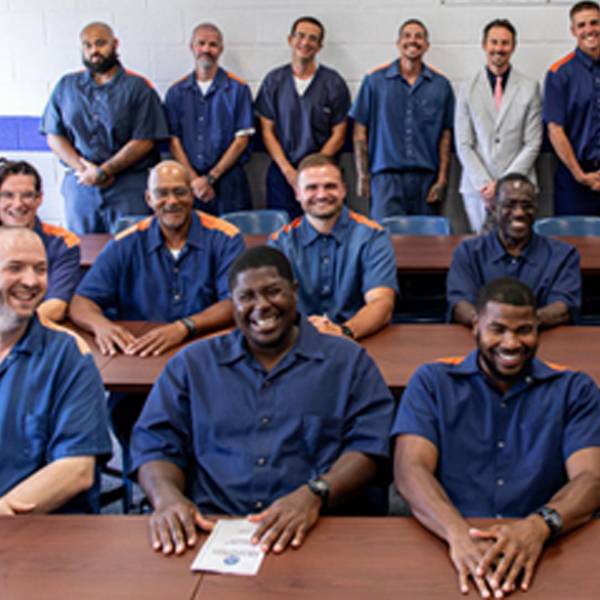
The first class of students in the Bellamy Creek Program will graduate in 2029.
Education changes lives. That belief drives Grand Valley’s newest education initiative at Bellamy Creek Correctional Facility in Ionia, where 20 incarcerated students are working toward a Bachelor of Science in Public and Nonprofit Administration.
Launched in 2024 by GVSU’s College of Education and Community Innovation, the program brings Grand Valley faculty on site to deliver a full liberal arts curriculum focused on community leadership, service, and future employment. Through service-learning courses and internships, students gain tools to prepare for meaningful roles in their communities after release.
A Grant to Build Momentum
Thanks to a grant from the Sunshine Lady Foundation, the program will grow stronger and more sustainable. The gift funds stipends for advisory board members who bring lived experience in the prison and re-entry system, and it supports a two-year fellowship for a new program director – ideally someone who also has lived experience navigating incarceration.
This investment helps ensure that the program remains student-centered and guided by voices of experience. “The Sunshine Lady Foundation was excited to support the excellent work of the Grand Valley State Prison Education Program,” shared Mary R. Gould, PhD, Executive Director of the Sunshine Lady Foundation. “We are proud of their efforts to create quality educational opportunities for students while they are incarcerated and to continue to support students as they transition to campus, ensuring consistency in their educational experience.”
Leadership with Lived Experience
As the Bellamy Creek program evolves, one of its most defining commitments is ensuring that leadership reflects the lived experience of its students. Acting Director Aaron Yore-VanOosterhout, Ph.D., is leading efforts to design a model that balances institutional stability with authentic, experience-based leadership.
“Rather than leaving the program (and leaving even before the first cohort graduates), I’m going to try to stick around and create space for broader leadership: for example, in a co-directorship or director/assistant director model, where each partner brings their own strengths and the program doesn’t lose institutional connections as it gains lived experience.”
For Yore-VanOosterhout, this approach is about more than continuity, it’s about representation and belonging. “It is essential that students see themselves in a leader, see that there is life after prison and that their hard work can pay off. This is, in fact, also essential for those of us outside prison.” He added, “Often it seems that when someone goes away to prison, they disappear with only a record of a terrible mistake they made or an addiction they suffered, disappearing into a ‘black box’ hoping to try again in the society they left behind. The more those of us outside prison see and talk with and learn from people who have left prison and successfully rebuilt their lives, the more likely we will be to extend that same opportunity to those who remain inside.”
Yore-VanOosterhout's vision is to build a sustainable program that centers student experience while creating a pathway for leaders who can truly understand – and guide – those following in their footsteps.
Hope for the Future
This program gives the students opportunities to create an impact on their community and opens the doors for them to enter a sustainable career after release. Yore-VanOosterhout shares a quote from a student, who said, "To me, this degree means that just because I ended up in prison doesn’t [mean], I ended in prison.” Explaining what the program means for his future, he adds, “Because of this program, prison isn’t the end for me. I have an opportunity to give back to the community that I took so much from.”