

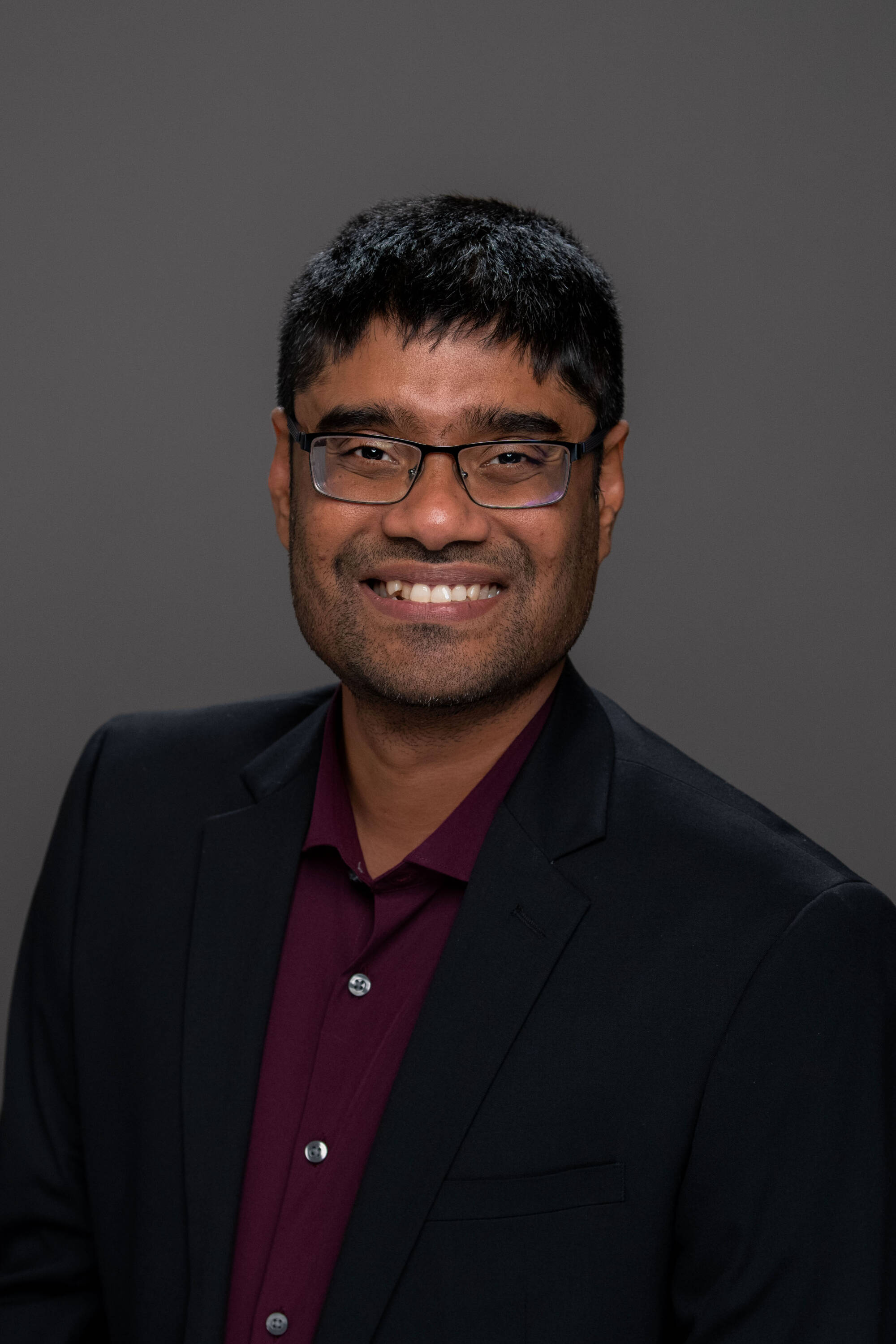
Rahat Rafiq
Graduate Program Director, Artificial Intelligence
Associate Professor, Department of Computer Science
Email: [email protected]
Phone: (616) 331-4377
Office: MAK C-2-213
Website: Personal Website
Education
Ph.D., Computer Science, University of Colorado Boulder, 2018
Semester Schedule
Other office hours by appointment only.
|
Day |
Session Title |
Time |
Location |
|---|---|---|---|
|
Monday |
CIS 263-01 Office Hours CIS 263-02 |
2:00 p.m. - 2:50 p.m. 3:00 p.m. - 4:00 p.m. 4:00 p.m. - 5:15 p.m. |
MAK B-1-116 MAK C-2-213 MAK B-1-118 |
|
Tuesday |
CIS 198 (CIS 180-05) CIS 198 (CIS 180-06) |
2:00 p.m. -3:50 p.m. 12:00 p.m. - 12:50 p.m. |
MAK A-1-117 MAK A-1-105 |
|
Wednesday |
Office Hours CIS 263-01 Office Hours CIS 263-02 |
1:00 p.m. - 2:00 p.m. 2:00 p.m. - 2:50 p.m. 3:00 p.m. - 4:00 p.m. 4:00 p.m. - 5:15 p.m. |
MAC C-2-213 MAK B-1-116 MAC C-2-213 MAK B-1-118 |
|
Thursday |
|||
|
Friday |
CIS 263-01 |
2:00 p.m. - 2:50 p.m. |
MAK B-1-116 |
Biography
Dr. Rahat Rafiq is the graduate program director for artificial intelligence and a faculty member in the College of Computing. His research lies at the intersection of natural language processing, computer vision, machine learning, applied computing, and social computing. Dr. Rafiq is deeply engaged in industry and community collaborations, including projects with Array of Engineers, Procter & Gamble, the Michigan DNR, and more. He's leveraging AI to address real-world challenges such as forest health, wellness tracking, oral care, and software automation.
His teaching interests include machine learning, data mining, natural language processing, software engineering, mobile computing, and data engineering. Prior to academia, Dr. Rafiq held roles at ThoughtSpot, DeepGreen AI, REVE Systems, and KONA Software Lab, where he contributed to projects in business intelligence, plant disease detection, and IP communication.
With a passion for interdisciplinary impact and experiential learning, Dr. Rafiq brings both academic rigor and industry relevance into the classroom. Outside of work, he enjoys reading, hiking, and camping.
Recent Publications
- Islam, M. S., Rafiq, R. I., & Tusch, G. (2024). Interactive Visualization of BioMedical Data. IEEE International Conference on Big Data, BigData 2024, Washington, DC, USA, December 15-18, 2024, 4981–4988. https://doi.org/10.1109/BIGDATA62323.2024.10825295
- Islam, M. S., Sutton, S. M., & Rafiq, R. I. (2024). A Generative AI Powered Approach to Cyberbullying Detection. Proceedings of the 2024 8th International Conference on Information System and Data Mining, ICISDM 2024, Los Angeles, CA, USA, June 24-26, 2024, 57–63. https://doi.org/10.1145/3686397.3686407
- Dahal, K., & Rafiq, R. I. (2023). What Makes A Good Course and Professor: Through The Lens of RateMyProfessor Website. The 7th International Conference on Information System and Data Mining, ICISDM 2023, Atlanta, GA, USA, May 10-12, 2023, 1–9. https://doi.org/10.1145/3603765.3603767
- Echeverri, E., Going, G., Rafiq, R. I., Engelsma, J., & Vasudevan, V. (2022). YouBrush: Leveraging Edge-Based Machine Learning in Oral Care. Mobile Computing, Applications, and Services - 13th EAI International Conference, MobiCASE 2022, Messina, Italy, November 17-18, 2022, Proceedings, 43–58. https://doi.org/10.1007/978-3-031-31891-7_4
- Khan, A. N., & Rafiq, R. I. (2022). A Preliminary Analysis of Twitter’s LGBTQ+ Discussions. Information Management and Big Data - 9th Annual International Conference, SIMBig 2022, Lima, Peru, November 16-18, 2022, Proceedings, 1–17. https://doi.org/10.1007/978-3-031-35445-8_1
Research with Students
- GoFundMe (GFM) Data Collection and Analysis:
This project involves the following. First, collect GFM data for future analysis. Second, use NLP and ML techniques to predict the category of a fundraiser (emergency, community, education) based on the description of the fundraiser. Three, understand how the fundraiser behavior is different across different categories. Fourth, can we predict the success probability of a given fundraiser given the initial donation time series of the samaritans. - Oak Wilt Detection in MI State Forests:
Partnering with Adopt a Hemlock and MI DNR to leverage computer vision and UAVs to facilitate early detection of oak wilt in Michigan - HITL-NLP Powered approach to visualize Gene Pathway Research:
Collaboration with Dr. Guenter Tusch to develop an nteractive dashboard for research into gene pathways. - Developing honeypot when cyberbullying takes place:
Collaboration with Dr.Sara Sutton to develop a system where bullying perpetrators are lured into a honeypot where the system analyzes bullying behaviors accordingly, mimicing victim and upstander roles accordingly. - NLP and HITL towards automated software test generation:
Collaboration Array of Engineers to develop a system that can generate safety critical software tests from requirements.
- LLM for Equity
- LLM Privacy
- Social Network Upstander Community Analysis
- Applied Natural Language Processing
- Ranking Methods for RLHF methods
- LLMs for Mental Health