Master's in Applied Computer Science Alumni Nathan Stern Sees Academic Success
Published January 25, 2025 by Maxwell Ritchie, Greg Wolfe, and Nathan Stern
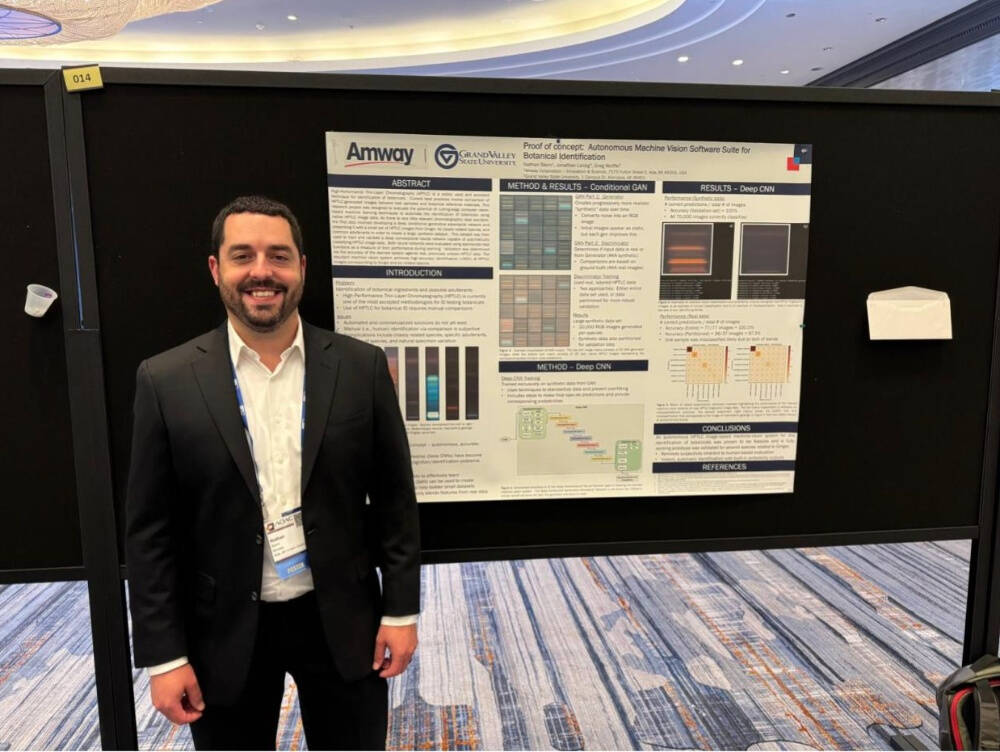
Congratulations to Nathan Stern, a graduate of the Applied Computer Science Master’s program. He recently presented his research, titled “Proof of Concept: Autonomous Machine Vision Software for Botanical Identification”, and authored an accompanying manuscript which has been accepted for publication in the Journal of the Association of Official Analytical Collaboration. He was co-advised on this project by now retired Professor Greg Wolfe and Professor Jonathan Leidig.
Nathan initially received a Bachelor’s in Biochemistry from Grand Valley and has been employed as a Research Scientist at Amway for the past 14 years. For the capstone requirement of his CIS Masters, which he earned in December of 2023, he searched for a research problem that would combine the knowledge gained in his undergraduate studies and professional career with the advanced machine learning he was exposed to in the Applied Computer Science program. “This was 100% Nathan’s idea,” said Wolffe, “I was immediately intrigued because, like Nathan, I began my scientific career in the life sciences. This project epitomized the interdisciplinary potential of our graduate degree.”
The goal of the project was to develop a machine learning model that could identify botanical species based upon images created using an analytical technique called High-Performance Thin-Layer Chromatography (HPTLC). The specific focus was on botanical-based dietary supplements, a nearly $100 billion market in the United States that has suffered from the widespread prevalence of botanical adulteration. Obviously, responsible companies would like to be able to assure consumers that they are getting exactly what it says on the label.
A machine learning model called a Deep Convolutional Neural Network (CNN) is particularly well-suited to this type of image recognition task. However, Deep CNNs typically require thousands if not millions of examples to learn the latent patterns that allow them to accurately identify objects. Unfortunately, not nearly enough botanical HPTLC images reside in company archives, and very few (<100) are available in the public domain. Stern’s solution was to use another machine learning model called a Conditional Generative Adversarial Network (CGAN) to create a large synthetic dataset. CGANs work by generating new images from random noise, then “grading” these images with a CNN. Over time and using that continuous feedback, the generated images get better (i.e. more realistic), until they resemble real images.
Creating a custom CGAN, Stern used this approach to generate a large synthetic dataset, which was used to train a custom Deep CNN. The resulting model was then presented with new, previously unseen data. It was able to identify various botanical specimens with 97% accuracy, and in another experiment was able to distinguish a popular herbal supplement, ginger, from its common adulterants with 100% accuracy.
Based on the encouraging results of this prototype, Stern plans to expand the number of species the system is capable of authenticating and assess its readiness for production use. As Leidig noted, “This is exactly what we’re hoping for in our Applied Computing graduates – the ability to apply classroom knowledge to solve a real-world problem.”
When asked about his experience, Nathan reflected on his time within the Master’s program at GVSU. "The GVSU Applied Computer Science Master's program has helped me learn the critical skills required to make a complex software system that tackles a difficult real-world problem.” said Nathan. He continued, “This includes the machine learning skills I gained, but also so many other important skills including software engineering principles, data/information management, and data visualization to name but a few.”