

GVSU faculty, researchers highlight AI’s role in future of medicine
Published September 16, 2025 by Brian Vernellis
The integration of artificial intelligence throughout the health care industry has made tremendous strides, transforming diagnostic and preventative practices while shaping how future generations of health care providers will deliver care.
As part of this year’s Tech Week Grand Rapids, “Tech Talks: Health & Technology,” hosted by Grand Valley and the Van Andel Institute on September 16, featured researchers and innovators to present their cutting-edge projects that are revolutionizing the health care sector.
President Philomena V. Mantella encouraged guests to explore GVSU’s programming this week, including tours of the Interprofessional Simulation Center during Healthcare Simulation Week at the Cook-DeVos Center for Health Sciences.
“It's been an incredible week, and I hope you all take advantage of the many opportunities to see the integration of tech and health care,” Mantella said. “We have more than seven events in our Interprofessional Simulation Center in nursing and health professions up on Medical Mile.”

President Philomena V. Mantella

Professor Kristen Vu
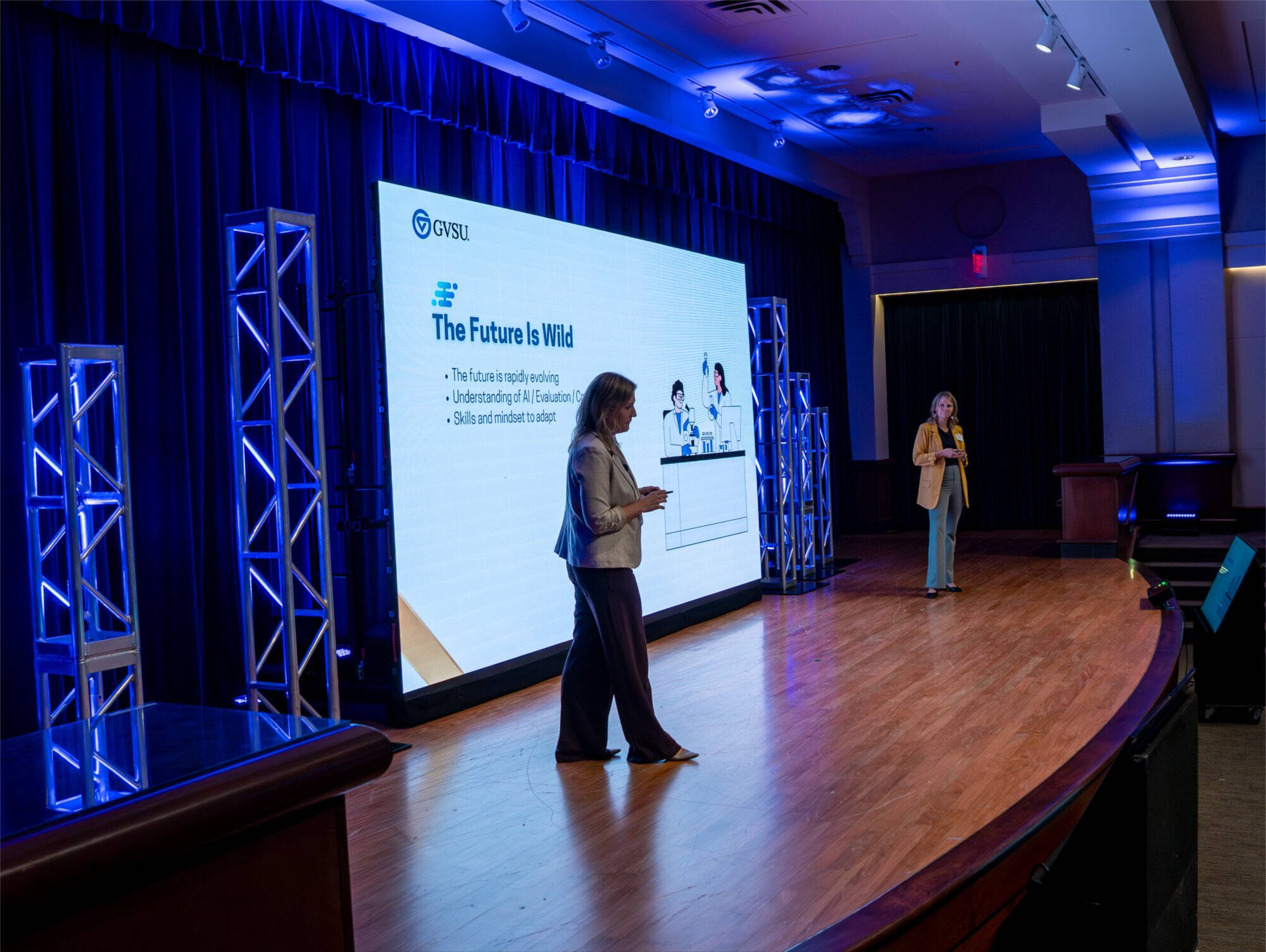
In their presentation, Kristen Vu, program director of medical dosimetry, and Michelle Strange, assistant professor in physician assistant studies, discussed how their departments and faculty members are embedding AI into their curriculum.
“Students will enter a workforce where AI is not optional, but a core part of care delivery,” Strange said. “Preparing our students to use these tools responsibly and effectively will ensure better patient safety and health outcomes.
“Education is where we ensure health care professionals don’t just use AI, but understand its strengths and weaknesses. Students will need to critically evaluate AI output, identify biases and integrate technology with clinical reasoning.”
Vu explained that in medical dosimetry, students learn to design treatment plans for cancer patients. AI can then analyze those student-built models to create more personalized plans.
“We're able to spend some time really talking about the evaluation piece of it, and how AI can be really great in things like efficiency, but we do have to be very careful about how we use that in our system and for patients,” Vu said.

Professor Kelvin Maupin

Lorem ipsum
For Kevin Maupin, his research is particularly personal since his son was diagnosed with leukemia in 2019. Maupin’s project explores AI’s ability to recognize patterns within a patient’s medical history that can help predict and guide personalized therapies.
“I’m very focused on this predictive aspect, and AI looking at different factors, particularly in the electronic health records or medical imaging, and how we can use that to make predictions," said Maupin, an assistant professor in the College of Computing.
“I don't want to get rid of clinicians or radiologists. I want them to serve as the guard rails because I think we're a long way off from having AI guide itself in terms of making these clinical decisions.”
Maupin added that while his son is now healthy, lingering side effects remain, underscoring the need for better predictive tools.
“We need to get eventually to the point where we have something broader, something that could be more generalized in terms of its ability to predict,” Maupin said. “But to get there, it's hard. All the different tests that you get, they live in different places, different databases, different formats.
“The AI needs to be able to reach out to all of these different places. We need to link outcomes to inputs from these multimodal data sets.”
Other featured presenters included the Van Andel Institute’s Andrew Pospisilik, who discussed AI’s applications to the field of epigenetics and Zoom’s Ron Strachan and Donald Dembinski, who discussed how Zoom's AI-first platform enhances health care communication.