

Dr. Rebecca Jonas on Designing Technology Around People
Published August 21, 2026 by Allison Bazaire
A movie and a cross-country road trip may seem like unlikely starting points for a career in computing research.
For Dr. Rebecca Jonas, both helped spark questions she is still exploring today.
When The Social Network premiered in 2010, Jonas became fascinated by what happened when something as fundamentally human as social interaction moved into a digital space. She began thinking about how technology changes the way people communicate and behave and what researchers could learn once those interactions became data.
Around the same time, a road trip across the United States revealed another side of the rapidly changing digital world.
Jonas had grown up outside Washington, D.C., surrounded by reliable access to technology. Traveling across the country showed her just how different that experience could look elsewhere.
"I could drive for hundreds of miles within the U.S. and have no signal," Jonas recalls.
Together, those experiences raised a question that would eventually become central to her work: Who benefits from technology, and who risks being left out?
Today, Jonas brings that curiosity to Grand Valley State University's College of Computing, where her work sits at the intersections of computing, human-computer interaction, human-centered design, and the social sciences.
Finding the Human Side of Computing
After completing her bachelor's degree, she spent two years as a Solution Engineer at Appian in the Washington, D.C., area. Although she ultimately chose a career in research and teaching, the experience gave her firsthand insight into how the technology industry operates and how digital products move from ideas into tools people actually use.
Her doctoral and postdoctoral work opened another window into the technology world.
Jonas presented research at international CHI and CSCW conferences, traveling to places including Yokohama, Japan, and Barcelona, Spain. During her postdoctoral work, she also lived in Silicon Valley.
These experiences gave her what she describes as "some very interesting insights into the culture that informs a lot of the technology that dominates our world." They also helped shape a research philosophy that puts people rather than technology itself at the center of the conversation.
Research With, Not Just About, Communities
Jonas describes herself first and foremost as a community-engaged researcher. This means that rather than entering a community, studying its members, and leaving with the results, Jonas wants the people affected by her research to help shape it.
"I try to do human-subject research alongside members of the community so that the people I research with are not only participants, but co-designers and facilitators of projects that contribute immediate impact back to their communities," Jonas explains.
One recent paper examined the experiences of rural Midwestern hunters and earned a Recognition for Contribution to Diversity and Inclusion, an honor Jonas says was particularly meaningful because diversity and inclusion are central to why she conducts research.
She also received a Google Academic Research Award to pursue an idea she had considered for years: working with members of fringe belief groups to co-design digital literacy frameworks.
For Jonas, both projects reflect the same underlying approach in that understanding technology requires understanding the people who use it, including communities whose perspectives may not always make their way into conventional technology design.
Turning the Classroom Toward the Community
As a new faculty member in the College of Computing, Jonas will teach undergraduate and graduate courses in human-computer interaction while establishing a research lab where students can contribute to projects involving digital literacy, social media fact-checking tools, and new interfaces for generative AI systems.
But, ultimately, she doesn't want students' work to remain inside the classroom.
In her User Experience Design course, students will work with local businesses to redesign websites and other aspects of their digital presence. Students will develop portfolio-ready research and design artifacts while their work creates a tangible benefit for organizations in the surrounding community.
"My goal in this role is to work with students on projects that have dual roles of developing students' computing education and skills while having positive impact on the local community," Jonas says.
It is an approach that links education, technology, and community impact: students learn computing not simply by studying technology, but by applying it to real needs alongside the people who will ultimately use what they create.
Jonas is also exploring interdisciplinary collaborations across GVSU in digital literacy and citizen science, opening new ways for computing to connect with expertise and questions across the university.
Thinking Globally, Acting Locally
For Jonas, meaningful innovation does not always begin with a new technology. Sometimes it begins with noticing a problem close to home and asking better questions.
Many students who may consider taking classes with Jonas already understand West Michigan in ways a researcher arriving from somewhere else cannot. At the same time, being part of a university gives them access to people with different backgrounds, disciplines, skills, and experiences.
Jonas wants students to recognize the value of both.
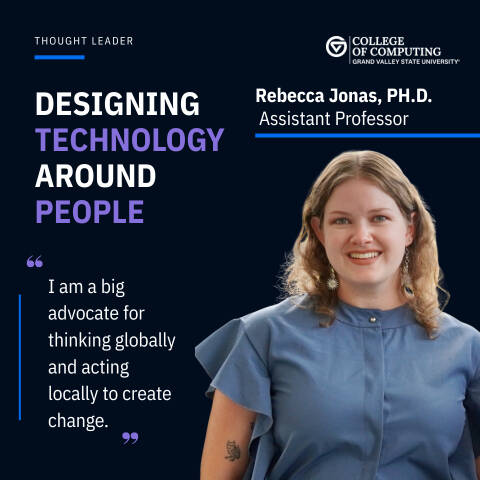
"I am a big advocate for thinking globally and acting locally to create change," she says.
She imagines students noticing a challenge in a nearby community and bringing it to her not because they already know the solution, but because they want to find one.
That might mean creating an application, providing technology education, conducting research, or simply asking better questions about what a community actually needs.
"There are a huge number of practical ways students can create impact through their class projects, independent research studies, and student organizations when they recognize the power they hold as members of both the local community and the GVSU community," Jonas says.
It is a vision of computing in which technical expertise and human understanding reinforce one another and in which students see themselves not simply as users or builders of technology, but as people capable of shaping how technology serves society.
Finding Inspiration Offline
For someone whose career revolves around understanding our relationship with technology, Jonas also appreciates getting away from it.
She loves hiking, spending time outdoors, and finding opportunities to unplug.
"As much as I think about technology, it is so important to unplug and get back in touch with the natural world," she says.
And there's an even easier way for students and colleagues to introduce themselves. Jonas is a self-described huge animal lover.
"If you see me around, please show me a picture of your dog!"