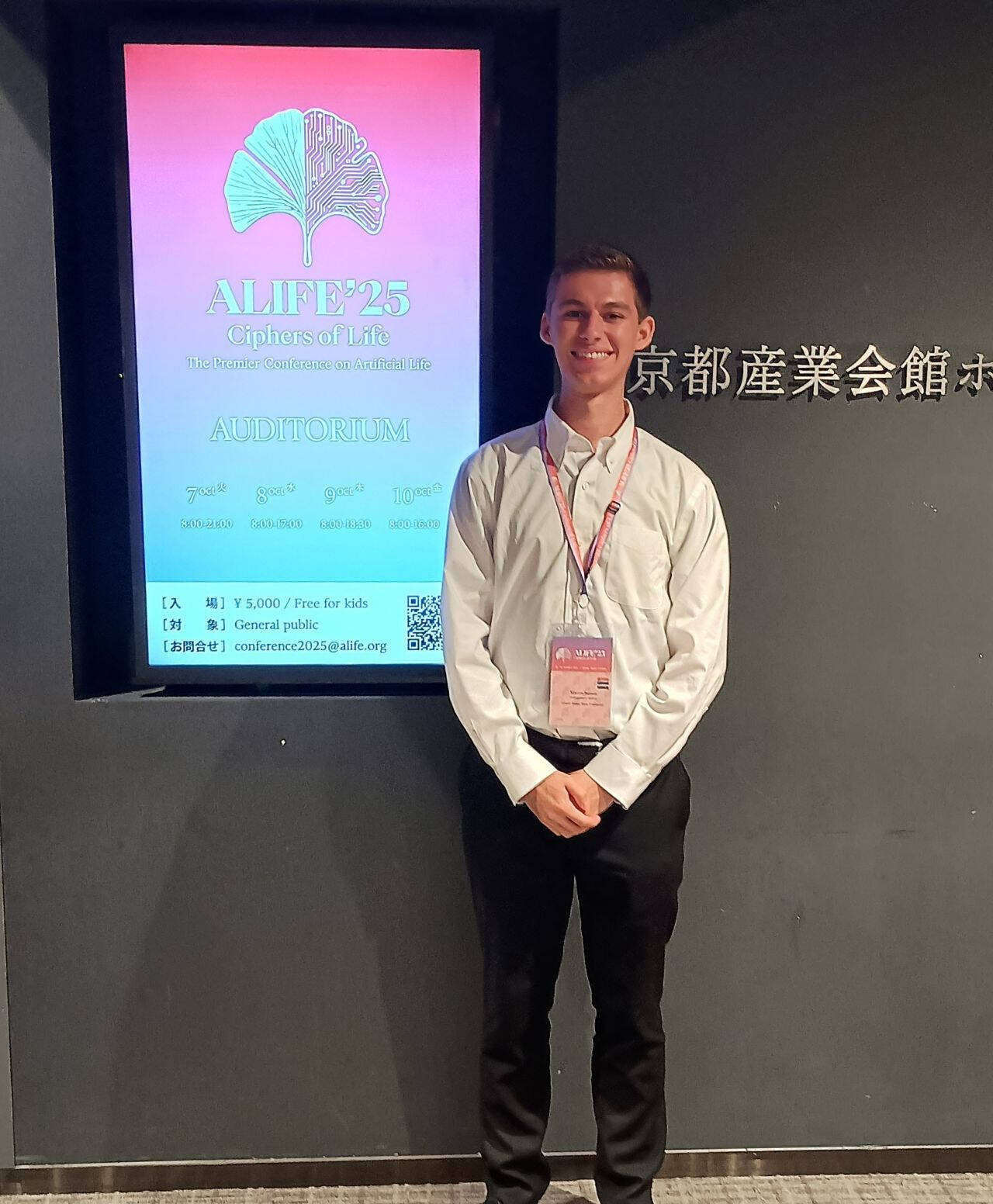
Marcos presents digital evolution research on the global stage in Japan
Published November 21, 2025 by Santiago Castellanos Donoso

When Grand Valley State University student Marcos Sanson began exploring the intersection of biology and computing, he didn’t realize his curiosity would soon take him across the world. What began as a classroom interest in evolution and adaptation developed into a research project over the semester. This work ultimately led to Marcos presenting at the 2025 Artificial Life Conference (ALife 2025) in Kyoto, Japan, a leading international venue for research on natural and artificial forms of life and intelligence.
Marcos’s project, guided by Dr. Austin Ferguson from the College of Computing, explores how living systems evolve over time - and what computer scientists can learn from that process. His team focused on identifying mutations that increased the evolvability of a population. “In nature, we see this when plants evolve new defenses or bacteria learn to use new nutrients,” Marcos explained. “But those processes take years in the lab. By simulating digital organisms on a computer, we can explore those same evolutionary patterns much faster.”
Dr. Ferguson introduced Marcos to this emerging field of digital evolution and helped him turn his curiosity into a research direction that bridges computing and biology. “He’s been incredibly supportive throughout this entire process,” Marcos said. “From helping me design experiments to preparing our paper for peer review, his mentorship has been invaluable.”
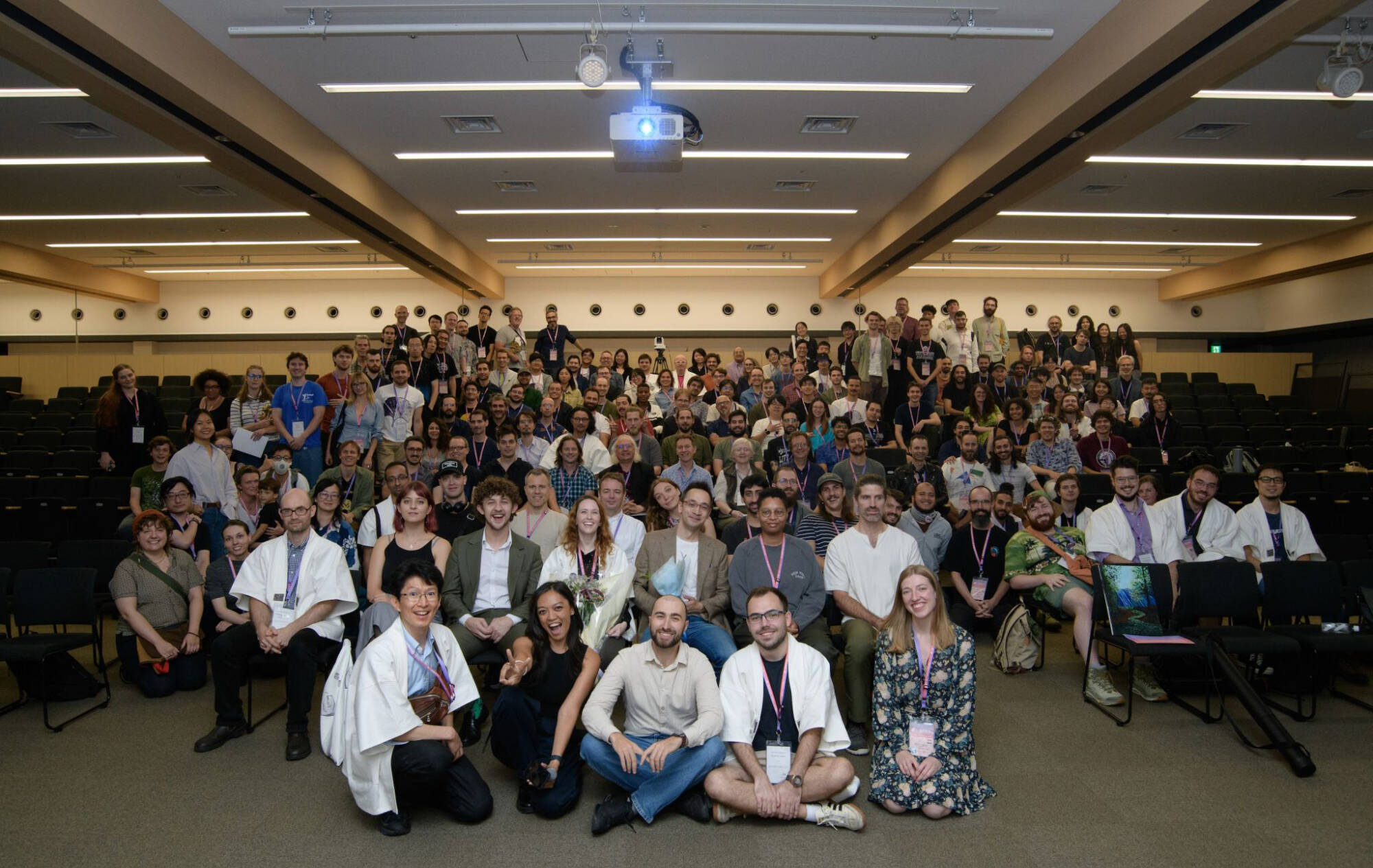
That work paid off when their paper was accepted for presentation at ALife 2025, held in Kyoto, Japan. The five-day conference brought together researchers from around the world to share cutting-edge discoveries in artificial intelligence, complex systems, and evolutionary computation.
For Marcos, presenting there was both a challenge and a milestone. “It was my first formal talk at an international conference,” he said. “I spent a lot of time preparing to make sure I could clearly explain our research to an audience of scientists from many different backgrounds.” At the conference, Marcos connected with researchers from around the world who approached evolution and computation from different perspectives.
Exploring Kyoto and Tokyo made the experience even more memorable, and navigating a five-day conference taught him how to prioritize sessions, prepare effectively, and build professional connections. Marcos credits the College of Computing, Office of Undergraduate Research and Scholarship, Academic Conference Fund, and the Padnos International Center for making the trip possible, and he expressed deep gratitude for Dr. Ferguson’s mentorship throughout the entire process.
Looking ahead, Marcos plans to continue developing this research by testing new evolutionary environments and exploring applications for evolutionary algorithms. He hopes to share future results at additional conferences and expand the project as he prepares for the next steps in his academic research career.