The Classroom Environment and Teaching Assessment (CETA) Updates
This article originally appeared in START Connecting in September 2025.

The Classroom Environment and Teaching Assessment (CETA) was introduced in 2011 to give teachers and school teams a proactive way to strengthen inclusive classroom practices and help ensure students have access to the least restrictive environment. The goal of the CETA is to create classrooms where all students can be successful, especially those with higher support needs.
With a strong foundation in research and best practices, the CETA aligns with approaches many educators already know, including Evidence-Based Practices, Positive Behavioral Interventions and Supports (PBIS), Universal Design for Learning (UDL), and High-Leverage Practices for Students with Disabilities.
Teachers can use the CETA as a collaborative tool with their team or on their own as a self-assessment. It’s a helpful way to acknowledge strengths, set goals for growth, and track progress over time.
A Brief History of the CETA
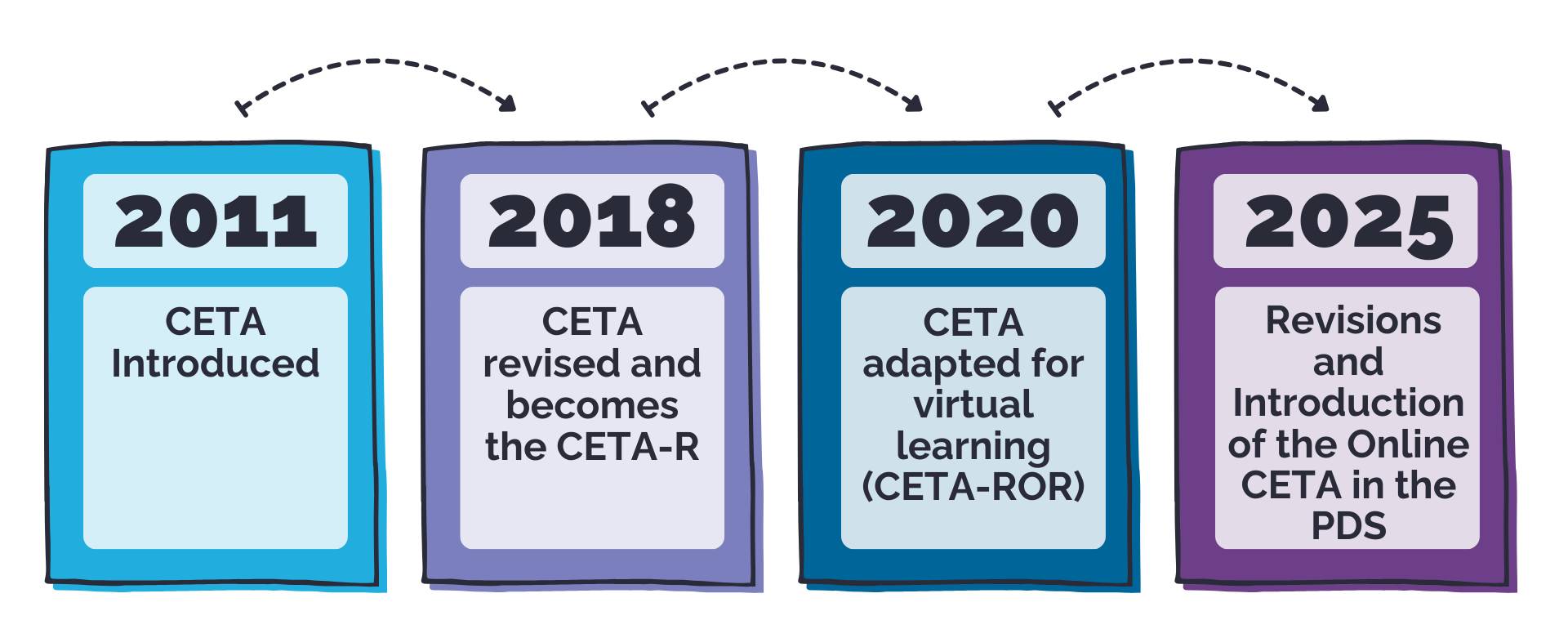
2025 CETA Revisions
What will you find in the revisions?
- All indicators were reviewed and revised to ensure they are clear and align with neuroaffirming language.
- Additional indicators were added to some sections to be more comprehensive, including expanding the Communications Systems and Supports section.
- The Adult Support and Interactions section was moved to the second position in the CETA.
- The Social Interaction and Peer to Peer Opportunities section received a small name change (Support was replaced with Opportunities).
- The Visual Organizer is updated to make it easier to use.
CETA in the START Planning and Data System (PDS)
We are excited to announce that the CETA is available to use in the START Planning and Data System (PDS). This new website offers a collection of planning and data tools to promote the use of evidence-based practices for students with autism and related disabilities. By using the CETA in the START PDS, teams will be able to:
- Distribute an individual copy of the CETA to each team member
- Take notes on their copy of the CETA
- Generate a printable plan based on the CETA data
- Access automatically generated graphs of the CETA data
- … And more!
Tutorial slides are available on the START Website to walk you through the process of using the CETA in the START PDS. The slides are geared toward specific user types (e.g., users who will have administrative tasks in the system, users who will be focused on using the CETA with their team), and you can select the slide deck that best fits your needs. If your team is interested in using the CETA in the START PDS, contact the Regional Collaborative Network Leaders from your ISD.
Written By: Amy Matthews, PhD, BCBA, Project Director and Stephanie Pulido, M.Ed., Program Evaluation and Resource Development Specialist