
The Pyramid Model as a Framework for Early Childhood Practice
This article originally appeared in START Connecting in January 2026.
[1769647944].jpg)
This month, we are spotlighting the Pyramid Model and its importance in early childhood programming. If you are new to the model or want to learn more, we are offering a two-hour introductory training on May 8, 2026. To pique your interest, we are sharing a brief overview of the Pyramid Model and their resources.
The Pyramid Model is a research-based framework designed to help young children build strong social and emotional skills while preventing and addressing challenging behavior. It is a set of practices that may be used alongside a classroom curriculum and within everyday family routines.
The model was developed by the National Center for Pyramid Model Innovations at the University of South Florida, in partnership with early childhood researchers and practitioners across the country. It primarily focuses on children from birth to age five, with guidance that is useful for early childhood special education personnel, early intervention specialists, and families. Resources from the model have also been used in early elementary settings.
The model was developed by the National Center for Pyramid Model Innovations at the University of South Florida, in partnership with early childhood researchers and practitioners across the country. It primarily focuses on children from birth to age five, with guidance that is useful for early childhood special education personnel, early intervention specialists, and families. Resources from the model have also been used in early elementary settings.
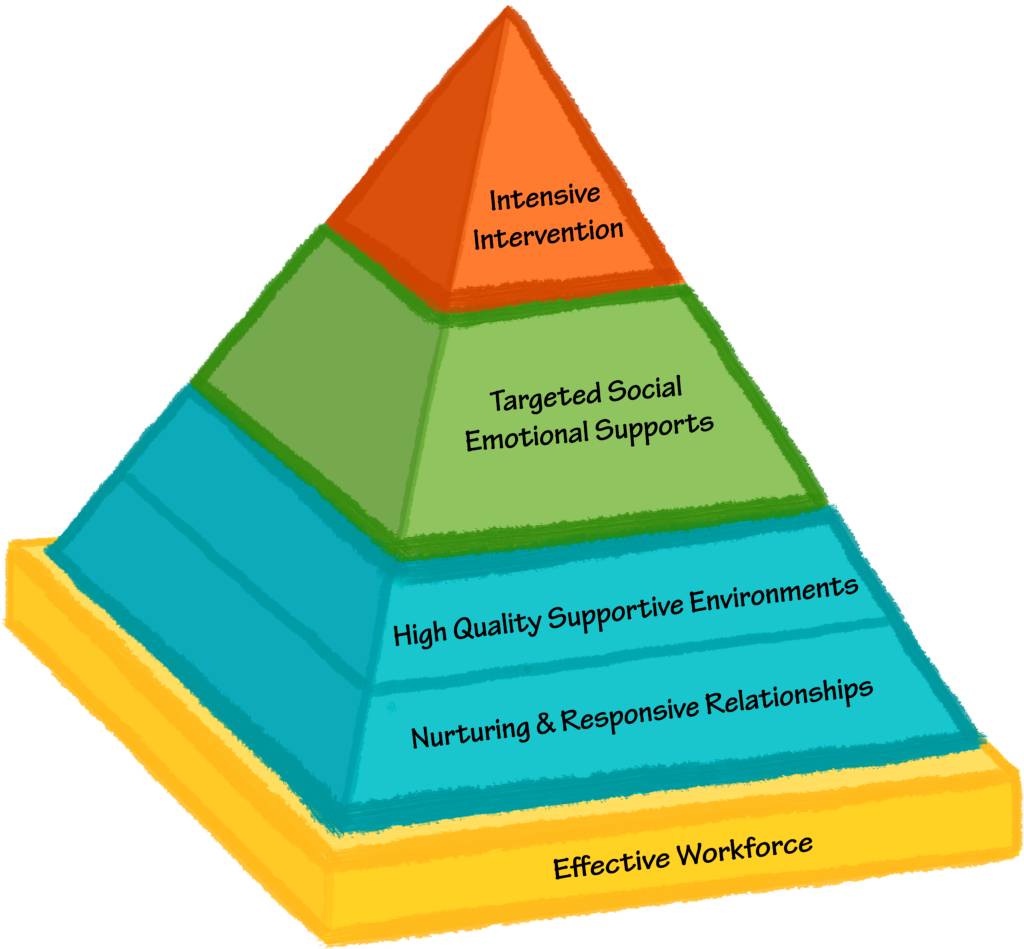
The Pyramid Model is organized like a pyramid with several levels of support. At the base are universal practices that promote positive relationships and supportive learning environments for all children. This includes nurturing, responsive caregiving and teaching social and emotional skills that help children engage in activities, make friends, and manage their emotions. Targeted practices provide children with additional support to develop these skills, and Intensive Intervention is designed to provide more individualized support for children with persistent challenges. The framework emphasizes the importance of building an effective workforce so that teachers and program leaders have the knowledge and policies needed to put these practices into action.
The Pyramid Model is important for early childhood programs because research shows that consistent implementation supports children’s social-emotional development, reduces challenging behavior, and strengthens educators’ ability to support all young children. By focusing on prevention as well as intervention, the Pyramid Model provides a proactive way to create inclusive learning environments.
The model includes guidance and tools for engaging families as active partners. This supports shared strategies and clear expectations across home and learning settings.
The Pyramid Model aligns with the goals and practices of the START Project. Both emphasize evidence-based practice, support inclusive environments, and build on PBIS foundations that focus on prevention as well as intervention. These practices are supported through professional learning, coaching, and practical resources that educators and teams can use to help all children succeed.
The Pyramid Model Resources page offers many ways to learn more about the model, including webinars, videos, printable fact sheets, and classroom resources. Some materials are available in multiple languages. If you are looking for an easy place to start in the classroom or at home, Tucker the Turtle is a helpful tool for teaching calming skills. We hope you will join us in May to learn more about the Pyramid Model.
Written By: Amy Matthews, PhD, BCBA, Project Director and Sarah Hampton, M.Ed., Autism Teacher Consultant at Copper Country Intermediate School District

Resources
- National Center for Pyramid Model Innovations
- Hemmeter, M. L., Ostrosky, M. M., & Fox, L. (Eds.). (2021). Unpacking the Pyramid Model: A practical guide for preschool teachers. Paul H. Brookes Publishing Co.
- MiMTSS TA Center Preschool Pyramid Model Practices
- START Project Training - Building Strong Foundations: An Introduction to the Pyramid Model for Preschool Educators