Radiation Therapy
Bachelor of Science (B.S.)
Undergraduate Major
Allendale • Grand Rapids • Face to face • 147 Credits

Undergraduate Major
Allendale • Grand Rapids • Face to face • 147 Credits
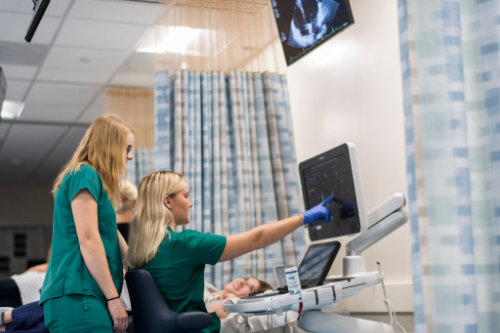
Radiation therapists are responsible for accurately recording, interpreting, and administering the treatment prescribed by radiation oncologists. During treatment, therapists help physicians use fluoroscopy, x-ray, or computed tomography to localize and outline anatomical areas requiring treatment. Secondary application and admission are required.
Grand Valley's radiation therapy program is one of Michigan's JRCERT-accredited radiation therapy schools, preparing students to become skilled radiation therapists in the heart of Grand Rapids' medical community.
Grand Valley's Radiation Therapy program prepares students to become skilled radiation therapists who accurately record, interpret, and administer treatments prescribed by radiation oncologists. The program requires a secondary application and admission, and students spend two years completing general education and prerequisite courses before entering two years of full-time professional coursework. The program is accredited by the Joint Review Committee on Education in Radiologic Technology and is located in the Cook-DeVos Center for Health Sciences in downtown Grand Rapids.
The curriculum covers a range of topics essential for a career in radiation therapy. Students will study:
Radiation Therapy boasts a strong curriculum, knowledgeable faculty, and diverse clinical site placements, which prepare students for the national certification exam. Small class sizes and cohort-based learning foster a supportive educational environment. Additionally, the program's location in the heart of the medical community provides students with valuable clinical experiences at various hospital affiliates, from large teaching facilities to small community hospitals.
A degree in radiation therapy involves a competitive admission process and completion of a secondary application. There are no waiting lists for these programs. Applications are due February 1. Admissions occur once per year beginning in the fall semester (August). The application requirements can be found online at gvsu.edu/rad.
The program is accredited by the Joint Review Committee on Education in Radiologic Technology.
The program is four years, and includes two years of general education/prerequisites before two years of professional coursework.
Provide radiation therapy to patients as prescribed by a radiation oncologist according to established practices and standards. Duties may include reviewing prescription and diagnosis; acting as liaison with physician and supportive care personnel; preparing equipment, such as immobilization, treatment, and protection devices; and maintaining records, reports, and files. May assist in dosimetry procedures and tumor localization.
Top skills| Annual Earnings | Percentile |
|---|---|
| $ 79,601.60 | 10% |
| $ 83,304.00 | 25% |
| $ 95,888.00 | 50% |
| $102,876.80 | 75% |
| $110,032.00 | 90% |
Grand Valley State University offers a wide variety of merit-based
scholarships. For information on all of the scholarships that are
available to students, please visit Scholarships at GVSU.
Grand Valley offers myScholarships
(a scholarship matching tool) to help admitted students match
with GVSU scholarships, as well as external scholarship opportunities.
myScholarships will prompt you to answer questions to help match you
to scholarships for which you might qualify.
Getting involved and staying engaged with our vibrant campus community help you make the most of your Grand Valley experience. Attending student life events, joining a student organization, or participating in campus recreation opportunities are all fantastic ways to maximize your college years:
Whether you are a first-year student, a transfer student, or a current student thinking about your career options, advising is an important part of your academic journey.