

Graduate Degrees and Badges
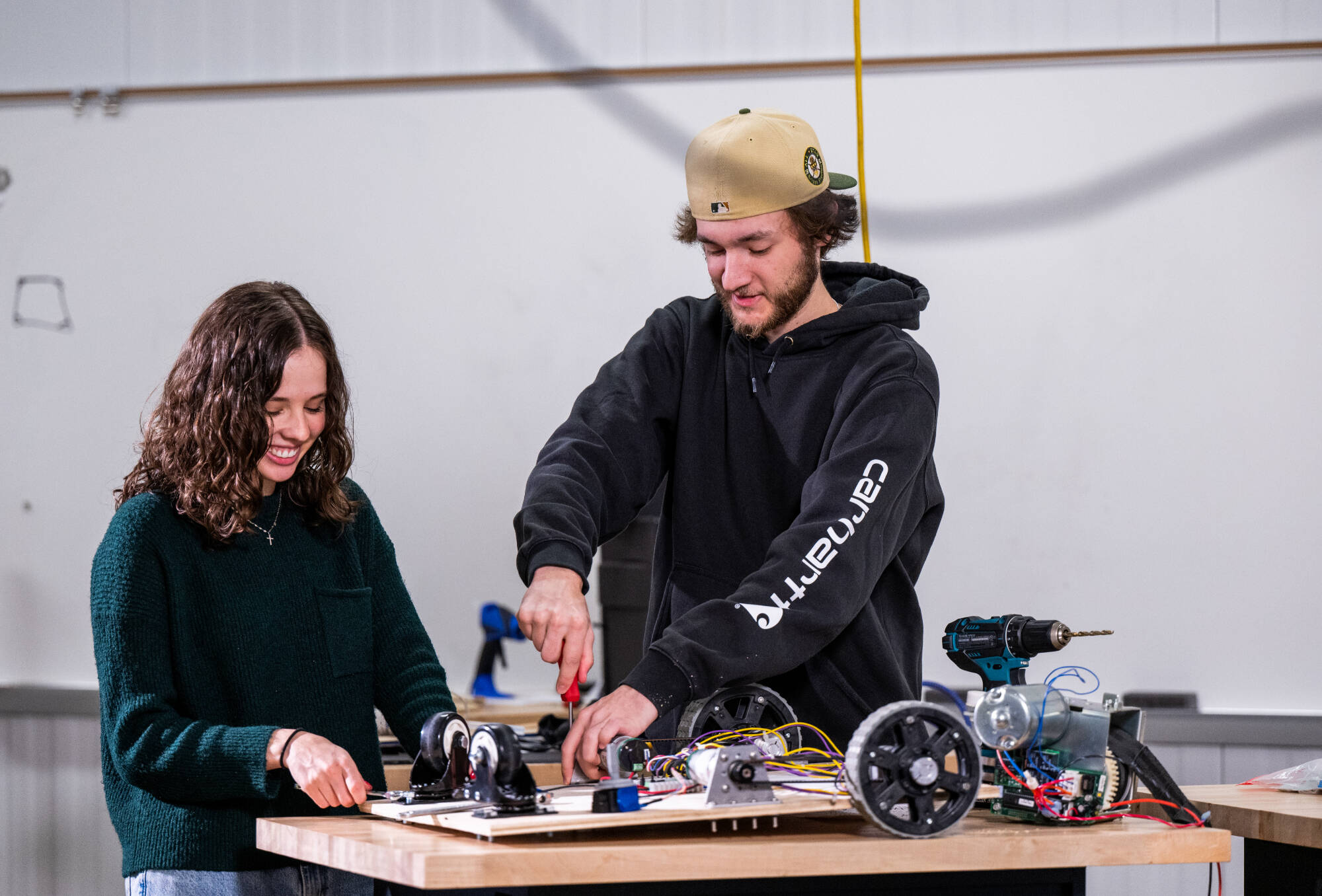
The Master of Science in Engineering (MSE) program is one of the first graduate programs at GVSU. Our students can major in Biomedical Engineering (BME), Electrical and Computer Engineering (ECE), Manufacturing and Design Engineering (MDE), or Mechanical Engineering (ME). The curriculum is designed to help each student identify and accomplish their unique purpose within their chosen profession. Through experiential learning, industry-sponsored project work, and faculty led research projects, graduate students can participate in high impact learning activities that help them develop critical thinking skills and a growth mindset, making them lifelong learners.
Graduate Degrees
Why get an MSE degree?
The Master of Science in Engineering (MSE) degree at GVSU produces engineers with a practical, hands-on, graduate education rooted in a strong theoretical foundation that our industry partners depend on to meet their evolving needs. Located in the vibrant heart of downtown Grand Rapids, our MSE program was established in 1998 to meet the increasing demand for engineering talent in West Michigan, one of the fastest growing technical, manufacturing, and industrial regions of the state.
The MSE program prepares students to become technical leaders in their profession as well as strong candidates for doctoral programs. Our graduates go on to work with multinational companies like GE, Stryker, and Ford, as well as smaller, local companies like Dornerworks and Twisthink. A growing number of our graduates are also pursuing PhDs at prestigious universities like Penn State, Northwestern, and University of Michigan.
The MSE requires a minimum of 33 credit hours of graduate coursework including emphasis-specific courses, electives, and a culminating experience. Full-time students (9 graduate credits) typically complete their graduate coursework in 4 semesters.
Each student works with the GPD to plan a course of study tailored to their needs. For students with a non-engineering undergraduate degree, this course plan will include undergraduate prerequisite courses to fill in any knowledge gaps.
Most of our classes are offered in the evening providing convenient scheduling for working professionals.
MSE students can choose to specialize in the following areas:
- Biomedical Engineering (BME)
- Electrical and Computer Engineering (ECE)
- Electromagnetic Compatibility (EMC) - NEW as of Fall 2026!
- Manufacturing and Design Engineering (MDE)
- Mechanical Engineering (ME)
Applicants to the MSE program must have a Bachelor of Science degree in Engineering, or a closely related field like Physics, Mathematics, Biomedical Sciences, Engineering Technology etc.
Applicants must have a cumulative undergraduate GPA of at least 3.0 on a 4.0 scale. Applicants must submit an essay, three letters of reference, their official transcripts, and a resume. Application fee waiver requests may be made to [email protected], the engineering program does not grant application fee waivers. Requests must include an explanation of why you need the waiver.
International applicants must also submit satisfactory GRE scores (≥300 for verbal+quant, ≥ 2.5 in writing) and show evidence of proficiency in English via TOEFL (≥ 80), IELTS (≥ 6.5), Duolingo (≥ 110), or ME Lab. More information for international applicants can be found here.
Deadlines: March 31st for Fall semester (Sept - Dec) start and September 1st for Winter semester (Jan - Apr) start. Applications are accepted and reviewed on a rolling basis throughout the year, but timely application is strongly encouraged to secure course enrollment and for funding consideration.
GVSU is one of the very few universities to offer limited funding at the Master's level via Graduate Assistantships (full or half). All funding decisions are made separate from the admissions decision and there is no separate application that needs to be filled out for funding consideration. Admission into the program does NOT guarantee funding. Funding decisions are made on a merit basis by the committee after it has reviewed all the admitted students. Funding is offered via a limited number of GAs to help support the teaching mission of our program by working in the labs, supporting the first-year engineering sequence, and helping our outreach efforts.
Graduate tuition rates vary by program and can be found here. The tuition for classes as a graduate student in the MSE program is $904/credit hour in AY25-26.
The combined degree program offer students the opportunity to complete both an undergraduate and graduate degree, meeting their unique personal, academic, and career goals. Pursuing a combined degree program can reduce the cost and total time required to complete both degrees, since up to 12 credits taken at the bachelor's level and price can be counted towards the master's degree.
Only current GVSU engineering students are eligible to apply for the Combined BSE/MSE Program.
Learn more about the Combined BSE/MSE Program
- Current GVSU students in related majors such as BMS, Physics, and Math can explore combined BS/MSE degrees via the Student-Initiated Combined Degree Programs.
- Current students pursuing a BSE in Computer Engineering also have the opportunity to do a combined degree and get an MS in Applied Computer Science i.e. BSE/MS.
Accelerated MSE Program ("Faster Master")
The MSE program can be completed in three semesters/one academic year via a 12/12/9 course credit format to complete the necessary 33 credits. Earlier degree completion allows students to start earning earlier and recoup their program costs faster.
Learn more about the Accelerated MSE Program
Non-Degree Seeking Graduate Student
Applicants who have a Bachelor's degree and are not enrolled in the MSE program can take graduate engineering classes at GVSU as a non-degree seeking student. A maximum of 12 credits hours taken as non-degree may be applied to a future MSE degree.
Graduate Badges
What is a graduate badge?
A digital badge, or badge, is a record of achievement that recognizes a student's completion of a coherent and meaningful academic experience. GVSU offers both credit and non-credit bearing badges as digital credentials. Credit-bearing badges include anywhere from 0.5 to 15 academic credits and may include additional noncredit criteria. Credit-bearing badges are also posted to the academic transcript.
Electromagnetic compatibility (EMC) is the ability of electrical equipment to operate correctly in its electromagnetic environment without causing or experiencing interference. The program covers topics such as electromagnetic emissions, susceptibility testing, shielding, grounding, and the application of design techniques to meet EMC regulations and standards in various industries.
The digital badge is comprised of two courses, a total of seven credits.
Completed in under a year, this badge offers a competitive edge and opens doors to advanced career opportunities in product design and engineering.
This Embedded Systems graduate badge provides students with a better understanding of interfacing peripheral devices with microcontrollers, integrating hardware and software for microcontroller-based applications, and writing firmware for real-time operating systems.
The embedded systems badge is two courses, four credits each, for a total of 8 credits.
Students obtaining this badge will learn to develop and debug programs for engineering applications using structured programming languages and development environments. Topics include understanding microcontroller architecture and interfacing with peripheral devices, integrating hardware and software for microcontroller-based applications, writing firmware for real-time operating systems, and working with digital and analog interfaces to control electromechanical systems.
Operations Research (OR) employs quantitative techniques to optimize decision-making under constraints, balancing objectives like cost, time, and resource allocation across industries. The badge teaches students to leverage statistical models for enabling efficiency improvements in logistics, supply chains, manufacturing processes, finance, and beyond.
The badge consists of three courses and can be completed in two semesters.
Upon completion, students will be equipped to make strategic decisions in manufacturing environments, analyze production systems through modeling techniques, and apply statistical tools to interpret experimental data effectively.
Admissions to complete a digital badge is open to both degree and non-degree seeking domestic students, and degree seeking international students. If you are not currently a GVSU student, start your application here.
Declaring a Badge
- myPath can track your progress toward a badge, but you must "declare" it.
- To declare a badge, go to Banner → Student → Student Records → Add a Certificate or Badge.
Applying for a Badge
- After you've completed a badge (or are nearing completion), you can "apply" to be awarded the badge, in the same way you "apply" for graduation.
- You can also use the Badge Application form (PDF). After the Registrar’s office approves it, they will update myPath.
Graduate tuition rates vary by program and can be found here. The tuition for classes in the graduate badge sequence is $826/credit hour in AY25-26.