
A History of Grand Valley State, 1958-2010
1958-1963
I. High Hopes
L. William Seidman, widely recognized as “the father of Grand Valley State University,” was interviewed for GVSU’s 50th Anniversary Video History Project shortly before his death in May of 2009. The Grand Rapids businessman, who became an economic advisor to Presidents Gerald Ford, Ronald Reagan and George H.W. Bush, chair of the FDIC and head of the Resolution Trust Corp., among other national positions, recounted his attempts in the late 1950s to gain community support for a somewhat radical idea. He proposed to establish an independent, state-supported, four-year institution of higher education in West Michigan.
“We started having meetings with all kinds of organizations,” he remembered, “the labor unions, the various luncheon clubs, anybody that would listen to us … I would come in and I would take out what we used to call a recording machine, and I would play ‘High Hopes.’ You know, the song ‘High Hopes,’” he continued, describing Frank Sinatra’s Top 40 hit of the day, “the ant moving a rubber tree plant? Then we would tell them about this (college proposal) and ask them for their support. We did that for about a year. I must have gone to hundreds of meetings.”
Seidman and his team of community leaders had reason to set their hopes high. Following the end of World War II in 1945, the birth rate in the U.S. began to rise dramatically, peaking in 1957 with 4.3 million babies born, compared to an average of about 2.5 million per year in the decade before 1946. Those babies would begin to reach college age in the early 1960s.
Michigan legislators were anticipating the impending tsunami of baby-boom college students as well. Beginning in 1955, a succession of appointed congressional and citizen committees resulted in the hiring of Dr. John Russell, Chancellor and Executive Secretary of the New Mexico Board of Educational Finance, to direct a survey of higher education needs in Michigan. Fourteen publications resulted from Russell’s work, but the most important conclusions for West Michigan were identification of the area as “the most likely location for a new state-controlled college,” and the recommendation that a new institution of higher education be created, “with its own administrative organization, fiscal structure, and program of offerings.”
Thanks to the conclusions of the Russell Report, and the agreement by community leaders that it would be best to transcend rivalries, the option of an independent, state-supported, four-year college was soon adopted by almost all involved. L. William Seidman, a 37-year-old partner in the accounting firm established by his father, had been active in the earliest efforts to establish a new, local four-year college. In late October of 1958 he joined a group of nine other men, including both U of M and MSU alumni, to form the Committee to Establish a Four Year College (CEFYC).
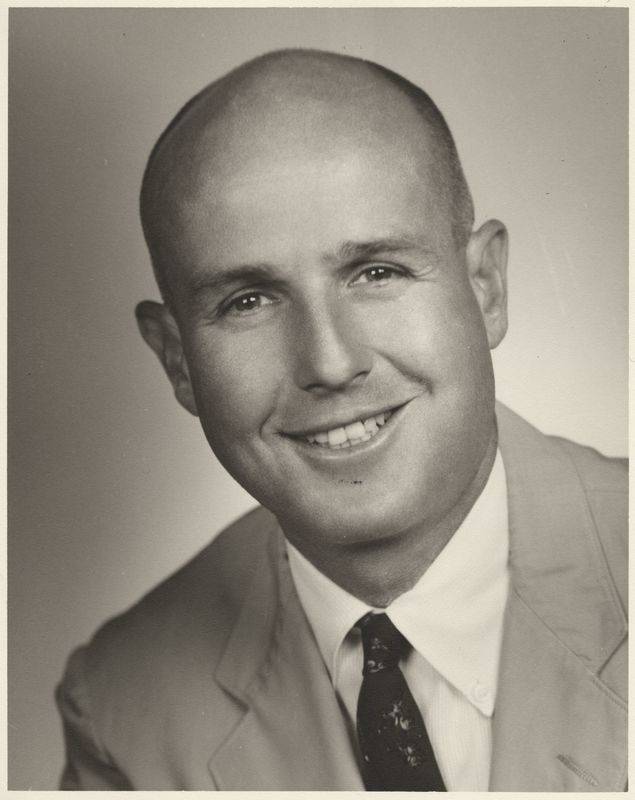
GVSC founder and Board of Control member L. William Seidman. Seidman served on the Board from 1960-1974 and 1977-1983, is named first "honorary life member" of the board.
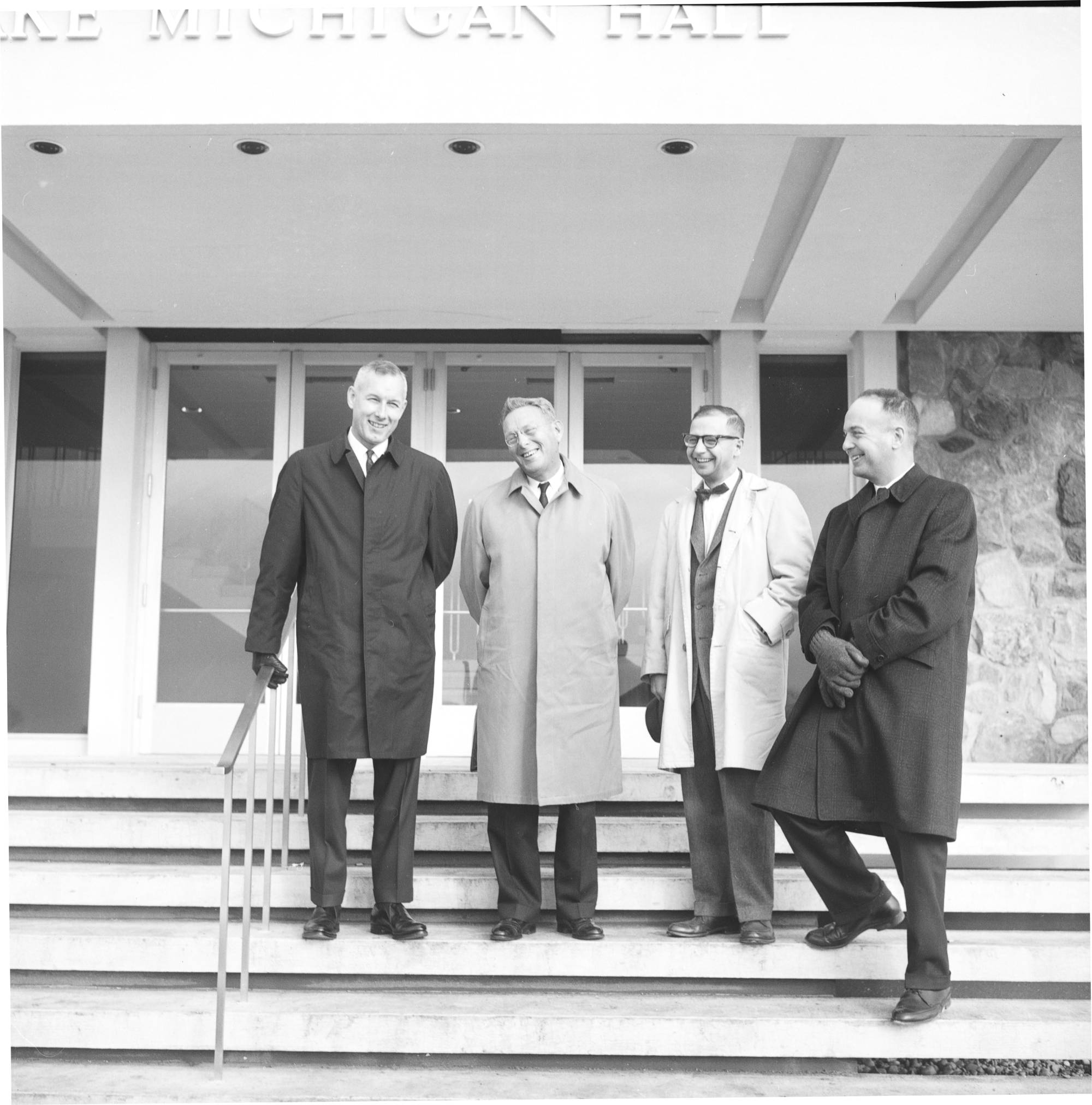
President Zumberge, John Russell, John Jamrich, and George Potter on the steps of Lake Michigan Hall. Russell and Jamrich wrote early studies that led to the establishment of Grand Valley.
The CEFYC, often meeting in one of Seidman’s favorite haunts, The Peach Nook at the Pantlind Hotel, was successful in attracting wide support for the proposed new college. Editorials and columns supporting the idea appeared in newspapers throughout the area, and by the beginning of 1959, more than 30 organizations had signed on in support. Preliminary work also had been done to establish a larger citizens committee to undertake the long process of making the project happen.
In February of 1959, Seidman and the CEFYC applied to the Grand Rapids Foundation for funds to collect data on the need for higher education in the area. $7500 was granted, with the stipulation that the study be under the direction of the Michigan legislature, and completed by the end of the year. Although no state funding was involved, it took four months of political wrangling to gain legislative approval. The CEFYC didn’t lose momentum during the process. They proceeded with identifying likely candidates for a Citizens Advisory Committee, and distributing 12,000 questionnaires to parents and students in second, tenth and twelfth grades.
The House Resolution also required the appointment of a citizen’s advisory committee, “to assist, and to report its findings and recommendations to the 1960 Legislature.” Seidman and the CEFYC had been working since late 1958 to identify people in the 8-county area who would be most effective in realizing the dream of a new college. They solicited community leaders from labor, education, business and finance, service clubs, the farm bureau, PTAs, and many more, coming up with a group that included 52 from Kent County, 11 from Ottawa, seven from Muskegon, five from Allegan, three from Barry, four from Newaygo, and one from Montcalm. This group would not only help in the campaign to convince the legislature, and the West Michigan community, that the college was needed, they would provide the basis for the army of volunteers who brought the dream to reality.
II. High Aspirations
By the end of 1959, hopes were again soaring for the success of the fledgling college. At a November 30 meeting at the Peninsular Club in Grand Rapids, Jamrich presented his highly favorable report to 75 members of the Citizens Advisory Committee, area legislators and other invited guests. On December 30, The Grand Rapids Press ran a front-page, banner headline story reporting that Seidman expected to break ground for a new college in 1961.
But the community was ready to go. In September 1960 the Grand Rapids Press reported that the Grand Rapids Foundation pledged $50,000 to get the ball rolling. Before the Herculean task could begin, however, a legal entity to receive the donations had to be established.
Many buildings on Grand Valley’s Allendale campus are named for founding members of the Board of Control.
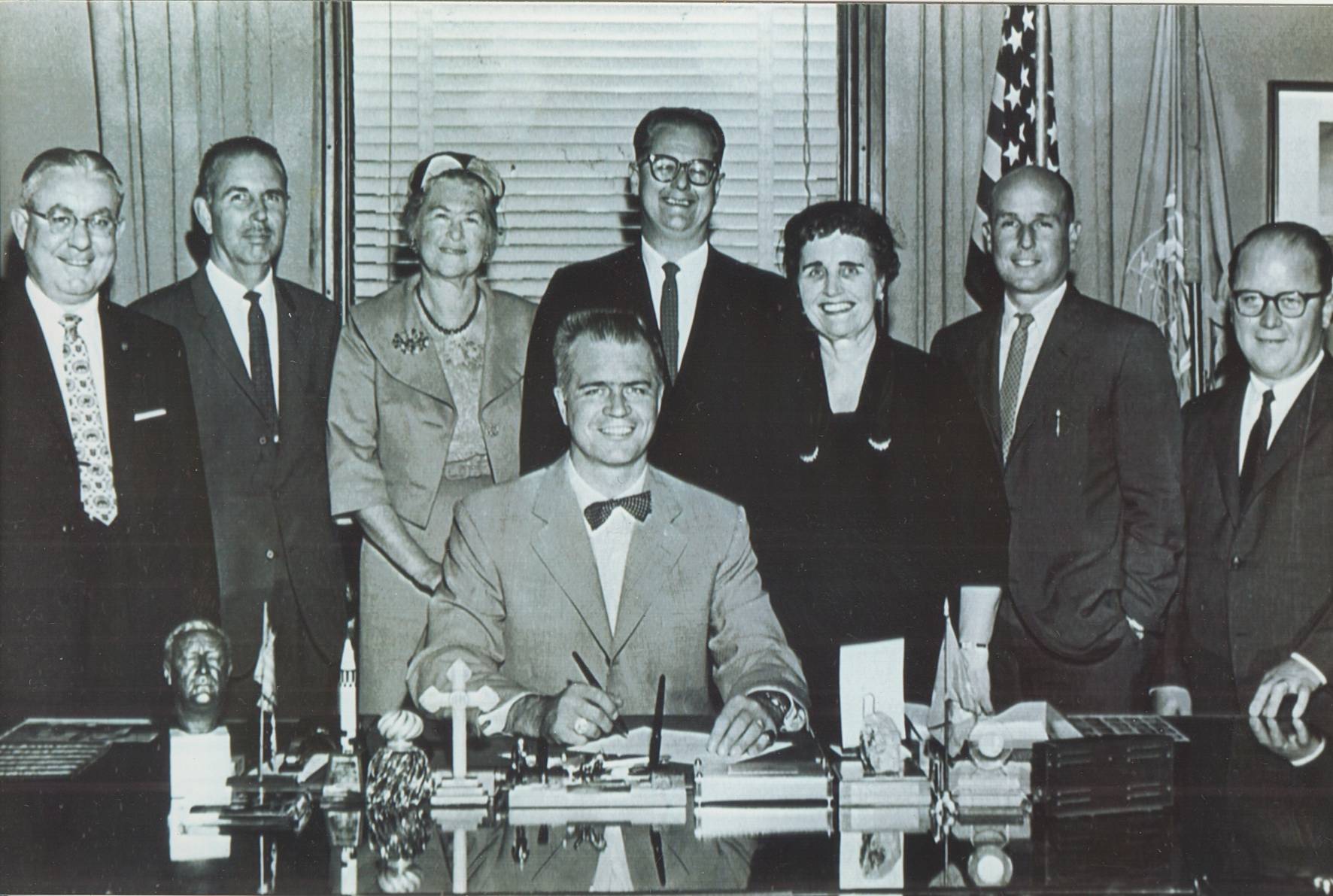
Governor G. Mennen Williams signing the bill that established Grand Valley State College as Michigan's 10th state-supported, four-year college on April 26, 1960.
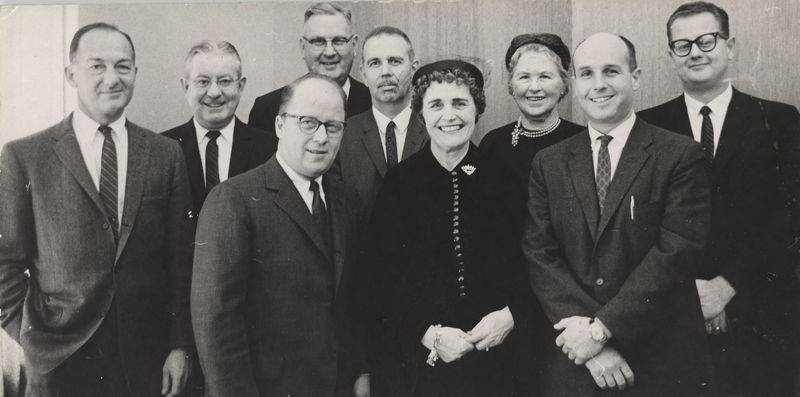
Members of the first Board of Control: l to r back row-- Edward J. Frey, James Copeland, Dale Stafford, William Kirkpatrick, Icie Macy Hoobler, Kenneth Robinson. l to r front row--Arnold Ott, Grace Kistler, and L. William Seidman, Chair. The nine member board was later reduced to eight, 1960.
III. The Board of Control
In October of 1960, Governor Williams announced his selection for a nine-member Board of Control, as required in the legislation. Five had been recommended by Seidman and the CEFYC: Edward H. Frey, President of Union Bank of Michigan and the Grand Rapids Chamber of Commerce; Mrs. John Kistler of Grand Haven, former president of the Michigan Federation of Women’s Clubs and chair of the Adult Education Committee of the National Federation of Women’s Clubs; Dr. Arnold Ott of North Muskegon, President of Ott Chemical Co.; Dale Stafford, Editor and Publisher of the Greenville Daily News, and Seidman himself. Williams, with counsel from state and local democratic leaders, added Kenneth Robinson of Grand Rapids, Director of Region 1-D, AFL-CIO; James Copeland of Greenville, President of Security National Bank of Manistee and Wyoming State Bank in Kent County; Dr. Icie Macy Hoobler from Ann Arbor, a nationally recognized biochemist; and William Kirkpatrick of Kalamazoo, President of the Kalamazoo Paper Box Co. They were sworn in by G. Mennen Williams in his office in Lansing on October 17, 1960 and convened their first meeting there. Seidman was, according to the minutes, elected chairman by a “unanimous and enthusiastic” vote.
The Board moved quickly to establish the new entity. At a meeting in the home of Bill Seidman at the beginning of November, they planned a contest to name the new college, and accepted the donation of office space by Union Bank, at the corner of Pearl and Monroe in downtown Grand Rapids. On November 22 the Board met in their new office and appointed 109 members to the new Citizens Advisory Council, many of whom had already served on the former committee which advised the Jamrich study.
It also became clear that professional help was needed to begin organizing the new college. Bill Seidman had had conversations and correspondence with representatives from many of the state’s universities, and they were approached to loan administrators to assist in the initial planning of the college. In early 1961 Michigan State University, University of Michigan, Western Michigan University and Wayne State University, as well as Grand Rapids Junior College, all loaned consultants to help with planning while a search for administrators was conducted.
The Board agreed on the need to hire professional administrators to coordinate planning for many crucial areas. Fortuitously, at the same time, Dr. Chris DeYoung, Dean Emeritus of Illinois State Normal University, was living in Grand Rapids temporarily following his marriage to a local teacher. A native of Zeeland, Dr. DeYoung volunteered his services in late 1960 to help the fledgling college, and served as coordinator of the consultants team until April of 1961. He was compensated for his services by the Board at a later date.
A flurry of meetings, dinners, conferences, reports, recommendations, and correspondence in the first quarter of 1961 resulted in principles and suggestions for site selection, fundraising, president and faculty, curriculum and many other aspects of the new college that would have far-reaching effects that continue to be felt at Grand Valley State University fifty years later. (Exhaustive detailing of this process can be found in the Swets report, Chapter VI.)
IV. A Place for Us
Even before the legislation enabling the new college was passed, rivalry for its potential location was heating up in the 8-county area. A committee had been appointed as early as 1959 to begin looking at potential campus sites, and area communities were quick to come forth with proposals and rationales for locating it within their boundaries. Grand Haven offered 150 acres of duneland along its north shore; even Whitehall, far north of the center of the 8-county area, came up with a proposed site in 1959.
The most serious early contender was a parcel of land donated to the city of Grand Rapids by Jacob Aman, who requested that it become a park. That was somewhat problematic, as the land on M-45 was several miles west of the city limits. Several city politicians saw the opportunity to turn it over to a new college as a solution. The issue became something of a football in city politics, however, while several other attractive proposals were floated. A group of enterprising citizens in Allendale, a small community about ten miles west of Grand Rapids, actually secured options on land along the Grand River they felt was supremely suitable for a campus. A Grand Rapids architect designed a 13-story “Tower of Learning,” to be located in the center city in an area slated for urban renewal. A group of Marne residents also were taking options on land near their community northwest of Grand Rapids, near what was to become Interstate 96, and Wyoming, southwest of the city, proposed a former industrial site.
In early 1961 the Board of Control appointed an official site selection committee of 36 members, chaired by Circuit Court Judge Fred N. Searl and Richard M. Gillett, executive vice-president of the trust division of Old Kent Bank and Trust Company. By February, 20 sites were under consideration, from Lowell to Muskegon, from Wyoming to Whitehall.
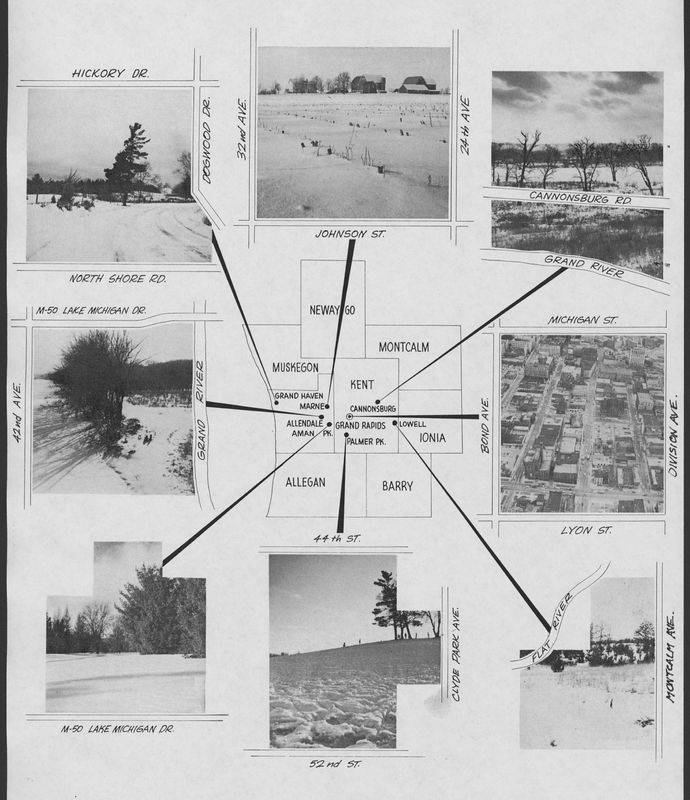
Map of original sites selected for the Grand Valley campus, published in the Grand Rapids Press, Jan 8, 1961.
The committee quickly narrowed the field. On February 15, 1961 they announced that they had chosen five finalists: Aman Park, Allendale, downtown Grand Rapids, Grand Haven, and Marne. Two communities scrambled to add their proposals after the deadline, Muskegon and Rockford, and the committee added them to the final consideration list. On March 10 the committee met to review its work to date. All sites had been visited and evaluated, and two were chosen as top contenders: Allendale and Marne.
Letters, telegrams, phone calls and petitions began to fly. The newspapers had a field day with recriminations and counter arguments. Backers of the Muskegon site were especially vehement, putting political, social, corporate and union contacts to work for their bid, and even taking their case to a committee of the Michigan legislature. But in the end, the central location of the Allendale site, unanimously recommended by the group of university consultants, as well as its physical beauty, won the day. Arnold Ott, the Board of Control member from Muskegon, told The Muskegon Chronicle that although he had been leaning toward the Marne location, after flying over the Allendale site he felt the “beauty of it could not be bought for a million dollars.”
On Friday, April 7, 1961, the Board met into the wee hours of the next morning considering the selection, and on April 8 at a public meeting at Grand Rapids Junior College, announced that the Allendale site had been chosen.
The 876-acre site on the Grand River once included Blendon’s Landing, a 19th century logging settlement long since vanished. Cut by ravines, the land slopes up sharply from the river, with several large areas of buildable terrain. The natural beauty of the campus would become a touchstone for the college community, even as, in decades to come, it began to expand into many of the areas which so hotly contested its initial selection.
V. A Name for Us
Although the legislation enabling the new institution of higher education for West Michigan refers to the entity as Grand Valley, there was not universal agreement that the somewhat bucolic moniker was suitable for the high aspirations of the new college. Bill Seidman, in correspondence cited in the Swets thesis, leaned toward something along the lines of Kent State, variations on the names of the constituent counties, or Michigan College at Grand Rapids.
At the meeting of the Board of Control in early November 1960, Greenville Daily News Editor and Publisher Dale Stafford was appointed to organize a contest among area schools to submit proposals for a new name. The prize offered was a four-year tuition scholarship to the new college.
By mid-January of 1961, more than 2500 entries had been received from approximately 1500 people. Among the most popular suggestions were: Wolverine State (59); Vandenberg (44); Wolverine (31); Wonderland (23); Great Lakes (19); Lakeland (16); Ko-mi-ban (many similar entries also were based on names of the area counties) (14); and 10 each for Arthur H. Vandenberg, Lake Michigan, Southwestern Michigan, Water Wonderland, and Western Michigan. Some suggestions had that mid-20th century ring of optimism: Learning for Life College, Bright Future, Bright Purpose, Bright Tomorrow, Dream Fulfilled, Paradise Gates, Peace, Utopia. Others set an idealistic academic tone: Athena, Cogito, Delphian, Octavo, Pallas Athene, Theta, Vade Mecum, Vale Vista.
In the end, nothing presented a more attractive alternative to the Board than the all-inclusive Grand Valley. In his Video History Project interview, Bill Seidman noted that "we decided we wanted a name that really sounded much more like an institution for the area that it was in."
GVSC Seal, 1960
Five people had submitted the name Grand Valley State College (a slight amendment to the HB 477 name Grand Valley College), so their entries were put in a hat and the winner selected. Frederick H. Brack of Grandville, age 20, was already a senior at Michigan State University. He designated his young sister Marianne Lovins, age 7, as the scholarship recipient, and in the fall of 1971 Marianne became a freshman at Grand Valley.
V. Million Dollar Mission Accomplished
The issues of site and name for the new college drew much public attention, but at the same time the more crucial issue of finance was being quietly pursued by some of the area's most influential movers and shakers.
The legislation enabling the new college in the spring of 1960 stipulated that a million dollar nest egg must first be raised, as well as funds for a campus site. Bill Seidman told The Grand Rapids Press in October of that year, "We are the only college to start with no assets and a million dollar debt."
At their second meeting, November 1, 1960, the Board of Control decided to organize the fund drive themselves instead of hiring professional consultants, and named Union Bank President Edward H. Frey as finance chair. Drawing on the strengths of their members, they also put Kenneth Robinson in charge of organizing support from the union community, and James Copeland was asked to establish the fundraising program in counties outside Kent County.
Much of the task for the group was to convince their peers in the area that the new college was necessary, and would be a good investment.
And there were some who needed convincing. There were objections on economic grounds by those opposed to increased taxation. Others questioned whether the state was obligated to provide higher education opportunities to students of limited academic accomplishment (a prominent Grand Rapids woman resigned from the CEFYC because of that belief). The Muskegon area, smarting from their unsuccessful bid to locate the campus there, was not forthcoming in financial support. The U.S. Chamber of Commerce president was quoted as saying the "so-called shortage" of college and university facilities existed only in the minds of those who wished to see the Federal government take over the responsibility of managing and financing higher education. Luckily, the Grand Rapids Chamber of Commerce, and its president, Edward Frey, were wholeheartedly in support of Grand Valley.
More than 5000 donors pitched in, with contributions ranging from $1 to $200,000. The Grand Rapids Press on April 29, 1961 announced that contributions from members of the Kent County Medical Society and the GR District of the Michigan State Nurses Association brought the total to $1,010,000. Along with generous individuals and businesses, many organizations collectively supported the effort, such as the United Auto Workers, the Michigan Education Association, and the NAACP (National Association for the Advancement of Colored People). The Grand Rapids Foundation (now the Grand Rapids Community Foundation), made a mid-April contribution of $150,000, bringing their total participation in the effort to $200,000, more than eight times any grant they had to that date given any individual campaign. It matched another $200,000 gift that had been given anonymously.
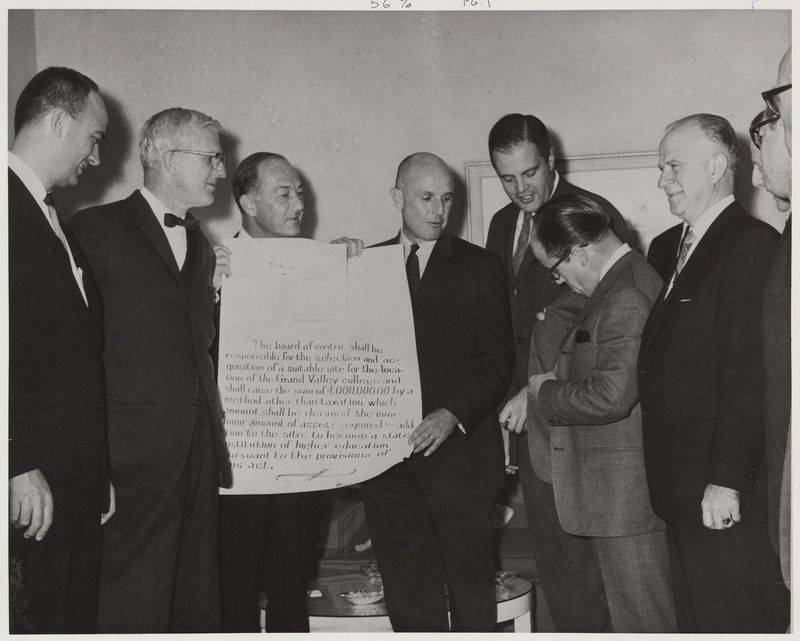
Board of control members: Dave Dutcher, Phil Buchan, Ed Frey, Bill Seidman, Dick Gillett, Arnold Ott holding facsimile of GVSC mortgage. The group was about to celebrate paying off the mortgage by burning it.
Many individuals worked long and hard to raise the staggering sum. But, according to Swets, in conversations regarding the effort Bill Seidman strongly emphasized the role of Richard Gillett, by then Old Kent Bank President. "He just went out and got 25 of the best fundraisers in the community and went to work," he said.
The legislature's requirements had been met. Governor John Swainson had proposed funding the new college in his January budget message, and on June 2, 1961, signed a higher education appropriations act that provided $150,000 for operational funding for Grand Valley State College for fiscal year 1961-62.
Grand Valley was now a reality -- the first new four-year institution of higher education to be established in Michigan in 60 years. In his concluding section, Swets writes about the unique role of the new college. "Seidman … stated that they had done research on the establishment of new institutions of higher education in the U.S. and that they had been able to find no new college that had been established as GVSC had been established within a quarter of a century. There had been branch colleges and several municipal colleges, scores of community-junior colleges, many private colleges converted into state-supported colleges, but no new institutions such as this one. And this occurred in a community that has been labeled the stereotype of the arch-conservative, arch-reactionary community. Their success refuted the gloomy prophecies of local seers and seem to belie the statements made by those who had pointed to the inhibiting factor of a conservative or reactionary community."
Expectations for the new college were high. It was up to the hard-working group of supporters to take a deep breath, marshal their forces, and plunge into the next step: hiring a president and establishing a curriculum.
VII. The Right People; The Right Program
The Board of Control, as usual, was prepared to move immediately when their appropriation was approved. They named Philip Buchen as the first officer of Grand Valley State College, to serve as chief executive beginning July 1, 1961 while the search for a college president proceeded. Buchen, a law partner of U.S. Representative, and future president, Gerald Ford, had served the Board as volunteer attorney.
The Board also voted to purchase parcels on the Allendale site and to rent office space in the Manger Hotel on Michigan Street at Monroe in downtown Grand Rapids (later called the Randall House and then Olds Manor). The new office was "modernized with imaginative, unconventional methods that combine to give it a forward look," according to a Grand Rapids Press article July 27, 1961. This also included modernist sculpture and paintings, in keeping with the up-to-the-minute ideas envisioned for the new college. A furious debate in the newspaper's letters column about the merits of modern art ensued, foreshadowing the major role Grand Valley would come to play in the artistic life of West Michigan.
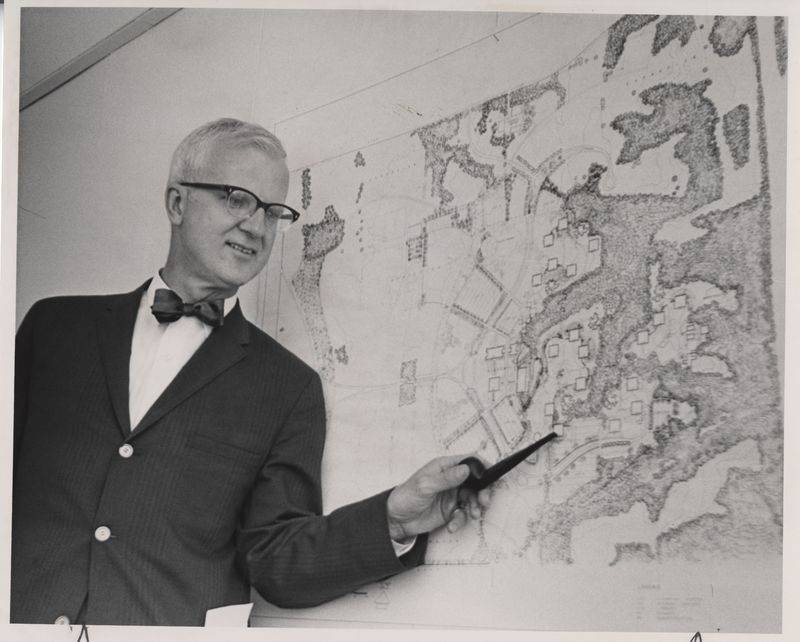
Philip W. Buchen reviews Grand Valley State College's Allendale campus map, 1963.
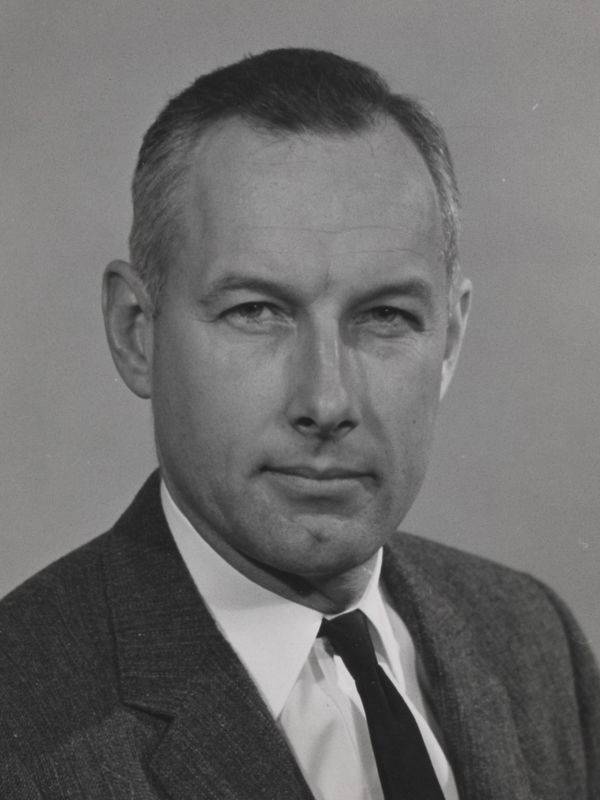
GVSC's first president, James H. Zumberge
Bill Seidman, Grace Kistler and Arnold Ott were appointed as a search committee charged with finding a president for the new college. A salary of $25,000 was proposed. A field of some 50 candidates was identified, and the position was first offered to a dean at the University of Michigan who had roots in West Michigan and had been assisting the Grand Valley group with curriculum planning. According to Bill Seidman, after Dr. Roger Heyns had accepted the job, he was offered another position he preferred (Heyns became Vice President of Academic Affairs at the University of Michigan in 1962 and Chancellor of the University of California at Berkeley in 1965). He asked to be released from his agreement with Grand Valley, and Seidman said that the stipulation they made was that he would assist them in continuing their search. Heyns was told, "We want to interview the top five candidates you have at the University of Michigan," Seidman remembered in his 2008 interview, "the ones you usually hide when recruiters come along."
Heyns complied, and in February of 1962 the first president of Grand Valley State College, James H. Zumberge, was appointed. A graduate of the University of Minnesota, Dr. Zumberge was a popular professor of geology at the University of Michigan and author of a widely used textbook. Only 38 years old, he had little experience in college administration. He was an internationally renowned geologist, and had led two expeditions to Antarctica, the first in 1957-58 during the International Geophysical Year, and a second two years later. Dr. Zumberge was appointed a delegate to the fifth IGY conference in Moscow in 1958, and a mountain in Antarctica was named for him.
One of the things that attracted the Board committee to Zumberge was his philosophy of education, closely aligned with the principles set out in the Russell and Jamrich reports. The new college would be targeted to a broad spectrum of potential students, and bold ideas about education would be embraced. In an interview with the Muskegon Chronicle, Zumberge said "We don't feel fettered by any previous program or system of ideas. We have to be bold in our moves and bold in our thinking, otherwise we'll be no different than the other nine state-supported schools."
Others in the West Michigan area were already agitating on behalf of their own bold, if somewhat retro, ideas. A group had formed, driven by the concerns mentioned above that providing higher education opportunities to students of limited academic accomplishment would not be a wise use of state tax dollars, and that it would dilute the prestige and tradition of excellence of a college degree. In July of 1961, the group, calling itself Grand Valley Citizens for a Better College, formulated ten principles which were published in The Grand Rapids Press, among them liberal education, enduring truths, intellectual discipline, and avoidance of vocationalism and highly commercialized programs of athletics.
Prominent in the movement to define the new school's focus, and a member of the citizens' group, was William Harry Jellema, founder in 1921 of the Department of Philosophy at Calvin College in Grand Rapids. He later chaired the same department at the University of Indiana, but returned to Calvin and retired at the mandatory age of 70 in 1963. He was hired first as a consultant to Grand Valley, and then as its first faculty member.
Jon Jellema, the son of Harry Jellema, joined Grand Valley's English faculty in 1972 and became Associate Vice President for Academic Affairs in 2005. In an article about Grand Valley Presidents in the Winter 2007 issue of Grand Valley Review, he wrote that, "Zumberge's strong credentials and academic reputation lent instant credibility to the foundling institution and helped attract a strong, albeit not very diverse, group of faculty."
In an article for the Fall 1995 GV Review, Dewey Hoitenga, who became a professor in the philosophy department at Grand Valley in 1965, quotes a letter written by Zumberge to Jellema's family at his death in 1982. "Harry Jellema began his second academic career at GVSC when he became the first professor that I engaged for the new college. He was the reason that we were able to field an unusually good faculty of fifteen to start things going. His presence set the level of quality that I was looking for."
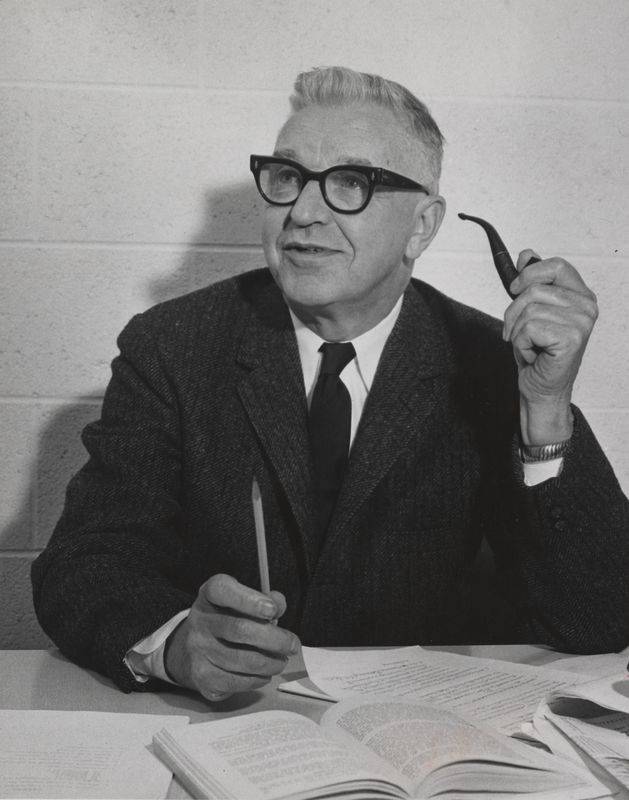
William Harry Jellema
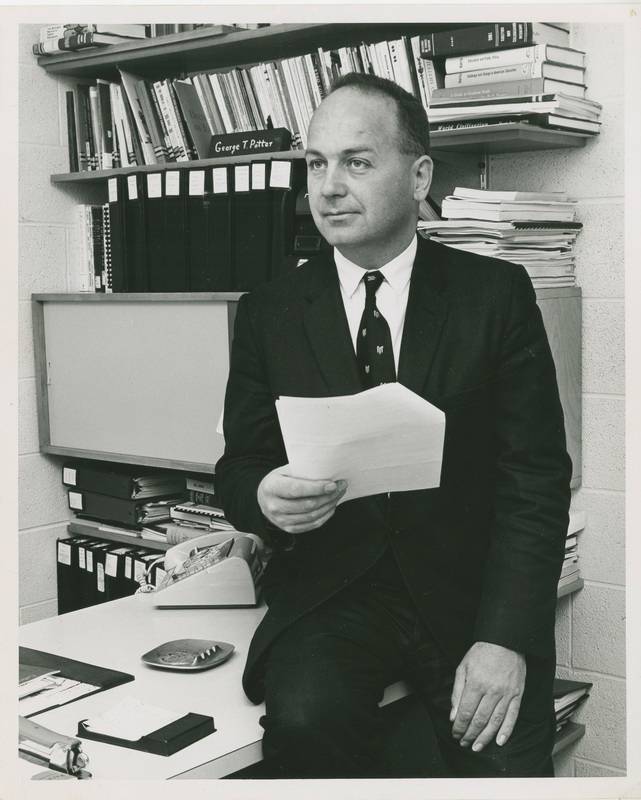
Vice President George Potter
Whether one or the other was more influential in the academic foundation of the new college, Zumberge and Jellema were definitely a powerhouse duo. Along with Bill Seidman, the fourth person to have a profound effect on the development of Grand Valley's first curriculum was George Potter. A graduate of Oxford University's Oriel College, founded in 1326, Potter was a strong advocate for the collegiate societies formed in venerable English universities, emphasizing a common curriculum of classic liberal arts. Potter was hired as President's Assistant for Academic Affairs in 1962, and became Grand Valley's first Vice President of Academic Affairs in 1966.
In a report written by Zumberge in 1964 describing the formative years of Grand Valley, he gives an account of a meeting he convened in June 1962 at Hidden Valley, a private club in northern Michigan. The weekend curriculum conference included Zumberge, Seidman, Jellema, and Potter, as well as Buchen, Grand Valley's new librarian Stephen Ford, and consultants from Michigan State University and the University of Michigan. Their goal for the weekend was to answer one question: what shall be the freshman program of instruction at GVSC? The pressing need was to produce a catalog with defined course offerings to begin recruiting faculty and students. The decisions made that weekend would have far-reaching consequences for the fledgling college.
The group decided to establish a foundation program in which all entering freshmen would be required to take nine courses, three each in the three 11-week quarters of the academic year. Each course would carry five credits, and students would also take a non-credit course in physical education. The proposed curriculum included courses such as History of Greece and Rome, Introduction to Moral Philosophy, Problems of Modern American Society, Frontiers of Science, and Foreign Languages 1 and 2, with choice of French, German or Russian. (The complete listing can be found on p. 14 of the Zumberge Report). Grand Valley would be strongly committed to undergraduate education and avoid the professional schools and graduate programs that dominated other regional universities.
Dr. Anthony Travis, who joined the Grand Valley History faculty in 1971, has written extensively about the college's early years. In an essay for the Grand Valley Review Fall 1995 titled "Community Pragmatism vs. Academic Foundationalism: The Beginnings of GVSU," he traces developments in American higher education across two centuries, and the conflict between those who were committed to a 19th-century classic liberal arts college model and the more contemporary idea that tax-supported institutions had a responsibility to the community to provide professional education in areas such as business and education. "The first ten years of Grand Valley State College … were dominated by two philosophical paradigms that competed to test which would form the academic culture of the new institution," he wrote. "The first of these I have termed 'community pragmatism' and the other 'academic foundationalism.' During the first ten years of (GVSC) these two educational philosophies were in creative tension."
There was another conflict for the idealistic group who were urging the latter model. They were under a mandate from the state legislature to keep costs low and enrollment high. The curriculum they proposed required intensive faculty-student contact, with small group discussions and tutorials in the classical education vein as the hallmark of the institution.
A definitely modern solution was proposed for the dilemma of how to inexpensively provide a faculty-intensive program to a large number of students. Bill Seidman had become interested in the earliest stirrings of information technology. He proposed an innovative system of audio-visual study carrels. Professors could tape their lectures and other materials, and students could dial up the tapes in individual carrels, greatly increasing the efficiency of student-teacher ratios.
The expectation of large enrollments also presented a problem for the planned curriculum of individualized liberal arts education. George Potter, drawing on his experiences with small, relatively autonomous college societies within England's large major universities, designed a system in which new academic complexes would be created for every 500 students admitted to the college (later increased to 1500 students). They would share common facilities such as the library and science labs. The decentralization plan set the stage for what would become Grand Valley's famous cluster college era.
The decisions made that weekend about curriculum and campus organization would not only inform Grand Valley's development to this day, the vision of the group would find physical form in the architecture being conceived for the Allendale site.
VIII. Breaking Ground
The idea that the physical structure of the new campus site and buildings was integrally tied to the academic vision was evident in the decision made in September 1961 by the Grand Valley Board to hire the newly formed firm of Johnson, Johnson and Roy of Ann Arbor as chief consultants for site planning of the new campus.
The firm's principals included a landscape architecture professor at the University of Michigan, William Johnson; his brother Carl, and Clarence Roy, both practicing landscape architects. In a 2003 monograph about the firm, which became JJR, author Fiona Gruber quoted William Johnson in a statement of the firm's philosophy that still resonates on the Grand Valley campus today. "In most cases, the leading element shaping community is thought to be architecture, while open space is relegated to a secondary role. Properly understood and crafted, open space can often assume a primary position, well before building programs are defined. Open space can form the basis for a development strategy."
The firm moved quickly to propose a site plan that emphasized the deep wooded ravines and narrow plateaus of the campus overlooking the Grand River. James Zumberge, in his 1964 President's Report on the formation of Grand Valley, wrote that the firm had just one directive: that the planned academic program would be best served by groups of small general purpose buildings. "The site planners used a distinctive feature of the campus terrain to achieve the … objective," he explained. "Each plateau is ideally suited for the building of two clusters of general purpose academic structures constituting one of the collegiate units of the master plan."
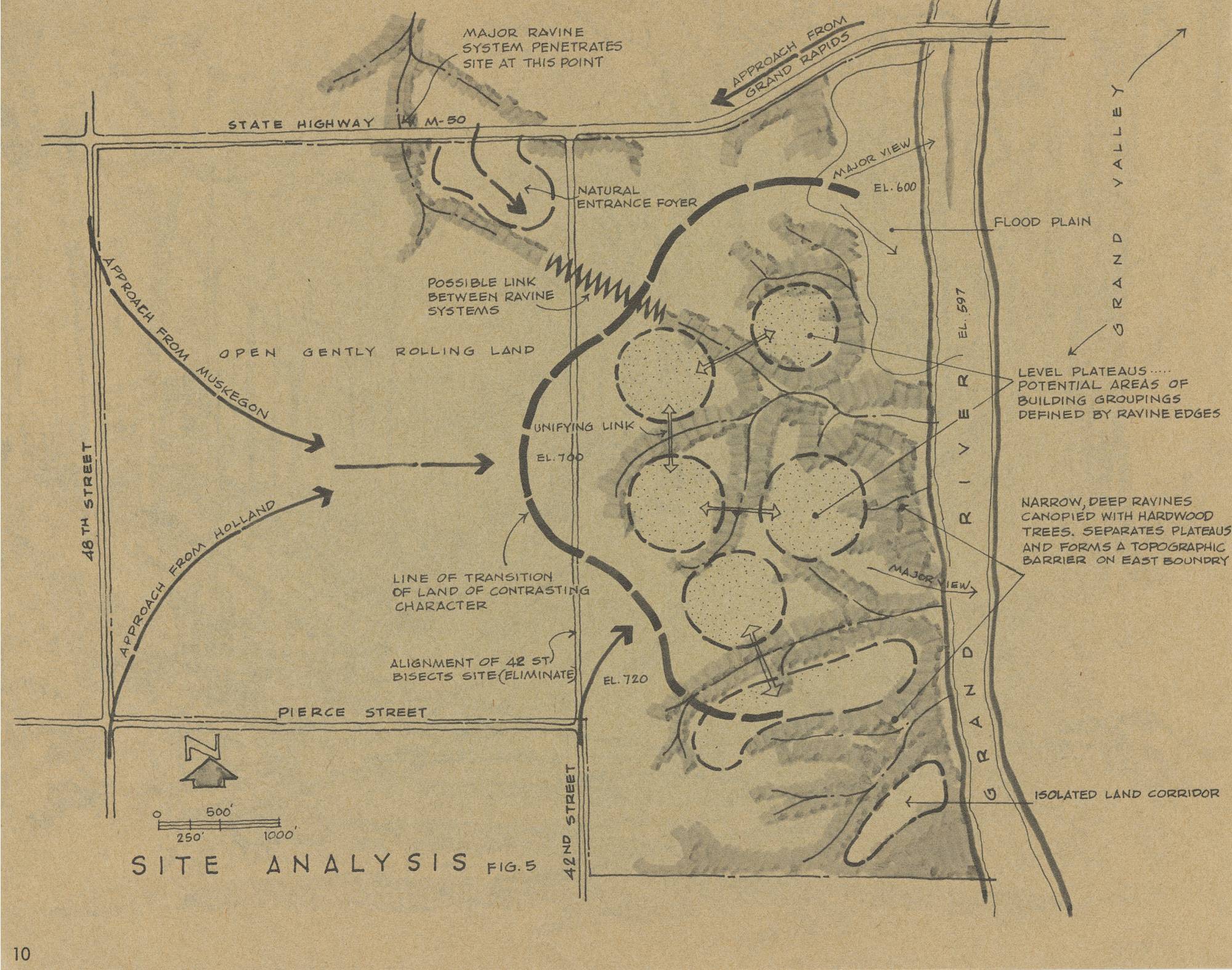
Site analysis map, circa 1961. The map, labeled as Figure 5 of the publication, features a site analysis of the landscape located west of the Grand River and south of State Highway M-50 (later designated M-45), including the topographic barrier created by the ravines and the plateau areas for potential campus building groupings along the edges of the ravines.
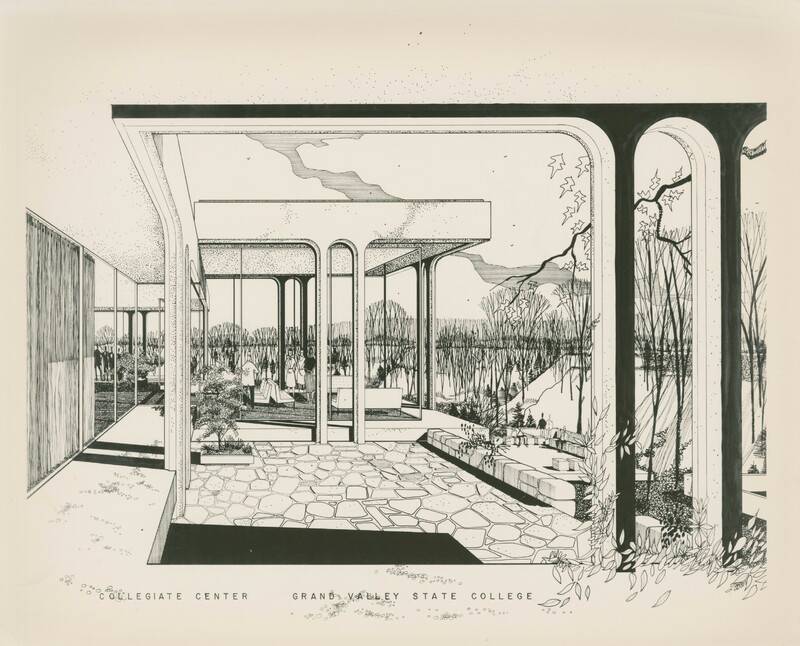
Architect's drawing of the interior and exterior of the Collegiate Center of Grand Valley State College, later named Seidman House, circa 1962. In the drawing, the study lounge and outdoor terrace of the Collegiate Center are featured among the wooded ravines, with people seen inside the windows of the building and outside enjoying the outdoor patio seating.
In November of 1961, the Board selected architects Meathe, Kessler & Associates of Grosse Pointe to design the college's first buildings. They were confirmed at the December 15 meeting, and within a week, William Kessler and Carl Johnson had set up a design shop in one of the old farmhouses on the Allendale site, spending hours walking the land and staying in a nearby motel.
It was an exciting time for architecture, mirroring the enthusiasm and drive of the era of President John F. Kennedy and the post-war confidence of America. William Kessler had been a student of Bauhaus icon Walter Gropius at Harvard, and had been attracted to Michigan, along with Philip Meathe, to join the firm of noted Detroit iconoclast Minoru Yamasaki. They were a part of a movement to transcend the international modernist style that had produced a popular backlash against mathematical, sterile exercises in concrete and glass. Their designs for Grand Valley's first buildings reflected new concepts about flexible space, interaction with the environment, and innovative use of materials and technology.
The plans for the new college's first buildings incorporated upright arched supporting columns made of cast concrete that came to be known as "concrete trees". Masonry walls between the columns were to be faced with split Michigan fieldstone, adding to the impression of living structures growing from the ravine-edge landscape.
In the spring of 1962, Grand Valley was asked to vacate its downtown Grand Rapids offices in the building which was slated to become Olds Manor senior housing. An army of volunteers -- cleaners, painter, plumbers -- descended on one of the old farmhouses on the Allendale campus to transform it into a new campus office. The college's Public Relations director, Nancy Bryant, and buildings and grounds superintendent Don Lautenbach, even planted a vegetable garden behind the old farmhouse, foreshadowing the renewed interest in local food that is sweeping the campus as it celebrates its 50th anniversary.
All the pieces were in place for the new college officially to break ground. On August 28, 1962, dignitaries gathered for the ceremony. Thoughtful and idealistic speeches were made, including James Zumberge's description of the design of the new buildings as "the marriage of the bride of beauty with the groom of function." Governor John B. Swainson hit the button to trigger a dynamite blast to break the ground, literally, at the site of the first new building. Nothing happened. He hit it again, and again nothing. In the archives of Grand Valley is a file of memos from Zumberge preparing for the event, including a detailed back-up plan for thoroughly cleaning out a barn to be used in case of rain. But there was no back-up plan for the failure of detonation. After a half-dozen tries, the Governor good-naturedly gave up. Master of Ceremonies David Dutcher announced, "Let us consider the ground broken," and proceeded with bringing the august occasion to a close. As the spectators and participants were dispersing, the dynamite finally ignited with a stupendous blast, prompting cheers from the crowd and signaling an auspicious beginning for Grand Valley's new home.
IX. Let the Learning Begin
Although there were some other glitches in the construction process (as was and ever shall be), including delayed bond sales and ill-timed workers' strikes, the stage was set for the first students to arrive at Grand Valley State College in the fall of 1963.
In the first brochure developed to describe the new college, the prospective student body was characterized: "The college will be searching for able surprises -- students with a talent for creativity who give promise of rising to the challenge of an imaginative college program."
That description might also have served for the men and women brought to remote Allendale to teach these "able surprises." In his 1964 Report of the President, Zumberge described the first faculty hires. "They saw an opportunity to participate in building a sound academic program in an atmosphere unshackled by tradition and unhampered by an existing 'old guard' faculty," he wrote. "That the first GVSC faculty looked for such opportunity is, in itself, an indication of the caliber of people who were attracted by our fledgling school. They realized that their contributions to the success of the college would be important."
Glenn Niemeyer, who would become one of Grand Valley's longest-serving academics, remembered his arrival in a 2008 Video History Project interview. With a just-earned doctorate in history from Michigan State, he said there were many openings for faculty across the country, many new and experimental ideas in education. But Grand Valley offered something else that attracted him, "the opportunity to craft a history curriculum … There was a kind of excitement," he remembered, "the fact that we were beginning a university."
In the fall of 1962, the first students were accepted and enrolled. It was not an easy task for the small staff charged with recruiting them. "Because GVSC was established to fill a need created by more students clamoring for a college education," Zumberge wrote in his 1964 Report, "it is paradoxical that we were not deluged with applications. But there was a reason for it. Students who could afford to go away from home to college were not likely to list Grand Valley as their first choice. And most students who could not afford to go away to school were inclined to select an institution of established reputation in the area before taking a chance on a new, non-accredited college whose physical plant was still on paper."
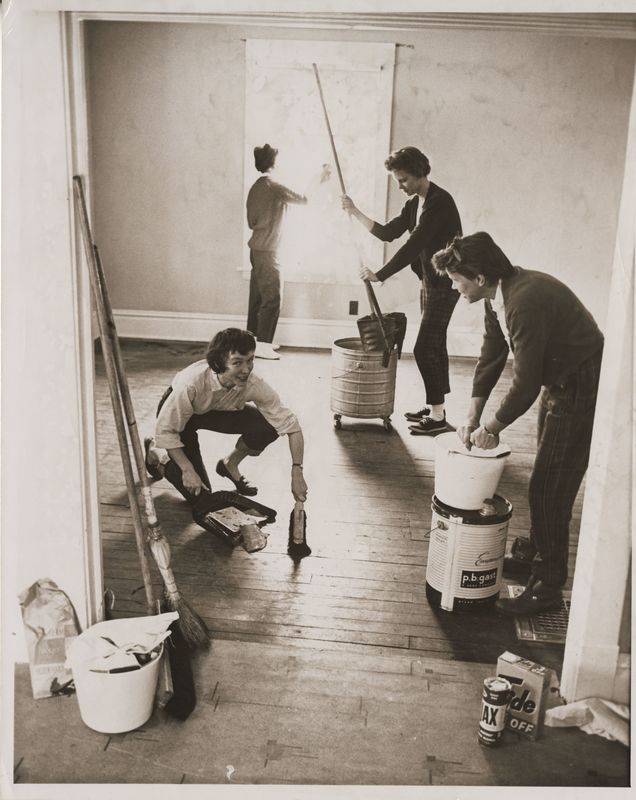
Cleaning Grey House, the location of the first campus administrative offices at Grand Valley State College, 1962.
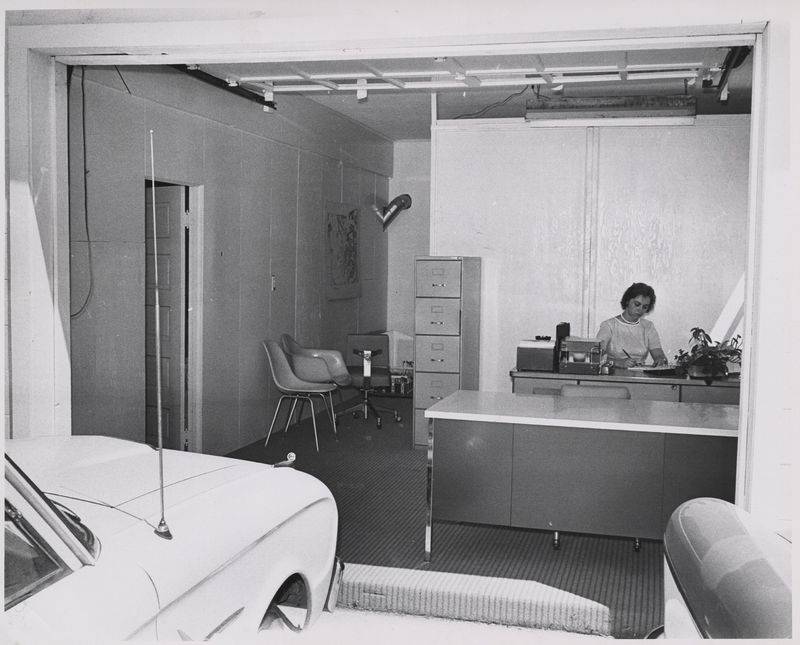
First administrative office in former garage of one of the original buildings called the Pink House.
Zumberge and his tiny admissions staff canvassed the area's high schools, attending College Night programs, talking to parents and potential students. He embarked on a vigorous fundraising program to establish tuition scholarships, and solicited letters from the University of Michigan, Michigan State University and Wayne State University stating that they would accept GVSC credits in transfers, prior to accreditation. He even hosted luncheons for high school counselors and principals, "hammering away," as he put it in his report, "at the virtues of the tutorial system." He concluded that it was this feature that finally won the sympathy and support of the counselors.
"My friends thought I was a little crazy," said Diane Paton in her 2008 Video History Project interview. Then Diane Hatch, she was the first accepted applicant to enroll at the new college. She describes being picked up in the college's VW bus with friends from Muskegon High School for a tour of the campus, which at the time was just a model on a table in a farmhouse, in the middle of cornfields.
By the fall of 1962, several dozen pioneer freshman had been registered in a garage on Lake Michigan Drive. The surroundings may have been improvised, but the college continued its innovative approach by becoming one of the first in Michigan to employ IBM's new punch-card computer technology to register students. After a winter notable for very cold weather and heavy snow, and a flurry of construction in the spring and summer, the new college was ready (just) to open in September, 1963.
X. A College in the Cornfields
In May, 1963, the first faculty meeting was held in the Allendale Township hall. With only 15 faculty members in 11 different subjects, the group organized informally into three divisions: humanities, social sciences, and sciences. None of the technology that was planned to assist in the faculty-intensive teaching program was ready for use, but the group agreed to the outline developed in the earlier curriculum sessions. Students would meet in large lecture groups of 90-100, break into smaller discussion groups of 10-20, and meet with professors for tutorial sessions of no more than 3-5.
By the end of the summer, more than 200 students had enrolled, and in August the college threw them a welcoming party, a "hootenanny," according to Diane Paton, including singing, hayrides and a barbeque.
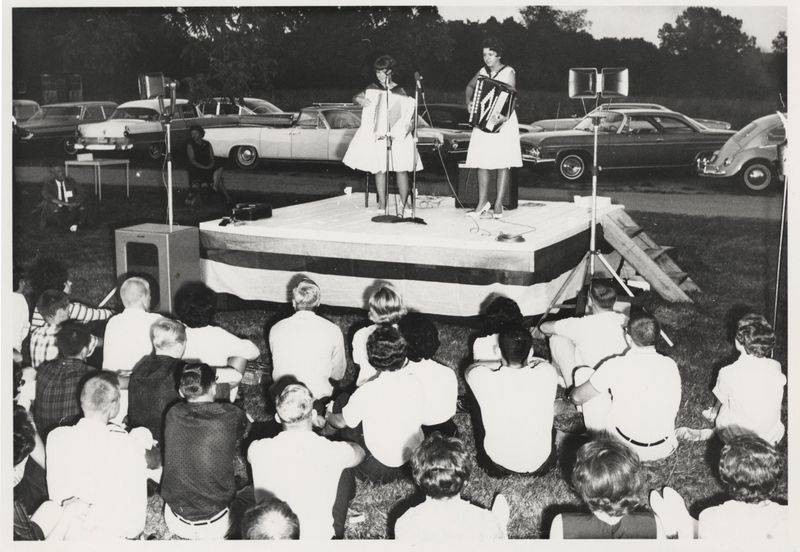
Hootenanny "Free For All" held for incoming students on the first day of classes, 1963
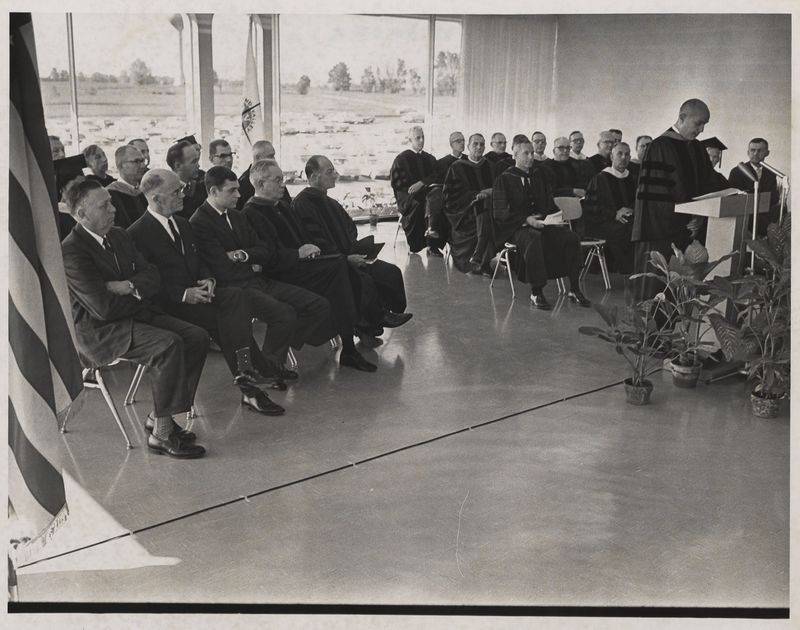
Board member William Seidman speaks at opening day ceremony, 1963.
A more solemn, if somewhat steamy, atmosphere pervaded the second floor of the theoretically air-conditioned Lake Michigan Hall on September 26, 1963. Opening ceremonies for Grand Valley State College assembled students, faculty in academic robes, parents, donors, and members of the Board of Control in what was the dining room for the college. "No event such as this had occurred in Michigan for nearly sixty years," wrote Zumberge in his 1964 report, "and we all felt at once a deep sense of humility and exhilaration at the thought of being part of this important endeavor."
Because of the problems with weather and construction delays, only Lake Michigan Hall was completed to welcome the 226 members of the pioneer class. But, ever plucky, all made do with what was at hand. The library, which had been a priority for the new President, was on its way well before opening day to establishing an impressive collection. Head Librarian Stephen Ford had been working on acquiring books for over a year, operating out of a small private house on the campus site. By the time they moved into temporary headquarters in Lake Michigan Hall, a staff of seven had been appointed and nearly 10,000 books had been catalogued. Business and administrative offices remained in the remodeled farmhouse, and faculty members doubled up in makeshift office space. Some of the problems were alleviated at the beginning of winter quarter, when Lake Superior Hall was completed in time for occupancy right after the Christmas recess.
The pioneer class rose to the challenge of creating student life on the new campus. A student government was formed and a student charter drafted. Physical Education, a requirement in the curriculum, was limited to outdoor track activities and shooting baskets in the hayloft of one of the old barns. A few showers were installed in one of the farmhouses. But the seeds of Grand Valley's longest running sport were sown before opening day, when racing shells for the rowing competition known as crew were purchased with a fund organized for that purpose by Grand Rapids businessman Mike Keeler. A crew house, nicknamed "Muscle & Corpuscle," opened in November and athletes began to train for what would become the college's debut in national intercollegiate competition. During the winter a ski club made use of the rolling terrain of the riverside campus, and a variety of inter-mural games were organized.
Also in November, the first student newspaper, The Keystone, published its first edition. Editor Elaine Rosendall wrote, "This is your paper; not the theorizing tool of the faculty." President Zumberge added a column enumerating his conception of the role of student newspapers, describing it as a "...forum for expression of student opinion and editorial comment." Somewhat presciently, if erroneously, considering events five years later, he concluded, "It is in this last role where many newspapers published by college students eventually end up at odds with the administration, faculty, townspeople, and parents. I don't think this is inevitable, however."
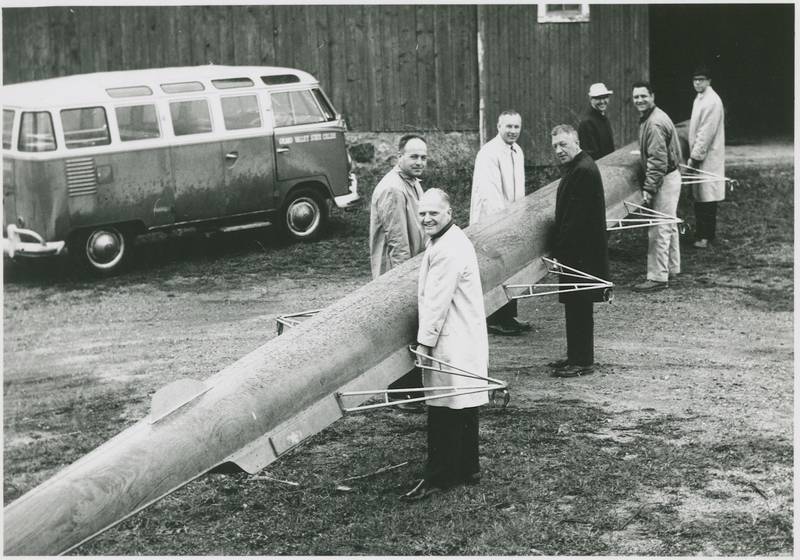
College administrators holding racing shell as rowing is initiated as the first sport offered by Grand Valley.
Grand Valley State College was on its way. In August 1963, a foundation had been established to receive gifts, donations and bequests for the benefit of the new college with Richard Gillett as its first president. The Loutit Foundation of Grand Haven contributed $300,000 to help construct a science building, the college's most significant gift to date and beginning a tradition of community support for growth that was to help the new college blossom over the next 50 years.
But not before some intense growing pains, and radical rethinking of almost every initial premise the founders had developed. The times, as one bard so famously put it, they were a'changing.
1964-1969
I. High Anxiety
"There is no question that the original academic program of Grand Valley College was a good one in theory. There was only one thing wrong with it: not very many students found it appealing."
Everything seemed to be going well as Grand Valley State College's pioneer class came to the end of its first academic year. Despite a sea of mud and the constant clamor of construction, there was a palpable sense of pride in being part of an innovative and creative new institution that was drawing national attention.
The November 1964 issue of Fortune magazine cited five new campuses in the U.S. chosen "because their superior architecture and design seem best to anticipate the kind of educational world they will serve." In the section about Grand Valley, titled "Self-Reliance Near Grand Rapids," the article dubbed it "a brand-new college, not just a new campus for an old college," praising it as "handsomely designed to fit its unique setting," and enthusing about its "latest teaching devices," which, they said, would "encourage the students' self-reliance and avoid overdependency on formal instruction."
In November 1966, Architectural Record ran a large section about the designs of Meathe, Kessler which prominently featured their work for Grand Valley. Interiors magazine featured the school in December 1964, and in September 1965 College and University Business ran a long cover story about Grand Valley's educational philosophy and the design of its first group of buildings.
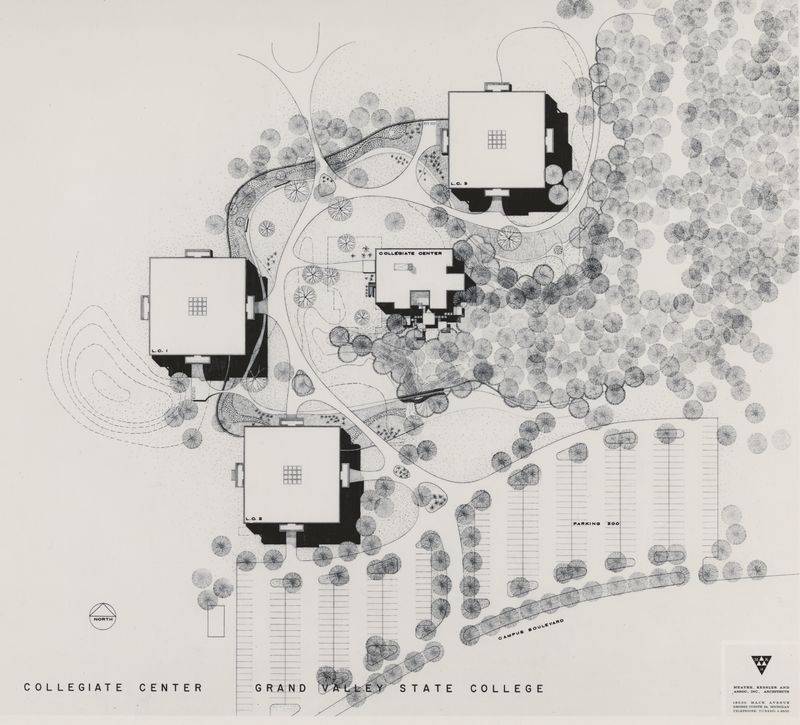
Architect's plan of the Great Lakes Group with the Collegiate Center (later Seidman House), and Learning Centers (LC1) Lake Superior Hall, (LC2) Lake Michigan Hall, and (LC3) Lake Huron Hall by architects Meathe, Kessler & Associates, 1962.
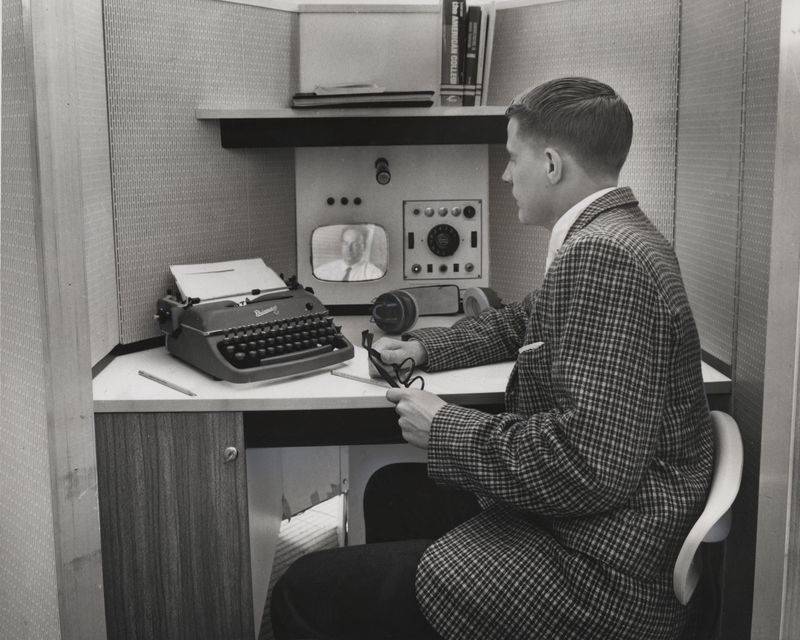
Student using audio-visual services at a sound-protected study carrel. The carrel is equipped with headphones, a microphone, video screen, and a typewriter, ca. 1964.
The innovative technology envisioned for Grand Valley had also drawn national press attention. The August 1963 issue of Architectural Forum had a special issue focusing on "Plug-In Schools." Grand Valley was called a "radically new kind of facility: the learning center." The school's carrels and audio-visual system were described as "instant access through the twirl of a telephone dial." An article in The New York Times on September 5, 1965 noted that "Students at Grand Valley State College … are at work on experimental Astra-Carrels, made by the American Seating Company."
Meanwhile, back in Allendale, the Grand Valley campus was growing by leaps and bounds. The Great Lakes Group of classroom buildings, including Lake Michigan, Lake Superior and Lake Huron Halls were open, as well as Seidman House, which provided space for a student center, bookstore, and offices for student groups. The Little Mac Bridge was dedicated in September 1965, connecting the north and south areas of campus and opening access to the site of the college's first residence hall, Copeland House, and the Loutit Hall of Science. By the end of August, 1966, work was progressing on seven buildings, including a domed fieldhouse.
By the fall term of 1966, however, it was becoming clear that some things were not proceeding according to plan. Projections for enrollment that fall had been in the neighborhood of 1,800; only 1,340 students had registered. Earlier that summer, The Grand Rapids Press ran a stinging feature about problems at the new college, suggesting that Grand Valley "rushed into operation" and that enrollment predictions had been "wildly optimistic." Because admissions were slow, the article reported, the college had accepted two of every three students who applied, resulting in a student body that had been cited in an early visit by an accreditation team from the North Central Association of Colleges and Secondary Schools (NCA) as the school's "weakest link."
The administration were not unaware of the factors that hampered the college's appeal. In the fall of 1965, programs in teacher training and business administration had been added to the curriculum, over the objections of some who cherished the pure liberal arts dream of the founders. And some conditions that had pushed the creation of new colleges in Michigan had changed. In his 1969 report, "Grand Valley State College: Its Developmental Years 1964-68," President Zumberge wrote that once the recession of the late 1950s was over, parents could afford to send their students to colleges away from home. "On the very day it opened," he explained, "GVSC was in a buyer's market instead of a seller's market, exactly the opposite of what the experts had predicted."
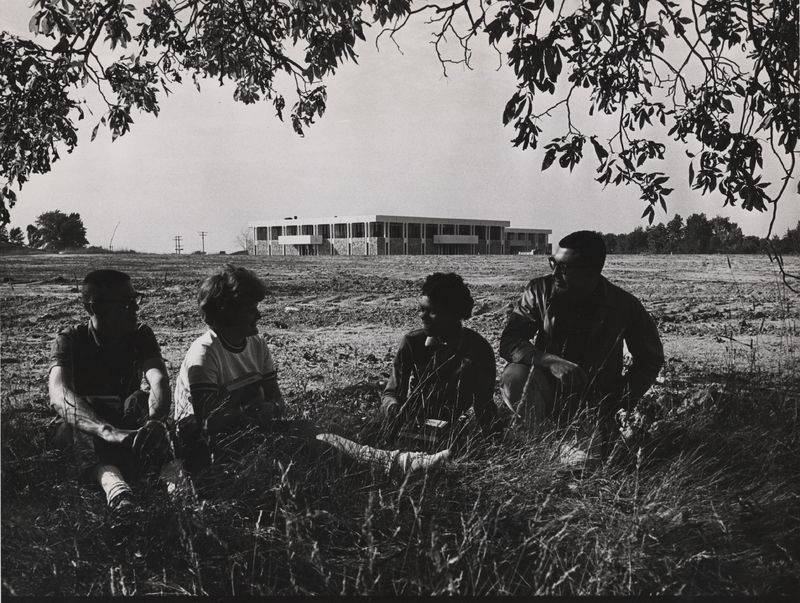
Students seated in a field on the GVSC Allendale Campus, 1960s.
Grand Valley also was facing a high drop-out rate. In surveys completed by students who were eligible to return but didn’t, two issues stood out: a limited academic program with demanding foundation requirements, and the lack of social life on campus. Although the college had abandoned the idea of remaining a commuter college and was constructing housing for students as quickly as possible, there was very little to occupy students outside class time. Allendale offered only a bowling alley, and Grand Rapids was a long drive away for an evening's diversion. In the Grand Valley Review of 1995, which featured essays about the college's history, Math and Statistics Professor Donald VanderJagt, who came to Grand Valley in 1964, dryly commented, "The regular sight of herds of cows and sometimes herds of deer on campus was simply not sufficient to satisfy the extracurricular needs of the students." In the early spring of 1965, four students were fined and two suspended in "Grand Valley's first panty raid."
More seriously, leaders of the new college realized that one factor crucial to attracting top-notch students was accreditation from NCA, the largest of the five regional accrediting associations for higher education in the country. The process includes detailed internal study by the institution, along with examination by a team of peers.
Zumberge first made contact with NCA in 1962, hoping that Grand Valley could graduate its first class as an accredited college. He hired a consultant, who visited campus in November 1963, just a month after classes began. The consultant helped the college prepare for an official visit by an NCA team in November 1964 that would determine if Grand Valley could be accepted as a Candidate for Accreditation. Their report was very favorable, although it did contain the line quoted in the Press: "The weakest element in the present GV picture is the quality of the student body. Relatively, the students fall far short of the quality of the faculty."
Although the accrediting agency was critical of Grand Valley's early students, there were many who thought the school was attracting an impressive group of young people who brought an interesting perspective to the new college. John Tevebaugh, professor of history from 1962-1988, remembered in a 50th Anniversary Video History interview that, "It was impressive how much study they would undertake," describing them as among the first in their families who went to college, and teaching them as "a refreshing experience."
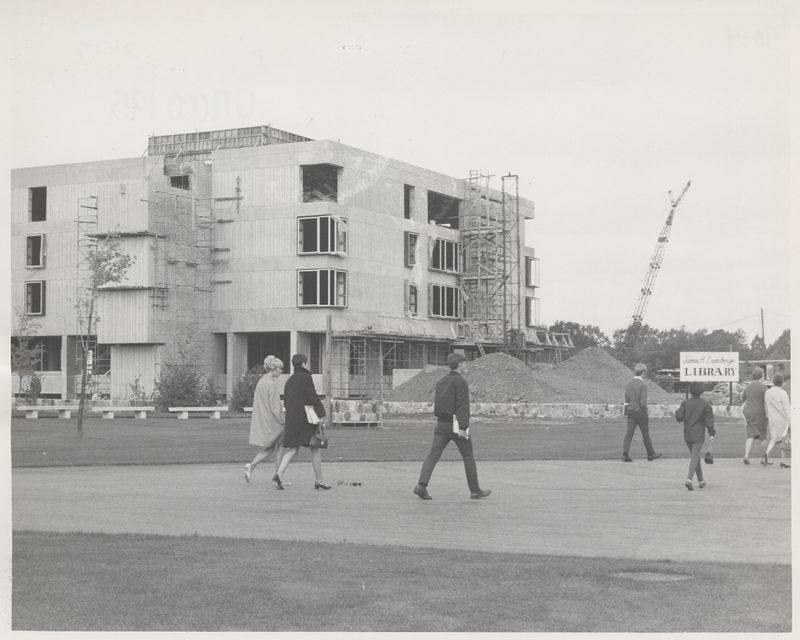
Zumberge Library under construction, 1968.
The college was accepted as a candidate in March 1965, and the administration were hopeful they might achieve their goal. But the NCA decided to deny the request for exemption from its requirement that one class graduate before considering the application for membership. "That ended the battle for early accreditation for GVSC," wrote Zumberge in his 1969 report.
Anticipating that possibility, however, the college had begun negotiations with the Michigan Commission on College Accreditation in December, 1964. "After much foot-dragging by that group and considerable prodding on our part," wrote Zumberge, an examining committee visited the campus in February 1966, and three-year accreditation was granted. Lack of NCA accreditation also prevented Grand Valley from providing teacher certification. An arrangement with Michigan State University made it possible for Grand Valley education students to enroll during their senior year so MSU could act as the legally authorized certifying authority, an arrangement which continued until Grand Valley was accredited in 1968.
II. Tweaking the Vision
In the fall of 1965, Academic Dean George Potter announced to the first meeting of the Faculty Assembly that changes must be made to the idealistic liberal arts curriculum in order to attract more students. A group calling itself the Committee on New Academic Programs was formed. In a 2009 interview for the 50th Anniversary Video History Project, Glenn Niemeyer, who retired from Grand Valley in 2001 as its first Provost, but in the mid-1960s was a professor of history, remembered informing President Zumberge about the group and their recommendations to expand the curriculum. "I went to talk to Jim about it," he recounted. "He and I had a very good conversation about it. He seemed openly receptive to the idea of expanding the curriculum and adding professional programs to it. Shortly thereafter, Jim left."
In the fall of 1966, the Faculty Assembly voted to recommend granting the Bachelor of Science degree at Grand Valley. By January 1967, the degree was in place. The doors were opened, wrote Zumberge, for a broader range of majors, including business administration, physical education, group majors in social studies and general science, medical technology (in cooperation with area hospitals), and engineering (a collaboration with the University of Michigan). "The college was able, by its own internal action, to initiate change when change was needed in order to survive," wrote Zumberge in his 1969 report.
The changes had an effect on enrollment, in both quantity and quality. By the fall of 1967, one-third of the entering freshmen had high school grade point averages of "B" or better, compared to one-tenth of entering students in the fall of 1963. Geographic distribution also changed. 75% of the student body still hailed from the eight-county area, but Grand Valley was now attracting students from throughout the state, plus 3% from other states and Puerto Rico. Only 65% lived at home compared to 90% of the pioneer student body.
On June 18, 1967, Grand Valley State College held its long-dreamed-of first commencement. In a tent on the Allendale campus, 138 seniors, including 86 members of the pioneer class that started in 1963, received their diplomas from Michigan's newest college. Harlan Hatcher, president of the University of Michigan, gave the commencement address. Coincidentally, for this 50th Anniversary History of Grand Valley, he spoke at length about the year 2010. "You will retire around 2010," he told the young graduates. "No one could possibly chart your course through these years, or risk foretelling what the world will be like ... One thing is reasonably certain: your grandchildren will think you aged and old-fashioned, out of tune with youth and the modern world of the 21st century. And they will try to redeem and overcome all the grave mistakes you will make in bringing up and educating your children, running the government, devising an intelligent foreign policy, and fighting unnecessary wars." He ended, "Best wishes between now and 2010."
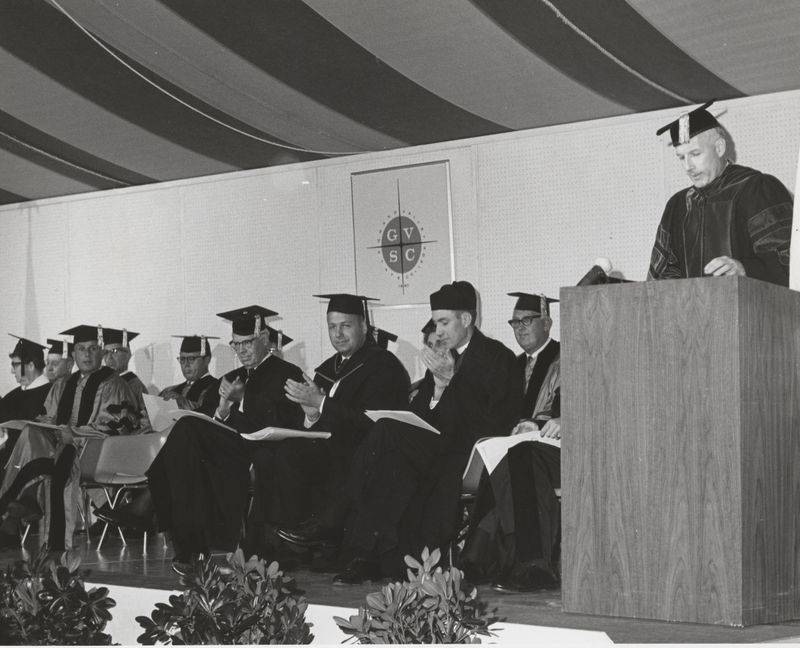
President Zumberge speaking at the first GVSC Commencement Ceremony, 1967.
III. A Second Society
While most of the faculty at Grand Valley were happy with the academic changes that brought more students to the Allendale campus, there were some who were disappointed by the diminishment of the school's traditional liberal arts focus. George Potter, now Vice President of the college, had been pursuing his earliest suggestions for decentralized collegiate societies, based on European models, specifically his experiences at Oxford University in England. In 1966 he appointed a Committee on Collegiate Societies, from which developed the Second Collegiate Society Study Group. The report of the group in 1967 proposed that a new satellite collegiate society would "recover the early commitment of Grand Valley State College to the tradition of liberal studies, but will also restore as the central feature of its program the pedagogical ideal implicit in the tutorial." They proposed a curriculum that focused on a "continuing community meeting," what came to be know as the "common program." The new school also would offer opportunity for independent study such as examination courses, seminars, off-campus projects, and special studies. Grades would be either satisfactory or unsatisfactory, with narrative evaluations by professors appearing on student transcripts.
There was a movement occurring nationwide as part of the social, political and demographic changes that were deeply affecting higher education in the 1960s. Many experimental or innovative new colleges, or divisions within established institutions, were attempting to redefine the experience of college students. Words such as experiential, interdisciplinary, student-designed curriculum, and participatory governance have been used to describe these programs, which appeared from Maine to California, from Evergreen State College in Olympia, Washington to the New College in Florida. In Michigan, Wayne State, Michigan State and the University of Michigan had opened new units to attract students interested in innovative educational ideas.
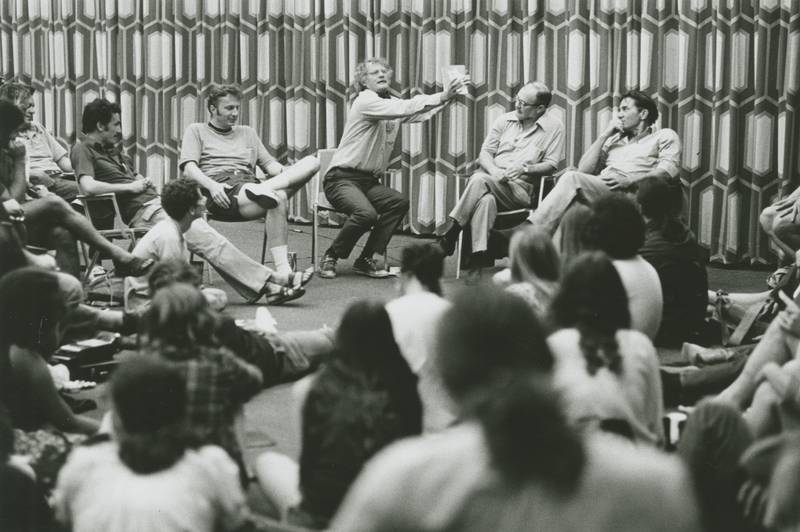
Poet Robert Bly instructing Thomas Jefferson College fine arts class.
In the fall of 1968, the School of General Studies (SGS, later renamed Thomas Jefferson College) opened at Grand Valley State College with 80 students and three full-time faculty. Other professors in the larger division at Grand Valley now known as the College of Arts and Sciences had dual appointments in both schools. The curriculum was not exactly what Vice President Potter had envisioned for his new academic society. In an article written by Grand Valley Professor Lynn Mapes in 1995 for a History Department project on the early history of the college, he describes Potter as unhappy with the substitution of "concentration" for the traditional major, and with "no grades, no courses, no degrees." Mapes, who joined the Grand Valley faculty in 1968, quotes Potter as huffing, "The Board of Control do not view decentralization primarily as an opportunity to play around with wild notions of what a liberal education can be."
In the first brochure developed to describe Grand Valley in 1962, the prospective student body was characterized as "able surprises -- students with a talent for creativity who give promise of rising to the challenge of an imaginative college program." It was apparent from the first days of SGS that the progressive new program would be attracting exactly those surprising students. Dan Clock, formerly in the math department at Grand Valley and now the new SGS chair, told the Valley View student newspaper, "There was a feeling of euphoria among the SGS faculty and students, and excitement in starting from scratch reminiscent of the esprit de corps when the Pioneer Class arrived." In an interview with the Detroit Free Press at the end of SGS's first academic year, he quoted Kierkegaard in describing the program: "A teacher cannot teach; he only makes an atmosphere in which a learner learns."
The academic euphoria shared by the SGS pioneers would be somewhat short-lived. But first, the college as a whole would have to rise to its next challenge: finding a new president.
IV. The Arrival of Arend Lubbers
While college faculty were hard at work determining the academic direction of Grand Valley, President James Zumberge and the administration were still deep in the accreditation process necessary for the success of any curriculum. Just before the college's first commencement ceremony, Zumberge flew to Chicago with two copies of the required institutional self-study in hand. In August NCA notified the college that the study was accepted and scheduled an accreditation exam. A team arrived in January 1968. Their report, though mostly favorable, questioned the launch of the Second Society. Zumberge and Potter were off to Chicago again, "with a suitcase full of data and reports," wrote Zumberge in his 1969 report. "By the time we were ready to appear before the (Committee) at 8:30 a.m. on March 25, 1968, I felt more like an attorney than a college president," he wrote. The committee meeting lasted less than a half hour, and all the prepared data and reports were accepted without questions. "The final decision to grant accreditation for a ten-year period … was delivered to me Wednesday (March 27, 1968) morning and was almost anticlimactic."
NCA accreditation certified that Grand Valley State College offered an acceptable academic program and had the necessary resources to accomplish its stated objectives. While that may seem like a bland statement, it was the culmination of a decade of work by community, faculty, administration and even students to bring the new college into existence and raise it to its proper place among its academic peers. Was it a coincidence that just the next month, James Zumberge announced that he would leave the presidency of Grand Valley to return to teaching as the director of the school of earth sciences at the University of Arizona? While many people who were at Grand Valley at the time said that the general feeling was that President Zumberge was frustrated by the tribulations of administration and wanted to return to a more academic life, he later served as president of Southern Methodist University, and retired as president of the University of Southern California in 1991. He died shortly afterward.
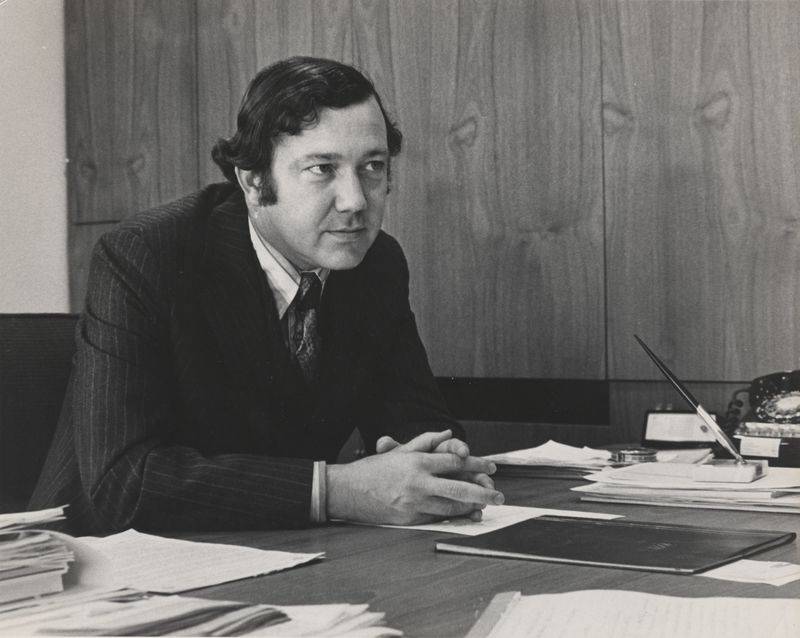
Grand Valley's second president, Arend D. "Don" Lubbers.
The Board of Trustees appointed a search committee including college faculty, alumni, students, and members of the committee who had worked to establish Grand Valley. Bill Seidman remembered the next events in his 50th Anniversary Video History Project interview. "We heard about this youngest college president in the United States and he was out there in the middle of nowhere in Iowa," he recounted. "I remember I flew out there in our plane to take a look at a guy named Arend Lubbers, who happened to be the son of the president of Hope College. And Hope College was not one of the institutions that was enthusiastic at that time about Grand Valley getting started. I spent about a half a day with Don Lubbers and I said, 'I think this is the man we want.' So we went forward from there, fortunately we got him. Today’s world, I doubt if ever we could do that. He didn’t have a Ph.D. at the time, he was going through a divorce, a lot of things that in today’s so-called “open society” or whatever you want to call it, would have made it difficult. Fortunately he came, he met with the Board, he introduced us to his new bride-to-be, Nancy, who was terrific, and he was unanimously elected by the Board to be the president. I’ve often said I’ve worked hard for Grand Valley, but the best thing I ever did was recruit Don Lubbers to be the president."
Arend Donselaar Lubbers, who urged everyone to call him Don, grew up on college campuses. His father was president of Hope College from 1945 to 1963, and was professor and president of other colleges before that. Don graduated from Hope and earned his MA in History from Rutgers University in 1956. He taught at Wittenberg College in Ohio before returning to Rutgers in 1958 to pursue a doctorate. In 1960 he was appointed president of Central College in Pella, Iowa at the age of 29, becoming the youngest college president in the nation. Two years later, the young academic attracted national attention when Life magazine included him in its 1962 feature "Red-Hot Hundred," profiling 100 outstanding American leaders under 40.
Lubbers was still among the youngest college presidents in the nation when he accepted Grand Valley's offer in December 1968. He would need all the youth and vigor he could muster as he stepped into a swirl of contention and controversy that mirrored the mood of the nation as the decade drew to a close.
At the end of February 1968, the domed roof of the innovatively designed new Fieldhouse at Grand Valley had given way under construction, and a worker had been critically injured. Some with memories of Grand Valley's early years cite this as something of an omen, ushering in a period of dissension, strife and public criticism that would threaten the very existence of the fledgling college.
Before Don Lubbers' term of office officially began in January of 1969, calls from Board members alerted him to problems surrounding the college newspaper, the Lanthorn. Near the end of November 1968, deputies from the Ottawa County Sheriff's Department had entered the campus office of the newspaper and confiscated copies of the latest issue. On December 3, the Ottawa County Circuit Court issued a complaint charging its editor with publishing obscenity and an injunction stopping its publication. The offense was characterized as the use of supposedly obscene words. But it was felt by many that the real issue at stake was the newspaper's coverage of political matters that were tearing the country apart in the late 1960s: the war in Vietnam, the drug culture, criticism of military and police tactics, student rights and civil rights. The Lanthorn under the leadership of editor Jim Wasserman had improved in journalistic style and relevant academic, artistic and political content over its predecessor student newspapers, but no one could dispute that it had become radically left wing, at odds with the conservative values of Ottawa County.
Although the editor was fired and publication of the newspaper suspended, Grand Valley brought a lawsuit questioning the authority of the prosecuting attorney and the sheriff in issuing an injunction halting publication. In August 1969, the Attorney General of Michigan ruled that the Ottawa County authorities did not have legal authority in closing the newspaper. The editor stood trial in the district court and was found guilty. There was a great deal of debate among faculty, student, and alumni organizations about whether to ask the college to aid in the editor's defense; in the end the Board of Control decided it would not. According to a Grand Rapids Press article in October, 1969, "1968-69 was the year of the four-letter word on many campuses," citing clashes between administration and student journalists at Purdue and the University of Minnesota. "Only at GVSC, however," the article reported, "was the student editor actually arrested."
Students around the U.S. and internationally were mobilizing around issues of freedom, war, equal rights, and the environment, and even at remote Grand Valley, the wave of unrest could be felt. In 1967 the first political demonstration at Grand Valley was held by a group of anti-war students and faculty members who picketed U.S. Senator Phil Hart on a visit to campus, although his views about the war ended up being more in line with theirs. By the fall of 1969, when the campus was celebrating the inauguration of Don Lubbers, marches, demonstrations and moratoriums were an almost weekly function.
Grand Valley students were doing more than marching, however. Awakening activism spurred some to participate in community outreach programs established by the college, such as Project Make-It to help high school dropouts enter college, the Urban Studies Institute focusing on problems and needs in downtown Grand Rapids, and a new Latin American Studies program. Grand Valley also began to offer its first study abroad programs, offering students opportunities at the University of Lancaster in England beginning in 1969, a program in Merida, Mexico, and one in Tours, France.
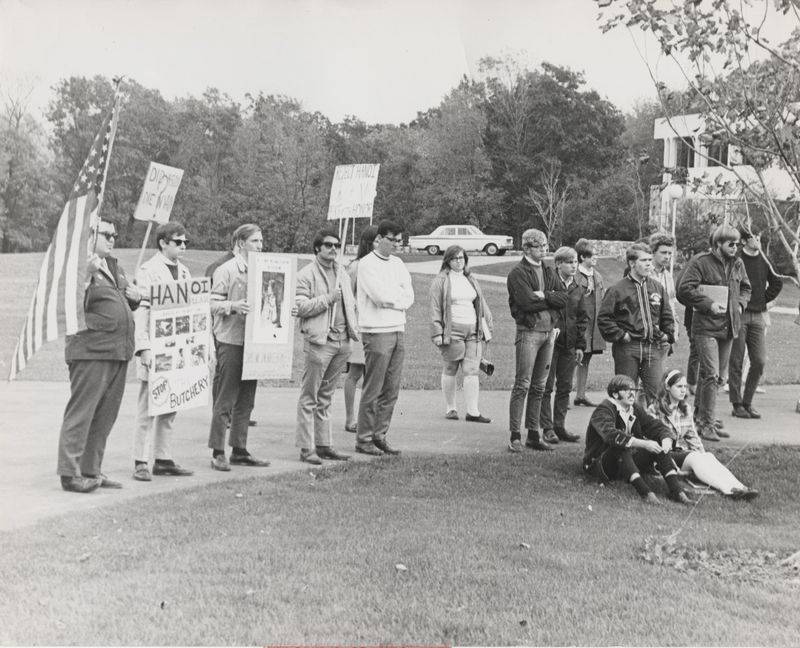
Group of students protesting the Vietnam War., ca. 1968
The new President was sympathetic to the spirit of the students (not being all that much older than they were). He participated in National Moratorium Day activities, lighting a gas flame in Mackinac/Manitou Plaza intended to burn until the end of fighting in Vietnam. He encouraged debates, teach-ins, guerilla theatre and many opportunities for discussion of pressing issues, brought home to the campus by the deaths in Vietnam of two former students.
Lubbers and the Board of Control also realized, however, that the growing institution would continue to face the problems of any large group of people living and working together. In February of 1969, William A. Johnson was appointed the first Campus Police Chief at Grand Valley, responsible for setting up a college security force. Johnson joined the Grand Rapids Police force in 1940 and was Superintendent for over 11 years. In his initial statement to the Press, he referenced the civil unrest that had been sweeping the nation over the past few years, specifically riots in Detroit and Grand Rapids. "The philosophy of non-violence and persuasion that we advocated during Grand Rapids' summer disturbances," he stated, "is particularly applicable to work with students."
In his inaugural address on October 12, 1969, Don Lubbers faced the issues squarely. "Despair has grown in the midst of the affluence that characterizes this nation," he told the assembly in the newly dedicated Fieldhouse. "Our educational institutions were for generations the focal point of the nation's social and industrial optimism … they have not escaped from the spreading despair. …The conflict inherent in the outside society has incited simultaneously a vicious indictment of the entire American educational system. The same reason that young people see for despair in the world outside the university they see writ just as large inside."
Lubbers chose to frame the problem in terms of academic relevance. "I am not here to take sides," he declared. "I see the office of president of a college as a place where the inevitable human conflicts are arbitrated and issues settled. Let me bring some issues to bear to illustrate what I mean. I have been told by some that this college must choose between liberal arts and specialized or technical training. How many colleges have been fooled or pushed into a bifurcation of this issue? Is this college to take up the sword for liberal arts while ignoring a society that demands from its schools the trained personnel to keep our economy alive? Or are we to man the barricades for technical training at the expense of educating the critical and historically conscious minds that a healthy democracy demands? I will endorse neither such approach. This college was built on a solid liberal arts basis and there it will stay."
Grand Valley and President Lubbers set out to accomplish this broad goal by initiating a program of academic expansion and division that would result in the school's famous "cluster college" era, again drawing national attention for innovative new approaches to education while creating challenges of marketing these approaches to students and the surrounding community. It would take another decade of hard work to bring the goals put forth by the new President into sharp focus.
1970-1980
I. The Cluster Concept
As the 1960s drew to a close, it seemed as if the new ideas about education percolating at Grand Valley State College were beginning to reap rewards. Enrollment in 1969 hit an all-time high, and in fall 1970 passed the 3000 mark. Another living center, named for founding Board of Control member Grace O. Kistler, was constructed in the curving dorm complex along the north campus ravines in 1971, along with a Fine Arts Center on the south campus.
The new president of the college, Don Lubbers, moved swiftly to build on the cluster college concept that, although foreshadowed in the earliest talks about curriculum, had begun just before his arrival with the establishment of a "second society" in 1968. The School of General Studies (described in the previous section of this history), was renamed Thomas Jefferson College in the fall of 1969.
The idea of offering experimental education was not unique to Grand Valley. Lubbers, in a 2008 interview for the 50th Anniversary Video History Project, remembered that it reflected, "a society that was beginning to look for experiments in higher education - to change it, to improve it," or, he continued, "at least in that part of society that was young and college bound, there were a number of them who wanted alternative ideas in higher education."
While renewed interest in experimental education did not originate at Grand Valley, the college's 10-year process of developing separate academic units organized around ideas rather than residential groups was particularly inspired. Over the next decade, Grand Valley would become a proving ground for innovations in education that attracted faculty and students from across the country, and, while often problematic and controversial, set a stage for discussions of teaching and learning that still resonate at the college today, and, some believe, shaped Grand Valley as exceptional among similar public institutions nationwide.
II. William James College
As the School of General Studies (TJC) was emerging, yet another planning task force had been meeting, interested in new ideas about education but taking as a model the work of 19th century American philosopher William James.
Conceived as an interdisciplinary, non-departmentalized college with concentration programs instead of majors and a common core of study (similar to Thomas Jefferson), the new unit differed from the "second society" in a very specific delineation of goals in the original blueprint for the college: "William James College will be future-oriented, since its programs will correlate with society's projected needs; it will be career-oriented, since its concentrations will lead to clearly defined professional opportunities, as well as to advanced studies; it will be person-oriented, in that its programs will stress intellectual and personal maturation within a community of learners."
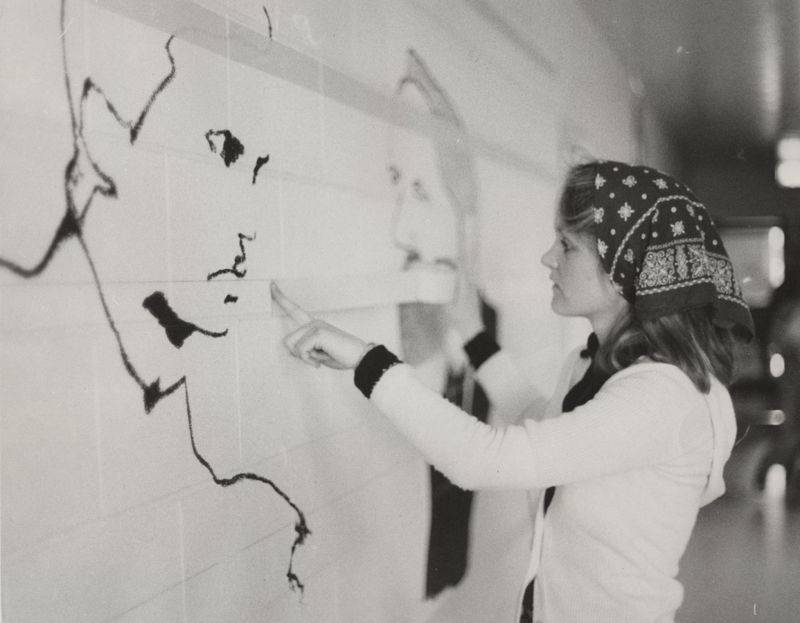
Student working on the William James College mural.
In the fall of 1971, 160 students and six faculty met in their new headquarters, Lake Superior Hall, for the first of what would become a hallmark of the school, the Synoptic Lectures. Designed as a counterpart to what many colleges offered as foundation or distribution courses, the Synoptic (literally "seeing together") Program that included the lecture series was planned to "acquaint students with a variety of intellectual fields," and provide an opportunity for "developing their own broad and comprehensive view of human experience." The initial series, titled "William James - Our Contemporary," featured scholars from the University of California Berkeley, Harvard, the University of Chicago, Yale and others, including Martin Marty, Jerome Kagan, and David Elkind.
In an article for the Grand Valley Review in Fall 1995, Richard Paschke, one of the first six WJC faculty, wrote that the demands of curriculum development and heavy teaching commitment "wreaked havoc on the personal lives and health of many WJC faculty and staff members in the early years. Yet," he continued, "so brightly burned the flame of William James' original vision that the pace of development held steady and even quickened in the second year of the college's existence: hired then were twelve new faculty members, including six women, one of whom, Adrian Tinsley, became its first full-time dean."
Over the next decade, the William James College philosophy of pragmatic education would draw national attention, including a prestigious 1977 grant from the U.S. Office of Education for a demonstration project in providing a career education at a liberal arts college. Students in several area concentrations would make an impact on the West Michigan community, including activities in urban and environmental studies, social relations, and information technology. But by the fall of 1974, according to a college self-study for NCA accreditation review, 34% of WJC students were concentrating in the Arts & Media program, a foundation for the strength of Grand Valley's current Film & Video major in the School of Communications.
Barbara Roos, a member of the Arts & Media faculty who joined the School of Communications when WJC was closed, has made a one-hour documentary titled "William James College: An Unfinished Conversation."
III. College IV (Kirkhof College)
By 1972, the reputation of Grand Valley for innovative, experimental ideas about education was spreading nationwide. Federal grants were secured to develop a curriculum plan and faculty for another new college by the man who would become its dean, Dr. Robert Toft. Perhaps reflecting the very prosaic aims of the new venture, it took the name College IV when it opened in the fall of 1973, indicating its position as the fourth college in the cluster that now included the College of Arts & Sciences, Thomas Jefferson College, and William James College.
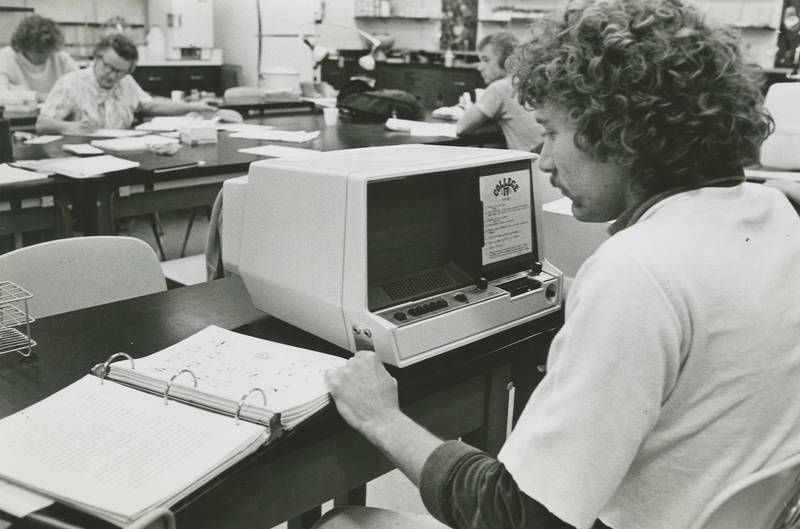
College IV student working on module, ca. 1973
"It was the dream of College IV to remove many of the barriers which kept people away from higher education," wrote David Bernstein, one of the original faculty hired for the psychology area of the new college, in an article titled "College IV: Elegant and Lonely" in the Fall 1995 issue of Grand Valley Review. "Some of these barriers were in the physical and social environments," he wrote. "Classes that all students had to attend in 'lock-step' fashion prevented those with certain kinds of jobs and/or family responsibilities from enrolling in college. The typical course also assumed that most students were roughly equal in preparedness for the course and that, once in the course, most students would march along productively at the pace set by the instructor."
College IV proposed to solve some of these problems by offering a self-directed, self-paced curriculum of modules, units of study or blocks of material that broke courses into conceptual chunks. The College produced booklets that instructed students on how to master those "chunks," and then tested them when they were ready to earn the half-credit each module carried (Grand Valley was on the quarter system at the time, and most courses earned 5 credits). Faculty were available for tutorials, coaching and consulting when needed.
The College (CIV) was housed in AuSable Hall, with a core section where students could study, flanked by a learning and testing center and a laboratory area. Milt Ford, who came to CIV in 1973, also wrote an article in the Fall 1995 Grand Valley Review. "I was excited about designing a whole English curriculum for people who needed schedules which would not conflict with work and family responsibilities and would be free of speed requirements," he wrote. But, like his colleagues at William James, Ford found the curriculum extremely demanding for faculty. "When I think of those first two years, I think of double or even triple time," he explained, citing the demands of nearly 20 hours of office availability, plus what he called a "paperwork nightmare" of materials design, test grading, and credit audits for graduation.
Bernstein digs into the problems with basic assumptions behind the concept of the new college, but Ford cites another purely practical problem. While attracting many students who moved quickly and efficiently through the curriculum (students who went to graduate school after CIV did extremely well), the college, as part of its philosophy, did not impose deadlines on the process. "Because things are the way they are," wrote Ford, "students kept doing the things in their lives that had deadlines and time constraints and saved their studies for later. At the rate one student was completing modules, it would have taken over 150 years to complete a degree."
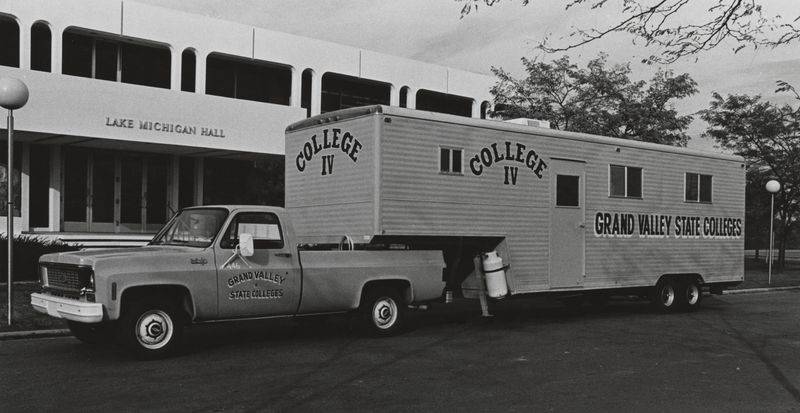
College IV used a Module Mobile as a classroom to take its self-paced curriculum to factories, businesses, and even shopping malls, during the 1975-76 academic year. The van eventually became the press box for the GV football field.
A local inventor and businessman had been following events at the new college. Russel H. Kirkhof, responsible for the development of dozens of electrical manufacturing devices, lived near Grand Valley in Tallmadge Township. Through his friend and neighbor John Scherff, GV's director of buildings and grounds, he had maintained an interest in the new college in Allendale. He had not been able to attend college himself, and was especially impressed by the practical nature of CIV. In October of 1978 he bestowed on Grand Valley its largest single gift to date, $1 million, and the Board of Control voted to re-name College IV as Kirkhof College.
In 1975, Toft left the new college and a new dean, Douglas Kindschi, led a revision of the original plan that added professional programs such as Hospitality and Tourism Management and Advertising and Public Relations, as well as a general education humanities program. Traces of these programs can still be found in Grand Valley's current curriculum.
IV. Graduate Education Comes to Grand Valley
While innovative ideas sparked life into the three independent cluster colleges that developed at Grand Valley, the largest academic division of the school, the College of Arts and Sciences, was also growing to meet new demands. In 1970, the Board of Control approved two new schools within CAS, the School of Business and Economics, and the School of Health Sciences, as well as degree programs in earth science, environmental science, public service, and theater. In 1971 majors in music and music education were added, and a four-year baccalaureate degree in nursing was approved by the Michigan State Board of Education. When students arrived to begin Grand Valley's four-year nursing degree in the fall of 1973, they became part of the only Bachelor of Science program in nursing in West Michigan. In the fall of 1972 a School of Public Service was established, developing programs in public administration, municipal government, police administration, criminal justice, and urban affairs. (All of these areas are still active parts of Grand Valley's academic offerings. More information about them can be found elsewhere on the GVSU website.)
At the beginning of 1973, Michigan Governor William Milliken signed a law changing the name of Grand Valley State College, making it Colleges to reflect the cluster of academic units that was blooming in Allendale. The previous summer he had quashed a community group's hopes to establish a law school at Grand Valley by vetoing a section of a higher education bill that would have allocated funds for new law schools at three Michigan institutions, including Michigan State and Western.
But the most radical step in the works at CAS (now referred to by most students as "the straight school") was a proposal to establish a graduate school of business. Many of the faculty who had worked on Grand Valley's "pure" liberal arts curriculum at its founding, or who had come to the school attracted by that commitment, were concerned about the growth of professional programs, and especially alarmed that a graduate school would drain more funds and resources from liberal arts undergraduate education. Philosophy Professor Dewey Hoitenga and English Professor Anthony Parise issued a manifesto titled "Graduate School as a Cuckoo," warning, among other things, that introduction of graduate education would destroy any hope for the return of pure liberal arts education at Grand Valley State. "Clearly, to introduce graduate school into CAS, or into any other unit that intends to honor undergraduate education, is to put a cuckoo's egg in a nightingale's nest," they wrote, passionately imploring the administration to return to the fundamentals of "Plato, Aristotle, Whitehead, and Maritain, who all maintained that a true liberal arts education is one that pursues knowledge for its own sake." (Some cuckoo species, for the non-biologists among readers of this history, are known for laying their egg in another species' nest, then leaving it to be nourished at the expense of the fledgling natives.)
The pragmatists won the day. President Lubbers, for the first and only time, made his recommendation against the vote of the faculty, and in June of 1973, the Board of Control approved the establishment of a Graduate College of Business. At its August meeting they voted to name the new school the F.E. Seidman Graduate College of Business in honor of founder L. William Seidman's father. The college opened in the fall of 1973, becoming the fifth in the cluster colleges at Grand Valley. The undergraduate and graduate business programs were merged into one school in 1979.
In 1974, NCA reaccredited Grand Valley for graduate programs, and in 1975 the College of Graduate Studies was approved by the Board, which, at the same meeting, also approved a new Graduate School of Education.
New majors and programs continued to be added to the College of Arts and Sciences through the rest of the decade, including opening a Continuing Education Office in 1973 and the International Studies Institute in 1974. Classes were offered in Holland beginning in 1974, and a Grand Valley Center was established at Muskegon Community College in 1976.
V. Culture Clashes
National attention and accolades were coming to Grand Valley as a result of its educational experiments: the Ford Foundation had awarded the school one of only two Michigan grants in a prestigious national initiative for "support of innovative undergraduate programs," President Lubbers was named to the American Association of State Colleges and Universities' new Committee on Non-Traditional Education, and the chair of an NCA evaluation team wrote after a visit in May 1974 that Grand Valley was a "unique and interesting institution," and complimented the college for "fine faculty, enthusiastic students, courageous endeavors, attractive campus, academically sound programs, and representative government." But all was not well in the neighborhood of West Michigan.
For many people in the area, Grand Valley increasingly represented the seismic cultural shift that was occurring throughout the nation, and, indeed, throughout the world. British writer Virginia Woolf once posited in an essay that "On or about December 1910 human character changed," observing that changes in human relations just before WWI were causing a shift in religion, conduct, politics, and literature. Some contemporary historians have pointed to "on or about 1968" as a similar marker in cultural transition.
In addition to the continuing and escalating conflict between those supporting and those opposing the war in Vietnam (many of the latter were college students) and the disillusionment of many young people following the political machinations that came to be known as Watergate, the social fabric of college life was changing rapidly, reflecting changing norms throughout society. At Grand Valley the time-honored tradition of in loco parentis, rules of conduct for students that put the college in the supervisory role of parents, was quickly coming to an end. In 1969 the Board rescinded the requirement that unmarried students under 21 must live in dormitories if not living with parents, except for freshmen, and in 1975 they abolished even that last vestige. Also abolished were rules that established curfews for women in the dorms and limited visitors. The use of illegal recreational drugs became more common, and Grand Valley had its first "pot busts" in 1968.
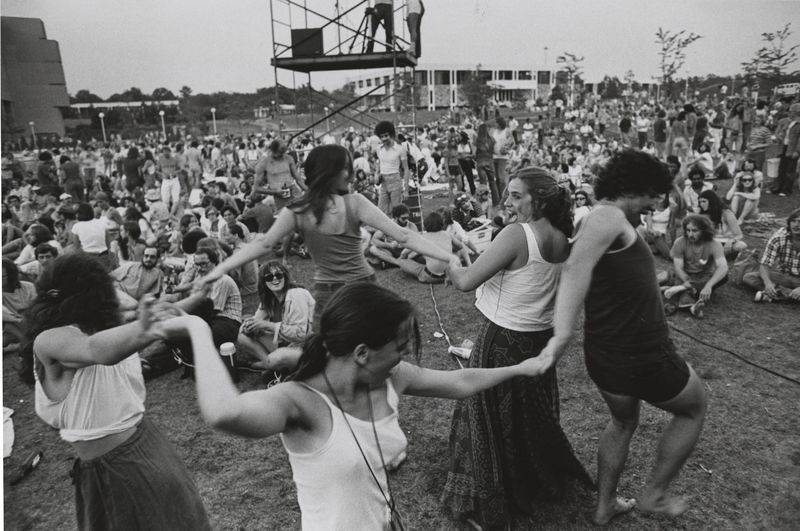
Students dancing on Grand Valley's campus lawn, circa 1970s.
In 1971 an informal group of GVSC women addressed discrimination with "A Report on the Status of Women at GVSC," pointing out, among other things, that of the 152 full-time and part-time teaching positions at the college, only 29 were filled by women. A Task Force for Minority Concerns in 1977 pointed out similar disparities in the student body - only 7.2% of the more than 6500 students were minorities. In 1976 Paul Phillips, Executive Director of the Grand Rapids office of the Urban League, had been named by Governor Milliken to the Grand Valley Board, the first African-American appointed to the college's controlling body. The College's first Gay Alliance was organized in 1971.
But the lightning rod for people in West Michigan concerned about what they perceived as radical threats to their way of life was Thomas Jefferson College (TJC).
The group of faculty who had founded the School of General Studies in 1968 (renamed TJC in 1969) had mapped out a curriculum of rigorous liberal arts in a classic system of lectures, seminars, tutorials and independent work, conceived to provide academic freedom for serious, hardworking students. The leadership of the fledgling school was concerned, however, about attracting enough students to make the enterprise viable. In 1969, a division of a college in Maine that also was marketed as experimental education was slated to be closed down, and a delegation from SGS/TJC traveled east to visit the campus, resulting in an invitation to students and faculty there to apply to Grand Valley's new school. Some 50 students and three faculty from the Nasson College New Division joined SGS/TJC in fall 1969.
Much debate has ensued about whether the changes that followed in the next few years at Thomas Jefferson College were the result of the arrival of the eastern bloc, many of whom espoused a decidedly countercultural lifestyle, or a reflection of the general changing spirit of the times. Gilbert Davis, a founder of the second society and one of its first faculty members, wrote in an essay in the 1995 Grand Valley Review, that "Within a few years, our experiment in educational reform was subverted by counter-culture warriors, whose goal of deconstruction included, among other things, the complete abandonment of the Common Program." In addition to the influx of radicals, he continued, "many TJC faculty members, deeply committed to the human potential movement, replaced academic studies with courses in psychological voodoo, from Yoga and meditation to EST and Rolfing, and many students were only too happy to seek therapy rather than academic instruction."
In 1974, TJC faculty member Bill Baum, who left the experimental college to rejoin the CAS Political Science department, discussed the pivotal year in an interview with GV History Professor John Tevebaugh that is preserved in the Grand Valley archives. "I'm not so sure that some of these things wouldn't have happened anyway," he mused. "…the struggle with the Nasson people was that they did not agree with those of us who had formed the School of General Studies. They did not agree with us that there are things that everyone should know. That's what it boils down to for me."
Don Klein, one of the faculty members from Nasson who came to TJC in 1969, posted a comment on the TJC Alumni Facebook page in September 2009. "To set history straight: Nasson never invaded Grand Valley," he wrote. "It was the cupidity of the GVC administration in seeking massive growth for TJC that invited both students and faculty, hopefully having researched the philosophies & practices of the New Division of Nasson College before doing so. What did they expect?"
Whatever had been expected, the expansion of the TJC curriculum to include such infamous courses as 17 credits for organizing an initiative to amend the state constitution to limit lawmakers pay, or five credits for remaining silent for 28 days, drew widespread media attention and criticism from taxpayers. In 1972, the State Auditor General questioned the credits earned by TJC students for "performance over which the college could have provided very little supervision." In an interview for Grand Valley's 50th Anniversary Video History Project, former Vice President Ron Van Steeland remembered that the report was picked up by media all over the state. "It raised questions even on campus about whether some of those innovative academic programs were legitimate," he explained, "and how do we feel if we are in the College of Arts and Sciences teaching traditional Biology, Chemistry or English when our colleagues across campus are doing some of these “flakey” things, and they must be flakey because they are identified by the general public as being flakey."
Flakey became the operative word for critics of TJC, and, by extension, Grand Valley State Colleges. But quieter voices also noted that many TJC students were among the college's most outstanding. "There was widespread agreement among faculty," wrote Gil Davis in his 1995 essay, "that TJC had Grand Valley's best and worst students."
President Don Lubbers, in his 50th Anniversary Video History Interview, described TJC as perhaps too far from the mainstream, but attracting excellent students, noting that "Thomas Jefferson College … was sending a larger percentage to graduate school than the College of Arts and Sciences."
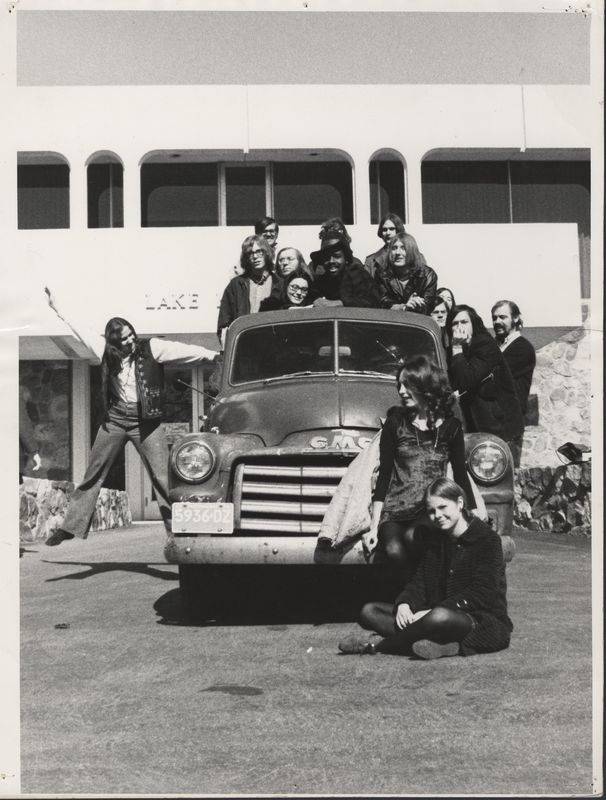
Thomas Jefferson College students posing on truck in front of Lake Huron Hall.
VI. But - A Community Resource is Beginning to Bloom
Despite the glare of unfavorable publicity and criticism in media and legislature, many people in West Michigan were beginning to realize what was plainly clear to the founders of Grand Valley, and to most residents reading this history today: that the presence of a major college or university would serve the surrounding community as a hugely valuable economic, cultural, and social resource.
Many efforts of the college to reach out into the community in the 1970s can be regarded as the roots of some of the most successful programs in today's university. Institutes were established with strong community involvement in Environmental and Urban Studies, International Studies, Educational Studies and Religion Studies; the University Consortium Center and Performing Arts Center initiated a variety of collaborative projects in the area. Good examples foreshadowing the incredible resource that Grand Valley would become include arts, public broadcasting, and sports.

National Poetry Festival, sponsored by the Thomas Jefferson College, June 14-24, 1973.
Ironically, the college attracting some of the strongest criticism, Thomas Jefferson, was also the source of some of the most positive developments at Grand Valley, especially in the arts. In 1970, Michigan author Jim Harrison, who would be a favorite visiting artist at Grand Valley over the next four decades, made his first appearance on campus as a guest in the classroom of TJC Professor Dan Gerber, his friend and co-publisher of the small poetry magazine Sumac. An enthusiasm for contemporary poetry at TJC, thanks also to Professor Robert Vas Dias, resulted in National Poetry Festivals in the summers of 1971, 1973 and 1975. Dozens of the country's most honored and innovative poets visited the Grand Valley campus for workshops, exhibits, readings and other events, including such luminaries as Robert Bly, Allen Ginsberg, Donald Hall, Gregory Corso, Robert Creeley, Diane Wakoski, Diane DePrima, Galway Kinnell, Nikki Giovanni, Ishmael Reed, and many, many more. Annual poetry programs continue to thrive at Grand Valley, bringing back some favorites and introducing students and the community to both venerable and new voices. In 2005, Jim Harrison donated his papers to GVSU's Special Collections.
TJC programs in theater also were making an impact. Stage III, a community theater in downtown Grand Rapids, was launched in 1972, offering contemporary and experimental drama not found elsewhere in the area, and United Stage, a traveling troupe of performers, provided experiences for schoolchildren and in parks throughout West Michigan.
The new performing arts center that opened in 1971, housing the 500-seat Louis Armstrong Theater, was named for sculptor Alexander Calder in 1972. Opportunities bloomed for performances that brought audiences to the Grand Valley campus, including concerts by the new Grand Valley String Quartet. Composed of first-chair players with the Grand Rapids Symphony, the campus's first resident ensemble gave open rehearsals and taught advanced music students, and appeared in concert each year beginning in 1972.
In 1970, the viola player for the quartet, Grand Valley music Professor Dan Kovats, began bringing high school band students to the campus each summer for "Bandarray," which included a public performance by such well-known bands as the Glenn Miller Orchestra and the jazz bands of Stan Kenton and Buddy Rich. The GVSU Marching Band was established in 1977 by William Root.
Also drawing large audiences to the Grand Valley campus were concerts in the new Fieldhouse dome. Primarily driven by student interest and volunteer effort, concerts began soon after the inauguration of both the new Fieldhouse and the new president in the fall of 1969. In early 1970, Country Joe and the Fish played a concert that reinforced public perceptions about the countercultural nature of the school. An eclectic array was on offer through the decade, however, ranging from Ike & Tina Turner and Sly and the Family Stone, to Aerosmith and REO Speedwagon, to Frank Zappa, Lou Reed and Dr. John..
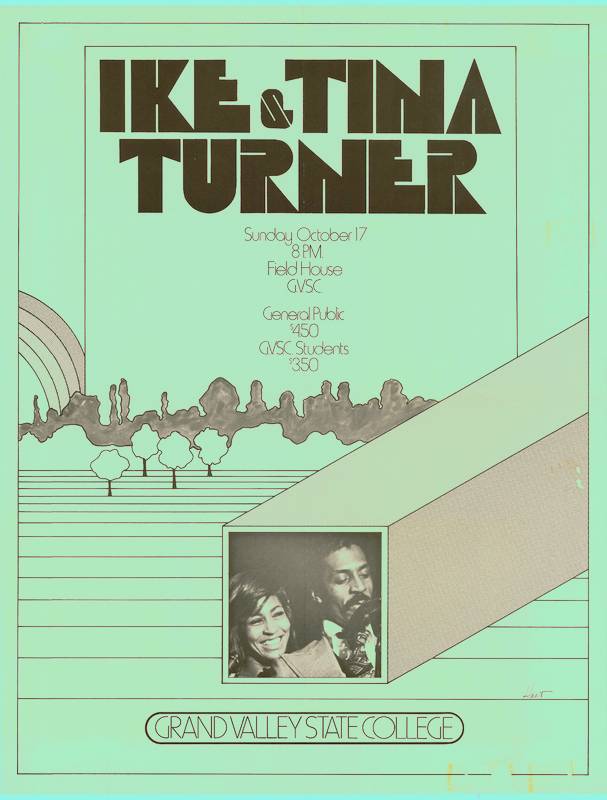
Ike & Tina Turner concert poster, October 17, 1971
“There was an amazing amount of creativity going on,” said Mark Schrock, a William James College student and musician who played with the noted Grand Valley-centered bluegrass band Cabbage Crik. “The staff there was so creative and young and vibrant and hip. It was very cool." Schrock's remarks are in the Spring 2009 issue of GV Magazine in an article that looked at the popular band and the atmosphere at Grand Valley in the 1970s.
The visual arts at Grand Valley, which would come to play such an important role in the growth and development of the college, were also emerging as a community resource. In 1973, Mrs. Irving Bissell donated to the college a major piece of kinetic sculpture, "Six Lines Hanging" by George Rickey, a precursor to a university-wide collection that has now become the envy of academic institutions nationwide. And the first building dedicated to studio arts was constructed, the Art Surge building, also known as Cedar Studios, southeast of Lake Michigan Hall.
On December 17, 1972 President Lubbers signed-on WGVC-TV, Channel 35, bringing public television to West Michigan. The culmination of years of organizing, application and engineering, the inaugural evening's programming offered local viewers their first look at Julia Child, the French Chef. The following summer, the biggest audience in the Fieldhouse to date would flock to see in person Big Bird, the beloved star of Sesame Street. The station, now WGVU-TV, and the affiliate National Public Radio station WGVU AM-FM, have continued to provide the residents of the area one of Grand Valley's most important public services.
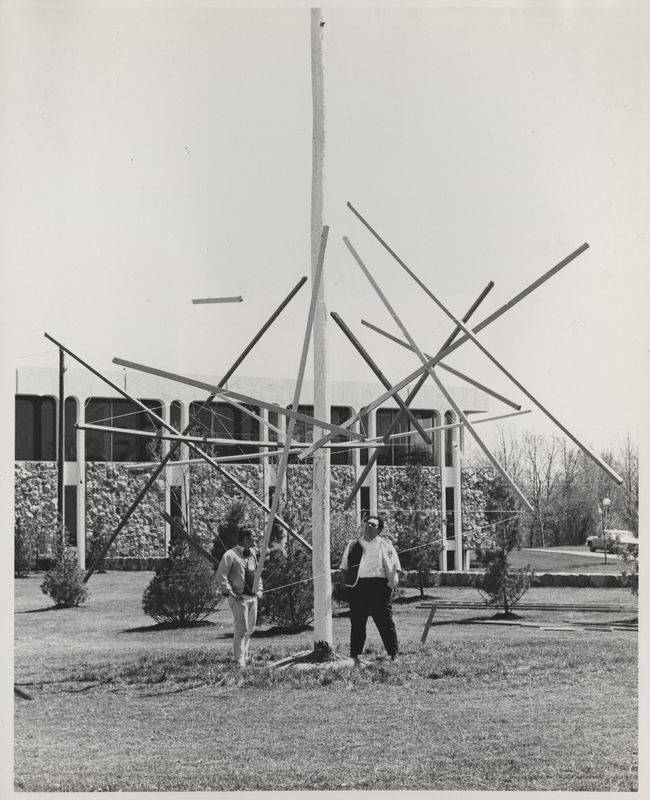
George Rickey's mobile, Six Lines outside Lake Huron Hall before being placed in the West Atrium of Loutit Hall.
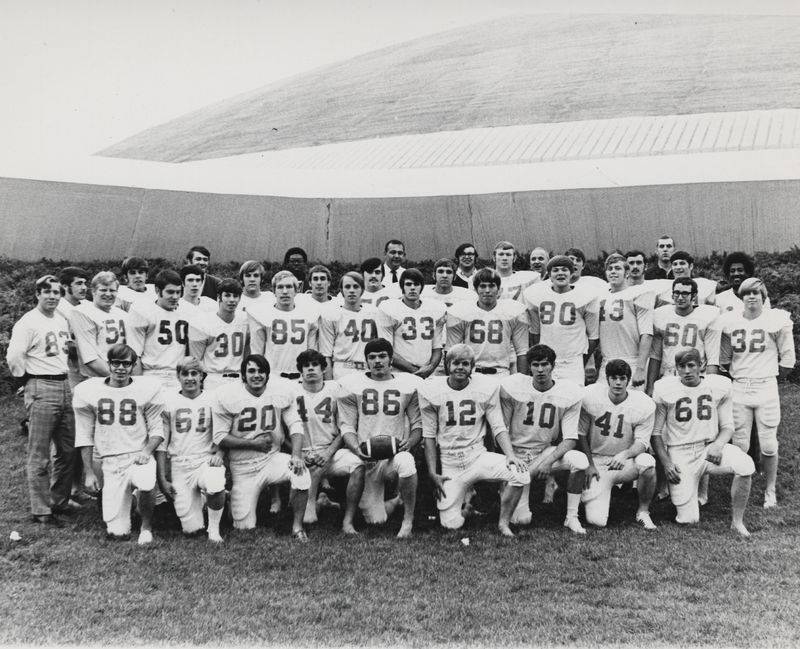
First football team at GVSC, 1970-1971. Head coach Rip Collins at center, back row.
And of course, there was sports. Although no one in the 1970s could possibly have predicted the powerhouse athletic program that would evolve at Grand Valley, there was plenty of action to draw both participants and spectators to the Allendale campus.
In the 1960s, most of the athletic activity on campus was in the area of physical education, under the direction of Charles H. Irwin, although the crew team participated in intercollegiate competition against such rivals as Purdue, Notre Dame and Michigan State.
Soon after the arrival of President Lubbers, the college launched its first intercollegiate football season. The first full-time athletic director, Donald Dufek, was hired in the spring of 1972, just after the formation of the Great Lakes Intercollegiate Athletic Conference, which Grand Valley had helped to found at the beginning of the year. In the fall of 1973 the Lakers logged their first football win, topping Kalamazoo College in front of Grand Valley's biggest spectator crowd to date, 2,300 fans. That season, the first under the legendary coach Jim Harkema, is cited as the beginning of Grand Valley's football tradition.
For the first time, area sports lovers could cheer on their local public university teams, or follow their fortunes in the local newspaper. In 1972 the Lakers Basketball team earned a berth in post-season competition, a first for the school. In 1974 they competed in the national tournament in Kansas City, and in 1975 took their first GLIAC crown. The college wrestling team also began charting national championships, and local sports enthusiasts could follow remarkable successes by women's basketball, softball and volleyball teams. Coached by the legendary Joan Boand, women's sports were to become a continual source of pride at Grand Valley. In 1974, Grand Valley became the first school in the state to award a women's athletic scholarship.
VII. Doom and Gloom
The scales measuring criticism of Grand Valley against appreciation for its increasing contributions might have balanced in the 1970s, but there was a finger pressing down on the negative side. Between January 1973 and December 1974, the New York Stock Exchange's Dow Jones Industrial Average dropped over 45%. Markets all over the world followed, and a new term was introduced into the American vocabulary, "stagflation," the simultaneous occurrence of inflation and economic stagnation. Conflict over Middle East politics had led to an oil embargo by Arab members of the Organization of Petroleum Exporting Countries (OPEC) in the fall of 1973, and Michigan, dependent on the auto industry, was hit hard.
By the mid-1970s, job prospects for college graduates were looking bleak. State appropriations for colleges and universities were slashed. Stories in the Grand Rapids Press during the summer of 1973 recount an embattled President Lubbers defending Grand Valley against attacks by legislators bent on curbing spending by the "cap and gown set," some centered on the questionable curriculum of Thomas Jefferson College (one story tied legislators' objections to the previously mentioned study of their pay by a TJC student who then led a petition drive to limit their salaries, all for college credit).
Lanthorn, vol. 7, no. 06, October 17, 1974. Article by Art Buchwald about "stagflation."
In addition to funding cuts and other economic pressures, Grand Valley also was feeling the strain of a drop in enrollment, especially in the liberal arts. Reflecting trends nationwide, students were turning to business and professional education in reaction to financial uncertainty. Beginning in fall 1977 enrollment at Grand Valley began to decline, reducing tuition income, and appropriations from the cash-strapped legislature continued to be cut.
Nearly everyone who was around the campus at that time recalls a widespread rumor that the legislature was considering closing a number of state-funded institutions of higher education, and as part of that plan, Grand Valley would be turned into a prison. Documentation of that plan, however, does not exist in the Grand Valley archives, nor in any private or public collection searched for this history. Any reader who might have such documentation is invited to contact the Grand Valley archives.
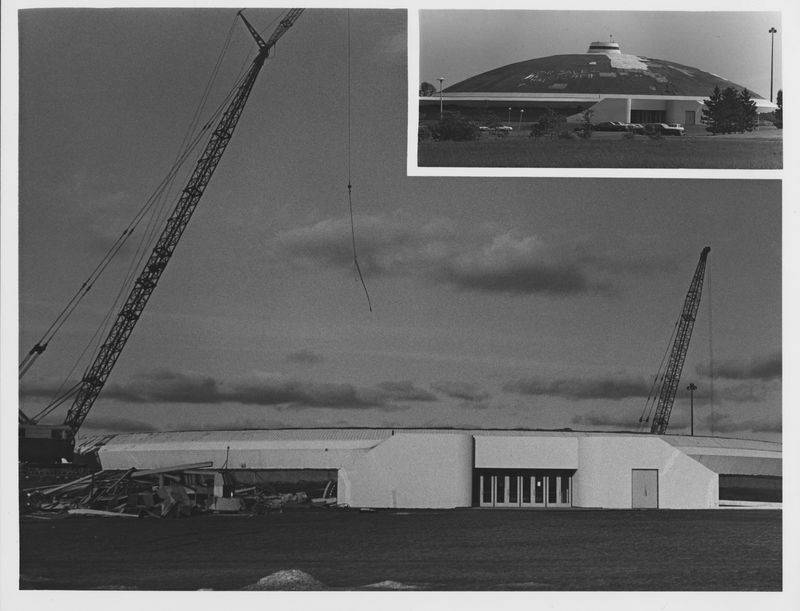
Field House dome prior to demolition.
Whether true or not, the rumor was an indication of the mood of the college as the decade drew to a close. Tribulations piled on, as the Press launched an investigation of faculty and administration compensation, zeroing in with an attack on the pay and fringe benefits of the President. Compensation security, along with other issues, also led Clerical, Office, and Technical staff at Grand Valley to vote to join the Michigan Educational Support Personnel Association in January 1979.
The following year members of the Grand Valley faculty made a third push to unionize academic personnel at the college, which had been tried without success in 1974 and 1977. In the spring of 1980, the faculty again voted to deny the proposal.
Perhaps portentous of the falling spirits on campus at the time was the collapse of the Fieldhouse dome. The crumbling physical education building was slated for demolition to make way for a new facility to be funded by bonds already approved by the state. On January 17, 1980 a wrecking ball hit a support beam, and the dome, which had been describe by architects earlier that week as "safe and usable," came tumbling down.
VIII. Survival
As the 1970s drew to a close, President Lubbers and his administration embarked on a drastic reorganization of the college. They proposed to merge the six undergraduate and graduate units into a four-college federation. CAS would include graduate programs in health sciences and social work, as well as a single School of Education for graduate and undergraduate programs. Seidman College of Business and Administration would also include both levels. William James College and Kirkhof College were included in the federation, but Thomas Jefferson College would be phased out by summer of 1980, with some of its programs to be transferred into other Grand Valley units.
The move was not unexpected. Students and faculty at Thomas Jefferson had been unsure of their future since 1976, when Dean Dan Gilmore was reassigned to a different division at Grand Valley. Still, they put up a fight. At a Board of Control meeting in April 1979, nearly 500 TJC supporters backed impassioned pleas to save the school. "This is the most painful recommendation I've made in the years I've been president," said Lubbers, but TJC enrollment now stood at only 260 students, down from its high in the early '70s of nearly 800. Despite other statistics put forward, including the highest continuous enrollment percentage across the college and the highest rate of graduates in graduate programs, the Board voted to close TJC. On June 2, 1980, students and faculty gathered at Lake Huron Hall's north entrance to dedicate a memorial plaque on a large stone beside the stairway. Quoting Thomas Jefferson, the plaque, which can still be seen today, reads "This institution will be based on the illimitable freedom of the human mind."
William James College and Kirkhof College, although spared the ax during the 1980 reorganization, could read the writing on the wall. It was only three years before another restructuring, covered in the next section of this history, would absorb their functions into the larger college. Howard Stein, a professor of Biology at Grand Valley, wrote an essay for the Fall 1995 Grand Valley Review titled "The Good Old Days at Grand Valley: A Personal View," in which he mused about the lasting impact of the cluster college era at the college.
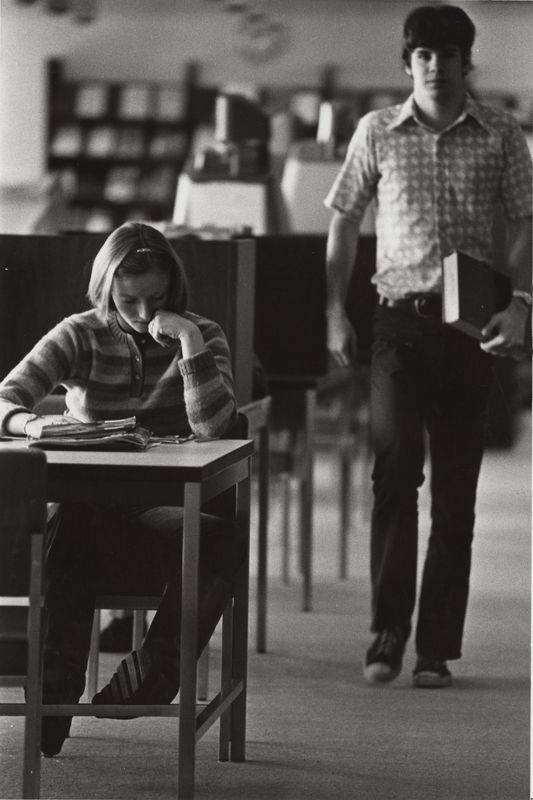
Students using in the fourth floor study area of Zumberge Library, ca. 1975.
"Although that decade may be remembered by some faculty as troublesome, Grand Valley served as a microcosm on one campus for most of the types of experimentation in higher education which were occurring in isolated centers throughout the U.S," he wrote. "It may have been hell to live through at times, but, in retrospect, it was an exciting decade for us. Important understandings of GV's later role were formed in the crucible of debate which characterized the college from its inception. The faculty and the administration learned from its errors and successes. We are probably a better university because of that history."
Many other difficult decisions were made as part of the 1980 reorganization. President Lubbers and his vice presidents agreed to salary reductions; 50 positions at the college were eliminated. When asked about the turbulent period for the 50th Anniversary Video History project, President Lubbers said ruefully, "I'm amazed I survived that time." Describing vehement criticism and difficult decisions, he continued, "People have asked me as I retired in 2001, 'What is your greatest accomplishment?' And I tell them survival."
But Lubbers and his team, along with canny members of the Board and other community supporters, had more in mind for Grand Valley than mere survival. In 1979 an anonymous donor gave the college $600,000 in a trust to be used for a campus site in downtown Grand Rapids. As the country, and the college, emerged from the dark days of the late 1970s and early '80s, Grand Valley would become a major player in the Renaissance on the Grand, the rebuilding of central Grand Rapids.
1981-2000
I. Academy Follows Economy
As this history was being written for the 50th anniversary of Grand Valley, the news media was full of phrases such as "the worst recession since the early 1980s" and "the highest unemployment rate since the recession of the early '80s." Although no designation seems to have stuck to the period of 1979-82, the way "The Great Recession" was being bandied about in 2008-09, it was similarly disastrous for Michigan.
The state had never recovered from the oil crisis and precipitous drop in car sales of the early '70s, and the effects of inflation and declining tax revenues meant ever-deepening cuts in state programs, especially in higher education. Taxpayers led by the Shiawassee County Drain Commissioner vocally and adamantly opposed any new revenue; Governor Milliken declared a financial emergency. Despite the slashed budgets adopted by Grand Valley at the end of the decade, voices were heard throughout the state suggesting that the newer public colleges be eliminated entirely.
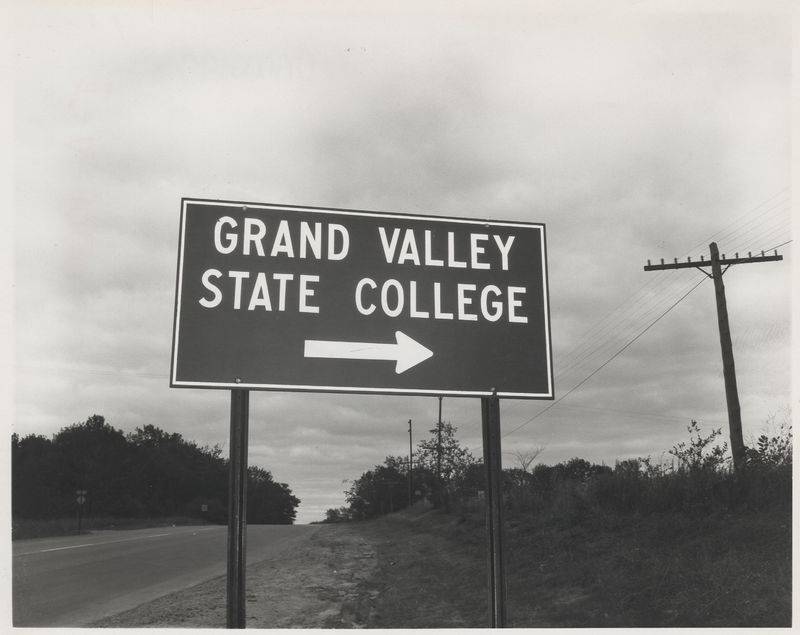
Grand Valley State College highway sign on Lake Michigan Drive (M-45).
By 1982, President Lubbers, his administration and the Board had reached a decision. "When our arithmetic lesson for (1981-82) is finished," he told the Grand Valley Forum in March 1982, "we have studied subtraction, not addition." At their June 1982 meeting, the Board of Control approved a major reorganization plan.
President Lubbers denied in the Forum article that the reorganization was "a closing of some colleges and the saving of others," and characterized it instead as a grouping "according to disciplines, into departments and schools." However, the undeniable outcome would be the subtraction of William James College and Kirkhof College and the end of the cluster college era.
The plan, which took effect in the 1983-84 academic year, returned Grand Valley to a single college structure with four divisions: Arts and Humanities, Business and Economics, Science and Mathematics, and Social Sciences. The "s" was dropped from the institution's name, reverting to Grand Valley State College. The William James name would remain the title of an annual Synoptic Lecture, and the Kirkhof bequest was recognized by renaming the Campus Center as well as the School of Nursing in his honor.
II. A Time of Optimism and Experiment and Reform
At the end of March 1983, Adrian Tinsley, former dean of William James College, returned to Grand Valley for the final Synoptic Series, "Endings and Beginnings." Her speech celebrated the accomplishments of the school. "We were young together at WJC," she told a group of alumni, "young in a time of optimism and experiment and reform, and we were able to do good work."
That good work was widely acknowledged, although not widely publicized. In an April 1979 report made as part of NCA accreditation, the site visit committee wrote, "It is a supreme irony that a college so well-equipped to focus on the principal educational interest of the region (preparation for employment) has almost totally failed to communicate that message. As a result, enrollment has begun to decline."
William James had attracted students and faculty from throughout the country, and initiated a curriculum that was considered a model by the U.S. Office of Education, which funded a demonstration project at the college on teaching career-related subjects from a liberal arts perspective and liberal arts subjects from a practical point of view. In 1979 the college hosted a national Conference on Education and Vocation. But difficulties persisted in WJC's relationship with the larger institution and its administrative structure. In his interview for the 50th Anniversary Video History Project, President Lubbers mused that "The William James people and the faculty saw themselves as a community making community decisions, not very interested in authority of any kind except authority of the group."
The NCA site visit team also recognized problems in relationships between the cluster colleges. "The College has also suffered from having its successful programs copied by other on-campus academic units who then forbid their students access to the William James alternative," they wrote.
Like WJC, Kirkhof College also was absorbed into the new structure at Grand Valley, a transition possibly made more smooth by substantial changes that had occurred at the college since its founding in 1973. The school had evolved into a combination of liberal and professional studies, utilizing both traditional and self-paced methods of education. Most of the faculty and programs found homes in the new divisional structure. In his article for the Fall 1995 Grand Valley Review covering the history of Grand Valley, Milt Ford, an original College IV faculty member, wrote that "the competency based general education program (of Kirkhof College) played a strong role in the definition of the general education requirements of the newly restructured Grand Valley." (More about the genesis and development of general education at Grand Valley can be found later in this narrative.)
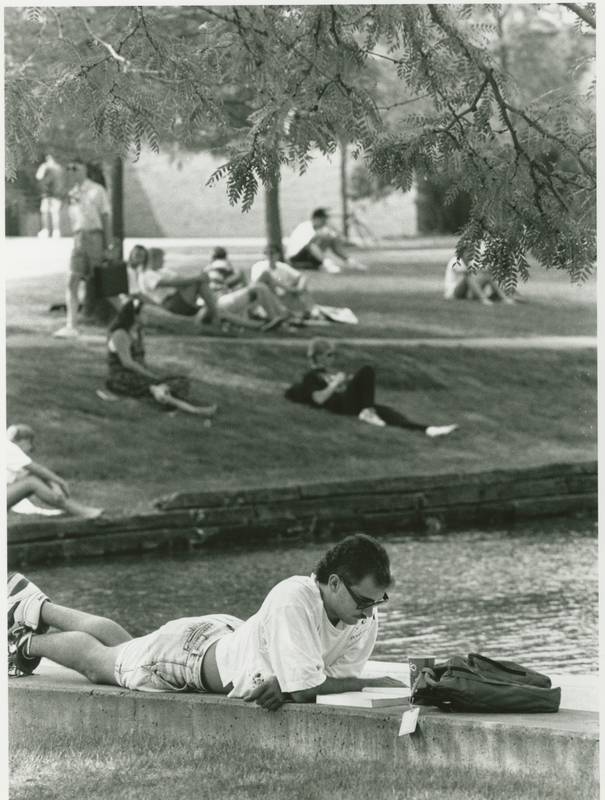
Students relaxing on the GVSC lawn, circa 1980s.
III. Surviving Stronger
While the period of retrenchment and restructuring at Grand Valley has sometimes been described as its "near-death experience," almost everyone agrees that the college came out much stronger on the other side. Enrollments began to rise again, beginning a trend that would set records for the college over the next two decades. By the mid-1990s Grand Valley was placing regularly on national rating systems of America's 100 Best College Buys, and by the end of the decade had become the fastest growing university in Michigan.
One of the factors that allowed the college, soon to be designated a university, to continue to grow as the economy continued to flounder was a major shift in financial management brought on by the trauma of the early '80s. Don Lubbers, in his 50th Anniversary interview, called it "one major blood-letting," explaining that "when we put forth the cuts we cut deeply enough so we could capture some cash to reposition the institution, starting some new programs." Ron Van Steeland, financial officer during President Lubbers' entire tenure at Grand Valley, said in his Video History Project interview that the administration "decided consciously to manage the financial affairs of the institution differently," learning to handle the ups and downs of the Michigan economy.
By 1987, when the economy took another drastic tumble, Grand Valley was nudging up against the 10,000 mark in enrollment, had been granted university status by the Michigan legislature, and was in the midst of hiring a wave of new faculty to accommodate a growing depth and breadth of academic programs (detailed later in this section).
What was to become the defining moment of the 1980s, however, was the persistent effort to open a campus for Grand Valley in downtown Grand Rapids, an undertaking that raised more than a few eyebrows. "The question was put to me by reporters," President Lubbers said in his 2009 Video History interview, "'What are you doing in a recession pushing for money to build a building downtown?' … I said to them, 'If I was a CEO of a business corporation in a recession and I was not planning for the future when the recession ended, I would probably be fired. Why isn't that true of a university … Times are going to be better, and we're going to be downtown.'"
IV. Building a Presence
"Allendale is 12 miles west of downtown Grand Rapids. It’s not seen by a lot of people. If you build downtown on the Grand River you in a sense are building a presence and when that building, the Eberhard Center, was built, thousands and thousands of more people saw Grand Valley."
—Don Lubbers, Video History Interview 2009
In 1979, an anonymous donor placed $600,000 in trust for Grand Valley, expressly earmarked for use in building a center in downtown Grand Rapids. The financial nudge was just what was needed to solidify plans the college had already been considering to consolidate programs it was running at multiple sites around the city. Another large gift was received in 1982 in a $250,000 bequest from Clara Loosemore. In 1983, the last land deal was made to secure 4.5 acres on the Grand River in the heart of downtown Grand Rapids.
The state of Michigan funded architectural plans for a proposed Grand Rapids Center, and in 1985 the Board of Control approved the design by Robert Lee Wold & Associates; ground was broken on June 4, 1986.
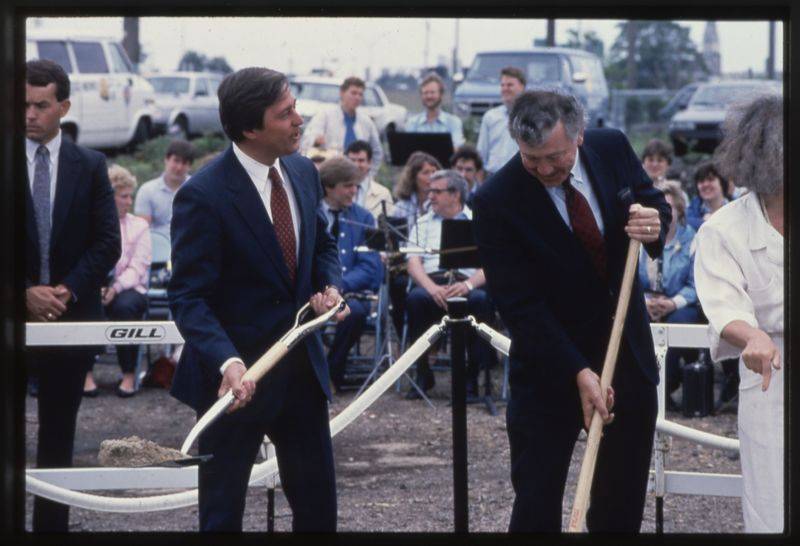
Breaking the ground of the new L.V. Eberhard Center in downtown Grand Rapids, 1986.
The legislature covered a large part of the construction costs for the 155,000 s.f. center, but the project also marked a new era of Grand Valley partnerships with community philanthropists. The Center was named for the largest donor in the capital campaign, grocery store magnate L.V. Eberhard. Another of West Michigan's most successful retailing businessmen, Frederik G.H. Meijer, funded a facility integrated with the Eberhard Center to house studios and offices for Grand Valley's public broadcasting television and radio stations.
At the same time, one of Grand Valley's longest serving supporters, indeed, the man widely known as "the father of Grand Valley," was leaving the area to move to Arizona. L. William Seidman had been a member and frequent Chair of the Board from 1960-74 and 1977-1983 (taking a break for service in the administration of U.S. President Gerald Ford). More about Seidman's role in founding Grand Valley can be found in Part One of this history. He was named the first "honorary life member" of the Board of Trustees in 1983.
In 1987, Steelcase Inc. donated an industrial building and large parcel of land near the Eberhard Center to Grand Valley. President Lubbers appointed a task force to study the role of the new downtown campus and its relationship to the main campus in Allendale. The group became known as the Stow and Davis Task Force, taking its name from the factory that had been located on the property. The conclusions and recommendations of the task force would have far-ranging effects on the growth and development of the university over the next two decades. They defined the roles of the two campuses. Allendale would be a primarily residential campus, focused on undergraduate liberal education. The Grand Rapids campus would focus on professional and graduate work. Perhaps the most significant recommendation adopted from the group's work was the plan to make the two campuses "one integrated institution." Rather than define the University's sites as quasi-independent satellites, as some others do, the two campuses would share the same governance and administration for all policies and curriculum. This principle would continue to guide Grand Valley's operations as it developed sites in other locations throughout West Michigan.
Another recommendation by the Task Force aligned with the economic development initiatives of Michigan Governor James Blanchard. State universities were envisioned as key partners with the private sector. The report of the Task Force stimulated debate about the fundamental purposes of Grand Valley's research mission and its relationship to instruction, affecting long range plans then under development.
L. V. Eberhard Center and the Meijer Public Broadcasting Center on Grand Valley's downtown campus.
V. Responding to the Market
In an address to the convocation opening the academic year in September 1981, President Lubbers anticipated the path that the institution would follow to survive. "In addition to being appalled by the invasion of harshness to which I referred earlier (demise of the ivory tower, campus riots), we must listen to and respond to terms such as productivity, market, and accountability—terms foreign to our profession," he told the gathered faculty. "(Our) sense of special purpose is endangered by the fears and fights brought on by economic stringency, closer public scrutiny, and continuing criticism ... the best way to survive is to hold before ourselves and the public the special reason for our existence ... If we in the academy lose our vision because we are not tough enough to cope with some adversity, we will betray ourselves and all of society."
By 1999, the NCA site visit team declared that the mission presaged in Lubbers' speech was accomplished. "The institution has now adapted its early idealism to the reality of student needs," they wrote, "which include a strong desire for professional education, without abandoning its original ideals."
Both professional and graduate education became an integral part of Grand Valley through the Seidman College of Business. The school was accredited by the American Assembly of Collegiate Schools of Business in 1997, a major external affirmation of the quality of its work, and by 2008 it was included in lists of the best business schools in the country.
Students walking across Lake Plaza in front of "Heaven and Earth" sculpture by James Clover, 1990s.
It is tempting to speculate from a perspective of nearly three decades, however, that the introduction of a graduate program in nursing in 1983 would mark the beginning of a new era for the university, when Grand Valley would experience exponential growth in the health sciences. In 1993, Kirkhof School of Nursing, which had been a unit within the Division of Science & Mathematics, became an autonomous school. Graduate programs in nursing began to be offered in Traverse City, Kalamazoo and Muskegon. By 1998, the growth of the School of Health Sciences resulted in restructuring it with the Department of Physical Education, and the stage was set for the College of Health Professions that would blossom on "Health Hill" in Grand Rapids in 2001 (more details in the next section of this history). A book about the School of Nursing was created in 2003 for the school's 30th anniversary. "Kirkhof School of Nursing Celebrating 30 Years of Nursing Education 1973-2003," by Michele Coffill, is available through the Grand Valley Library.
Grand Valley also initiated a four-year program in engineering in 1983, an enterprise that would culminate in a move to splendid new facilities in 1999 with the expansion of the downtown campus (covered later in this section).
Other programs that responded directly to the educational needs of professionals in the area were developing rapidly. Grand Valley's Master of Social Work program established in 1980 was accredited in 1985. The School of Criminal Justice was established in 1989 and began offering Master's degrees in 1997. A Master's program in Public Administration was accredited in 1995. Information about these schools and programs is available elsewhere on the Grand Valley website.
VI. 25 Years and Still Growing
The Celebration of Grand Valley's 25th Anniversary in 1985 highlighted the growth of other academic divisions. The Science and Mathematics Division sponsored an appearance by two-time Nobel prize winner Dr. Linus Pauling. The annual WJC Synoptic Lecture by civil rights leader Bayard Rustin, and a Jazz Jubilee featuring renowned bandleader Buddy Rich and jazz bands from 25 area high schools gave Arts and Humanities and Social Sciences students and faculty their own take on the anniversary celebration. A special edition of Horizons magazine traced the school's history.
Two other significant events were high points for Science and Mathematics during this period. First, in 1993, ground was broken for a new $40 million science complex. The project was long anticipated to upgrade the aging facilities of Loutit Hall of Science, one of the first buildings on the north campus. In an address to the community at the beginning of the 1991-92 year, President Lubbers remarked that, "The long-sought Science Building is like a military fortress that does not surrender. We have just launched our latest campaign and ever the optimist I hope in 1992 we will achieve our objective. The war is a long one."
Aerial view of Padnos Hall of Science and Henry Hall.
The war was won in April 1996 when the Padnos Hall of Science was dedicated, part of a 300,000 s.f. complex that also encompassed Henry Hall and a new Student Services building, completed in 1995. The science center was named in honor of Seymour and Esther Padnos for their many years of commitment to the university, particularly to its science programs. Henry Hall was named in honor of the late Paul B. Henry, U.S. 3rd District Congressman from 1985-1993. The new complex also marked a major shift in architectural design that would shape the university's physical form through the next decade.
The new facility opened up numerous opportunities, not the least of which was the expansion of the Michigan Regional Science Olympiad, which Grand Valley began hosting in 1985. In 1998, GVSU became the first non-research institution to host the National Science Olympiad, earning rave reviews as a record 108 teams from Alaska to Florida converged on the Allendale campus.
This was also a period of growth and success for the Arts & Humanities division, as they absorbed much of the creative energy of the cluster colleges Thomas Jefferson and William James. By the end of the 1990s the School of Communications was one of the largest majors at Grand Valley. Also growing by leaps and bounds was the Art and Design department. The number of art majors doubled between 1996 and 1998, and in 1997 the program moved into dramatically expanded and renovated facilities, putting everyone in the department under one roof for the first time. It was christened Calder Arts Center, moving the name from the performance facility opened in 1971. The designation honors internationally renowned sculptor Alexander Calder, whose stabile erected in downtown Grand Rapids in 1969 was the first public art project funded through the National Endowment for the Arts. Grand Valley awarded Calder an honorary degree that same year.
A semester-long Celebration of the Arts began with the dedication of the new Calder Arts Center and the repurposed Performing Arts Center, now a hub for the Music and Dance department, on March 19, 1998.
Perhaps the most visible development in the arts at Grand Valley during this period was the growth of the University's art collection. Although the Campus Center Art Gallery had been established in 1978, and budget allocated for exhibitions and a permanent collection, Don Lubbers, in his 50th Anniversary Video History Project interview, traces the source of the expansion to an addition to AuSable Hall in 1992. "One day I was walking through that and I said, 'This place needs … art,'” he remembered. "I couldn’t think of anything else, it needs art! We’d always bought art and we had purchased art from faculty, but it was in seeing that building that we really set the policy of every building should be an art gallery."
In 1999, the University realized that its growing art collection needed the attentions of a full-time professional. Don Lubbers contacted Henry Matthews, director of the Muskegon Museum of Art for the previous 13 years, and persuaded him to take charge of the more than 700 works scattered throughout the college campuses. Since then, the entire collection has grown to nearly 9000 pieces, and can be accessed in an online gallery.
Alexander Calder Fine Arts Center
In 1993, the academic organization of the college was reviewed. The School of Education and the School of Social Work had been part of the Social Sciences Division, and were made autonomous schools, along with Kirkhof School of Nursing, formerly part of Science and Mathematics. It was also in this period that the Center for Philanthropy and Nonprofit Leadership began to develop. Established in 1992 by a grant from the Kellogg Foundation, it was named for Board of Control member Dorothy A. Johnson in 1999. More information about all of these schools can be found on the GVSU website.
With the demise of the cluster college system, under which the historic goals of Grand Valley's liberal arts education were met by different segments in the curriculum of separate colleges, the need for an all-college general education program became apparent. In his speech at the 1981 convocation, President Lubbers threw out a challenge to the faculty: "Build a coherent general education curriculum in the pluralistic, professions-directed university … for the good of the human mind and the professions themselves."
Thus began a conversation that continues to the present. The program that was developed and implemented as part of the reorganization of 1982 was examined and revised in 1987, and again in 2000, when the current themes program was implemented.
Another area that drew close scrutiny in the academic world of the 1980s and 1990s was diversity. In their 1989 report the NCA site visit team wrote, “Although the University has done rather well in the recruitment of minority faculty, there is much affirmative action to be taken in correcting the disparity between the number of men and women faculty, especially in higher administrative positions and at the associate and full professor ranks."
A study group was formed representing a broad campus constituency, and an 18-month period of discussion and survey produced the 1991 Women's Climate Study Report — with tangible results. Salary studies were undertaken, a new children's center was opened, the Women's Commission was established, a group was formed to study gay/lesbian/bisexual issues, and the discriminatory harassment policy of the university was clarified and promulgated. In March 2000, GVSU and the study's director, Mary Seeger, were presented with the Progress in Equity Award by the Legal Advocacy Fund of the American Association of University Women.

Students in a computer lab
In 1981, the Grand Valley Library established a computer system to link students and area residents with sources of published information across the country; articles could then be mailed from the source to the local library within a few days. It seemed astonishingly efficient. By 1982, a Computer Center on the third floor of Manitou Hall was jammed with students wanting access to the terminals there, and Computer Science classes filled up immediately. A new era was beginning.
Grand Valley had long prided itself on cutting-edge technology. In 1988 the Library computerized an integrated online system, connecting it to the new Eberhard Center and offering unprecedented access for personal computers. By the 1990s, direct electronic communication for faculty and students was established, and advanced programs in digital technology were being offered in many academic areas. The Music Department's facilities for electronic music and composition were described in the NCA's 1999 evaluation as "possibly the finest such in Michigan." In 1999, Grand Valley offered its first completely online course, British Writers II, for language arts students at the University's Traverse City campus. That same year Grand Valley began appearing on lists of the "most wired" schools in the U.S., a designation repeated throughout the next decade..
But the growth at Grand Valley was more than virtual. As enrollment skyrocketed, competition for space continued to be a challenge for the university. The new Fieldhouse opened in 1982 with a community celebration featuring a concert by Willie Nelson and one by the Grand Rapids Symphony. From 1987 to 1998, a construction boom brought nearly a dozen new living centers to the Allendale campus, providing a level of student housing far superior to anything that had been previously available. Development of the Cook De-Witt Center began a move to define the heart of the campus in 1991, solidifying in 1994 with the dedication of the Cook Carillon Tower on November 15.
In 1994, the Meadows Golf Course opened, quickly joining the ranks of top golf courses in Michigan and attracting NCAA championship play.
Grand Valley also began to take its place as a major regional university serving the entire West Michigan coastline. While courses had long been offered in Muskegon at a variety of locations, in January 1995 construction of the James L. Stevenson Center for Higher Education on the campus of Muskegon Community College offered the university new opportunities in the shoreline community. A collaboration with MCC, along with Ferris State University and Western Michigan University, the three-level building looms over Fourmile Creek like a huge cruise ship. In 1995 Grand Valley also became a part of a consortium of universities to establish the Northwestern Michigan College University Center, which houses the GVSU Traverse City Regional Center.
The important role of Grand Valley in Muskegon would be further emphasized by the growth of the Robert B. Annis Water Resources Institute. Founded in 1985 as part of the biology department, WRI had centered much of its off-campus activities in Grand Haven, home port of the D.J. Angus, the school's water research and education vessel.
In 1996, Dr. William Jackson, long-time advocate for stopping the pollution of Muskegon Lake, was a major donor for WRI's second vessel, named in his honor, to be docked in Muskegon. The stage was set for a permanent home for the new vessel and the Institute, which had experienced rapid growth in the 1990s and outgrown several homes on the Allendale campus. A $5 million capital campaign in 1999, the largest ever undertaken in the Muskegon area, resulted in the opening of the Lake Michigan Center in June 2001. The 24,500 s.f. Center houses education, research, conferencing, docking and vessel support operations (the D.J. Angus remains docked in Grand Haven), and has become one of Grand Valley's most visible and most successful community outreach projects.
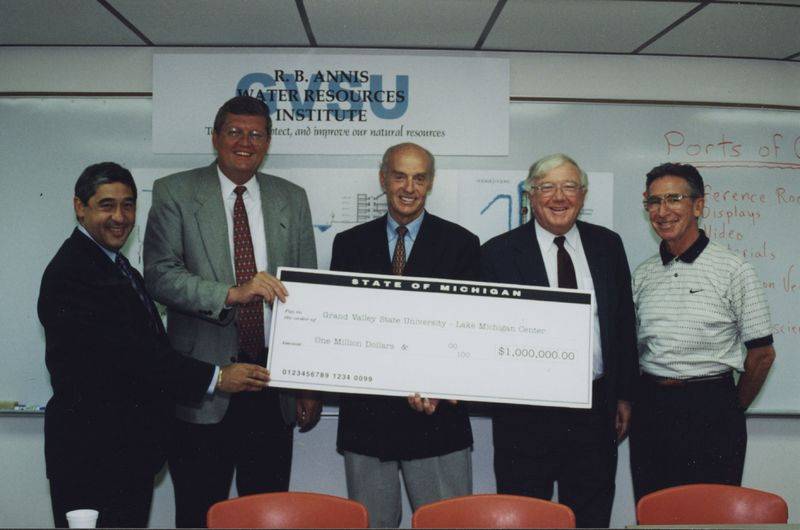
Donation of a million dollars to Annis Water Resources Institute.
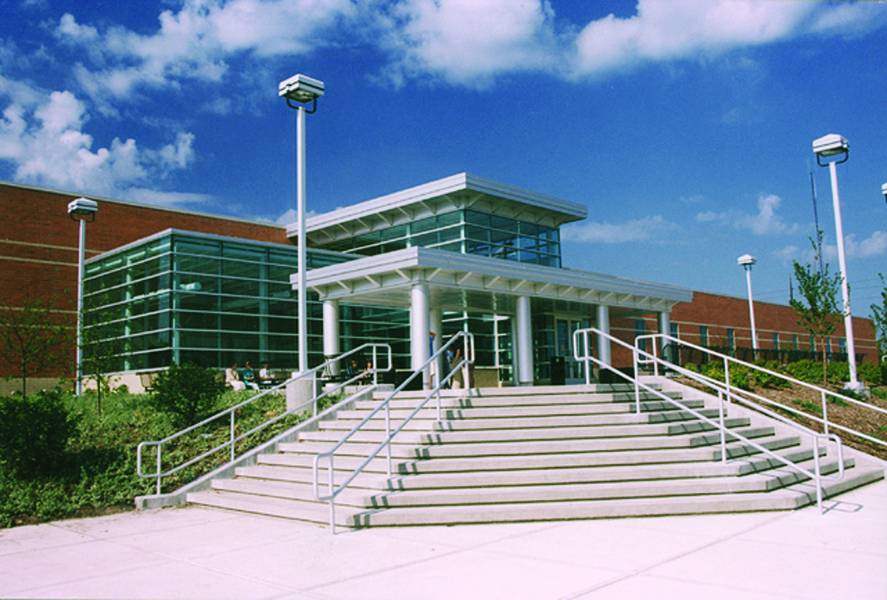
Meijer Campus in Holland, Michigan.
In 1997, Meijer Inc., a long-time benefactor of Grand Valley, donated a 19-acre site in Holland to the University, setting the stage for a facility to consolidate continuing education programs that had been offered in the Ottawa County area for many years. The Meijer Campus was dedicated in August 1998, and offers a wide variety of academic and support services to area students.
VII. Good News, Bad News: Growth and Goodbye
In an address to the faculty on March 20, 1997, President Lubbers outlined his vision for the continued growth and prosperity of the University. "I am overwhelmed, almost, by the decisions we in the university community will make in the next few years," he said, after describing the progress Grand Valley had made in its first three decades. He was speaking primarily of the impending expansion of faculty and the importance of making the best possible choices. But, he added, "people and programs require facilities if they are to work effectively. In our rush to the future, we are building, but we need to build more." Earlier in his speech he alluded to the growing importance of funding from private donors for buildings, endowments and programs, a sum which, he said, had doubled in three years.
At the end of that academic year, the largest graduating class in GVSU history would move commencement ceremonies to Van Andel Arena in downtown Grand Rapids for the first time, and ceremonies also would be held for the first time in Traverse City. Anticipating the continued needs of the expanding University, a campaign to raise $15 million in private funding for new buildings in downtown Grand Rapids had been organized in 1996. The Grand Design 2000 Campaign was a success, and in fall 1997, ground was broken for a $50 million expansion of the downtown campus, which opened in the fall of 2000.
Named for Amway Corporation co-founder and long-time GVSU supporter Richard M. DeVos, the main structure in the expansion was DeVos Center, constructed along with the Steelcase Library. They were soon followed by Engineering Labs named for businessman and philanthropist Fred M. Keller, and the John C. Kennedy Hall of Engineering (2007), also named for a local business innovator, all part of the Seymour and Esther Padnos College of Engineering and Computing. The downtown campus was named to honor Robert C. Pew, a former Steelcase Inc. chairman who had been part of the college's founding committee, and had remained an active supporter over the decades. At the heart of the DeVos Center is the Beckering Family Carillon Tower.
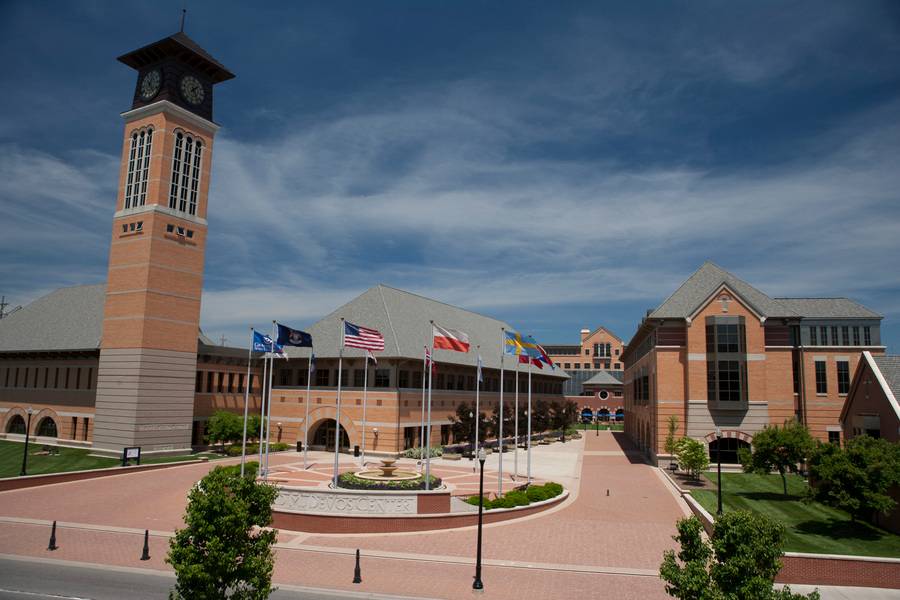
Richard M. DeVos Center on the Grand Rapids Campus.
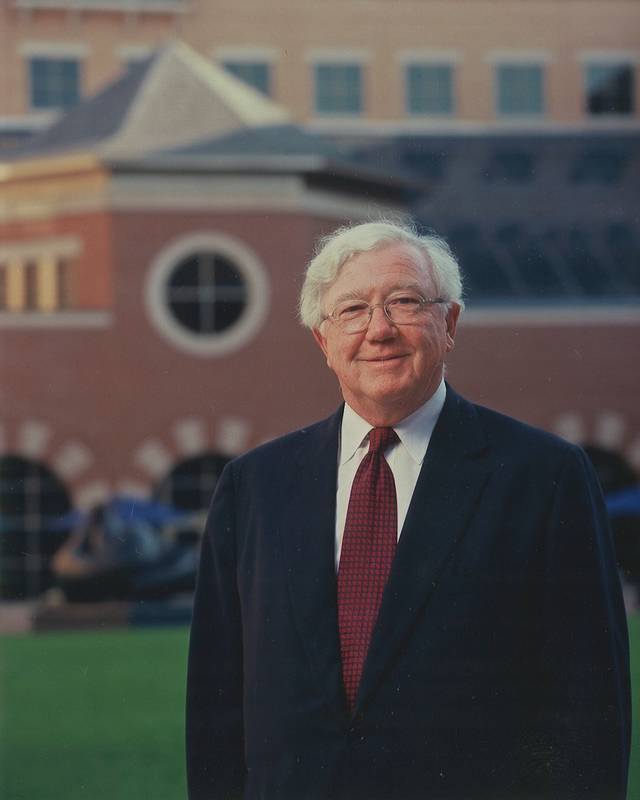
Arend D. Lubbers, President of Grand Valley State University, 1969-2001
Don Lubbers' prediction of the importance of private donors to the growth of Grand Valley had been spot on. Smaller but equally significant donations enabled the construction of a new Alumni House and Visitor Center on the Allendale campus, dedicated during Homecoming 2000. But President Lubbers had a prediction that fall that many greeted with consternation. "Nancy and I have decided to retire June 20, 2001," he told a gathering of faculty, staff and students in September 2000 at the Cook-DeWitt Center. "I don't know when I will run out of steam, but I will be 70 three weeks after we leave the presidency. That's as good an age as any to admit your mortality. With the steam that is left in me I will always be ready to use it for Grand Valley."
When Arend Donselaar Lubbers came to Grand Valley in 1969, he was one of the youngest college presidents in the nation. Now, in 2001, after 32 years at the helm, he was the country's longest serving president of a public university.
In his farewell address to the University on April 17, 2001, he noted that other members of his administration, including Provost Glenn Niemeyer and Vice President Ron VanSteeland, were also planning to retire. "The first generation of Grand Valley faculty and staff are leaving the stage," he said. "We have given this place, I believe, a larger dose of commitment than most state universities. That dose has made some special things happen here, and my hope is that you will carry this place forward keeping the commitment quotient high."
2001-2010
I. After Three Decades, A New Era
Around the world people ushered in the new millennium wearing goofy 2OOO eyeglasses and anticipating widespread chaos if computers failed to adapt to the chronological odometer rollover (they did adapt). At Grand Valley State University, contemplation of change was perhaps not quite so hysterical, but many were concerned about the future of the institution. The 1999 report of the NCA re-accreditation site visit team put it succinctly: "The greatest short-term challenge for GVSU comes with the loss of its greatest sources of stability, cohesion and vision for the last three decades, the retirement in the next few years of its President and most of its senior Vice Presidents."
The Board and the Grand Valley community had plenty of warning that the long-time administrative team would be leaving, and just three months after the April 2001 farewell "Hail to the Chief" celebration of Don Lubbers' presidency, Mark A. Murray became the third president of Grand Valley State University on July 1, 2001.
Murray was treasurer of the State of Michigan when the Board selected him to lead the university. He had spent more than 20 years in state government leadership positions, including advisor to Governor John Engler on education policy, as well as state budget director from 1994-98. He had served as vice president for finance and operations at Michigan State University in 1998-99, and his tenure with the state involved a variety of experience with educational policy, including directing MEAP testing and spearheading implementation of the Michigan Merit Award for college-bound high school seniors. Still, it was a thinking-outside-the-box choice that some questioned. "He has managerial skills with very complex organizations," explained Board Chair Donna Brooks when the appointment was announced, "combined with a passion for leadership, knowledge of the area and of the university."
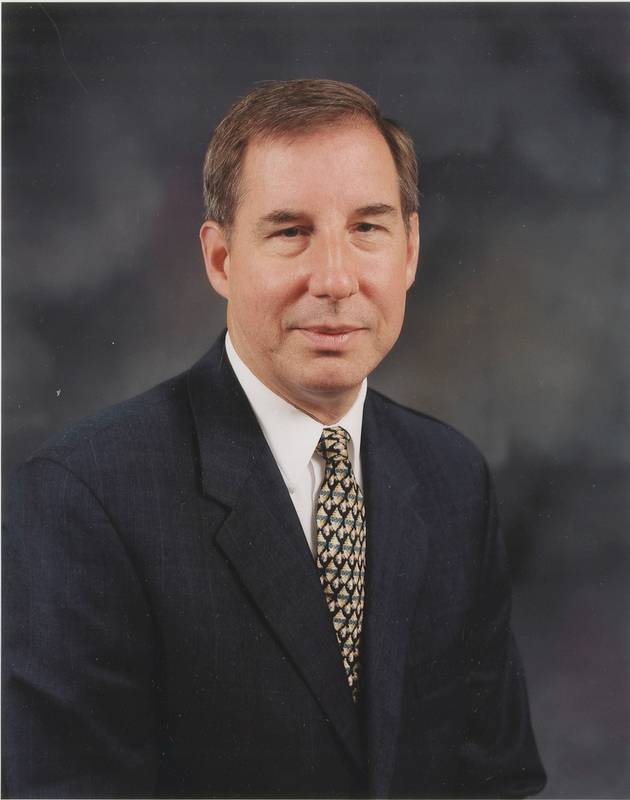
President Mark A. Murray.
In an article for the Fall 2002 issue of Grand Valley Magazine, Murray looked back on his first year at the helm of the university, and the questions he faced at its beginning. "I think it's perfectly natural for the faculty to question an individual coming in who is not from the academic community," he said. "I received a very warm and comfortable reception from the faculty. I think people know that I take the core mission of the university very seriously and value very highly the teaching and learning experience."
Mark Murray had barely settled into his office when the events of September 11, 2001, shook the world, and the campus. Evening classes were cancelled and memorial services arranged to honor the victims of the attacks on the World Trade Center in New York and the Pentagon in Washington, and the crash in Pennsylvania of a terrorist-controlled airplane. The new president made what he felt was an "absolutely critical" decision to gather the campus community quickly, and then to return to classes as soon as possible.
Provost Gayle Davis, 2006
When Mark Murray was interviewed for the 50th Anniversary Video History Project, he was passionate about describing his priorities for the university from his very first days. "This was a materially better institution than the brand gave it credit for," he said. "We needed an unalloyed commitment to absolute excellence in the undergraduate experience." He called it the "gold standard option," and vowed to build the brand of Grand Valley.
In a 2009 interview with the author of this 50th anniversary web history, President Emeritus Don Lubbers mused about the things that set Grand Valley apart from other comparable regional universities, and high on his list was the fact that the Provost is the chair of the budget committee. "The vice presidents of finance or development don't have as much influence," he explained. "We built a university building an academic program."
It was clear that the next critical event in the evolution of Grand Valley would be finding the right person to serve as the university's second Provost (third Vice President for Academic Affairs). In his Video History Project interview, Mark Murray acknowledged that "with a non-academic president, we needed a strong Provost," and joked that "everyone talked about how tough I had it following Don. (The new Provost) came after Glenn Niemeyer."
The right person proved to be Dr. Gayle R. Davis, who had, according to Murray, "a passion for undergraduate education, a love of the academy." Associate Vice President for Academic Affairs and Research at Wichita State University in Kansas, she had been at Wichita State for twenty years and had not planned to move. In an interview with the author in 2009, she described the position at Grand Valley as an opportunity she couldn't resist. "It was a new team in an organization that had stability, a young, vibrant university in a place I love, and a niche in higher education that was very attractive to me at a personal level." Davis had earned a doctorate in American studies and a master's degree in art history from Michigan State University, following undergraduate work in French at Muskingum College in Ohio.
II. Reorganizing for Absolute Excellence
Both Mark Murray and Gayle Davis were clear on their first priority. It had been repeatedly suggested during NCA re-accreditation processes that Grand Valley needed a stronger emphasis on strategic planning. A new position of special assistant to the president for planning and equity had been created by former president Lubbers shortly before he retired, and President Murray created a division of planning and equity with a Vice President at the helm early in his tenure. He assigned planning activities at all levels to the new Provost and that Vice President, Patricia Oldt, and the two led the development of strategic plans and the refinement of assessment plans for every academic and nonacademic program, unit, college, and division across the university.
In February 2003, the Board of Trustees adopted a new mission statement: "Grand Valley State University educates students to shape their lives, their professions, and their societies. The university contributes to the enrichment of society through excellent teaching, active scholarship, and public service."
A slightly more lengthy process was required to reorganize the university's academic affairs division. "Reorganization conversations had been going on for a long time," said Provost Davis in the 2009 interview. "Don, Glenn and Ron (Lubbers, Niemeyer and VanSteeland) had tried to move toward it. I brought new eyes. They broke the ice and I brought it up again in the context of strategic planning." The process of analyzing and reorganizing academics at the university began in the spring of 2003, and by July 2004 a plan was ready to be implemented.
The new plan emphasized the core role of liberal education at Grand Valley, while acknowledging that the university's mission also includes professional and graduate education. The reconfiguration dismantled what had been a divisional structure with schools, and replaced it with colleges. The largest is the College of Liberal Arts and Sciences, combining sciences, mathematics, social sciences, arts and humanities.
The reorganization also addressed a growing need to define Grand Valley's professional education programs in ways which made sense to national accrediting agencies. "Grand Valley is so unusual," explained Gayle Davis in 2009. "We are the largest comprehensive university in the Midwest that still is focused on education not research … It's wonderful that Grand Valley has hung on to its liberal arts focus," she continued, but "professional programs at the college have different expectations."
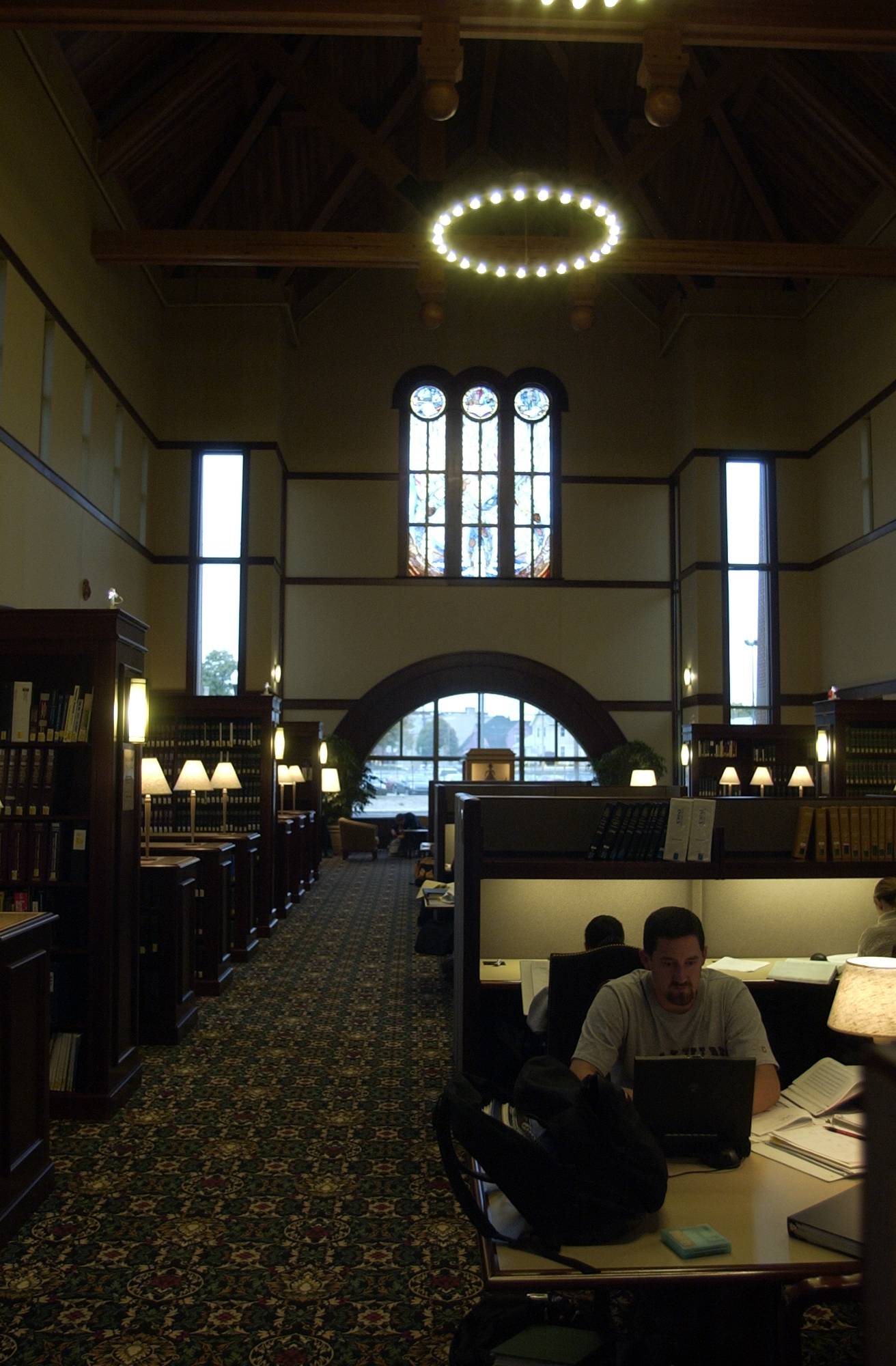
Students in the Steelcase Library reading room, 2003.
To strengthen the University's professional programs, the reorganization established the College of Community and Public Service, the College of Education, the College of Health Professions, Kirkhof College of Nursing, Seidman College of Business, and the Seymour and Esther Padnos College of Engineering and Computing.
At the same time, the College of Interdisciplinary Studies was established to strengthen the connection within, between, and among academic units, and reinforce a central value of the university's mission that all students, regardless of their degree, achieve a liberal education. It includes all university requirements, such as the general education program, junior level writing exam, and supplemental writing skills program, as well as the Honors College, the Faculty Teaching and Learning Center, the International Center, Continuing Education, Liberal Studies, Environmental Studies and other programs that blend knowledge with experience.
President Murray, in his remarks at the Convocation opening the academic year in 2004, when the reorganized structure took effect, was emphatic about the elements of a liberal education that he said had changed very little, even in a rapidly changing economy: "solid quantitative and verbal skills, the need to question the conventions of the day, the need to explore the new and different, the need for basic integrity and honesty, the value of curiosity, reaching out to hear what would otherwise be 'missing voices,' and an unwavering dedication to excellence." The attributes of a liberal education, or, as he termed it, a "liberating education," would give students the tools "to get to more basic truths about the problems and challenges of the day." He concluded, "We are better at everything when we are grounded in the skills to learn effectively."
One reason that the need for a new academic structure had become critical was rising on a hillside along Michigan Street in downtown Grand Rapids. On September 15, 2003, the Cook-DeVos Center for Health Sciences was dedicated, providing more than 200,000 s.f. of space to house the new College of Health Professions, Kirkhof College of Nursing, and much more.
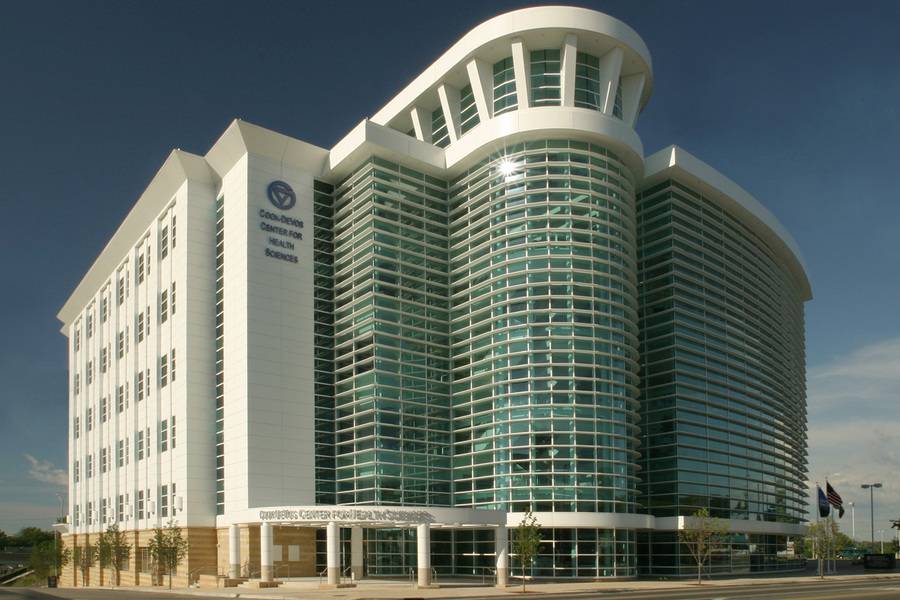
Cook-DeVos Center
III. Health on the Hill
In an address to the faculty in 1997 titled "The Golden Age of University Building," President Lubbers described new funding approaches and new plans for future growth. He emphasized the overcrowding of Henry Hall after only two years of use, demonstrating the need for more space for expanding health programs. The programs "should be located downtown, preferably attached to the Butterworth Hospital Campus," he said. "To have it in at least five years, we must begin thinking about it now."Not too long after that, a community campaign to raise funds for the project was organized. Richard M. DeVos, Peter C. Cook, Audrey M. Sebastian and Jay Van Andel were honorary co-chairs of the Building for Life Campaign, which became the largest private campaign Grand Valley had ever conducted.
More than 460 donors contributed more than $20 million, led by gifts from Peter and Pat Cook and Rich and Helen DeVos, for whom the new center was named. The State of Michigan committed $37.1 million to the project, and a state-of-the-art facility for training and research was the result. "A successful partnership of the private and public sectors along with our community's heart for giving have helped us surpass our goal for another major campaign," said DeVos, a trustee of the University in the 1970s and '80s and chair of the Grand Valley University Foundation. "We're thankful for the quality of our health care and understand the importance of investing in the training of medical professionals who will be ready to provide top-notch care."
The Cook-DeVos Center for Health Sciences is on the corner of Michigan and Lafayette Streets in the heart of what is known variously around the city as Medical Mile and Health Hill, an area shared by the renowned Van Andel Institute and the Spectrum Health Butterworth Campus, which have become important partners with Grand Valley for health care education and research. The Center also houses the West Michigan Science and Technology Initiative, a partnership created with the Right Place, Van Andel Research Institute, the City of Grand Rapids, and Grand Rapids Community College to promote and attract high technology business development to the area using a business incubator model. The partnership has been expanded to include Spectrum, Saint Mary’s Health Care, Mary Free Bed Rehabilitation Hospital and the Grand Angels, and the initiative is one of two SmartZones of the university authorized by the Michigan Economic Development Corporation.
The new facility houses 10,000 s.f. of wet lab research space, twelve general classrooms, two computer labs, 23 teaching and research labs, a 150-seat auditorium, twelve seminar rooms, ten conference rooms, and two levels of parking. At its opening celebration, however, almost as many oohs and aahs were generated by the outstanding art collection displayed in its public spaces and along its corridors. The College of Health Professions has expanded to accommodate a variety of demands, including developing Grand Valley's first doctoral program in 2004. In 2008, an agreement with its newest neighbor, the Michigan State University College of Human Medicine, provided a link for premed students at Grand Valley. In his 2008 Video History Project interview, President Mark Murray recalled proposals for a medical school at Grand Valley.
IV. Among the Best
It wasn't just the health story on the hill that brought Grand Valley to state and national attention over the first decade of the 21st century. The construction of new facilities on the downtown Pew Campus prompted an organized plan to make improvements to existing classrooms, beginning in fall 2002 with a major addition to Mackinac Hall in Allendale. In 2005, a fifth building in the original Great Lakes academic complex was constructed, Lake Ontario Hall, and ground was broken for the John C. Kennedy Hall of Engineering on the Pew Campus. At the groundbreaking ceremonies, Governor Jennifer Granholm noted that the United States will be able to compete only if it creates "a workforce of workers who love to learn, a workforce of knowledge workers."
Programs all over the university were developing to meet the demands of a new economy. The Hauenstein Center for Presidential Studies was founded in 2000 with a $1 million gift from Ralph Hauenstein, who was chief of intelligence in the European theater under General Eisenhower in World War II. A $5 million endowment campaign for the Johnson Center for Philanthropy was successful that same year, and Grand Valley's first endowed chairs were established: The Stuart and Barbara Padnos Chair in Art and Design; The Frey Foundation Chair in Family Foundations and Philanthropy; and The James R. Sebastian Endowed Chair in Engineering, Cooperative Education, and Educational Development.
In 2001, the Seidman School of Business, (now College of Business) was named the new Michigan Small Business Development Center State Headquarters by the SBA, marking the first time a federal program had placed its state headquarters in West Michigan.
In fact, Grand Valley began showing up regularly in national rankings by a variety of ratings agencies. Whether these systems have substantial merit or not is a discussion for another forum, but since the late 1990s, Grand Valley has consistently been named one of the country's Best College Buys by Institutional Research and Evaluation, Inc., a Best Midwestern College by The Princeton Review, one of America's Best Colleges by U.S. News & World Report, a Best Value for Tuition Dollar by the Kaplan/Newsweek College Catalog, and, of course, as one of the "most wired campuses" by WIRED magazine.
But perhaps the greatest attention has been drawn to the campus in recent years by its pioneering efforts in campus sustainability and green building. In 2004, Grand Valley launched a formal sustainability initiative. By 2009 it was named as one of the top 25 environmentally responsible and cutting edge green colleges in the Kaplan College Guide 2009.
Grand Valley's renown for sustainability efforts grew exponentially with the construction of the Michigan Alternative and Renewable Energy Center in Muskegon in 2004. The first building in the shoreline community's SmartZone high-tech business park, the center also was among the first new construction projects in Michigan to earn a gold rating in the U.S. Green Building Council's Leadership in Energy and Environmental Design (LEED) system. MAREC was created as a self-sustaining distributive energy center that features a high-temperature molten carbonate fuel cell, photovoltaic solar roof tiles, and nickel metal hydride battery energy storage system. The facility offers business incubator space, an energy laboratory, a conference center, and classroom facilities.
But it was football that brought the plucky little school from West Michigan to television screens nationwide. In 2002, the Grand Valley Lakers beat Valdosta State in the national Division II finals, bringing home the university's first national title. And even better, they did it again in 2003, 2005 and 2006!
All this success drew attention from many quarters, including one of West Michigan's most substantial businesses. In January 2006, Mark Murray announced that he would be leaving Grand Valley to become President of Meijer, Inc., one of the Midwest's retailing giants. In his Video History Project interview, Murray was asked about his accomplishments and disappointments during his short tenure as Grand Valley's third president. "The flywheel was moving fast when I got here," he admitted. "I helped keep it spinning. I'm proud of the tone and culture, the continued development of a strong institution." He did express regret that "the opportunity at Meijer came only five years in," saying that he had hoped to put in at least 7-8 years before deciding his next step until retirement. “He was a champion for liberal education,” said Jon Jellema, Associate Vice President for Academic Affairs at Grand Valley and a former representative in the Michigan legislature. “Students and faculty alike expressed disappointment over his decision.”
A series of open forums was scheduled in January and February 2006 to gather community input on the search for Grand Valley State University's fourth president. In June, Provost Gayle Davis was named as interim president, and a living center on the south campus in Allendale was named in honor of Mark A. Murray.
V. Thomas J. Haas is Grand Valley's Fourth President
At their July 10, 2006 meeting, the GVSU Board of Trustees appointed Thomas J. Haas as the university's fourth president, and, unusually, a professor of chemistry as well. He had been president of the State University of New York campus at Cobleskill since 2003. Haas holds a Ph.D. in chemistry from the University of Connecticut and had been a tenured faculty member, department chair, dean, vice president and president over the previous two decades. A graduate of the U.S. Coast Guard Academy, he served two years on the USCG Cutter Acacia in Port Huron, Michigan, and earned a Master of Science in Chemistry and another in environmental health sciences at the University of Michigan. He also holds a Master of Science in human resource management from Rensselaer Polytechnic Institute in New York.
Grand Valley was appealing, said Haas in an early interview, because "it had dramatically focused on offering programs that are relevant." He shared the university's student-centered mission, noting its reputation for "producing quality graduates who were ready for the work force here in Michigan," students "who were ready to assume their responsibilities in leadership."
The new president put his words into action upon his arrival on campus, hosting pancake breakfasts for members of the Student Senate and playing pick-up basketball with students in the Fieldhouse. On one of his first walks around campus, a group of students gathered around him, and among their questions was, "What shall we call you?" One yelled out, "Hey, T-Haas." The nickname stuck, and can be heard chanted by students in the stands at football games inviting their engaging president to join the cheering section, which he inevitably does.
More seriously, the new president was faced with an economic situation in Michigan that was growing more dire every year. At his investiture on October 27, 2006, he noted that "We are proud of the atmosphere of teaching and learning we have at Grand Valley, and proud that we do it in a fiscally sound manner. We must continue to be good stewards of all of our resources and our communities." Some have quipped that Grand Valley operates in an almost too fiscally sound manner, as it has for many years managed with great success while being funded at the lowest per-student appropriation among universities supported by the Michigan legislature.
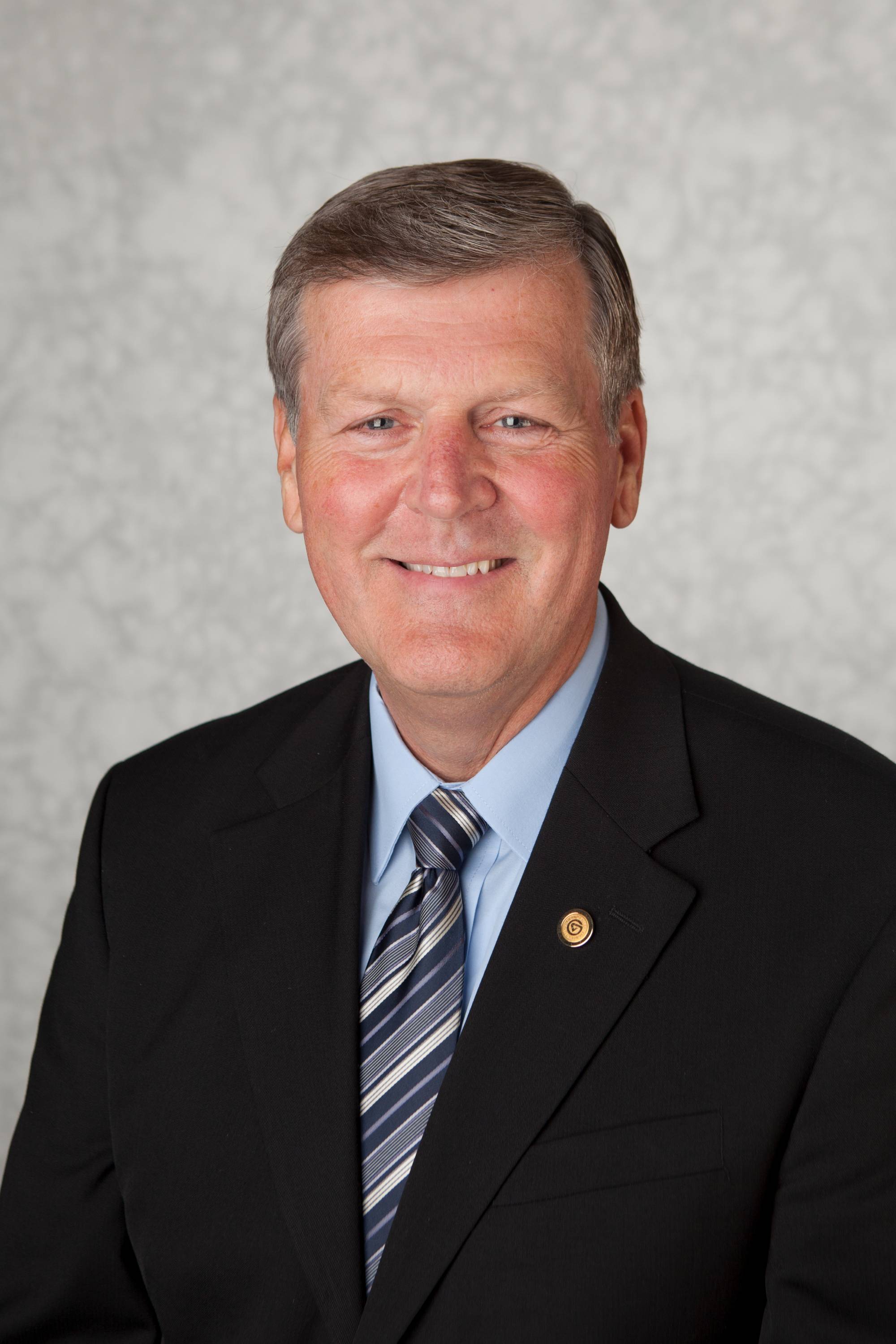
President Thomas J. Haas
Like many other institutions of higher education, shrinking public funding has meant higher tuition costs at Grand Valley, although tuition and fee growth at the university has been relatively low over the past decade when compared to peer institutions. Enrollment growth has continued to be strong, indicating students perceive Grand Valley as a good value (agreeing with national ranking systems that repeatedly list GVSU among "America's Best College Buys").
During his first speech at his investiture, Haas introduced what would become a very familiar word during his administration. "Because we are a public university," he told the Grand Valley community, "we are accountable for what we do. A degree from Grand Valley should rightly be considered a public good. It is a promise for our students and to our society." Under his direction, the university produced the 2007 Accountability Report, providing for the first time a public review of the university's academic and economic performances, including the proper use of resources, and demonstrating the university's ability to educate successful students in the state of Michigan.
The Accountability Report was conceived for taxpayers, legislators, students and parents to show that Grand Valley is a responsible steward of resources, but the project also has earned national attention for transparency and value, and was featured in the magazine of the Council for Advancement and Support of Education as a model for other institutions. The report is integrated with the ongoing strategic planning and positioning processes initiated by Mark Murray, Gayle Davis and Pat Oldt, which can be followed at www.gvsu.edu/strategicplanning, and now includes the 2010-2015 document.
Another area that President Haas was determined to address upon his arrival at Grand Valley was diversity and inclusion. The University had made some progress in previous decades toward improving multicultural awareness and activities, with both student organizations and administration positions geared toward creating a rich and diverse learning environment. By 2001, the University's Minority Scholarship Fund had reached $1 million, and in 2005, President Murray commissioned a survey that focused on personal characteristics like sexual orientation and beliefs surrounding religion and politics. Questions centered around climate, negative treatment and perception of Grand Valley's commitment to diversity.
President Haas brought a unique perspective to the issue. In a 2010 interview with the author, he described his experience with both military service and the academy. "The military is a leader in diversity because the building of a team to accomplish a mission demands it," he said. It was a fortunate coincidence that he arrived at Grand Valley just as it was becoming a critical issue, he explained. "I believe passionately that diversity is an intellectual asset."
In November 2007, Haas appointed a Diversity Assessment Committee to research current campus diversity initiatives and recommend ways to comply with Proposal 2 (Michigan's 2006 voter-driven constitutional amendment banning public schools from discriminating against, or granting preferential treatment to, any individual or group on the basis of race, sex, color, ethnicity, or national origin in the operation of public employment, public education, or public contracting) and to increase diverse representation for a rich learning environment. He also had been leading the process to establish a new administrative division. Dr. Jeanne Arnold, Vice President for Inclusion and Equity, began her duties in January 2008, one of the first chief diversity officers hired at the senior leadership level by a regional four-year public university.
President Haas made diversity part of the strategic planning imperative. "I'm a chemist," he said in the 2010 interview. "I think in systems. We could develop a predictable model that comes out of strategic planning." The process was not a result of Proposal 2, he explained. "I was disappointed that it passed, but not discouraged." His initiatives had begun before that campaign, and have resulted in a strong value statement in the current strategic plan: "The institution values a multiplicity of opinions and backgrounds, and is dedicated to incorporating multiple voices and experiences into every aspect of its operations. We are committed to building institutional capacity and strengthening our liberal education through providing an inclusive environment for all of our Grand Valley constituents."
VI. A Comprehensive University
In September 2008, Grand Valley re-dedicated its 35-year-old Honors College in celebration of its move into a splendid new living and learning center named for retired Provost Glenn A. Niemeyer. The new facility houses 450 students, more than twice the former Honors College living center, along with classrooms, offices, and meeting and study areas. Established in 1973 by Niemeyer, along with Thomas Cunningham and Mary Seeger, the Honors College offers academically motivated students an interdisciplinary curriculum and other challenges.
In October, the Honors College was named for Frederik Meijer in recognition of a gift that established scholarships for first-generation college students, an endowed chair, an ongoing lecture series, and career development opportunities for graduate students.
The following summer, the building was awarded silver certification in the U.S. Green Building Council's LEED rating system, close on the heels of the announcement that the new Indoor Turf Building had earned LEED Gold certification. The building opened in Fall 2008 to provide more recreational opportunities for students, as well as Movement Science classes and intercollegiate athletics. It was Grand Valley's second building to be awarded the coveted status (the first was the Michigan Alternative and Renewable Energy Center, covered earlier in this history).
As mentioned previously, Grand Valley was becoming nationally renowned for its sustainability efforts, and was the only Michigan school cited in the Kaplan College Guide 2009 list of "cutting-edge green" colleges and universities. The university was the recipient of the USGBC’s 2008 Recognition Award and the Sustainable Endowments Institute’s 2008 National Sustainability Innovator Award; the Mark A. Murray Living Center was the first university student housing unit in Michigan to receive an Energy Star designation from the U.S. Environmental Protection Agency.
The Grand Valley State University of today is a large comprehensive institution that is much more complex than can be summarized in a narrative history such as this. The reader is invited to delve further into its historical story by checking the Sidebar sections accessible at the top of this page, and by visiting the individual pages of each college and school at the University on this website, many of which contain valuable historical information.
VII. Shaping Our Future: GV Celebrates 50 Years
On June 10, 2008, the largest fundraising initiative in Grand Valley's history was announced. Shaping Our Future is a $50 million campaign to fund multiple capital and endowment priorities at Grand Valley. "Our top priority continues to be a new library," explained President Haas, "but this will not be the kind of library most of us are used to. We need to replace the library that was built in Allendale to serve a couple thousand students with a new kind of library for the information age. It will serve our 24,000 students looking for tools they’ll need to build their own futures and contribute to the overall economy of the region.”
In addition to the Learning and Information Commons, the $50 million campaign targets funds for student scholarships, faculty chairs and academic support, endowments for the Hauenstein Center for Presidential Studies and the Dorothy A. Johnson Center for Philanthropy and Nonprofit Leadership, along with support for the Movement Sciences and Indoor Recreation Building and the John C. Kennedy Hall of Engineering in Grand Rapids.
By spring 2009, more than 70,000 students had graduated from Grand Valley, with nearly half that number living or working in the West Michigan tri-county area. The number of graduates has nearly doubled in the last ten years, with an enrollment growth rate of about 42%. And, nearly all GVSU graduates are employed or in graduate school, with 94% remaining to work or study in Michigan.
As this history of Grand Valley was being researched and written from January-December 2009, the national economy was struggling to recover from its near-collapse at the end of 2008. It is an echo of the many desperate times Grand Valley has weathered through its 50-year history. While previous recessions threatened the university's very existence, the challenge now is to maintain success and growth in a changing environment. "We're examining the curriculum," said Provost Gayle Davis in a 2009 interview. "Are we offering what students need in a changing world? How can we make sure our students are at the top of the list for graduate schools and jobs in this competitive market? That's where liberal education comes in — the job you are trained to do may not exist by the time you graduate. We aim to graduate students who know how to think, how to keep learning. A lot of employers are getting that now. How do you look at things other than credentials — at competencies? This is another crossroads for Grand Valley."
A memorial service was held in September 2009 for L. William Seidman, who had died in May. President Thomas Haas told the community gathered in Louis Armstrong Theater to mourn the founder of Grand Valley about a new commitment to acknowledge his legacy. "Rich and Helen (DeVos) would like to do something directly memorializing Bill and holding up the Seidman legacy very high," he told the audience, announcing a lead gift to launch efforts to construct a new building for the Seidman College of Business.
It's a fitting end to this 50th anniversary narrative of Grand Valley's history to circle around to the beginning and quote Bill Seidman, who set out in the late 1950s with such high hopes, and gathered around him the strength of a community that still keeps Grand Valley strong and growing, shaping our future.
About This History
This history narrative was researched and written from January 2009-February 2010 by Julie Christianson Stivers (Grand Valley Class of '72, Thomas Jefferson College) for the 50th Anniversary website. Most of the information for this history was drawn from University Archives located in the Lemmen Library and Archives in Seidman House on the Grand Valley campus.
Work by Professor Anthony Travis and Professor Lynn Mapes of Grand Valley's History Department for a 1995-97 project was a foundation for the early history included in this narrative.
The project also benefited from work by the University's News and Information Services division for "Grand Valley Celebrates 50 Years of Shaping Lives," a 50th anniversary commemorative book available through the Grand Valley Bookstore or online through this website. Many interview clips selected for this narrative came from the 50th Anniversary Video History Project. Matthew E. McLogan, Vice President for University Relations, was the interviewer in those videos, except for two which were conducted by Chris Barbee, Director of Alumni Relations. The author also wishes to thank the many people in the University community who responded to requests for information.
The author would especially like to thank Teri Losey, Special Assistant to the President and Chair, 50th Anniversary Steering Committee, for initiating this project and for her collaboration and guidance throughout its completion. Valuable consultation also was provided by the advisory group for the project: Gayle Davis, Provost and Vice President for Academic Affairs; Professor Rob Franciosi, Department of English; and Jon Jellema, Associate Vice President for Academic Affairs. Dave Poortvliet and Kelley Rogers have been amazingly patient web design collaborators. Many thanks as well to Robbi Osipoff for coordinating anniversary activities, and to Sherry Bouwman for help with the archives of News and Information Services. Many Grand Valley faculty and staff provided useful information and encouragement for this project, but special thanks to Dean Emeritus Mary Seeger and President Emeritus Arend D. Lubbers for their long view.
About the Author
Julie Stivers is the author of "The Presence of the Past: The Public Museum of Grand Rapids at 150," published by the Museum in celebration of their sesquicentennial anniversary in 2004. After graduating from Grand Valley State Colleges, she worked in public television and for the Grand Rapids Symphony before becoming the founding editor in 1982 of On-The-Town, a magazine of arts and entertainment in West Michigan. In 1995 she became writer and editor of Discoveries, the newsletter of the Public Museum of Grand Rapids. She has been a writer for many nonprofit and corporate clients in Grand Rapids, and has served in volunteer leadership roles for a number of area arts organizations.