
Hybrid Program for Master of Public Health, M.P.H.
Grand Valley State University's Master of Public Health (MPH) degree, offered by the School of Interdisciplinary Health, prepares students by enhancing career opportunities through the acquisition of quantitative and qualitative problem solving research skills, service, and experiential learning. Public health professionals promote good health and prevent disease within communities. Our MPH Hybrid programs, with cohorts meeting in Grand Rapids or Traverse City, provide graduate and community-based education and research grounded in social justice to help meet these goals.
Join one of our Online (webinar) MPH Information Sessions or an MPH Open House to learn more about the MPH Hybrid Programs.
MPH Online/Hybrid Program
The Master of Public Health (M.P.H.) Hybrid Program at Grand Valley State University is available to students interested in pursuing either the Epidemiology or Health Promotion emphasis.
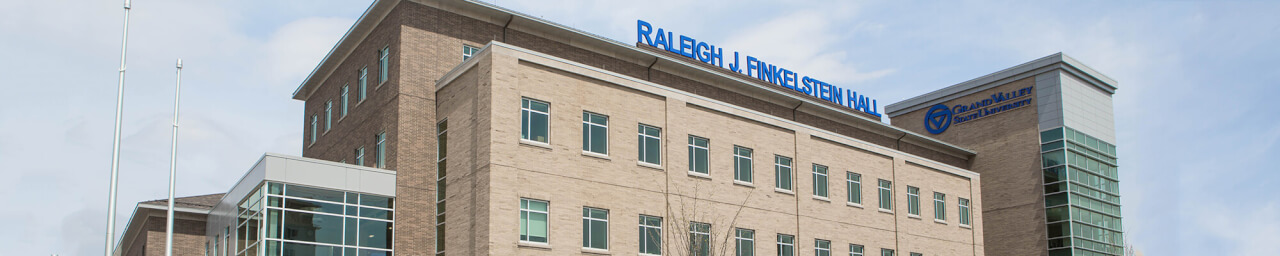
The MPH Hybrid Program is a high-quality, fully-accredited, MPH curriculum with flexibility and convenience. Beginning with the Fall 2026 cohort, students will have one required in-person meeting, a two-day Summer Public Health Intensive at the program's midpoint (tentatively planned for July). Students in the Grand Rapids cohort meet at Raleigh J. Finkelstein Hall on GVSU's Health Campus in Grand Rapids, Michigan. Students in the Traverse City cohort meet in the Beckett Building on GVSU's Traverse City campus (Northwestern Michigan College's Front Street Campus). The in-seat meeting will include lectures, activities, community engagement, and service-learning opportunities. *Some semesters may require a synchronous online meeting.
Undergraduate students, eligible to apply for the Allied Health Science B.S. - Master of Public Health M.P.H. Combined Degree program or the Exercise Science B.S. - Master of Public Health M.P.H. Combined Degree, may apply for either of the Hybrid Cohort MPH program locations.
Related Pages
Grand Rapids Hybrid Cohort
Hybrid students traveling to Grand Rapids (MI) for the Summer Intensive will find several lodging, restaurant, and free or inexpensive transportation options convenient to our GVSU Health Campus location. Grand Rapids is within a few hour's drive from several cities, including Detroit, Toledo, Fort Wayne, South Bend, and Chicago. Grand Rapids is also easily accessible via air service to the Gerald R. Ford International Airport, Amtrak rail service, and the Greyhound bus. Learn more about traveling to Grand Rapids. Many area hotels offer discounted rates to GVSU students who are commuting.
Traverse City Hybrid Cohort
Hybrid students, especially those from northern Michigan, may prefer the convenience of travelling to Traverse City (MI) for the Summer Public Health Intensive. The hybrid cohort meets in downtown Traverse City, on the NMC Front Street campus, alongside several other GVSU programs. Traverse City is a popular destination and features numerous accommodations and amenities for visitors. Explore TraverseCity.com for more information.
Why Should I Select the Hybrid Option?
There are many reasons our online hybrid option might work best for you:
- adult learner or nontraditional student
- prefer the flexibility and convenience of online learning
- family and/or job commitments conflict with traditional in-seat program meetings
- unable to relocate - commuting only once, to either Grand Rapids or Traverse City, puts less demand on your finances and possibly your vehicle
- financial: out-of-state students may find GVSU's program-based tuition rate more affordable than in-state tuition at home
About Hybrid Learning
Students in the MPH Hybrid Program should expect to spend as much time in study and preparation, or perhaps more, than in a completely classroom-based course. Students are managing their own learning using the information and resources located in Blackboard.
This requires that the student be self-disciplined, motivated, and have some skills using a networked computer and a Web browser. At a minimum, the student should have experience using email, sending email attachments, and browsing the internet. The content and rigor of an online course offered by GVSU is equivalent to an on-campus, in-class version of the same course.
If you are considering the MPH Hybrid Program, you might want to explore GVSU's Online Education website. This site will help to prepare you for what is involved in being an online/hybrid student. You will learn the features of Blackboard, determine if your computer meets the technical requirements, and hopefully get a sense of whether learning online is right for you!
Each student will be given a Username and a Password for Blackboard before the first day of the MPH Hybrid Program. If you need assistance with your Username and Password, please contact the Information Technology department at (616) 331-2101.
Technology Requirements for Online/Hybrid Courses
Technology Proficiency and Computer Requirements
All online courses require access to the Internet. Unless you will be traveling to a campus computer lab, you will need to have access to your own computer and a high-speed Internet Service Provider. A webcam and a headset or microphone for your computer is recommended and may be required.
You should be proficient in the following:
- Basic computer skills
- Sending/receiving email
- Using a web browser
- Finding resources through search engines
- Downloading and installing software
- Using word processing, presentation software, or other productivity applications
- Experience/familiarity with a variety of file formats
- Familiarity with using document scanners or document scanning apps to convert handwritten work to a PDF file
- The ability to be self-directed in learning new technology skills
These skills, as well as others, are covered in the “Essential Tech Skills” module that is a part of the optional, self-paced “Digital Skills for College Success” course that all students are enrolled in.