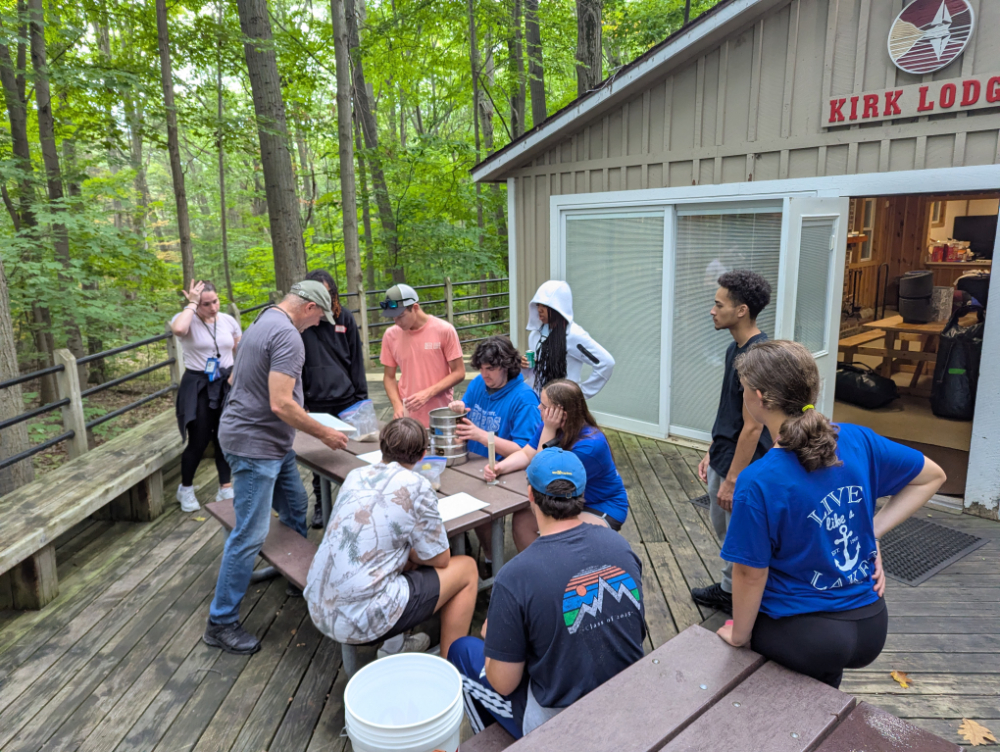
Students in a First-Year Learning Community spent a weekend in
September at Kirk Lodge.
Photo Credit:
Eric Covey
Two faculty members with First-Year Learning Community (1YLC) courses
planned experiential learning activities for their students during a
trip to Kirk Park in late September.
Eric Covey, affiliate faculty of interdisciplinary studies, and Peter
Riemersma, associate professor of geology, and other faculty members
were involved in creating a memorable weekend for students in the
paired courses: INT 100 and GEO 105. 1YLC is an optional program for
first-year students in which courses are paired together around a
shared theme.
At the Lake Michigan beach, Riemersma introduced students to the
importance of Marram Grass. They explored the process of dune
formation by conducting experiments to identify the different types of sand.
"They returned from their short hikes with a very high level of
enthusiasm that was a joy to witness," Covey said.
Rob Larson, affiliate faculty of biology and member of the
Nottawaseppi Huron Band of Potawatomi, introduced students to the
Indigenous concept of Two-Eyed Seeing, which combines traditional
ecological knowledge with Western knowledge.
After Covey introduced the concept of citizen science,
interdisciplinary studies faculty members Danielle Demuth and Malik
Raymond served as guides for a bird-watching hike.
"Peter and I agreed that the Kirk Park lodge was an ideal place
for a nearby experiential experience, especially in the context of the
FYLC goal of creating a sense of belonging among students," Covey said.
Participants spent 10 weeks in an accelerator program offered by the DeVos Center for Entrepreneurship & Innovation, in partnership with GVSU's Northern Michigan Region.
Featured
July 14, 2026 (Volume 49, Number 19)
Article by
Shannon Owen