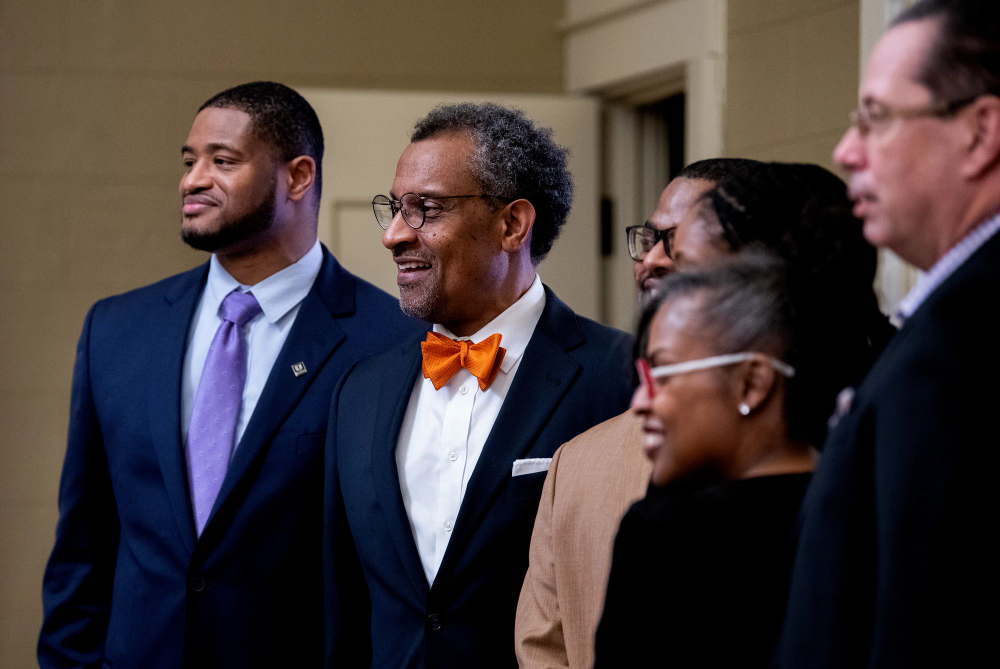
Bobby Springer, second from left, is pictured with other members
of the MLK Partnership Committee and panelists who participated in
'A Call to Courageous Community Action' on February 4 at Wealthy
Theatre in Grand Rapids.
Photo Credit:
Kendra Stanley-Mills
Bobby Springer is the director of Grand Valley's GEAR UP program, a
college access initiative providing students and families with the
resources they need for college success. He is also a longtime
co-chair of the committee that plans campus events to commemorate the
legacy of the Rev. Dr. Martin Luther King Jr.
Below, Springer discusses Black History Month and Grand Valley's MLK
Commemoration Week, and how these observances connect to the
university’s broader mission.
What does Black History Month mean to you personally? Black History Month represents both remembrance and
responsibility. It honors the extraordinary role Black individuals
have played in building this country through innovation, leadership,
resilience and sacrifice, while also reminding us that history is
still being written today.
For me, it is about understanding truth through knowledge. Until we
fully learn the facts, triumphs, challenges and truths, we cannot
fully appreciate the value of the lessons and contributions made by
Black individuals or the progress still ahead. Throughout my career in
higher education and multicultural education leadership, I have seen
how education, storytelling and intentional dialogue help communities
move beyond awareness to opening doors to empathy, collaboration and
growth. Black History Month invites us to reflect not only on past
achievements, but on how we each contribute to shaping a more
equitable future.
How can the campus community engage in Black History Month in
ways that are meaningful and more than a single calendar event? Meaningful engagement begins with participation, but it should
not end there. Attending campus and community programs is an important
first step because it builds shared understanding and collective connection.
Going deeper requires curiosity and personal investment. I encourage
students, faculty and staff to explore the research, scholarship and
lived experiences that highlight the many ways Black individuals have
influenced education, health care, business, science, the arts and
public service. When learning extends beyond the commemorative
calendar and becomes part of everyday dialogue, it strengthens
institutional culture and creates lasting impact.
As someone who has spent decades mentoring students and shaping
multiculturalism, I believe that true engagement happens when we
connect history to action through mentorship, inclusive engagement
practices and creating spaces where every voice feels valued and heard.
You have worked with Grand Valley’s MLK Executive Planning
Committee for many years. What does the community response to MLK
Commemoration Week mean to you? After more than 25 incredible years of co-chairing the annual
commemoration on campus, my excitement and passion remain as strong as
they were on day one. Each year, I am deeply honored to help bring
awareness to Dr. King’s legacy — a legacy that continues to challenge
us to dream bigger, lead with courage and build communities grounded
in justice and compassion.
Seeing the campus and community partners come together reminds me
that this work is bigger than any single person or program. The
community response affirms that Dr. King’s message of nonviolence,
unity and collective responsibility still resonates deeply.
This year’s theme, "Mission Possible II: Building Community,
Uniting a Nation the Nonviolence Way," reflects a shared
commitment to move forward together. Dr. King’s words, “Injustice
anywhere is a threat to justice everywhere,” continue to guide my
multicultural philosophy.
Co-chairing this celebration is not simply an assignment; it is a
labor of love and a reflection of my lifelong dedication to building
bridges across differences and empowering others through education and
service. Through lived experiences, my belief remains that education
is one of our strongest tools for transformation.
How do Black History Month, and similar commemorative
months connect to Grand Valley’s broader commitments and values? Black History Month aligns naturally with Grand Valley’s
commitment to education, inclusion and community engagement. The
university’s continued investment in cultural programming reinforces
its understanding that learning extends beyond the classroom. These
programs enrich the campus experience, foster dialogue and help
cultivate current relationships and future student leaders who are
preparing to thrive in a diverse and interconnected world.
When institutions support commemorative months with intention and
resources, they demonstrate that history, culture and belonging
stimulate intellectual curiosity, which are central to the academic
mission. Through sustained collaboration between campus leaders,
students and community partners, Grand Valley continues to model how
higher education can honor the past while preparing future generations
to lead with purpose.
Participants spent 10 weeks in an accelerator program offered by the DeVos Center for Entrepreneurship & Innovation, in partnership with GVSU's Northern Michigan Region.
Featured
July 14, 2026 (Volume 49, Number 19)
Article by
Shannon Owen