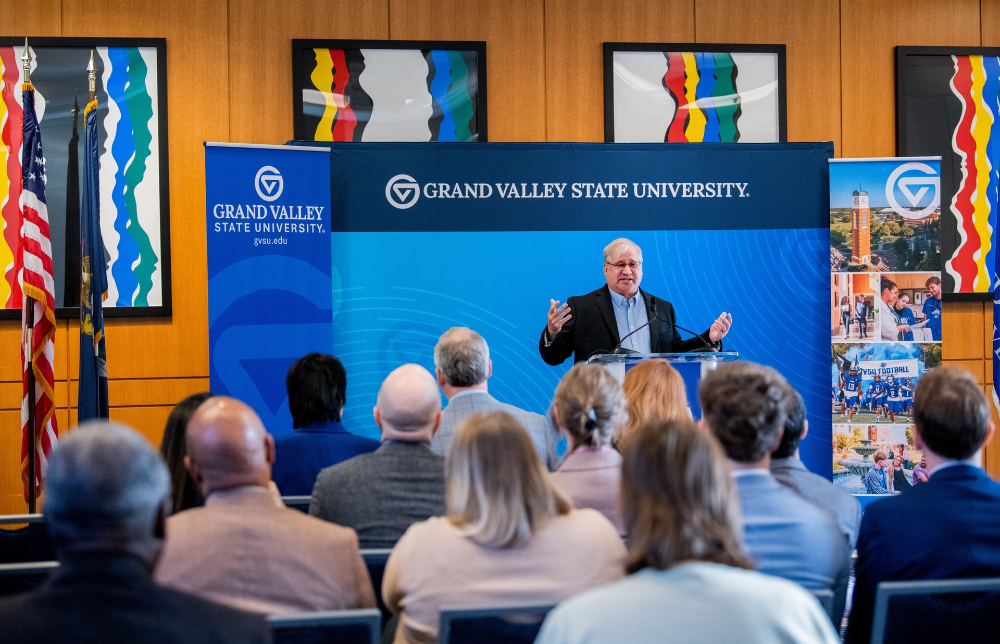
Paul Isely, associate dean and professor of economics, discusses
the university's economic impact report during a news conference in
early October at the L. William Seidman Center.
Photo Credit:
Kendra Stanley-Mills
Grand Valley’s latest economic impact
report reveals a powerful story: Nearly 100,000 alumni live and
work in Michigan, fueling one in 20 college-educated jobs statewide.
Ranked No. 1 in Michigan for talent retention and in the top 1%
nationally, GVSU returns $31 for every $1 taxpayers invest.
Paul Isely, associate dean and professor of economics, and Dawne
Bell, executive director of Economic Development and Public-Private
Partnerships, discuss why economic impact matters and what’s next.
What sparked the idea for the report and why now? Isely: The state invests in GVSU, and it’s important to show the
value that investment creates for taxpayers. Our impact is significant
compared to many other ways the state could spend money. Bell:
This is GVSU’s first economic impact study in over 10 years. It shows
what faculty and staff make possible every day: a student experience
that drives talent retention for our state, strengthens communities
and generates exceptional return on investment.
What’s one part of this project that you brag about at a
dinner party? Isely: The impact of our alumni was larger than I expected.
Nearly 100,000 graduates live and work in Michigan, powering one in 20
college-educated jobs statewide. That shows two things: GVSU enhances
the state through engaged citizens, and students get real value for
every dollar they invest.
Bell: I brag about Paul.
Isely: Aw, thanks.
Bell: When I talk about the powerful data from this report with
leaders outside the university, I consistently hear their surprise.
GVSU’s role as an economic driver for Michigan is not yet widely
known. We’re thankful to everyone across GVSU for helping to amplify
GVSU’s impact.
What do you hope faculty and staff take away from this report? Isely: I hope they take away that they have created a student
experience that benefits graduates financially and helps the state
grow. Bell: You don’t have to be an economist to share this story.
Every program, every partnership contributes to these outcomes.
What’s next for this work? Isely: Taking this deeper and mapping where benefits occur and
connecting them to specific GVSU activities. Bell: Continuing to
tell the story. This report is a starting point for conversations with
policymakers, community and business leaders, and supporters about
impact, innovation and opportunity.
Participants spent 10 weeks in an accelerator program offered by the DeVos Center for Entrepreneurship & Innovation, in partnership with GVSU's Northern Michigan Region.
Featured
July 14, 2026 (Volume 49, Number 19)
Article by
Shannon Owen