

Evolving Better Networks: College of Computing Receives Research Grant to Improve Wi-Fi Performance
Published August 18, 2026 by Sarah Schaible
Slow Wi-Fi can bring everyday life to a frustrating halt. A video buffers, a webpage takes forever to load or a large file download seems to crawl. For businesses and organizations that depend on reliable networks, performance problems can have even greater consequences.
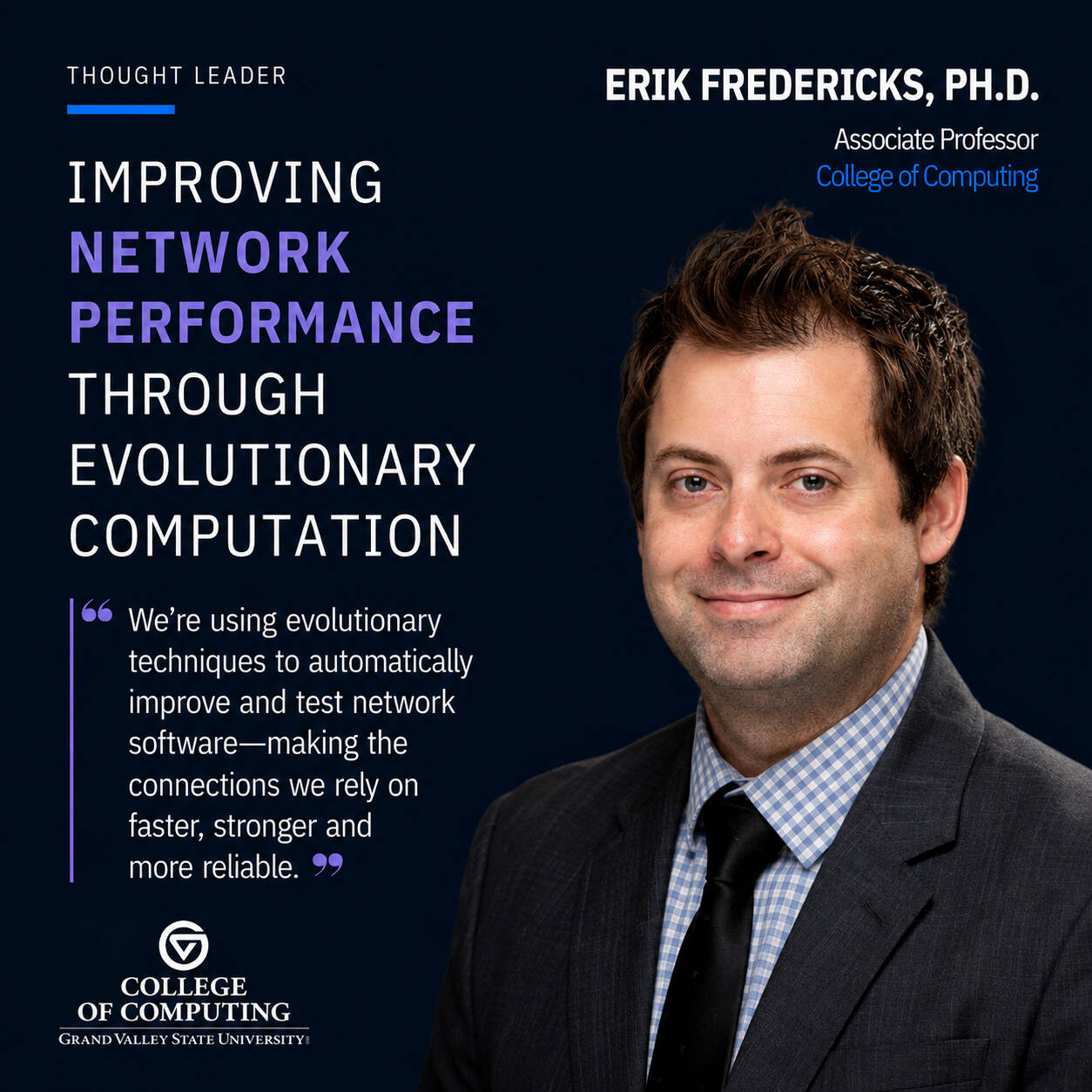
Grand Valley State University College of Computing Associate Professor Erik Fredericks is exploring a new way to improve the software behind the networks we rely on every day. His research project, “Improving Network Performance via Evolutionary Computation,” will use techniques inspired by biological evolution to identify ways to make open-source network software faster, more reliable and more resilient.
The research focuses on the software that operates common network equipment such as home routers, switches, mesh networks and wireless access points.
“Evolutionary computation gives us a way to search through an enormous number of possible solutions to a problem,” Fredericks explains. “We can use that approach to find improvements to software that might be difficult or impossible to discover through traditional methods.”
Teaching software to evolve
At the heart of the project are two evolutionary computation techniques: genetic improvement and search-based software testing.
Genetic improvement applies concepts from evolutionary computing to source code. Rather than relying solely on a developer to identify and manually implement an improvement, the process can automatically explore potential changes to existing software and evaluate whether those changes improve performance.
In this project, Fredericks will investigate whether genetic improvement can identify code patches that make network software perform better under realistic conditions.
The second technique, search-based software testing, takes a different approach: instead of trying to improve the software, it tries to break it.
Search-based testing can generate and evolve inputs designed to push software in unexpected ways, helping researchers uncover bugs and weaknesses that traditional testing may not find.
Together, the techniques provide a complementary approach. One searches for ways to improve software while the other searches for ways to expose problems.
From the home network to real-world impact
To evaluate potential improvements, Fredericks' research team will model realistic network environments. Imagine a home where several devices are streaming video, others are downloading large files and another is being used to browse the web. Researchers can establish a baseline for how the network performs under those conditions and then test whether automatically generated software improvements lead to measurable gains.
The project will also investigate whether search-based testing can uncover previously unknown bugs in existing software or in newly generated versions of the software.
The goal is not simply to make one network perform better. By focusing on open-source software, the research has the potential to benefit a much broader community of developers, researchers and network users.
All software, testing artifacts and documentation produced through the project will be released as open source through Fredericks' GitHub organization, allowing others to build on the work.
Connecting research with the real world
The project reflects the College of Computing's emphasis on research that addresses challenges people and organizations encounter in their everyday use of technology.
For Fredericks, that means looking beyond theoretical improvements and asking whether evolutionary computation can produce solutions that work in the environments where people actually depend on them.
The research will contribute to the growing field of search-based software engineering, with planned submissions to leading conferences including the International Conference on Software Engineering (ICSE), Foundations of Software Engineering (FSE), Symposium on Search-Based Software Engineering (SSBSE), Automated Software Engineering (ASE), and the Search-Based and Fuzz Testing Workshop (SBST).
The team also plans to pursue journal publications in venues including Automated Software Engineering, IEEE Transactions on Software Engineering and Empirical Software Engineering.
By applying evolutionary ideas to the software that powers everyday networks, Fredericks' research is exploring a fundamental question: What if software could help discover its own path toward becoming better, faster and more reliable?
For the millions of people and organizations who depend on a stable network every day, that could make a meaningful difference.