


Research Intensive Course Designation
Research-Intensive (RI) courses actively engage students in research and scholarly practice as a pedagogical approach to teaching skills and content. RI Courses are one mechanism through which students can participate in undergraduate research and the scholarly process.
The Council on Undergraduate Research (CUR) defines undergraduate research as “a mentored investigation or creative inquiry conducted by undergraduates that seeks to make a scholarly or artistic contribution to knowledge.” Undergraduate research can take many forms, including co-curricular research and course-based research. Course-based Research Experiences (CUREs) are research, scholarly, and creative projects in the curriculum (Hensel, 2018b).
CUREs include five elements of authentic research:
- Engage students in disciplinary scholarly practice
- Emphasize collaboration
- Examine broadly relevant topics
- Expose students to the process of discovery by exploring novel questions
- Integrating the iterative process of scholarship, so students see how they can contribute to the process of discovery (Auchincloss et al., 2014).
Criteria for the Research-Intensive Designation
Classes and courses that seek a Research-Intensive Course Designation should integrate undergraduate research as a major part of the coursework and learning experience. To be considered Research-Intensive, a class or course must include the following:
1. At least 30% of the work and class grade should involve research that the student completes under the supervision of their instructor, either individually, in pairs, or as a part of a group effort.
2. The coursework should include at least one form of dissemination of the research, which could include authoring a report or paper, designing and holding presentations, engaging in critique, exhibiting and/or performing.
3. The dissemination piece should engage individuals and groups beyond the classroom, as appropriate in discipline (examples include but are not limited presenting at SSD, invite external audience to provide feedback, author a report directed toward an external agency, among others).
4. Students’ course-based research projects may include field work, data collection, literature reviews, report drafting, performances, creative works or other outcomes, or other forms of scholarly expression as defined by the discipline.
5. Assignments that include reflection on what the student is learning through the inquiry-based process about themselves and skills they are gaining in the research process throughout the semester.
Section v. Course-based Model
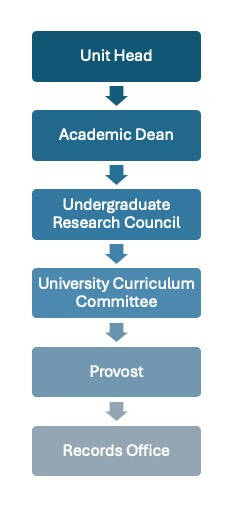
Research-Intensive Courses will be approved by the Undergraduate Research Council (URC) through two pathways: course-based and section-based. First is course-based. This means that a unit, department, or program may submit courses for Research-Intensive Course Designation approval. This means that all instructors of this course will follow the Research-Intensive Designation Requirements. The second pathway is section-based. Section-based approvals mean that the Research-Intensive Designation is approved for a course, but the designation is only applied to the requesting instructor’s sections of that course. This means that if there are multiple sections of a particular course offered during a given semester, only the approved instructor’s class will receive the Research-Intensive Designation.
2026/2027 Timeline for Approval
- SAIL Applications Due: November 6, 2026
- Request for Revisions, if needed: November 11, 2026
- Revisions Due: December 4, 2026
- Submitted to Registrar: January 30, 2027
Research-Intensive Instructions for SAIL
- After logging in, select “New Proposal” and then select either “Change Course” or “New Course” (whichever is relevant to you).
- After submitting the necessary information, click edit under “Required Information.”
- For a new course, this will be editing “New Course” under “Required Information.”
- On this page, you will be prompted to select “Type of Change,” to which you should pick “How the Course Fits into the Curriculum (including General Education, Community Based Learning, SWS).”
- For a new course, this is under “Course is Proposed as”.
- Once you select this option, below, you can select existing course identifiers (on the left) and the type of changes (on the right). Research Intensive (RI) should be included here as an option. Once you select RI as the type of change, you will see the prompts required for the RI proposal.
Research-Intensive Proposal Questions in SAIL
- Number of RI-designated sections to be offered per semester by the applicant.
- Is this a course-based or section-based application?
- What semester(s) will this RI course be offered?
- Description of CURE
- Describe the research, inquiry, or creative endeavor explored in the class.
- Why this type of research is most suitable for this course.
- Types of students who typically take the class.
- Application of Learning
- Explain how students will actively engage in the research process (use examples of content, assignments, assessments, etc.).
- Demonstrate how the allocation of work/class grade attributed to research totals at least 30% (use examples of content, assignments, assessments, etc.).
- Describe the plan for dissemination of the research and how the process of dissemination engages individuals and groups beyond the classroom.
- Reflection
- Identify and explain how students will utilize guided reflection for their learning and growth throughout this RI Experience.
Getting Research Intensive Attributes on CourseDog
Below is a step-by-step guide for getting the Research Intensive (RI) Attribute listed in CourseDog
CourseDog Guide
Offering a Research-Intensive Course Designation aligns with GVSU’s mission to offer an empowered educational experience for students (e.g., Reach Higher 2025 and the CLAS Voyage as two examples). Students who have enrolled in CUREs do not currently have a way to officially confirm the research experiences they have had in the classroom. Adding a Research-Intensive Designation would allow students to officially “claim” their undergraduate research experience when applying to research positions on campus, or after GVSU when students apply to graduate school or seek employment.
Adding a Research-Intensive Designation would allow students to easily find undergraduate courses that include research experiences. Although OURS works tirelessly to connect students with research opportunities, not all students have access, time, and/or desire to complete independent research work on faculty-led research. Making CUREs more widely advertised will connect students with research experiences and give students the language needed to reflect and discuss their learning experiences.
Teaching CUREs often involves more time resources for faculty members, and this labor goes largely unrecognized in units, colleges, and at the university. Adding a Research-Intensive Course Designation names, recognizes and elevates this aspect of the workload of faculty members. Moreover, offering a Research-Intensive Course Designation will facilitate collaborative opportunities between faculty members who frequently do course-based research with students.
Adding a Research-Intensive Course Designation would also allow faculty to market their courses to students interested in undergraduate research experiences. Along the same lines, the Research-Intensive Course Designation would also redirect students from enrolling in the course if participating in a research experience does not align with their academic goals or is not appropriate for them for a variety of factors.
GVSU increasingly recognizes the importance of high impact practices, which includes undergraduate research (e.g., Reach Higher 2025 as well as the CLAS Voyage as two examples). Providing a Research-Intensive Course Designation would create institutional understanding of what course-based undergraduate research looks like through naming and providing language around what course-based research is.
Offering a Research-Intensive Course Designation would also allow the University and its colleges to capture how many undergraduate research experiences occur more easily and accurately on campus. Collecting data on CUREs is crucial when applying for external grants and relaying accurate information to stakeholders to support continued implementation of high impact practices on GVSU’s campus. In addition, a Research-Intensive Course Designation would allow the institution to assess learning outcomes related to student research, understand how student research experiences relate to student success and retention, and more easily identify how to support faculty who provide students with course-based research experiences.
Moreover, many universities already offer a Research-Intensive Course Designation, and adopting such a designation would align GVSU with other institutions focused on providing students with high impact learning experiences.
Alkaher, I., & Dolan, E.L. (2014). Integrating research into undergraduate courses: Current practices and future directions. In D. Sunal, C. Sunal, D. Zollman, C. Mason, and E. Wright (Eds.), Research in Science Education: Research Based Undergraduate Science Teaching. Information Age.
Auchincloss, L.C., Laursen, S.L., Branchaw, J.L., Eagan, K., Graham, M., Hanauer, D.I., Lawrie, G., McLinn, C.M., Pelaez, N., Rowland, S., et al. (2014). Assessment of course-based undergraduate research experiences: A meeting report. CBE - Life Science Education, 13, 29–40.
Bangera, G., & Brownell, S.E. (2014). Course-based undergraduate research experiences can make scientific research more inclusive. CBE - Life Sciences Education, 13(4), 602–606.
Dolan, E. L. (2016). Course-based undergraduate research experiences: Current knowledge and future directions. National Resource Council Commissioned Paper, 1, 1-34.
Fischer, A. E. Immel, K. R., Wilkum, K., & Lee, L. (2021). A taxonomy for developing undergraduate research experiences as high-impact practices. Journal of the Scholarship of Teaching and Learning, 21(1): 84-106.
Freeman, S., Eddy, S.L., McDonough, M., Smith, M.K., Okoroafor, N., Jordt, H., & Wenderoth, M.P. (2014). Active learning increases student performance in science, engineering, and mathematics. Proceedings of the National Academy of Sciences (PNAS), 111, 8410–8415.
Hensel, N. (2018a). Course-based undergraduate research: Educational Equity and High-Impact Practice. Stylus Publishing, LLC.
Hensel, N. (2018b). Crazy observations, audacious questions. In N. Hensel (Ed.), Course-based undergraduate research: Educational Equity and High-Impact Practice (pp. 1-11). Stylus Publishing, LLC.
Kuh, G. (2008). High-impact educational practices: What they are, who has access to them, and why they matter. Washington, DC: Association of American Colleges.
Lee, L., Wilkum, K., Immel, K. R., & Fischer, A. E. (2020). A taxonomy for designing and evaluating high-impact practice experiences. College Teaching, 69(4), 1–11.
Mantai, L., Swain, C., Bearman, M., & Brew, A. (2024). Assessment of student learning in undergraduate research engagement. Higher Education Research & Development, 43(4), 937-951.
Shortlidge, E. E., & Brownell, S. E. (2016). How to assess your CURE: a practical guide for instructors of course-based undergraduate research experiences. Journal of microbiology & biology education, 17(3), 399-408.
Thompson, J.J., Conaway, E., & Dolan, E.L. (2015). Undergraduate students’ development of social, cultural, and human capital in a networked research experience. Cultural Studies of Science Education, 11, 1–32.
What is CUR’s definition of undergraduate research? (n.d.). Council on Undergraduate Research. https://www.cur.org/about/what-is-undergraduate-research/.
If a section of your course is approved as a Research-Intensive Course, and you would like to stop or take a break from teaching it as a Research-Intensive, you can communicate with your unit and the Office of Undergraduate Research and Scholarship (OURS) about this change in status. Your unit can remove the Research-Intensive Course Designation from your course for one or more semesters.
Capstone will be considered on a case-by-case basis. Research Methods courses will be considered for a RI course designation, as such courses are not universally designed with a research component at GVSU.
The impact on Faculty Workload will be minimal. The Research-Intensive Designation will apply to existing courses at Grand Valley State University. Applying to have one’s course labeled with the Research-Intensive Designation is the choice of the faculty member who teaches the section of the course or the unit offering the course. If a faculty member seeks the Research-Intensive Designation, they will have to apply, which will take some time resources. The Office of Undergraduate Research and Scholarship (OURS) will offer support through consultations as well as syllabus or proposal review to faculty or units who wish to apply for a Research-Intensive Course Designation. If a course is designated as a Research-Intensive Course, there will be some assessment work to be completed to make sure the course continues to comply with the Research-Intensive Designation parameters (the parameters are described on pp. 1-3 under Criteria). The Office of Undergraduate Research and Scholarship will have Faculty Fellow appointed to this assessment work to assuage the impact on the instructor’s workload. Assessment is described in greater detail on pp. 7-8 of this proposal. In fact, offering a Research-Intensive Course Designation could reduce certain aspects of faculty workload. The approval of a Research-Intensive Course Designation will create a central repository of all courses that include undergraduate research. This will allow the Office of Undergraduate Research and Scholarship (OURS) to better understand how many CUREs exist on campus. This will help OURS better direct resources toward faculty and units offering these experiences to students. More specifically, OURS will work with faculty to support the development and maintenance of Research-Intensive Courses in several ways. OURS will provide resources to faculty members interested in developing Research-Intensive Courses through one-on-one appointments, as well as Learning Communities (LC), (for example, one LC focused on research intensive courses is occurring during AY 2023-2024 through Pew FTLC). This will facilitate relationships between faculty members to build connections with faculty doing similar work, allowing for the exchange of ideas and potential collaborations that could shift or reduce workload. OURS will also provide Council on Undergraduate Research (CUR) memberships for faculty who currently teach/are interested in teaching Research Intensive Courses. CUR offers an annual meeting, workshops, discussion boards, and other resources for faculty who work in the field of undergraduate research.
Faculty will not be required to complete any additional assessments for Research-Intensive (RI) Courses beyond those that they assign as part of normal practice within the course. Moreover, faculty will not be required to use a particular rubric or submit scores on students’ work related to their research project. As noted earlier, faculty will submit a course syllabus when they apply for a course to receive the Research-Intensive designation. Each year, the Office of Undergraduate Research and Scholarship (OURS) will seek confirmation that the requirements for the research project as described in the syllabus are unchanged or, when necessary, expect an explanation of changes with an updated copy of the syllabus. Program assessment of the Research-Intensive Courses will be completed through The Office of Undergraduate Research and Scholarship (OURS). This assessment will involve compiling data from each syllabus to document the types of research products students are producing and the number of CURES at GVSU. The registrar will provide data on the number of students enrolled in Research-Intensive designated courses to OURS. In addition, program assessment will include collecting data to capture the impact of the Research-Intensive Courses on students’ learning and agency in each CURE. This will include the use of research-based survey instruments or interview and focus group protocols (e.g., Mantai et al., 2024; Shortlidge & Brown, 2016). The Office of Undergraduate Research and Scholarship (OURS) will seek volunteers from enrolled students and faculty instructing Research-Intensive Courses for these data collection efforts. Participation in program assessment is not a requirement for students or faculty.