




STORY BY BRIAN VERNELLIS | PHOTOS BY CORY MORSE
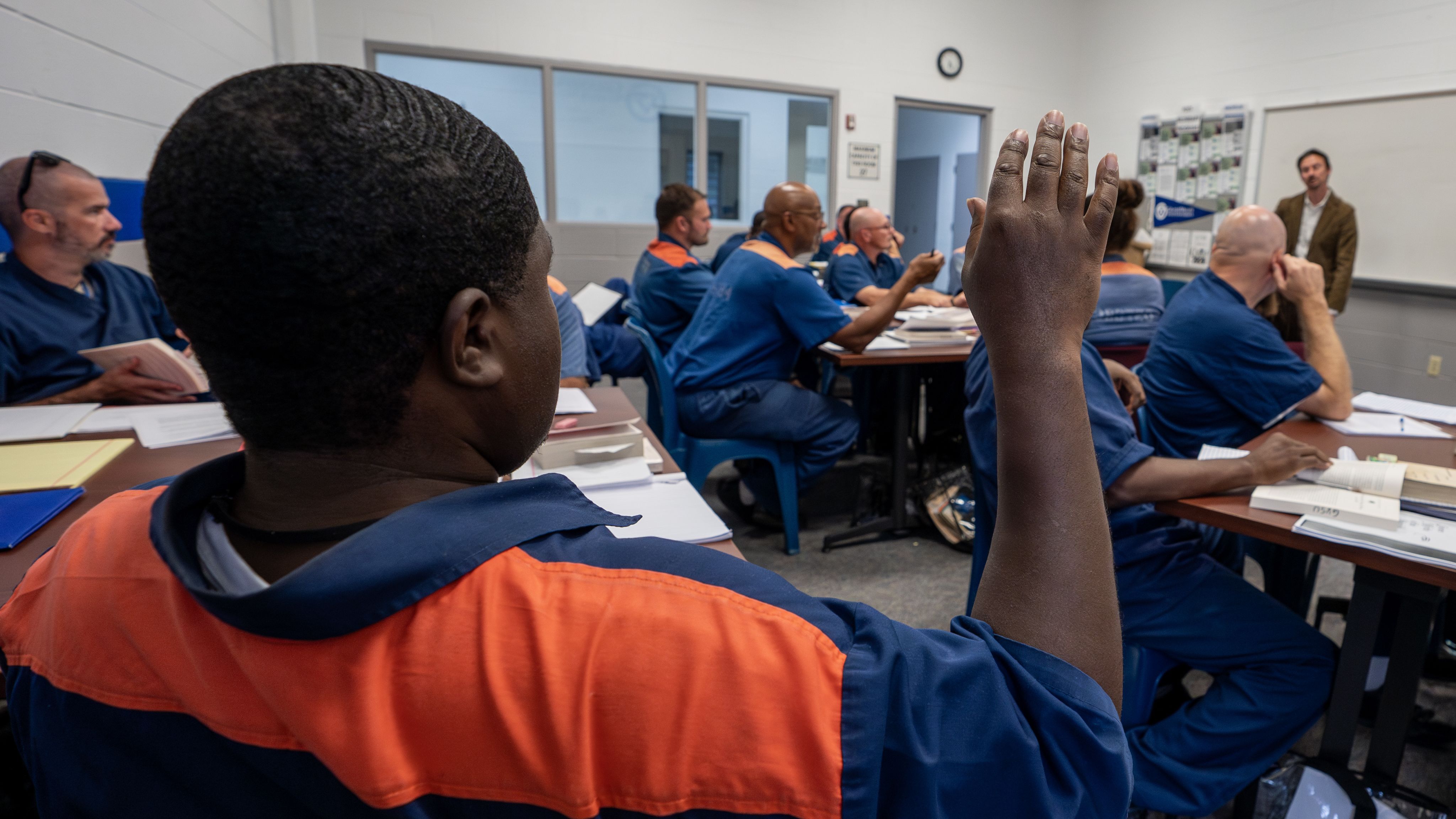
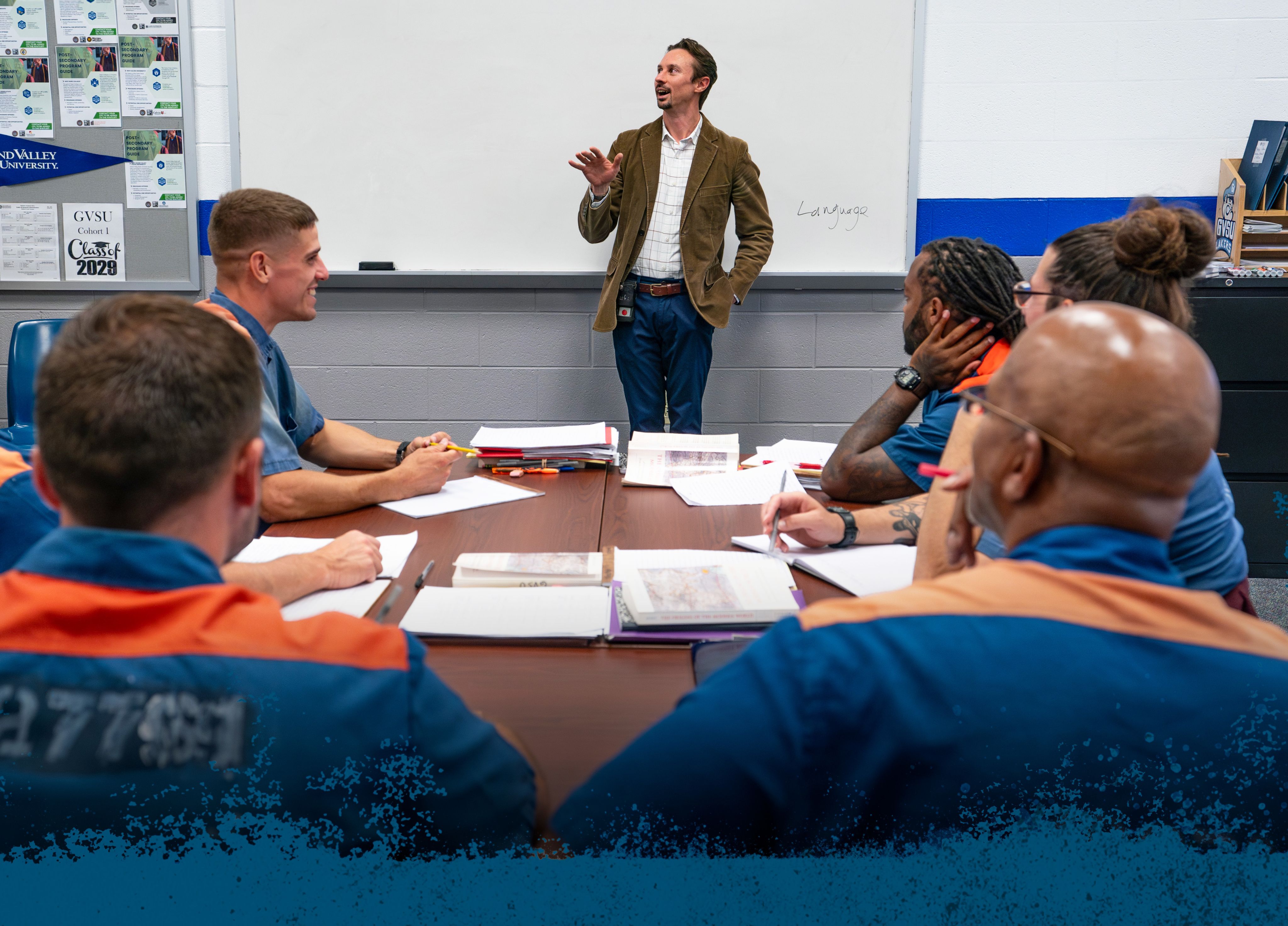
As students begin to file into the classroom, the scene could be mistaken for any other on Grand Valley’s Valley or City campuses.
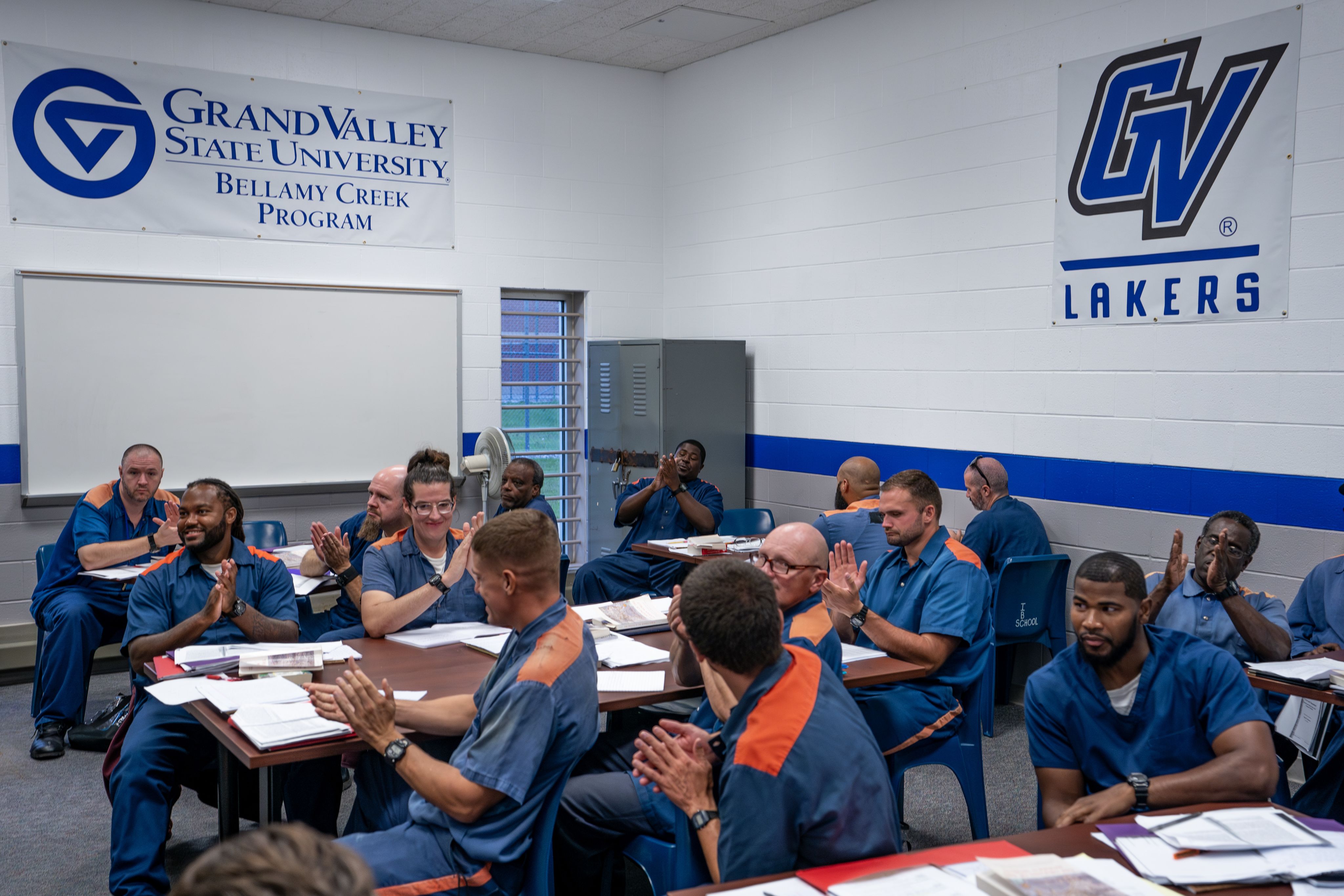
GVSU memorabilia decorates the space. A pennant is pinned to a corkboard. A lectern adorned with a Grand Valley plaque stands at the front of the room. A large “GV Lakers” placard hangs from the back wall.
Beyond the classroom walls lies a starkly different setting. This campus in rural mid-Michigan is surrounded by ring after ring of massive fencing, each topped with razor wire. Watchtowers are strategically placed around the compound’s perimeter and armed officers patrol the grounds.
Back inside the classroom, another large placard provides the reason for the gathering: “Grand Valley State University Bellamy Creek Program.” The students, wearing matching blue and orange jumpsuits, find their seats and are prepared for a lively discussion.
“Imagine a classroom filled with adult learners who’ve done all the reading, including the footnotes and the back cover of the book,” said Aaron Yore-VanOosterhout, director of the Bellamy Creek Program.
“They absolutely want to engage with you because it is the most interesting thing for that day. It is an opportunity for a lot of these students to engage in something completely different from their day-to-day activities.” Welcome to the first year of the Bellamy Creek Program.
Under the supervision of Yore-VanOosterhout, this first cohort of 16 incarcerated students is taking the initial steps toward completing a bachelor’s degree from Grand Valley.
“There was a lot of training to prepare us about the risks of going into this setting,” said Lauren Keough, associate professor of mathematics. “But, once you were in the classroom, it felt like any classroom atmosphere at Grand Valley.”

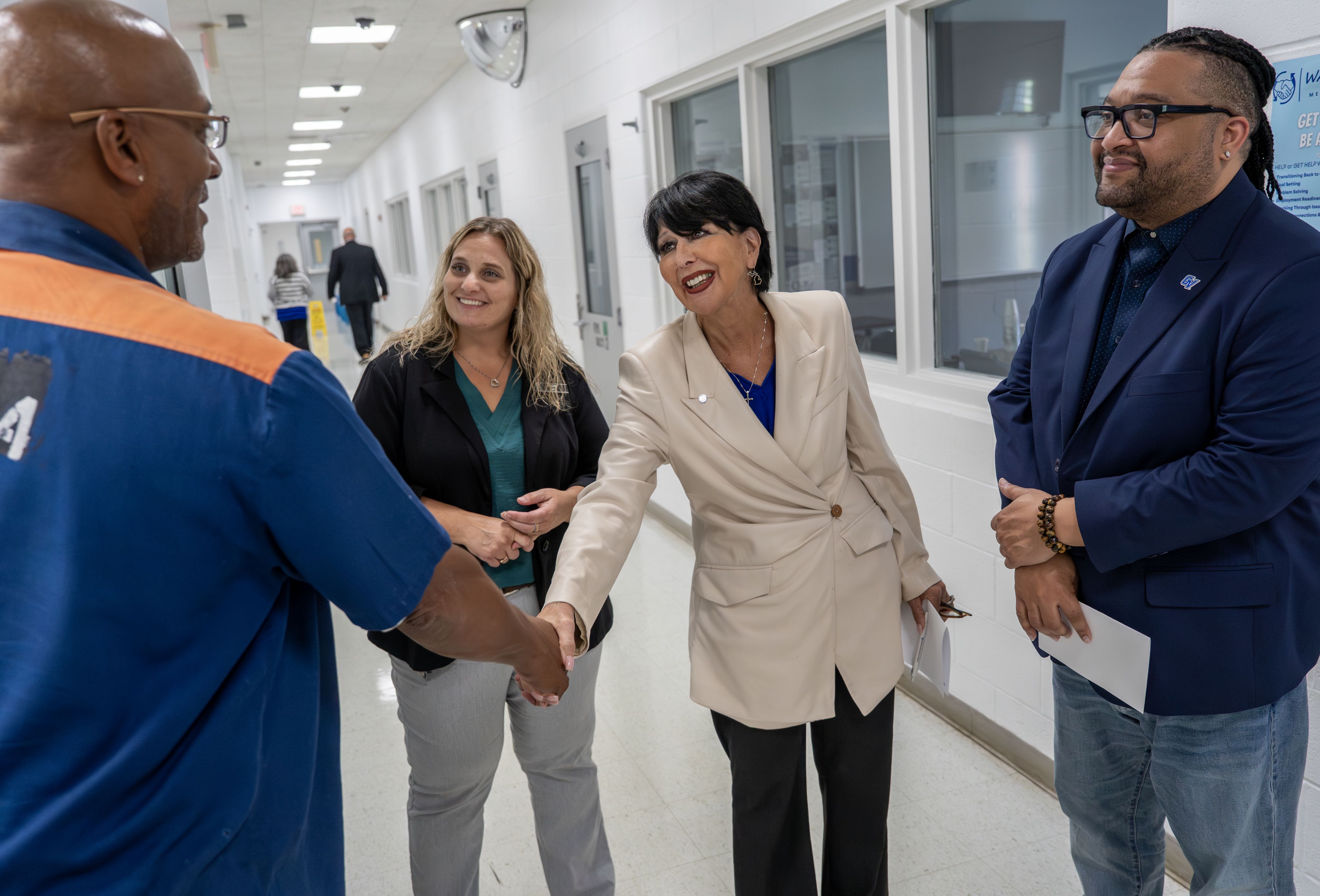
President Philomena V. Mantella and other GVSU leaders visit the Bellamy Creek Program. Robert Shorty, vice president for People, Equity, and Culture, is at right. At the left of Mantella is Jennifer Peska, college program coordinator for the Michigan Department of Corrections.
President Philomena V. Mantella and other GVSU leaders visit the Bellamy Creek Program. Robert Shorty, vice president for People, Equity, and Culture, is at right. At the left of Mantella is Jennifer Peska, college program coordinator for the Michigan Department of Corrections.



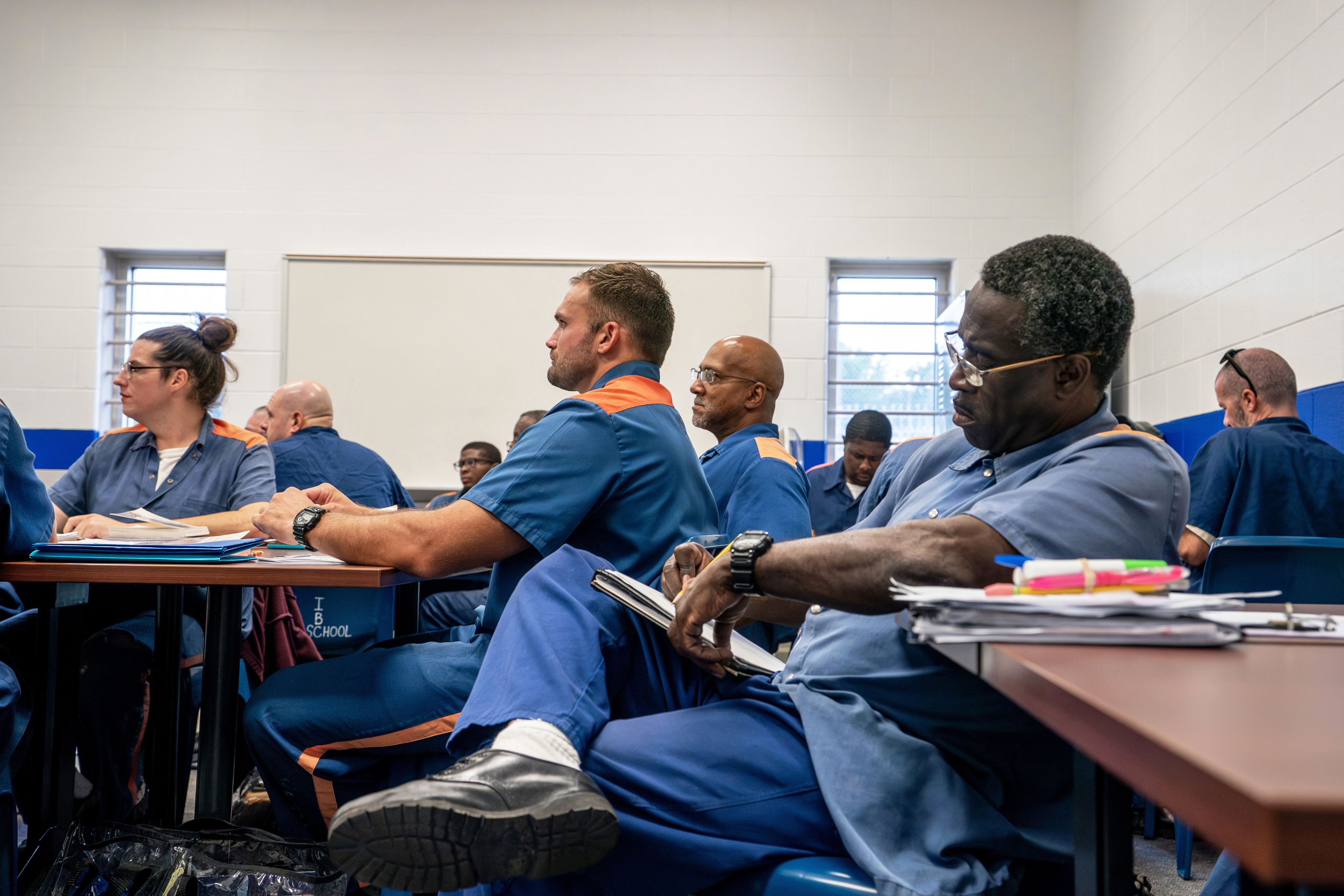
Prison education programs like GVSU’s Bellamy Creek Program have shown to greatly reduce the rate of recidivism among the incarcerated.
Prison education programs like GVSU’s Bellamy Creek Program have shown to greatly reduce the rate of recidivism among the incarcerated.


COLLEGE IN PRISON
Ionia’s lengthy history with correctional facilities dates back to its first prison, the State House of Corrections, which opened in August 1877. Renamed as the Michigan Reformatory in 1901, that facility (which once hosted a football game in 1970 between those incarcerated and Grand Valley’s first football team) was one of the oldest in the state and officially closed in 2022.
Ionia’s three correctional facilities have the combined capacity to house as many as 3,400 people. The Ionia Correctional Facility and the Richard A. Handlon Correctional Facility sit on the north side of the Bluewater Highway. Across the street, the Bellamy Creek Correctional Facility, which replaced the Michigan Reformatory, has a capacity for 1,500 incarcerated individuals.
For more than a decade, Michigan’s higher education institutions have been developing degree programs for prisoners. The Michigan Consortium for Higher Education in Prison (MiCHEP), which comprises 13 community colleges, universities and theological seminaries, provides support and resources among its members. According to MiCHEP, there are 1,300 incarcerated students participating in these programs, with another 3,100 on waiting lists. Many incarcerated students have access to Pell grants to help pay for their education.
“Over the last couple of decades, GVSU has had some presence inside a correctional facility with different faculty running individual programs on their own or in collaboration with others,” Yore-VanOosterhout said.
“ It’s a full undergraduate degree that’ll look just the same as anybody else’s graduating from Grand Valley.”
AARON YORE-VANOOSTERHOUT
From 2009-2020, GVSU’s Community Working Classics and Inside-Out Prison Exchange Program served hundreds of students who were incarcerated. But those initiatives did not confer degrees to those inside, Yore-VanOosterhout said.
Under the Bellamy Creek Program, students who are currently incarcerated will receive a bachelor’s degree in public and nonprofit administration upon completion of their five-year studies.
“It’s a full undergraduate degree that’ll look just the same as anybody else’s graduating from Grand Valley,” he said.
Eventually, Yore-VanOosterhout said he’d like to incorporate a rolling cohort method, welcoming a new class of 20 students who are incarcerated at Bellamy Creek each academic year.

Ultimately, the mission is to reduce the recidivism rate and provide the incarcerated a foundation for their return to society.
A 2011 report from the Institute for Higher Education Policy (IHEP) showed that nearly seven in 10 people who are formerly incarcerated will commit a new crime, and half will end up back in prison within three years.
However, prison education programs like GVSU’s have shown to greatly reduce that risk. A 2005 study by IHEP detailed that recidivism rates for incarcerated people who had participated in prison education programs were, on average, 46 percent lower than the rates of incarcerated people who did not take college classes.
Michigan’s recidivism rate — declining over the last 20 years — measured at 21 percent in 2025, the lowest rate on record. MDOC’s records show its prison population is at its lowest level since 1991.
“There is a considerable dramatic difference between (people who are incarcerated) who don’t have a college degree and those who do,” Yore-VanOosterhout said.
“That is absolutely the goal of the Department of Corrections and of Grand Valley. We want people to succeed. We want people to have a more fulfilling career and life upon release. This is a population we have not served adequately up until now, and this is our opportunity.”



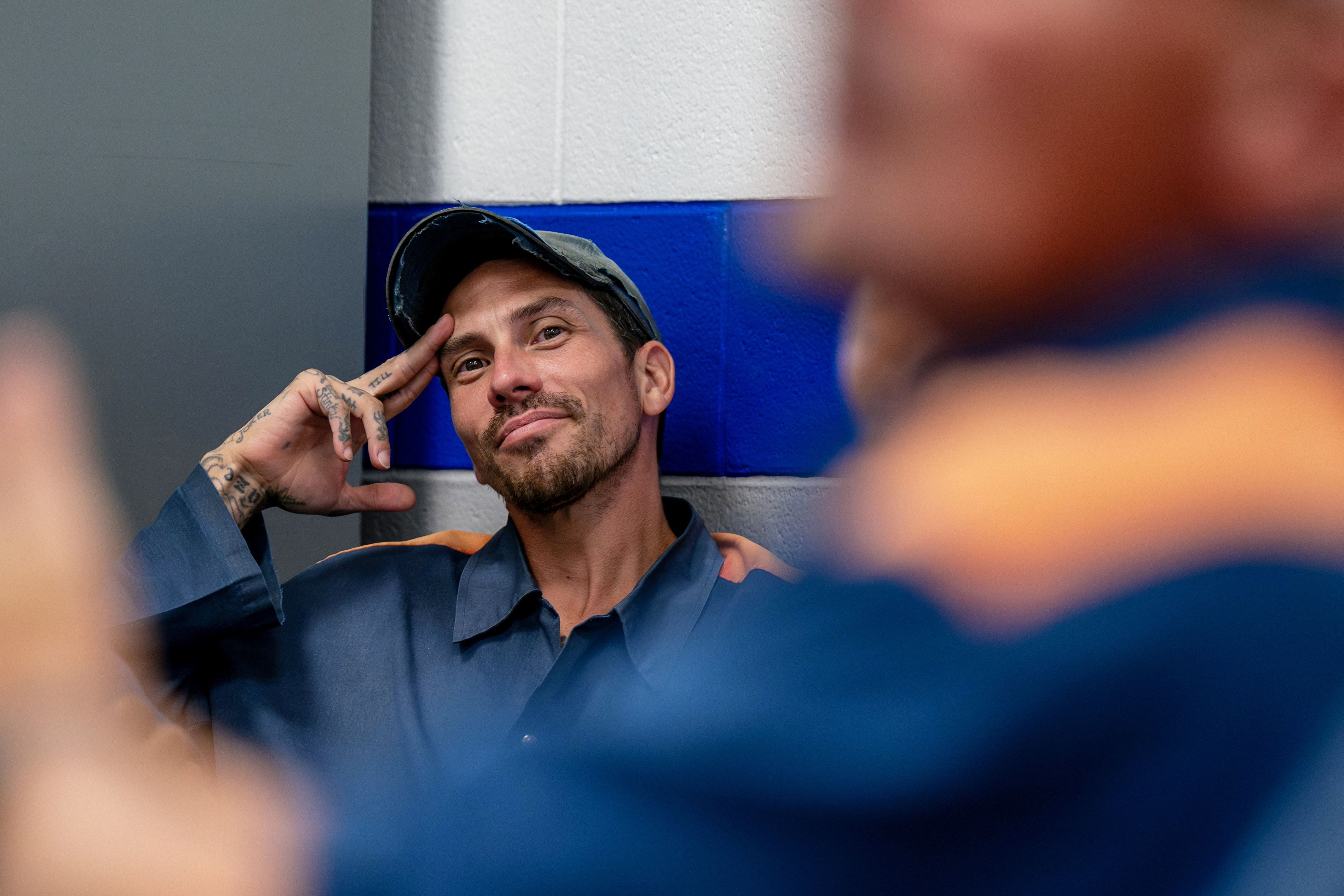
Fourteen GVSU faculty members teach classes at the Bellamy Creek Correctional Facility and more faculty are interested in participating.
Fourteen GVSU faculty members teach classes at the Bellamy Creek Correctional Facility and more faculty are interested in participating.

TEACHING THAT TRANSFORMS
Emma Carlisle, affiliate professor of writing, didn’t hesitate when she was asked if she was interested in teaching at Bellamy Creek. As a graduate student, Carlisle had previously taught a creative writing course for incarcerated students at the county level.
“I was really excited to take the opportunity because I have a personal belief in the value of education for rehabilitative purposes,” Carlisle said. “It’s important that programs like this exist. I thought it would be an interesting challenge and experience.”
Carlisle and Keough are two of the 14 GVSU faculty members participating and supporting Yore-VanOosterhout by teaching classes that each meet once per week. Keough’s classes, Math 108 and Math 109, focus on algebraic concepts and prepare students for future coursework in statistics.
“As a math community, we haven’t always done a great job of welcoming everyone,” Keough said. “Here was an opportunity to change students’ minds about math and also welcome them into a space that they may not have felt welcome in before.”
The experience has been illuminating and deeply rewarding for Carlisle and Keough. Students devoured the reading assignments and were eager for class discussions, ready to discuss their own life experiences. With limited interaction outside class hours, Keough said her lesson plans required deeper, more thorough evaluation.
“The students absolutely insist on your best,” Keough said. “If you’re saying something, it’s important, and they want to know why and what it means.
“The class took way more prep than usual because I want to give these students everything that I have and the best education that I can, and because of the setting, there was little communication outside of the classroom. You really have to go in with your stuff ready to go.”
The students’ preparation and participation has also drawn the attention of other GVSU faculty, Yore-VanOosterhout said.
“We’re running into a good problem, which is we’re now having more faculty interested in teaching than perhaps there are spots,” he said.
“The more cohorts we can bring online or bring into the facility, the more we can incorporate this interest, and keep the momentum going as the program builds.”
Keough said one student’s educational journey in particular reminded her of the importance of the program and Yore-VanOosterhout’s work. The student was initially trepidatious about the math course, but eventually gained more confidence in his abilities over the year.
“He was reflecting one day in class and said that his granddaughter had called him and said she was really struggling in math class,” Keough said. “He told her to email him her questions, and he would help her through the fear of math.
“Math has held people back from really good careers for a long time. So to watch him say he was going to help his granddaughter and have the confidence to do that, it was a moment that I wanted to cry because this has a generational impact.”