





STORY BY THOMAS CHAVEZ | PHOTOS BY CORY MORSE
“Sometimes you don’t overcome, you just deal with it,” said Shamurat “Shon” Raimbekov, an international student, about facing challenges because of his visual impairment in his home country of Kyrgyzstan. “My main way to overcome this was coming to the U.S.”
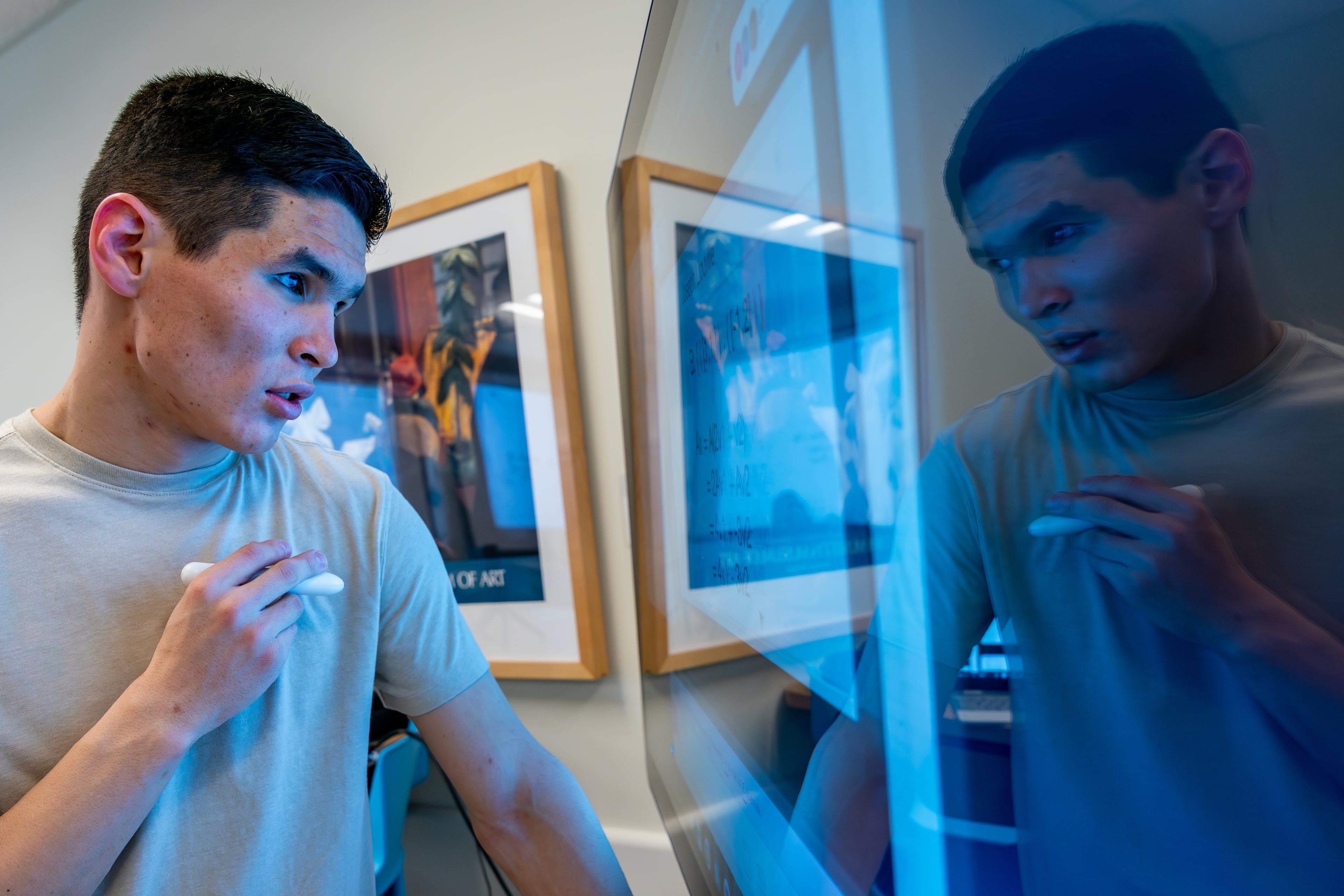
Raimbekov and professors Paul Yu and Joy Oslund are now immersed in a study to develop methods to help instruct blind and visually impaired students in mathematics.
Yu and Raimbekov built a relationship when they started study sessions to help Raimbekov in his math classes in 2023. Since then, they have received a two-year, $50,000 grant from the Spencer Foundation to continue their study and help with the dissemination of their research.
The grant was one of 18 awarded to universities as part of the foundation’s competitive Small Research Grants on Education Program.
Because he is legally blind, Raimbekov faced many challenges in Kyrgyzstan. He lived in an orphanage and took classes at a boarding school.
Raimbekov is completely blind in his left eye, while his right eye has only limited vision. With Kyrgyzstan’s education system limited in its ability to effectively teach visually impaired students, Raimbekov found it difficult to imagine a fulfilling life for himself.

Curiosity fuels desire to study in the U.S.
Raimbekov became interested in studying in the United States when he was in the fourth grade. His boarding school had an English teacher from the Peace Corps, a woman from Minnesota, and Raimbekov’s curiosity about the United States sparked while in her classes. At the time, all he knew about the U.S. was that Washington, D.C., was the capital, New York City was the country’s largest city and Barack Obama was president. Raimbekov took the opportunity to learn more.
“I used to always ask questions after class. That’s how I got her attention. But I did not have the intention to receive help. It was just interesting,” he said. “She started noticing the potential of me going to the United States because I started picking up English.”
Raimbekov then applied to the Future Leader Exchange Program to study in the U.S. and stay with a host family.
He applied six times, with the first five applications being denied. He took those denials in stride and found opportunities to study abroad elsewhere.
In the sixth grade, Raimbekov began studying in different countries: Russia, Turkey, Germany, Moldova and the United Arab Emirates. Yet, Raimbekov remained committed to studying in the United States because he saw it as the best opportunity to receive the best education he could.
“I had to try something. I had to learn something. I had to do something about it, because it couldn't continue that way, in the way that I lived,” he said.
On his sixth application to study in the U.S., Raimbekov was accepted and was scheduled to leave in early February 2020. In late January, he still did not have a host family and was told that if he was not assigned one before his flight, his plans would be canceled. Over the next few days, Raimbekov spent every possible moment checking his email. Each day passed without an update.



On deadline day, Raimbekov received an email shortly before midnight. A host family was found. He was going to the United States to stay with a West Michigan family.
During his exchange year, Raimbekov attended Rockford High School. He said his host family has a daughter and two adopted children with visual impairments. The family’s experience made Raimbekov’s adjustment to life in the U.S. simpler.
When it came time to apply to colleges, Raimbekov said Grand Valley was an easy choice as he would have the chance to join the university’s club wrestling team, an activity he began at age 12, although he was not allowed to compete in Kyrgyzstan.
Raimbekov initially intended to study linguistics as he speaks five languages: Kyrgyz, Russian, Turkish, German and English. He has since switched to majoring in computer science and management with an emphasis in information systems and a minor in mathematics. In his computer science classes, he said he learned his sixth language: Python.
Early in his math courses, Raimbekov needed help. He needed course textbooks available in braille, online materials with provided descriptions for tables and f igures, and extra tutoring help.
When Yu was asked to help Raimbekov, he quickly said yes.


Increasing accessibility to mathematics
During their first meetings, Yu said he found Raimbekov inquisitive and ready to learn. However, Raimbekov was missing some integral math background, which Yu referred to as “need to know“ math, to have success in his courses.
“He was a blank slate in the purest form,” Yu said. “I was able to give him the mathematics he needed to know at that moment, as it matched his abilities.”
Yu reached out to the Perkins School for the Blind for insight into how he could best work with Raimbekov, as well as develop his own strategies from his hands-on experiences with his student.
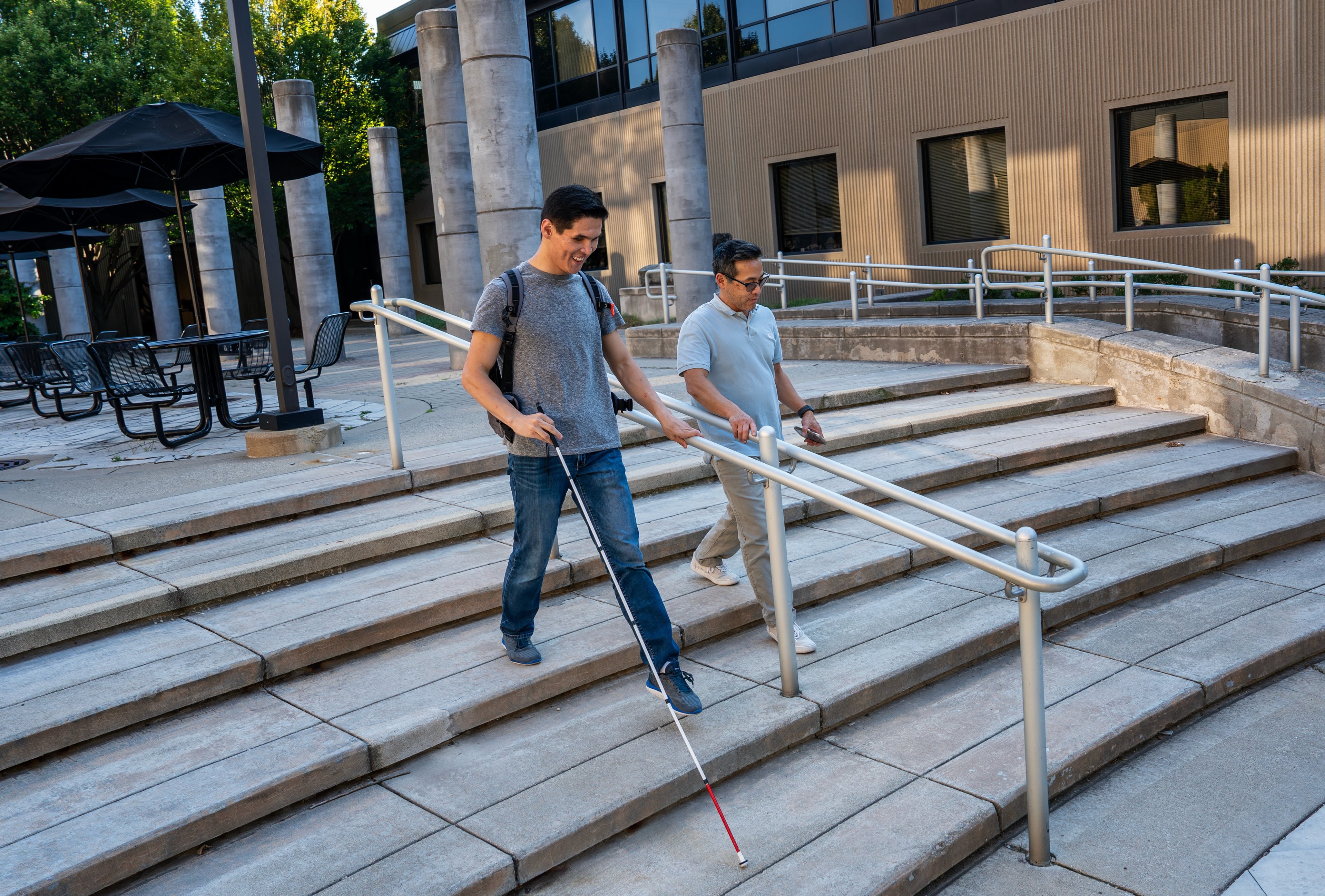
Yu provided Raimbekov with tactile ways of understanding the mathematics being taught. He helped explain concepts such as slope by walking up and down different staircases with Raimbekov.
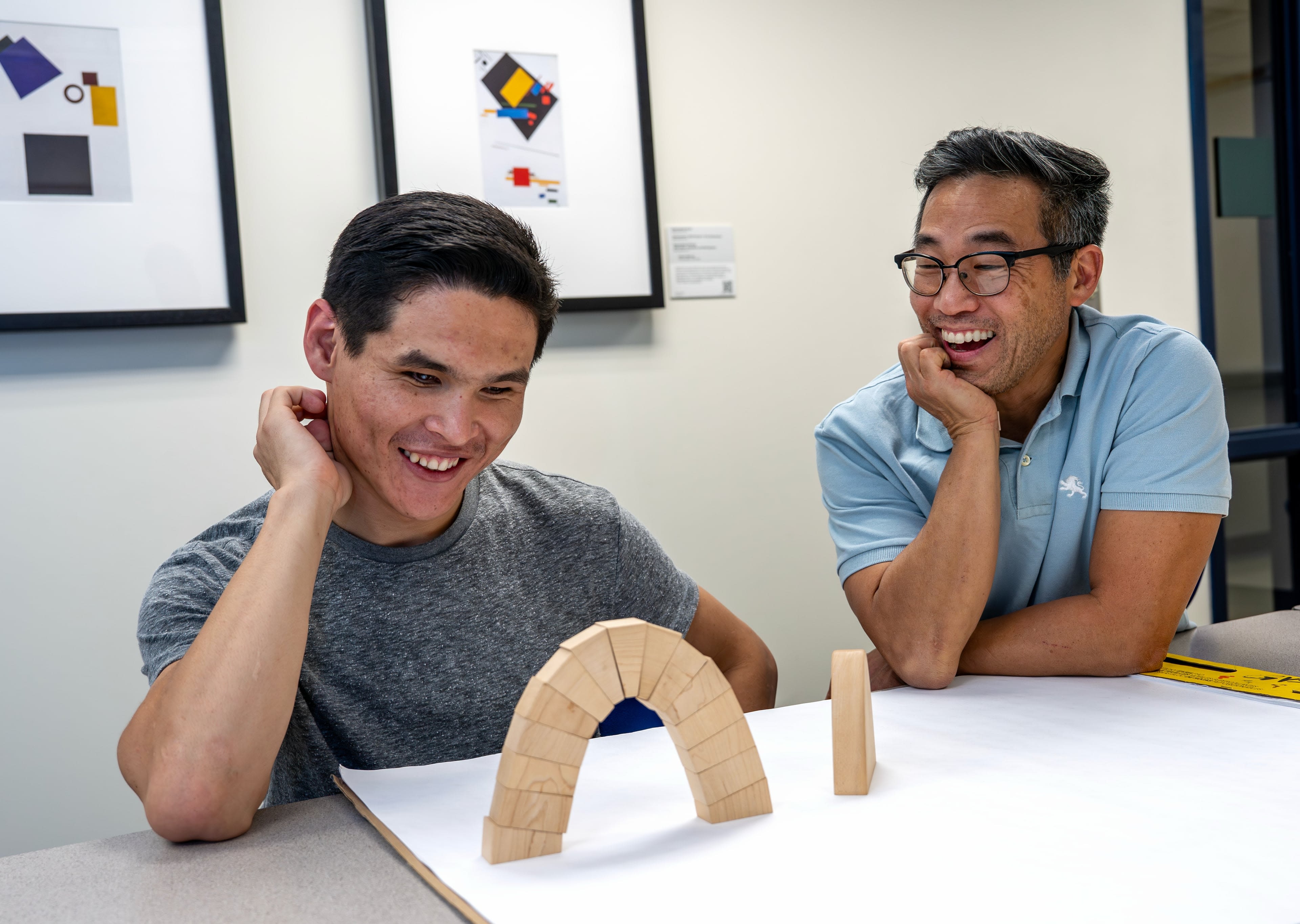
The pair worked on developing an understanding of parabolic functions by having Raimbekov build a parabolic arch with symmetrical blocks.
As the case study developed, their sessions were recorded, allowing them to be cataloged and allowing Raimbekov to reflect on his learning when they were played back to him.
Yu said Raimbekov picked up the concepts quickly.
“You find the highest levels of exceptionality and excellence in places you might not have imagined,” he said. “There are assumptions that the mathematics teaching and learning community has about mathematics that disable the student.”


“Blindness is not a disability. It’s just a discomfort. In terms of taking and successfully completing a class, it’s not holding me back.”
Shamurat 'Shon' Raimbekov

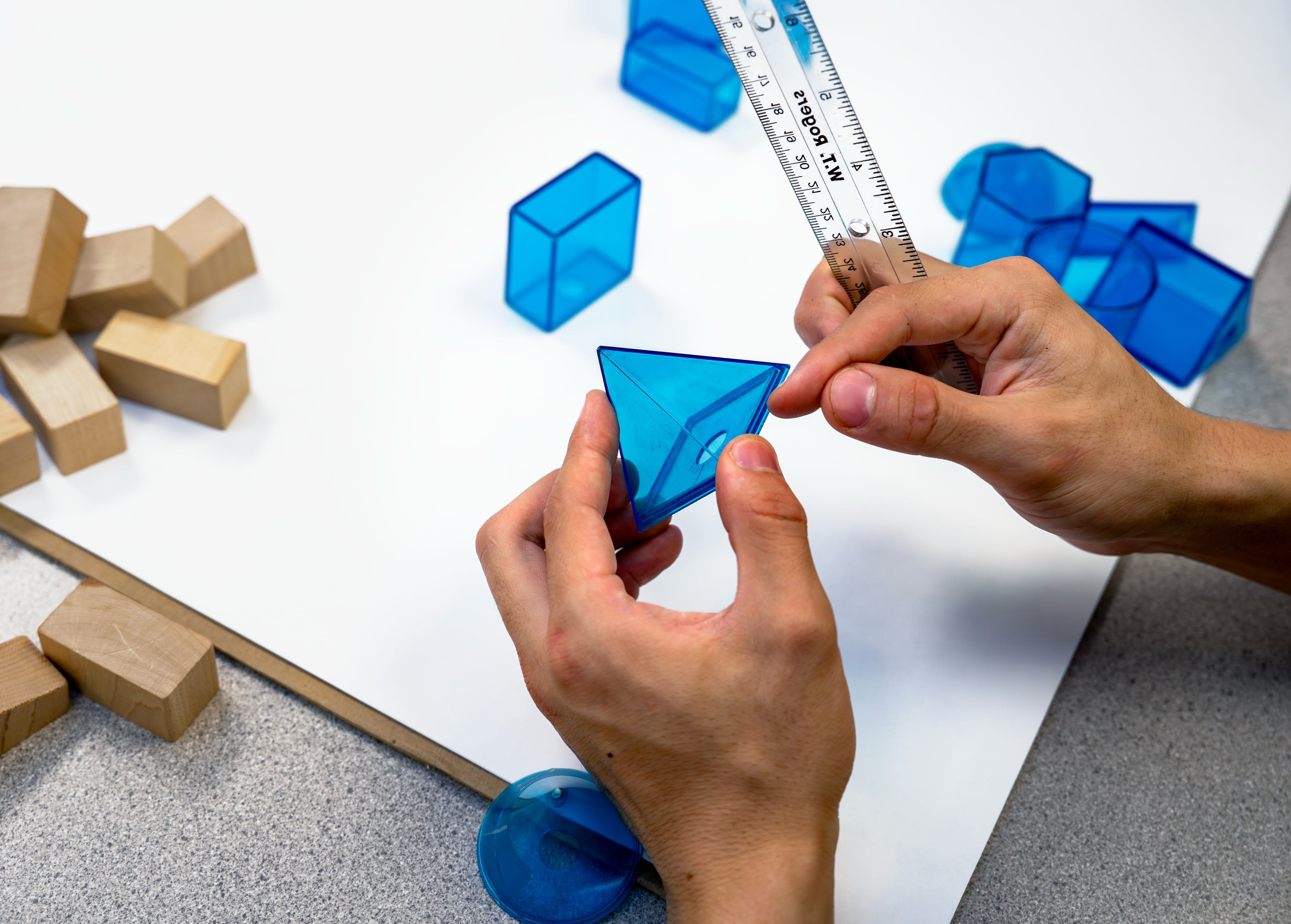
Through the study, Yu and Raimbekov aim to develop effective ways to educate blind and limited-vision students with tactile lessons and physical experiences. Yu said he believes these tactile lessons can benefit all students.
“I’m interested in coming up with ideas of teaching and learning mathematics that not only benefit Shon, but benefit all sighted students in the classroom, as well,” Yu said.
Yu added that as much as he has been helping to teach Raimbekov over the past two years, Raimbekov has been helping him continue learning.
“To work with Shon in a way that has forced me to think about how mathematics teaching and learning are disabling has been an absolutely priceless opportunity,” Yu said.
The two-year grant runs through Raimbekov’s planned graduation in Fall 2026. While he does not know where his life will take him after that, Raimbekov hopes to one day take what he has learned with Yu and return to Kyrgyzstan to help other blind and limited-vision learners.
“Blindness is not a disability,” Raimbekov said. “It’s just a discomfort. In terms of taking and successfully completing a class, it’s not holding me back.”