
Program Description
Preparing students for successful careers in the geological sciences is one of the primary goals of the Geology Department. Therefore we ask our students to acquire adequate preparation in mathematics, chemistry, and physics along with geology. And we strongly encourage our students to continue their education by attending graduate school. More than 50 percent of our graduates apply to graduate school, and many are accepted with financial support. The list of graduate schools includes such prestigious institutions as Brown University, the University of Arizona, the University of Colorado, Michigan State University, Ohio State University, Southern Illinois University, Wright State University, Princeton, and Rutgers.
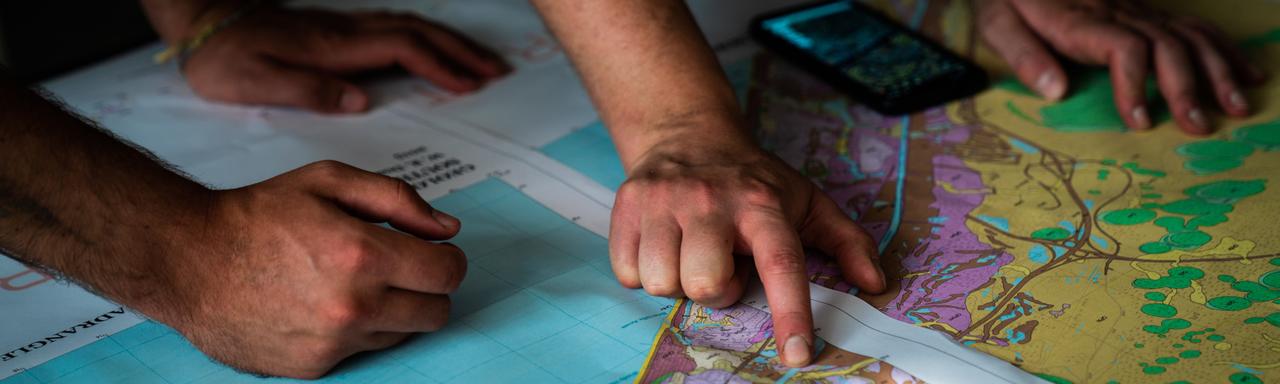
The Geology Department is housed in the Seymour K. & Esther R. Padnos Hall of Science and is well equipped with mineral, rock, fossil, and map collections. The Mary Idema Pew Library holds one of the finest collections of geological publications in west Michigan. Equipment for preparation and analysis of geological materials (saws, laps, petrographic microscopes, X-ray diffractometer, spectroscope, etc.), geophysical investigations (ground penetrating radar, seismographs, electrical resistivity meter), a complete paleomagnetism and rock magnetic laboratory, field sampling equipment including a vibracoring system, and mapping equipment (including a laser topographic scanner and total stations) are housed in the Geology Department or are shared with other science departments (e.g., the atomic absorption spectrophotometer).
Students may choose one of the following geology degree programs: B.S. in geology; B.S. in geology with environmental emphasis, B.S. in geology-chemistry. Two minor programs are also available, one in geology and one in earth science.
The B.S. programs in geology and dual geology-chemistry are intended primarily to prepare students for graduate study in the geological sciences. As terminal degrees, they are also useful in a variety of careers, including environmental technology, mineral and energy resource exploration, science writing, and business.
The B.S. in geology requires, in addition to general university degree requirements: 35-40 semester hours of geology courses, an approved summer field camp, and one year each of chemistry, physics, and mathematics (see the sample curriculum, below). The B.S. in dual geology-chemistry requires, in addition to general university degree requirements, 61 hours of core courses from both the geology and chemistry bachelor's degrees (see catalog).
The minor program in geology is designed to provide a supportive second discipline for students in such majors as anthropology, other science areas, and business. A minor in geology requires GEO 111, 112, 214, 220, 311, and one geology course at the 300 or 400 level.
"The professors are the best teachers and mentors, they really care for each individual student. I left this program with a degree, lifelong friends, and the skills and knowledge to have a thriving career."
CLAIRE THOMASSEN // GEOLOGY ALUMNA, ENVIRONMENTAL CONSULTANT
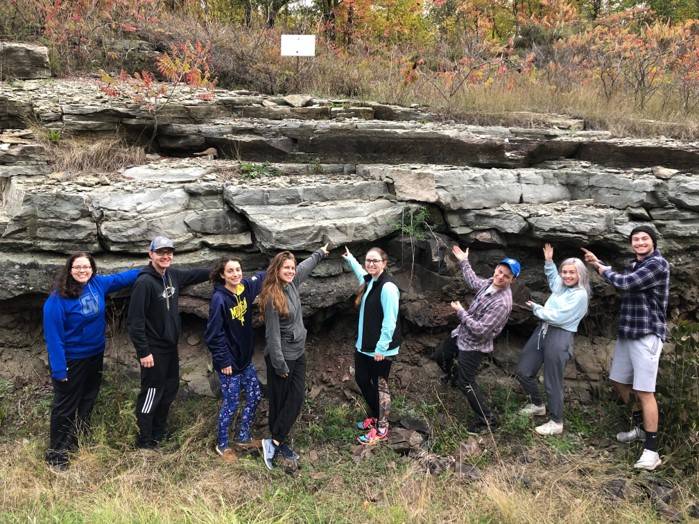
“Gaining a strong background across both geology and chemistry has helped me become a more well-rounded scientist. The faculty works with you closely to ensure success at and beyond GVSU.”
MICHAEL STEFANOU // GEOLOGY-CHEMISTRY ALUMNUS, ENVIRONMENTAL CONSULTANT
For more information about geology programs at Grand Valley, write or call:
Dr. Carrie Menold
Unit Head, Department of Geology
Grand Valley State University
One Campus Drive
Allendale, Michigan 49401-9403
Telephone: (616)-331-3728
Email: [email protected]
or
The Admissions Office
Grand Valley State University
Student Services Building # 300
One Campus Drive
Allendale, Michigan 49401-9403
Telephone: (800)-748-0246 or (616)-331-2025
Fax: (616)-331-2000
Email: [email protected]