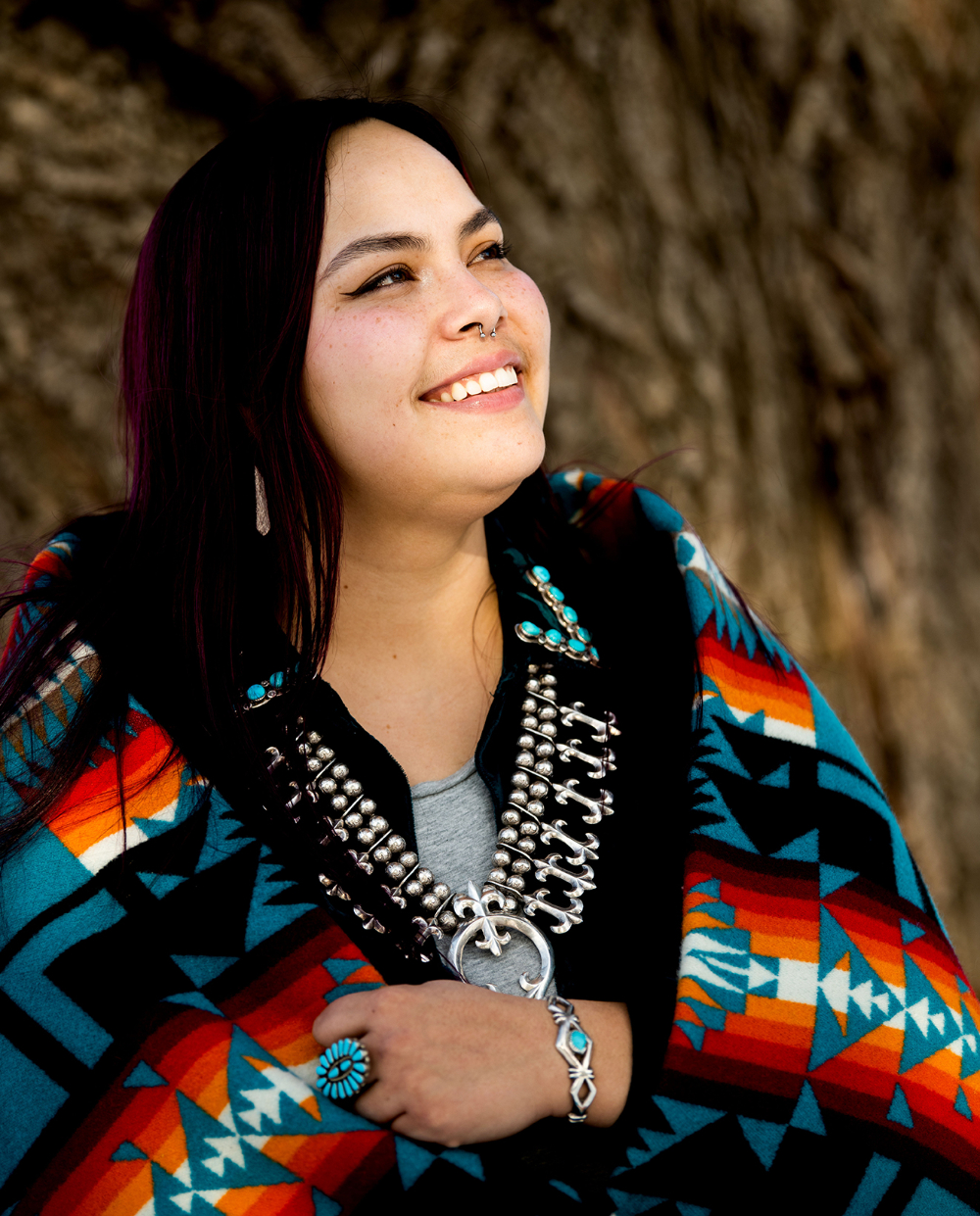
Ayebah Wilson, assistant director for the Office of Multicultural Affairs
Photo Credit:
Kendra Stanley-Mills
Ayebah Wilson recently joined the Office of Multicultural Affairs as
assistant director. Wilson brings a diverse background to the
position, including stints at the University of New Mexico and a
Milwaukee art studio. Below, Wilson discusses her passion for working
with Native students and how that integrates into her artwork.
Tell us about yourself. My name is Ayebah. I am a citizen of the Navajo Nation, which is
where I was born and grew up. We moved back to Michigan after some
time away. My bachelor's degree is in anthropology and cultural and
global studies, with certificates in American Indian studies and
cultural competency from Central Michigan University. Soon, I will
graduate with a master’s degree in community-based education from the
University of Michigan-Dearborn.
Before Grand Valley, I worked as an art assistant at Cloud9 Workshop
in Milwaukee, giving art lessons and workshops that challenged me to
reuse recycled materials. It shifted my brain to think about using
different materials and giving them new life.
I recently worked with the University of New Mexico, and they had a
Native languages archive grant. I helped 12 different Pueblo tribes
establish their own system of archiving historical records without
relying on outside sources that often require subscriptions or contingencies.
What are some aspects of this role that you’re excited about? This summer, I’ll get to help put together the Native Youth
Leadership camp. I participated in these camps in high school and I
know how much that helped me develop my identity and understand my
place in other communities.
These camps provide a place for connection in ways that students
don’t always have otherwise. Today, I’m still friends with people I
met at camp. I also think it helps students see themselves in higher
education. Even seeing allies who are there who choose to give up
their time in the summer to lead a workshop or lecture at camp shows
them, "Oh, they're here for me."
Overall, I’m excited to improve visibility in spaces outside of OMA,
asking questions like: How can I hold other spaces and departments
accountable for how they might be, intentionally or not, contributing
to the invisibility of Native students on campus? Are we considering
the ways our students are still being limited? How are they still
being pushed off their own land? Really, trying to bring awareness
outside of moments where you "expect" to see Native people.
What led you to this role, and why are you passionate about it? A lot of what's motivated me is the issues my older siblings
faced. My two older siblings passed away from an overdose, and I can
see the ways that the system failed them. Services and resources can
literally mean the difference between life and death. There weren't
any summer camps like the ones I had when my older siblings were
around, and there weren’t as many opportunities for Native people in
higher education. So it's very real to me to realize that my being in
this position could make that difference for others in a similar way.
Overall, I’m excited to present Indigenous frameworks that have
proven to help us maintain our identity, sense of belonging and
academic success. I'm hoping to bring different things in to help
Native students walk that path in a way that is balanced. I think
that's key: helping them find balance within themselves so that they
can be as successful as possible, and then, hopefully, take that back
to their people and so that they can benefit from it, too.
My phrase has always been: What am I meant to do for my people? I
know I have all these skills that I've gained along the way and I'm
ready to use them. I'm ready to help.
What do you like to do when you’re not at work? My parents live in Grand Haven, so I love going out to Lake
Michigan and just watching the water. I’ve noticed my relationship
with water is very strong, which makes sense, since one of my Navajo
clans is Tó'aheedlíiniii, which means "water flows
together." I’ve always needed to be around water in so many ways,
because it’s so inherently a part of me.
I do my own art as well, jewelry and printmaking. I always enjoy
printmaking because it’s very therapeutic. Society is so fast-paced,
and you feel like you always have to be doing something productive.
It’s a good reminder to slow down and focus. It’s a nice reminder,
too, of my own Indigenous ways of not having to be perfect. In Navajo
culture, you're actually supposed to make a mistake in your art;
otherwise, you risk leaving a piece of your soul in the art. Making a
mistake leaves a way out for that piece of your soul.
Participants spent 10 weeks in an accelerator program offered by the DeVos Center for Entrepreneurship & Innovation, in partnership with GVSU's Northern Michigan Region.
Featured
July 14, 2026 (Volume 49, Number 19)
Article by
Shannon Owen