

Experiential Learning In Action
SPEECH AND DEBATE TEAM
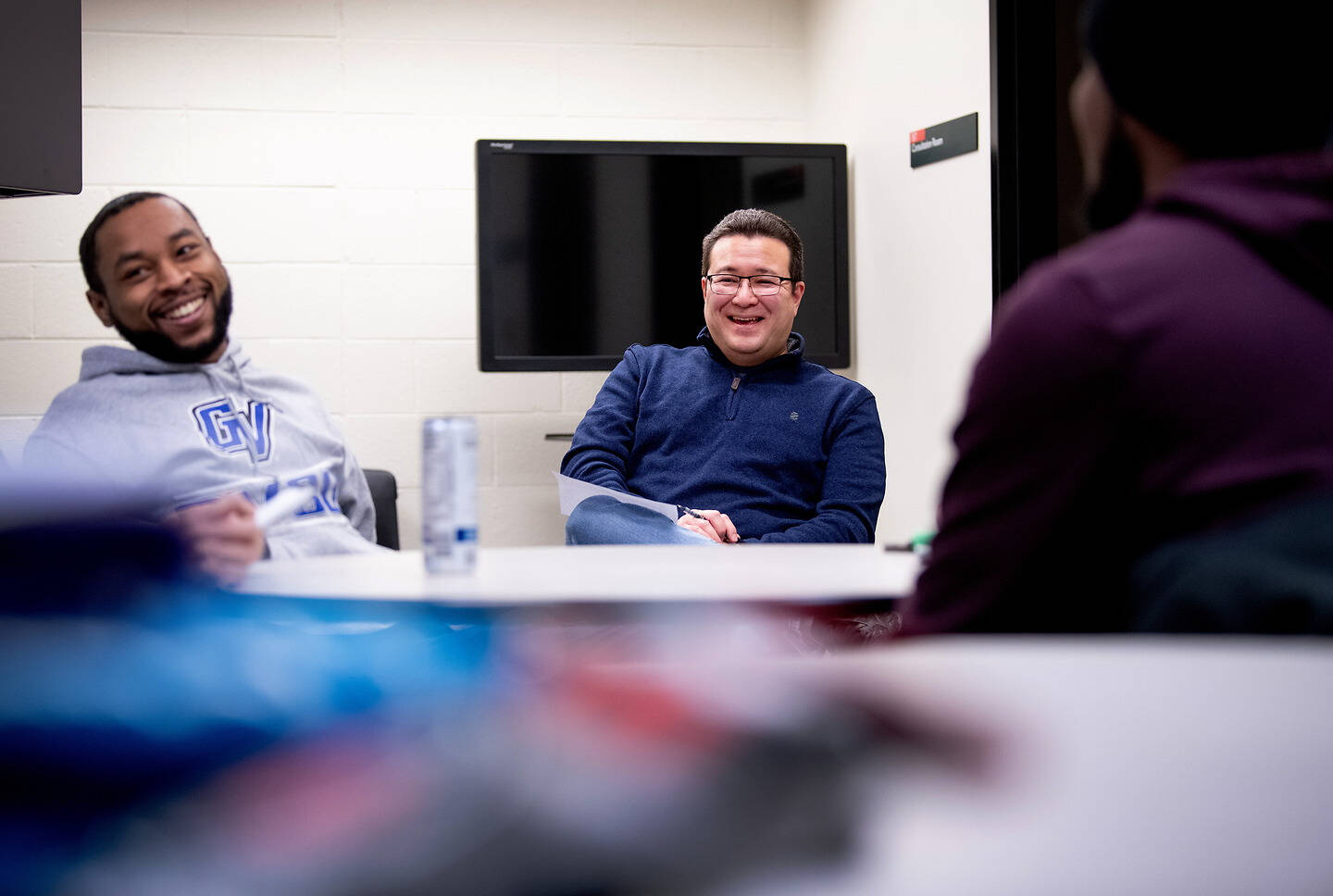
Professor Besel with New Team Members
GVSU STUDENTS TURN VOICE TO POWER
Starting a team from the ground up is no easy task. Richard Besel, GVSU professor of communication and media studies, knows this challenge firsthand.
In 2019, Besel worked to start a speech and debate team, also known as a forensics team, at Grand Valley. The team managed to send a student to a competition, but momentum was derailed by the COVID-19 pandemic and funding uncertainties.
During the fall 2025 semester, Besel received the opportunity to build a team again, this time as an extracurricular activity funded by the School of Communications and a grant from the CLAS Center for Experiential Learning. In the midst of its inaugural season, the new team is focused on growth.
SCHOOL OF COMMUNICATION
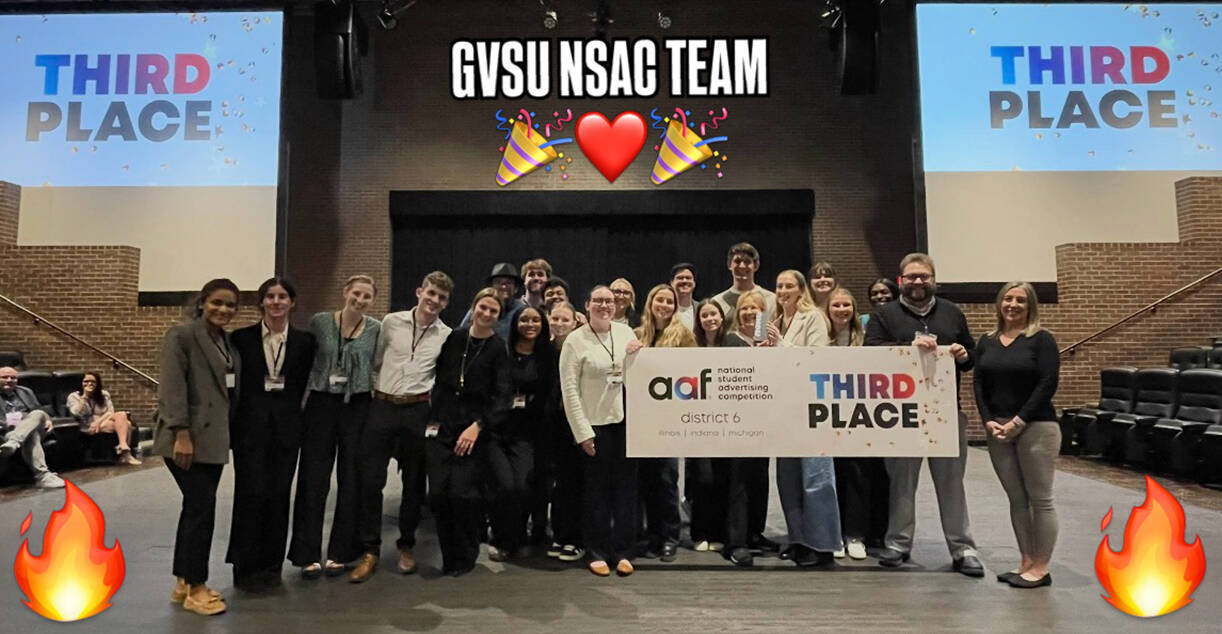
Experiential Learning Champions
National Student Advertising Competition Team
With financial support from the Center for Experiential Learning, the School of Communications hosted Grand Valley’s National Student Advertising Competition (NSAC) Team as they developed a campaign for the National Football League (NFL). Recognized as one of Grand Valley’s premier competitive teams, NSAC provides students with hands-on experience in advertising, public relations, research, strategy, and professional presentations. Competing against universities across Michigan, Indiana, and Illinois, the team earned third place after presenting their campaign to a panel of industry judges. Through this experience, students showcased their creativity, critical thinking, and collaborative skills while representing Grand Valley on a regional stage.
MODERN LANGUAGE
GVSU students making arts and crafts
Cultural Festivals
The 2026 Global Languages & Cultures Festival welcomed over 700+ high school students representing 7 west Michigan school districts to Grand Valley’s Valley Campus. The festival encouraged students who have been learning a second language to see firsthand how language and culture come together as well as the opportunities language can bring should they continue their education at Grand Valley. Nearly 30 unique tables were represented at the festival ranging from student organizations to individual departments and unique cultural games. Additionally, the festival highly encourages students to take our language placement exam, where we have a separate room set up with equipment to give students real time feedback on how their language skills may transfer to GVSU. We received very positive, encouraging feedback from the high school teachers. They were amazed at how engaged their students were with the festival and voiced how thankful they were to be invited this year, as well as how excited they were for next year’s event. We are looking forward to implementing some additional feedback to continue making this festival one that the larger west Michigan community looks forward to year after year.
LAND USE PLANNING
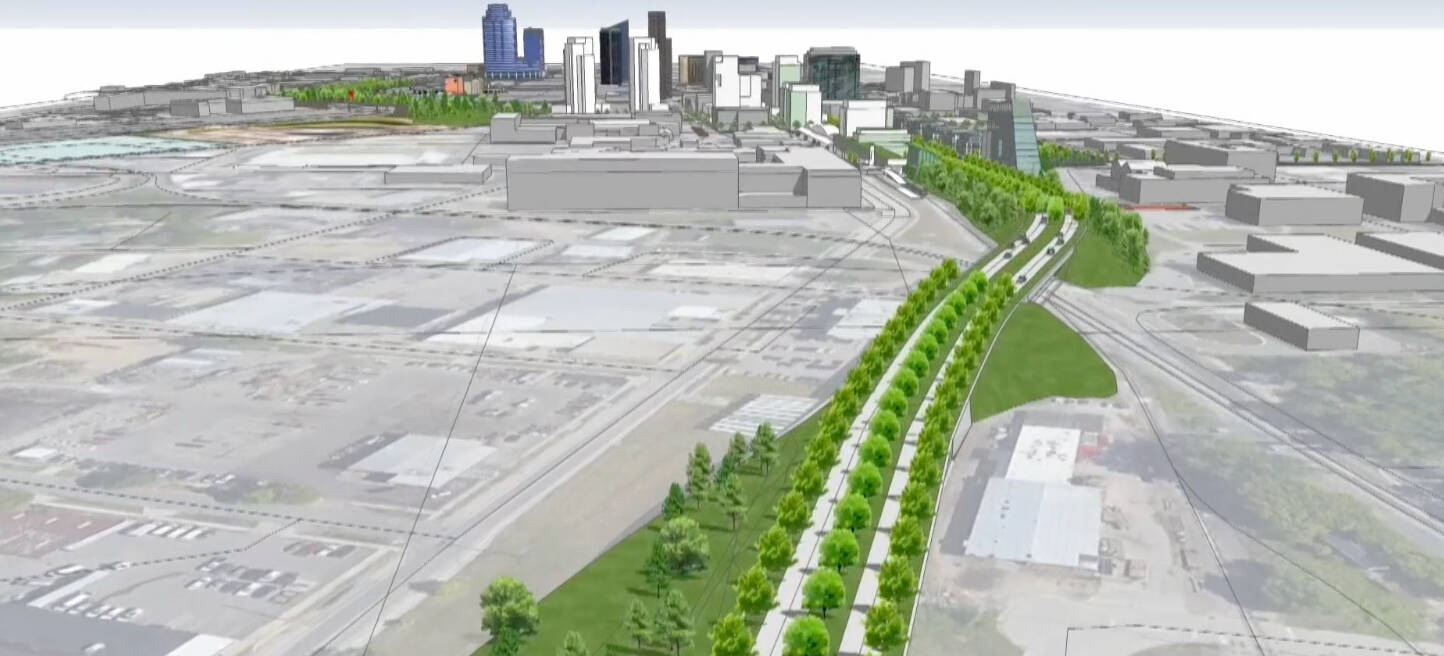
GVSU students studying street grid alternative to US-131
Geography Capstone
In the GPY 414 Land Use Planning course, students participated in a semester-long experiential project that culminated in the design and facilitation of a public community workshop centered on reimagining land use along the US‑131 corridor in Grand Rapids. Working with community partners, including national and local planning organizations, students developed and executed an interactive event that invited residents to share their lived experiences and envision alternative, more sustainable and equitable urban futures. Hosted on GVSU’s downtown campus, the workshop drew over 80 participants and featured student-led presentations on highway removal case studies, environmental justice, and planning technologies, alongside hands-on mapping activities, comment boards, and opportunities for dialogue. Participants engaged directly with visual materials and contributed feedback that reflected both community aspirations and challenges, particularly highlighting the difficulty of reaching underrepresented populations most affected by infrastructure decisions. Through the process of organizing and implementing the event—from research and outreach to facilitation and data collection—students gained practical insight into public engagement, collaborative planning, and the complexities of inclusive participation, while developing a deeper understanding of how community voices shape land use decisions. Support from the Center for Experiential Learning helped enable this immersive and community-centered experience.
MUSIC MENTORS
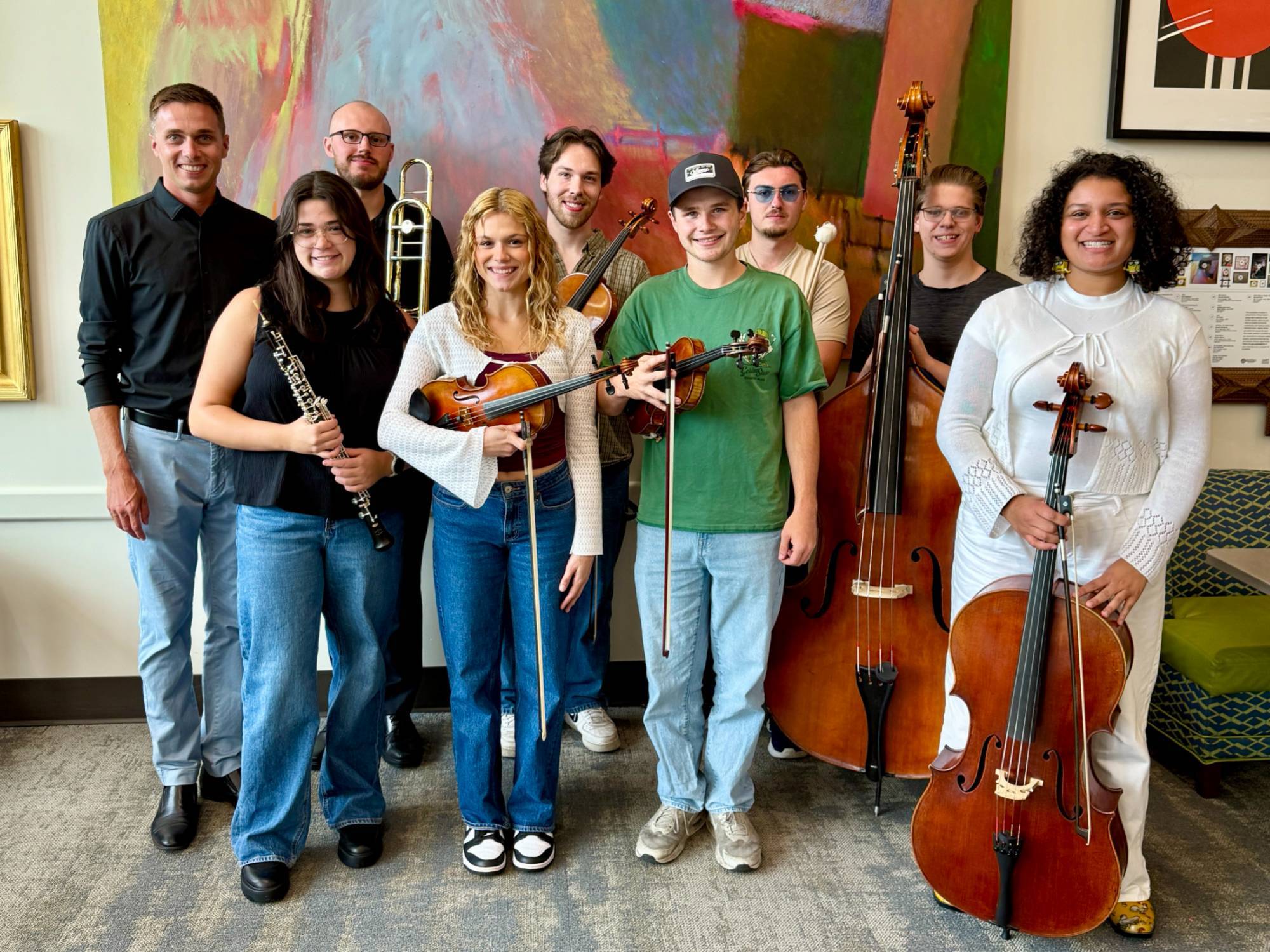
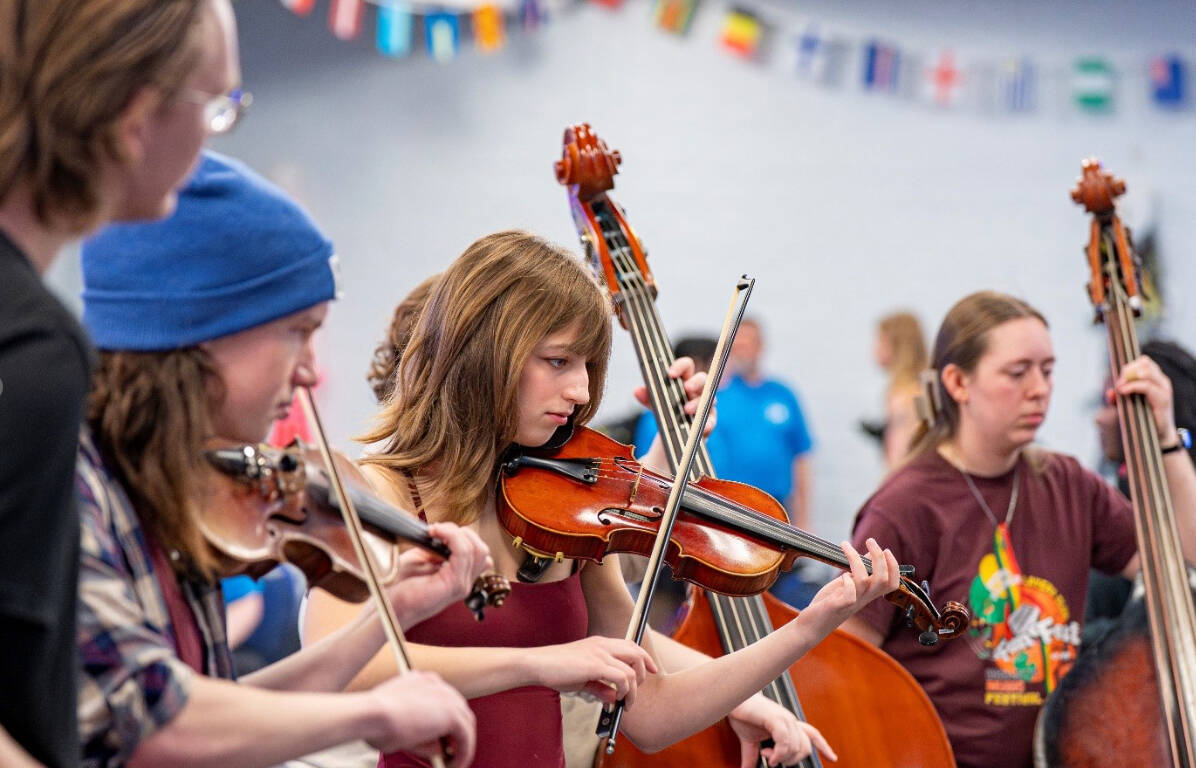
GVSU Students working with the St. Cecilia Youth Philharmonic Orchestra
Music, Theater, and Dance
CLAS Voyage in Action: Beginning Fall 2025, students from the GVSU Department of Music, Theatre, and Dance will partner with the St. Cecilia Music Center serving as music mentors with the St. Cecilia Youth Philharmonic Orchestra. Through this unique community-based partnership with the St. Cecilia School of Music Youth Programs, GVSU music students will apply their pedagogical training and musical expertise in a structured, professional environment mentoring advanced middle and high school youth orchestra students. GVSU mentors will work throughout the season leading sectionals, coaching students, and providing side-by-side rehearsal mentorship. This collaboration is coordinated by Dr. Joel Schut, GVSU Associate Professor and Director of the GVSU Symphony Orchestra, Cyndi Betts, St. Cecilia Music Society Education and Community Engagement Coordinator, and Cathy Holbrook, St. Cecilia Music Society Executive and Artistic Director.
BEHAVIORAL NEUROSCIENCE
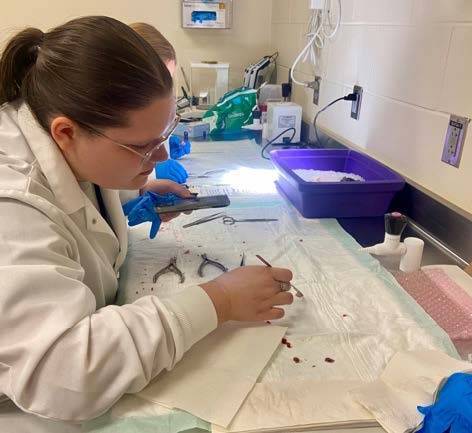
Students using the dissection tools in the lab.
Psychology Department
The Behavioral Neuroscience Program is grateful to the CLAS Center for Experiential Learning (CCEL) for supporting the launch of our new laboratory course, PSY 380-02: Mouse Behavior Laboratory Course. CCEL funding helped expand hands-on learning opportunities for students while strengthening the course’s research and laboratory infrastructure. Through CCEL support, the program was able to hire undergraduate teaching assistant Arnica Schaeffer, who has become an invaluable resource for students. Arnica assists with mouse health checks, body weight monitoring, cage changes, and other regulatory requirements, while also mentoring students through the research process, including data collection, analysis, and presentation. CCEL Pilot Project funding also made it possible to purchase additional mouse brain dissection tools. Previously, the program relied on a limited set of instruments from the Flandreau research laboratory, allowing only one student to work at a time. With the new equipment, at least three students can now conduct dissections simultaneously, making it possible to complete these activities within a single lab period and significantly enhancing the student learning experience.
SHAPE MICHIGAN CONFERENCE
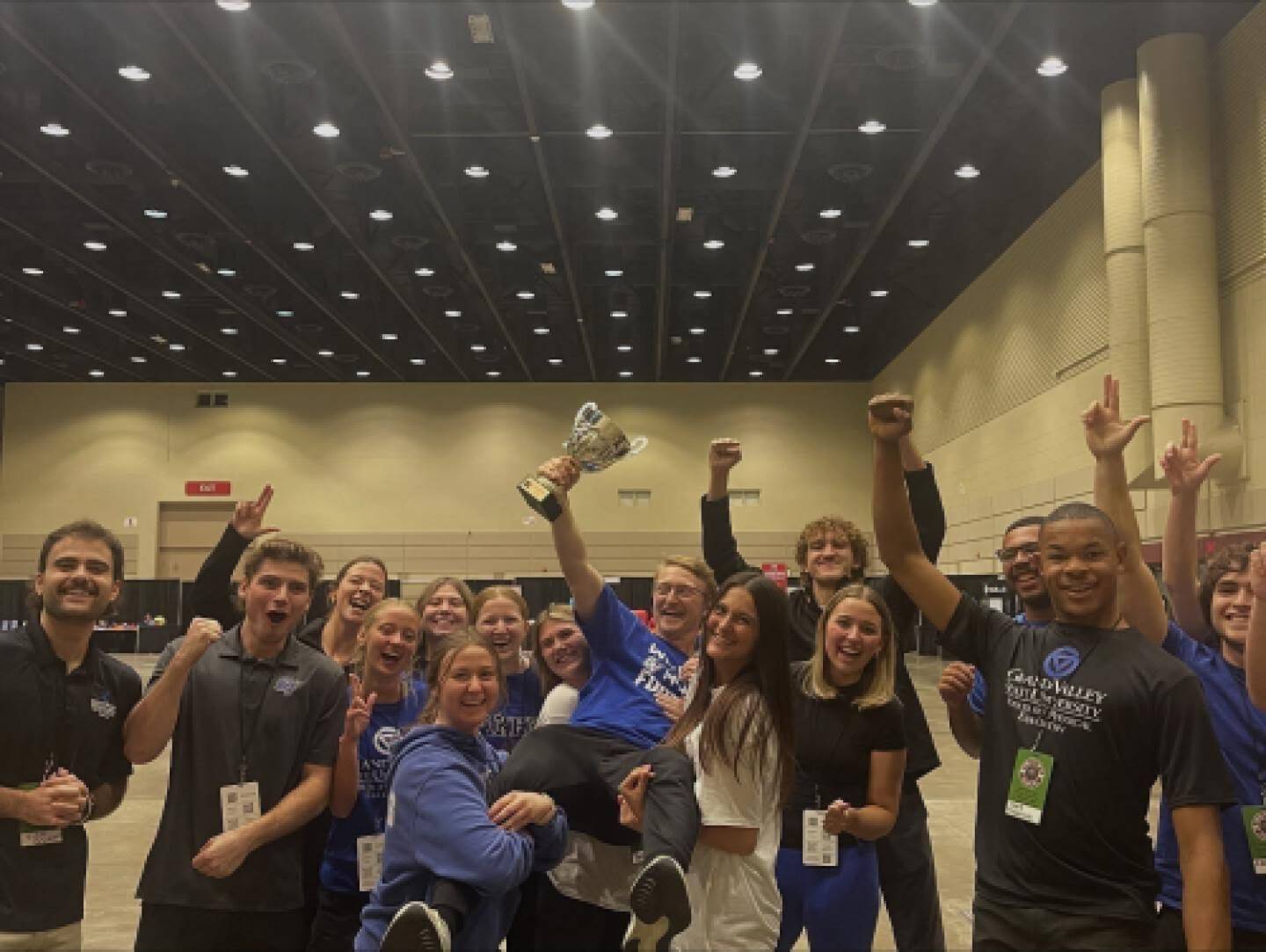
GVSU students winning the trophy, which they keep until next year.
Movement Science
In November 2025, 22 GVSU Health and Physical Education majors, accompanied by their faculty, participated in the SHAPE Michigan Conference, engaging in a professional learning experience that connected coursework with real-world practice. Throughout the conference, students attended and even co-presented in a wide range of relevant professional development sessions focused on best practices, emerging trends, and advocacy in health and physical education. In addition, GVSU students competed in, and won, the "highly coveted" SHAPE MI Student Competition, marking the triumphant return of the event after a long break dating back to pre-2020.
Beyond sessions and competition, students built meaningful connections with K–12 educators and leaders in the field, expanding their professional networks and deepening their understanding of career pathways in health and physical education. This experience exemplifies GVSU's commitment to experiential learning and preparing future educators to lead with confidence, competence, and professionalism. Students who participated noted that this experience also planted the seed for future opportunities to attend conference, many noting that they plan to attend the 2026 SHAPE Michigan conference, while others are eager to attend the 2026 National Convention in Kansas City.
It was often mentioned at whole-conference sessions that there was an awful lot of “Laker Blue” in the crowd, which was great to hear. Many people asked how we got so many students to attend! I cannot thank you enough for the support of CLAS Center for Experiential Learning. I think the best part of the experience was the overwhelming number of students who returned to campus and told their classmates that they should have attended. Our students were responsible, highly active, and professional. Several students who were only going to attend on Thursday ended up staying over and attending Friday too because it was better than they expected.
MAJOR RESEARCH PRESENTATIONS
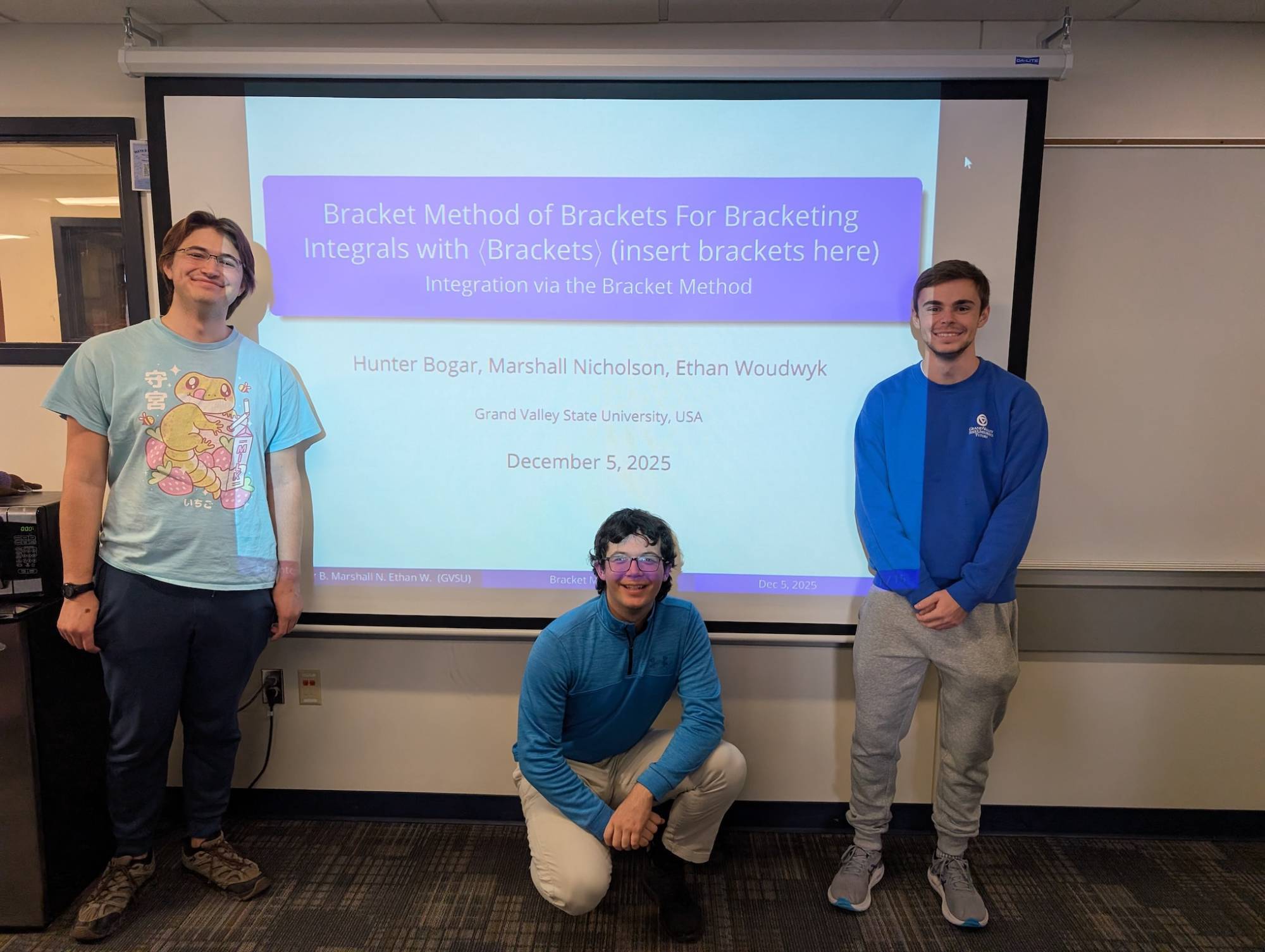
GVSU Math Students presenting on their research.
Mathematics Department
The end-of-semester math major research presentations in the Math Peer Collaboration Space. At least 25 people attended, including many math majors and some statistics and computer science majors, as well as multiple math faculty. Eight students gave a total of four presentations on their research. Topics included modeling plasma in nuclear fusion reactors, based on a summer research project at Oak Ridge National Lab, as well as multiple presentations about the Bracket Method of Integration which was studied in Dr. Feryal Alayont's MTH 496 Research Capstone course. CCEL funding helped us provide food for the event, including pizza, soft drinks, and snacks.
URBAN ECOLOGICAL DESIGN
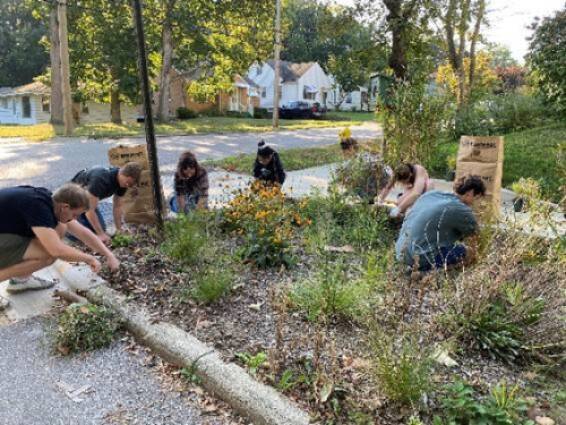
GVSU Students cleaning drainage systems in Kent County Parks
Geography Department
Dr. Heather Moody, faculty in Geology and Geography at GVSU, recently taught Urban Ecological Design where students partnered with local organizations on projects such as planting raingardens, cleaning drainage systems, and assessing tree benefits in Kent County parks. A major highlight was designing the Garfield Park Community Garden using SketchUp, a3D modeling program, to address food access challenges. Student presented these designs during finals week.
This hands-on learning experience, field-based activities and the SketchUp program, was supported by funding from the CLAS Center for Experiential Learning. Dr. Moody has also received an EPA Region 5 Great Lakes Thriving Communities Grant to collaborate with community organizations on environmental justice initiatives, further advancing her research and teaching impact.
GAME DESIGN PROJECT
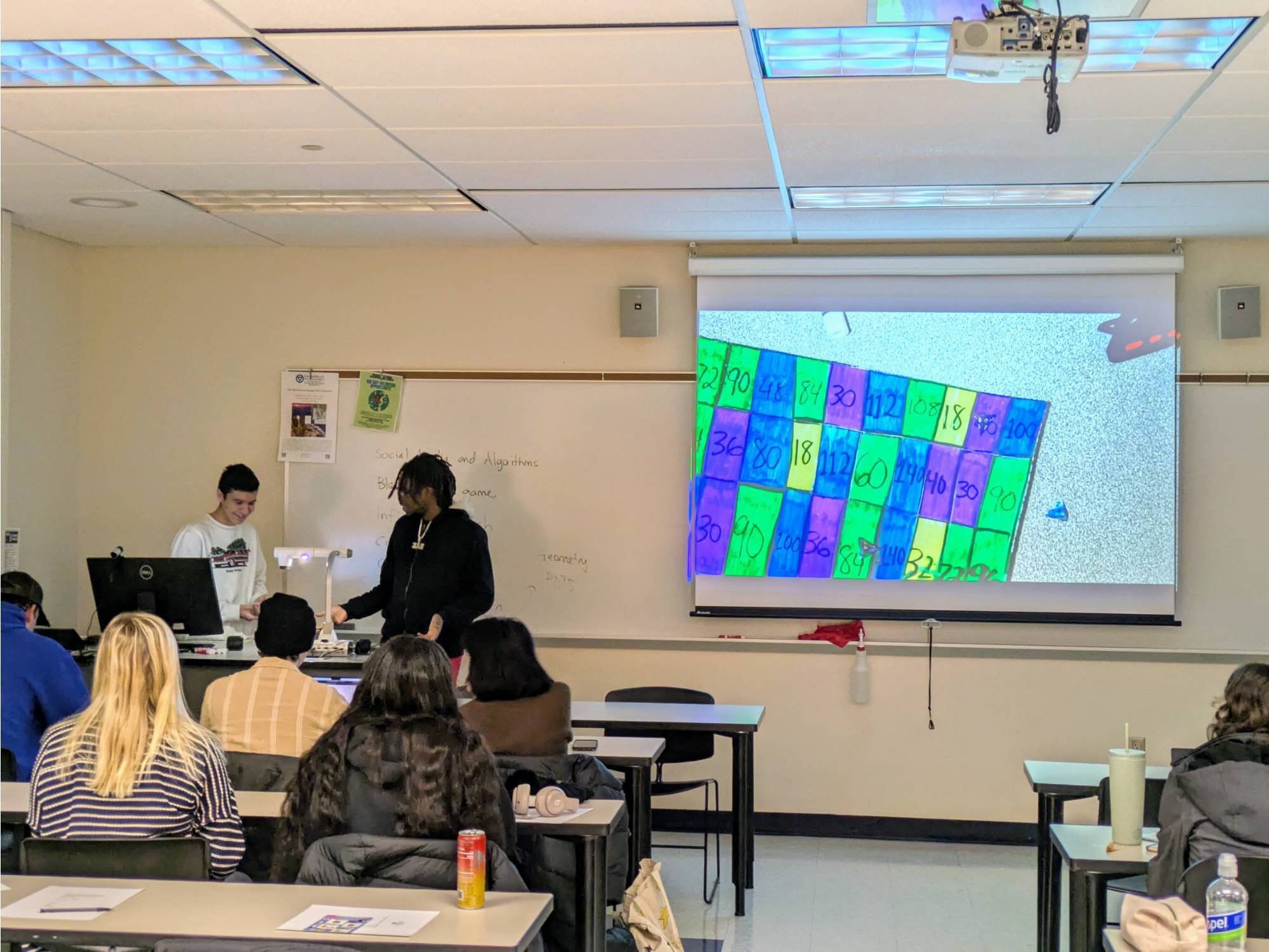
GVSU Students in MTH 131 presenting their game design.
Mathematics Department
During the Fall 2025 semester, students in MTH 131-01 completed team-based research and game design projects as part of an experiential learning component of the course.
Research projects focused on comparative analyses of real-world data and included:
- Environmental costs of using generative AI for paper writing compared to non-AI approaches
- Sentiment analysis of user comments across two YouTube channels
- Inflation trends for independent restaurants compared to McDonald's
- Social media use across four commonly used platforms
- Statistical analysis related to POTS disease
Game design projects focused on creating original games grounded in mathematical concepts. These included:
- The Geodot Game, where players drew geometric shapes under specific constraints to earn points
- The Black Knight Game, using deductive reasoning to identify a hidden role among players
- A factoring game focused on identifying factor pairs of integers
- A cryptography game in which players solved puzzles to recover missing digits
Students presented their work during the final exam period. Research teams shared posters and infographics, while game design teams brought physical versions of their games. Several teams incorporated short gameplay sessions so the audience could experience how the games worked.