Business Process
Graduate Badge
Grand Rapids • Face to face • 8 Credits

Graduate Badge
Grand Rapids • Face to face • 8 Credits
Organizations are placing increasing emphasis on end-to-end process thinking as a foundation for operational excellence, customer value, and digital transformation.
This badge will equip students with abilities in business process design, mapping, analysis, and improvement across functional areas such as operations, supply chain, business communication, and information systems. By integrating concepts from process modeling, quality management, and data-informed decision making, the badge enables students to understand how work flows across departments, identify bottlenecks and waste, and contribute to more efficient, responsive, and customer focused processes.
Core topics include:
This badge is designed to provide students with little business experience or training with a deeper understanding of business processes with a focus on how to become a stronger individual contributor and future leader. The need for this areas of focus is validated by discussions with a variety of key stakeholders that include current students/faculty, alumni, advisory boards, corporate partners and local businesses.
A digital badge, or badge, is a record of achievement that recognizes a student's completion of a coherent and meaningful academic experience. GVSU offers both credit and non-credit bearing badges as digital credentials. Credit-bearing badges include anywhere from 0.5 to 15 academic credits and may include additional noncredit criteria. Credit-bearing badges are also posted to the academic transcript.
Admissions to complete a digital badge is open to both degree and nondegree seeking students. If you are not currently a Grand Valley student, start your application here.
For current GVSU students:

Seidman College of Business
Erika Morrison, Director, Executive and Corporate Education
50
Front Ave SW, suite 1031
(616) 331-7026
[email protected]
Plan, direct, or coordinate the operations of public or private sector organizations, overseeing multiple departments or locations. Duties and responsibilities include formulating policies, managing daily operations, and planning the use of materials and human resources, but are too diverse and general in nature to be classified in any one functional area of management or administration, such as personnel, purchasing, or administrative services. Usually manage through subordinate supervisors. Excludes First-Line Supervisors.
Top skills| Annual Earnings | Percentile |
|---|---|
| $ 49,013.10 | 10% |
| $ 64,647.26 | 25% |
| $ 99,062.49 | 50% |
| $154,715.54 | 75% |
| $222,601.07 | 90% |
Develop, maintain, or implement business continuity and disaster recovery strategies and solutions, including risk assessments, business impact analyses, strategy selection, and documentation of business continuity and disaster recovery procedures. Plan, conduct, and debrief regular mock-disaster exercises to test the adequacy of existing plans and strategies, updating procedures and plans regularly. Act as a coordinator for continuity efforts after a disruption event.
Top skills| Annual Earnings | Percentile |
|---|---|
| $ 48,426.51 | 10% |
| $ 63,497.72 | 25% |
| $ 80,202.51 | 50% |
| $100,583.39 | 75% |
| $135,793.38 | 90% |
Produce financial and market intelligence by querying data repositories and generating periodic reports. Devise methods for identifying data patterns and trends in available information sources.
Top skills| Annual Earnings | Percentile |
|---|---|
| $ 60,122.12 | 10% |
| $ 76,745.11 | 25% |
| $100,007.99 | 50% |
| $130,723.56 | 75% |
| $164,385.52 | 90% |
This badge will allow students from colleges outside of Seidman to take these courses as part of their respective programs, as well as providing upskilling/reskilling opportunities to non-degree seeking students interested in deepening their knowledge and business acumen. The badge may also appeal to current GVSU undergraduate athletes who have remaining eligibility and seek to continue to advance their education.
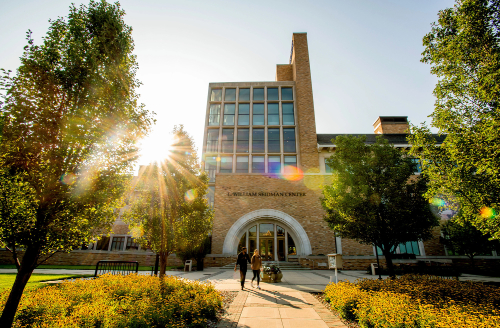
The center of all things business at Grand Valley, the L. William Seidman Center houses the Seidman College of Business and features multipurpose room for lectures and events, a state-of-the-art trading room, and student collaboration and study spaces.
Seidman College offers several assistantships for full-time graduate students (enrolled in at least 9 credit hours/semester) in good academic standing. Full-time graduate assistantships require a 20-hour per week work assignment for 16 weeks per semester. GA's receive tuition credit for up to 9 credits and receive a $4,000 stipend each semester (fall and winter).