
Strategic Planning, Assessment, and Program Evaluation in GVSU’s Division of Student Affairs
While interconnected through the advancement of a culture of evidence, strategic planning, assessment, and program review are three uniquely different methods of helping student affairs examine our work and determine if the way we deliver our programs, services, and processes truly makes a difference in furthering the mission and goals of the university, division, and department. The common throughline in our efforts is our commitment to advancing diversity, equity, and justice.
Advancing a Culture of Evidence
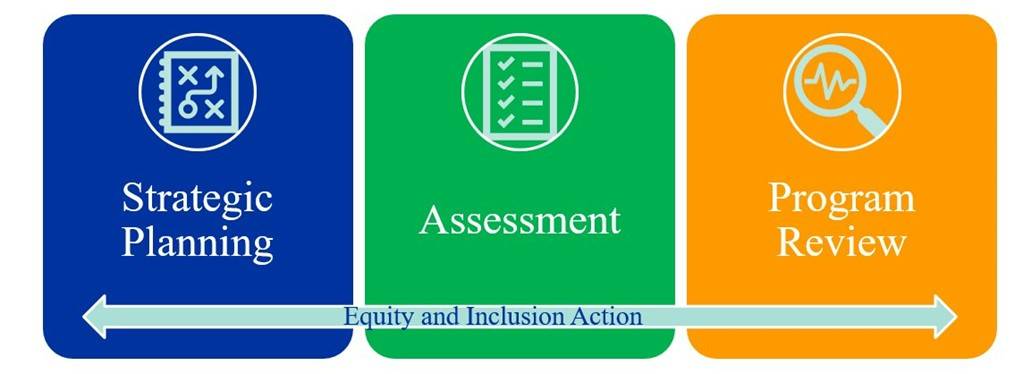
Culture of Evidence
Strategic Plan
The Division of Student Affairs’ work is guided by GVSU’s institutional mission as well as our divisional mission, vision, and values; this work directs the efforts of our individual units as we partner with students. In order to advance our mission and vision, we set strategic objectives that we report on annually. Each of the units within Student Affairs develop unit missions, visions, and values specific to those areas. Within our unit strategic plans, units evaluate ongoing efforts to support students and report on objectives (e.g. utilization, satisfaction, student learning).
The Division of Student Affairs strategic plan is a living document linked to the university strategic plan. Progress updates are added annually.
Assessment of Student Learning & Student-Centered Outcomes
The Division of Student Affairs is committed to using data to show evidence that our programs, services, and practices are effectively contributing to student learning and student-centered outcomes. To support this effort, DSA developed a set of student learning domains that are foundational to our work. Through an annual reporting process for assessing student learning, units stay committed to a culture of continuous improvement. Each year, in order to complete assessment expectations, Student Affairs staff must make meaning of what was learned during the assessment process (utilizing data to inform decisions, planning action as a result of decisions, describing significance of findings and implications for future work).
Program Review
DSA is committed to using data to show evidence that our programs, services, and practices are effectively contributing to excellence within student engagement and support.
Routine program reviews are helpful for longer term planning, strategic action, and accountability. Typical program review components:
- Purpose & Scope (development of timeline and expectations)
- Self-study (using available data)
- Internal review choices
- External review & site visits (use of content experts)
- Formal reporting & action steps
Student Data
The Division of Student Affairs uses information provided by the Office of Institutional Analysis and Division of Inclusion and Equity to provide relevant programs and services for the Lakers of today.
Strategic Planning
The Mission, Vision, and Guiding Principles of the Division of Student Affairs provide a strong foundation for our collective work. While no single statement can capture the full scope of each department’s contributions, this framework is designed to be both bold and flexible- grounding us in shared purpose while allowing room for growth and interpretation.
Division of Student Affairs Mission & Vision
Mission: We inspire and support learning for all Lakers.
Vision: To be a national leader in innovative and inclusive student affairs practice- where students and staff thrive, teams lead with heart, and impact lasts a lifetime.
Guiding Principles
Well-being: We promote holistic wellness and supportive systems that uplift our community.
Equity, Belonging, and Accessibility: We cultivate inclusive environments where all people are seen, heard, and empowered.
Community of Care: We nurture a culture of empathy, respect, and connection where everyone feels safe, supported, and valued.
Accountability: We act with integrity, transparency, and responsibility, guided by our principles and informed by data.
Relationships: We foster open communication and authentic partnerships to break down barriers and reach shared goals.
Engagement: We enrich student life through dynamic, hands-on experiences that spark reflection, growth, and lifelong learning
Assessment
DSA Student Learning Domains
The DSA student learning domains help guide the assessment efforts of the division. Our domains are informed by GVSU’s Reach Higher Commitments, the DSA Strategic Plan, CAS (Council for the Advancement of Standards), and NACE competencies for future career success. Below are the four learning domains which each Student Affairs unit will be asked to support through the creation of unit-level student learning/student centered outcomes.
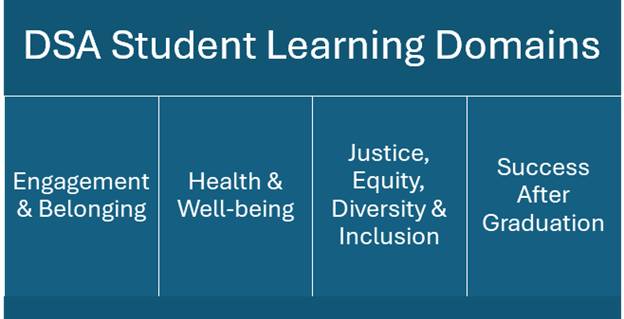
- Engagement & Belonging: Students engaged in Student Affairs programs, services, and activities will experience increased feelings of belonging, characterized by a sense of acceptance, value, and inclusion within the community.
- Health & Well-being: Students engaged in Student Affairs programs, services, and activities will develop/deepen understanding about their own health, well-being, and happiness (and that of others) and connect their goals to their overall life satisfaction.
- Justice, Equity, Diversity & Inclusion: Students engaged in Student Affairs programs, services, and activities will cultivate an appreciation for cultural diversity, involving respect and celebration of differences in others, effective collaboration with diverse individuals, and awareness of actions promoting social justice, equity, and inclusion.
- Success After Graduation: Students engaged in Student Affairs programs, services, and activities will develop their ability to synthesize and apply their academic, relational, career, and civic engagements at GVSU toward their personal and professional short and long-term goals after graduation.
DSA Assessment Committee
- Colleen Bailey, Housing & Residence Life*
- Melissa Baker-Boosamra, Office of Student Life*
- Kaylee Barkman, Center for Health and Well-being
- Dr. Brian Bossick, University Counseling Center*
- Amy Campbell, Recreation and Wellness
- Joey Grubbs-Hulst, LGBT Resource Center
- Dr. Kate Harmon, AVP of Student Affairs* (chair)
- Tim Mohnkern, Student Accessibility Resources
- Holly Jasinski, Center for Women and Gender Equity
- Tiburcio Lince, Office of Multicultural Affairs
- Jeremy Paul, Office of Student Life
- Susan Sigler, Dean of Students Office
- Daphnea Sutherland, Children's Enrichment Center
*- University Assessment Committee members
DSA Strategic Planning Committee
- Dr. Kate Harmon, AVP for Student Affairs, Well-being & Inclusion
- Members of the DSA Leadership Team
DSA Program Review Committee
- Dr. Kate Harmon, AVP for Student Affairs, Well-being & Inclusion (chair)
- Dr. Aaron Haight, Assoc. VP for Student Engagement & Dean of Students
- Dr. Alisha Davis, AVP for Student Affairs, Social Justice Centers
- Dr. Shontaye Witcher, AVP for Student Affairs, Disability Support Resources