

GVSU Conflict Model: The Restorative Approach
At GVSU, we approach conflict through a restorative lens—shifting from blame to accountability, avoidance to engagement, and individual fault to collective learning.
Our approach emphasizes addressing concerns early, locally, and constructively, using fair, consistent, and transparent processes. Whenever possible, we seek resolution at the lowest appropriate level while focusing on what is relevant and actionable now, the impact of conflict, and the desired state for the relationship, team, or workplace.
Core Elements
Restorative practice honors lived experience and relies on deep listening, openness, and a willingness to engage with discomfort in service of meaningful repair.
With curiosity rather than judgement or defense.
Speak from individual experience and perspective.
Seek clarity and empathy, not necessarily agreement.
Establish repair, boundaries, and a path forward.
Circle Offerings
|
Circle Type |
Guiding Question |
Primary Purpose |
Facilitator Role |
Expected Outcome |
|---|---|---|---|---|
|
Listening Circle: A Pause & Process Conversation |
How are we experiencing this? |
Connection, with a focus on experience |
Hold space |
Shared understanding, no after circle action |
|
Dialogue Circle: An Opportunity for Feedback & Exploration |
What do we think, need, or recommend? |
Input, understanding & action, with a focus on issue/change/decision |
Facilitate exchange & inquiry |
Information, ideas, clarity, and possible after circle action |
|
Restorative Circle: A Process of Repair & Restoration |
What happened, who was impacted, and what is needed to repair? |
Repair, accountability and restoration, with a focus on relationship & harm |
Guide a structured repair process |
Understanding, accountability, shared agreements |
Restorative approaches are used whenever appropriate to de-escalate and resolve workplace conflict at the local level. Some situations require an off-ramp, including potential violations of law or University policy or circumstances requiring professional conflict resolution or mental health support beyond the scope of this framework.
Definition of Terms
A structured agreement that establishes clear behavioral expectations, communication guidelines, and professional boundaries to support respectful, functional, and productive working relationships when interpersonal conflict remains unresolved.
Coming soon
A structured, one-on-one developmental process in which an HR or Employee Relations professional works with an individual to strengthen self-awareness, communication strategies, and behavioral effectiveness in order to navigate workplace conflict more productively.
The intentional use of communication, empathy, and boundary-setting strategies to reduce tension and prevent further harm or escalation of conflict.
A structured, facilitated conversation designed to exchange perspectives, explore questions, gather feedback, and build understanding around a specific issue, decision, or organizational change. Dialogue Circles encourage curiosity, open communication, and collaborative problem-solving and may result in identified actions, recommendations, or next steps.
A principle emphasizing transparency, consistency, and inclusion in decision-making and conflict resolution. When people understand the process, believe their perspectives were heard, and see decisions applied consistently, trust in outcomes increases even when full agreement is not reached.
A structured, documented process initiated to address ongoing or escalating workplace conflict through facilitated communication, clear expectation setting, and accountability measures designed to stabilize the work environment. This intervention signals organizational concern and requires intentional engagement by the involved parties, while remaining separate from formal investigation, grievance procedures, or disciplinary action.
The negative effect that words, actions, or decisions have on another person's sense of trust, connection, or belonging.
The emotional, relational, or organizational effect of words, actions, or decisions on others — which may be positive, neutral or negative and may differ from the original intent. Understanding impact is foundational to restorative engagement.
A structured, facilitated space for participants to pause, reflect, and listen deeply to one another with curiosity, empathy, and respect. Listening Circles create space to process shared experiences, particularly during times of organizational change or transition, and build connection and shared understanding. They are not intended to solicit feedback, resolve concerns, or produce action items.
An understanding of what aspects of a situation one can and cannot influence. Recognizing and acting within one’s locus of control is essential for effective and sustainable conflict resolution.
Shared expectations or agreements that guide how team members interact, communicate, and make decisions. Resetting or clarifying norms is often part of restorative repair and rebuilding processes.
A shared belief that individuals can express ideas, ask questions, raise concerns, acknowledge mistakes, offer feedback, and respectfully disagree without fear of embarrassment, retaliation, or other negative consequences. Psychological safety creates the conditions for honest communication, learning, constructive conflict, and meaningful participation while maintaining mutual respect and accountability.
Actions taken to acknowledge harm and rebuild trust after a conflict or relational breakdown. Repair may include apology, changed behavior, restitution, or other steps mutually agreed upon by those affected.
A structured, facilitated process used when harm, conflict, or a significant rupture in trust has occurred. Restorative Circles provide participants an opportunity to understand what happened, explore the impact on those involved, take responsibility where appropriate, and identify steps toward repair, accountability, and restoration of relationships.
An approach to community and relationship-building that emphasizes repairing harm, restoring trust, and strengthening connections rather than assigning blame or punishment. Restorative practices include both proactive strategies for preventing conflict and responsive processes for addressing harm when it occurs.
Creating Healthy, Respectful Workplaces
People • Relationships • Trust
Prevent
Shared Agreements
Build the foundation for a healthy, respectful environment. We strengthen our culture, relationships, and systems to prevent problems before they start.
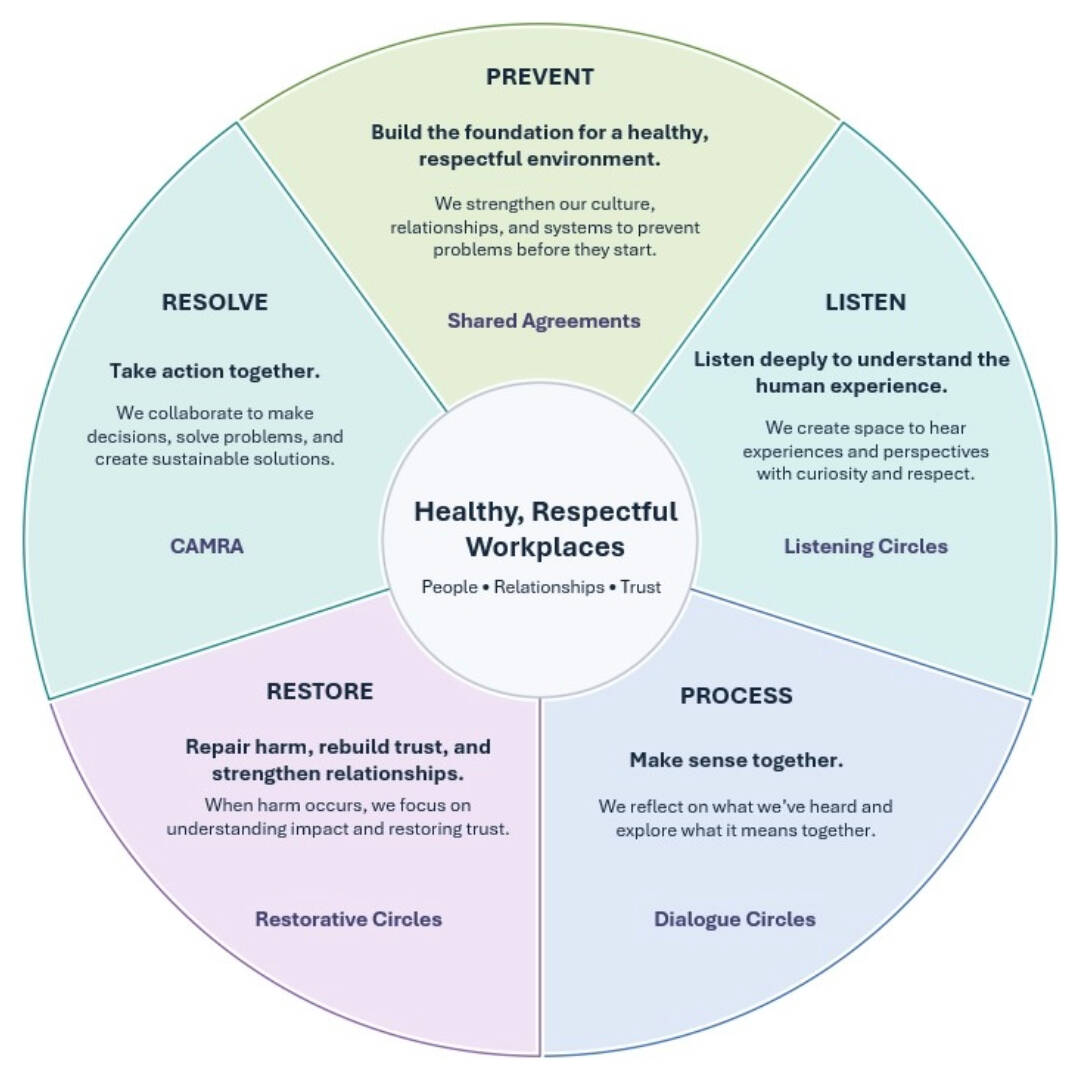
Listen
Listening Circles
Listen deeply to understand the human experience. We create space to hear experiences and perspectives with curiosity and respect.
Process
Dialogue Circles
Make sense together. We reflect on what we’ve heard and explore what it means together.
Restore
Restorative Circles
Repair harm, rebuild trust, and strengthen relationships. When harm occurs, we focus on understanding impact and restoring trust.
Resolve
CAMRA
Take action together. We collaborate to make decisions, solve problems, and create sustainable solutions.