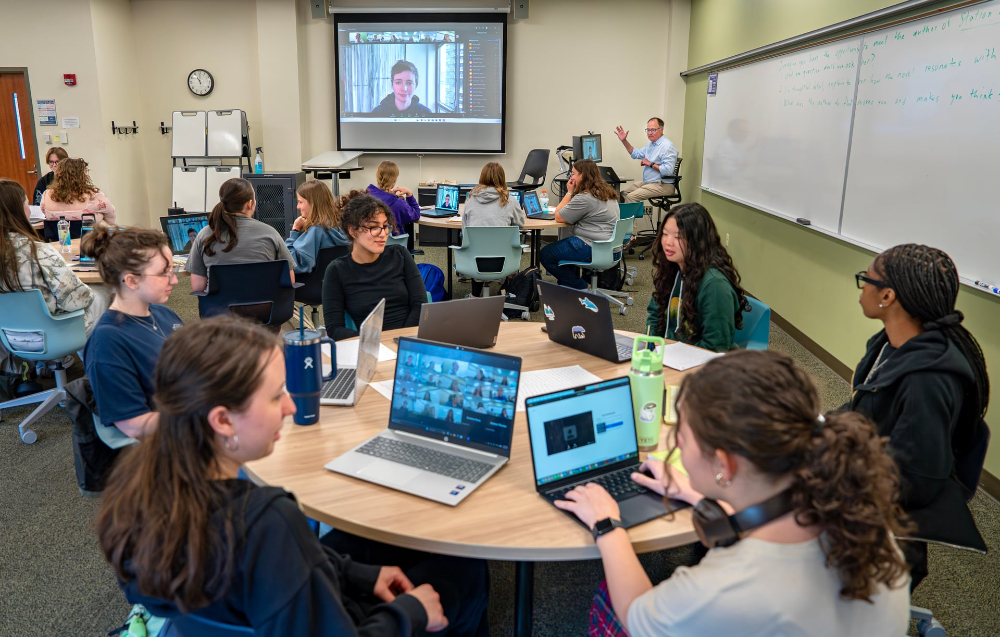
Emily St. John Mandel discusses her book 'Station Eleven' via Zoom
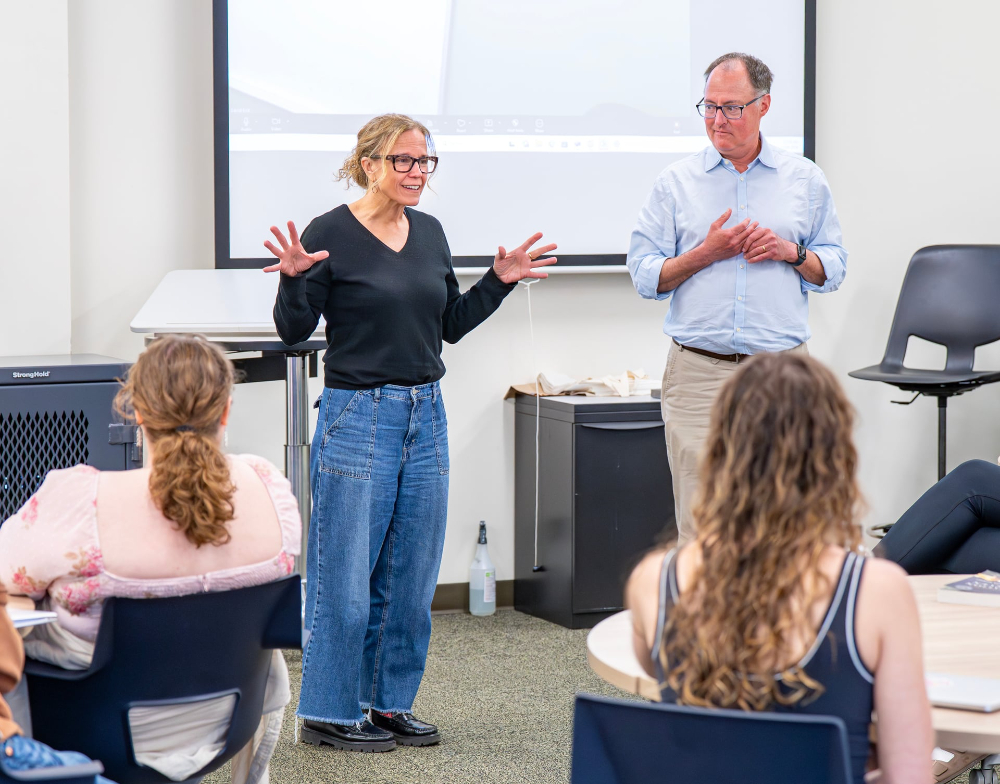
to David Eick and Ellen Adams' honors class at the Niemeyer Learning
and Living Center on April 28.
Photo Credit: Cory Morse
As they settled into their classroom for their final exam, students
in Ellen Adams’ and David Eick’s “Dangerous Ideas” course learned that
they would have a far different experience than they had envisioned.
Dangerous Ideas is a first-year interdisciplinary sequence in the
Meijer Honors College focused on moments of change, which students
explore through works of art, music, film and novels, such as the
highly acclaimed bestseller "Station Eleven" by Emily St.
John Mandel.
"They were so engaged by this brilliant novel," Eick said.
"So we thought, ‘What if we got the author to Zoom in to the
final exam?’"
Eick, without any budget, made a long-shot request to St. John
Mandel’s team for her to speak to the class. He said he was astonished
to receive an enthusiastic response from the author herself.
"We were excited, but didn’t tell the students," Eick said.
The book follows the lives of interconnected characters throughout
various stages of a pandemic and the collapse of civilization. The
story takes place in the Great Lakes region, centering on a traveling
troupe of actors and musicians, a plot that allowed St. John Mandel to
delve into humanity and culture within a post-apocalyptic environment.
For their final exam, students were greeted with a prompt asking them
to imagine they meet the author of "Station Eleven." They
wrote about what made the novel resonate and the questions that still
lingered in their minds.
When St. John Mandel virtually joined the class via Zoom, awestruck
students began asking questions one by one. They commented on the
book's Shakespearean motifs and their favorite characters. They asked
about what inspired her to write the story and which of her characters
she saw herself in. One student asked about her choice of using the
third-person point of view.
“Showing a character’s thoughts is such a privilege of prose,” St.
John Mandel said.
Students were also interested in the writing process and what led her
to make certain choices.
“I start off with a scene and then the scene begins to build
characters, and a plot builds off of that,” St. John Mandel said. She
also expressed the importance of realness and believability in a
dystopian tale. For example, she knew it would be most plausible for
post-apocalyptic civilizations to exist along bodies of fresh water,
so she chose to set the story near Lake Michigan.
Students asked if she would change anything about the novel, now 12
years after its publication. St. John Mandel explained that she is a
different person now, so she would certainly make different decisions.
She said she viewed it as a reflection of that period and believes
that all writing is a sort of time capsule for writers.
“The novel is totally a product of the time it was written, as well
as a product of the person you are at the time you write it,” she said.
— Sofia Ellis is a senior writing major and a student writer for
University Communications.
Participants spent 10 weeks in an accelerator program offered by the DeVos Center for Entrepreneurship & Innovation, in partnership with GVSU's Northern Michigan Region.
Featured
July 14, 2026 (Volume 49, Number 19)
Article by
Shannon Owen