


GVPrep
Dual Enrollment that Works for You
Project Summary
A first-of-its kind initiative from a state public university, GVPrep provided large-scale access to high quality university-level courses that directly connected students with a path to future learning. This program focused on removing student success barriers and increasing the number of underrepresented students statewide who enrolled in four-year colleges and graduated on time.
The program successfully ran from January 2023 through May 2024.

140+ dual enrollment college credits earned through courses in science, mathematics, history, English, social sciences, and business.
Grand River Preparatory Academy, Covenant House Academies (Detroit East, Detroit Southwest, Grand Rapids), PrepNet Virtual Academy, and West Michigan Aviation Academy.
Arizona State University, Central Community College, Franklin University, Indiana Institute of Technology, Ranger College, Southeastern University, Washtenaw Community College, Western Texas College
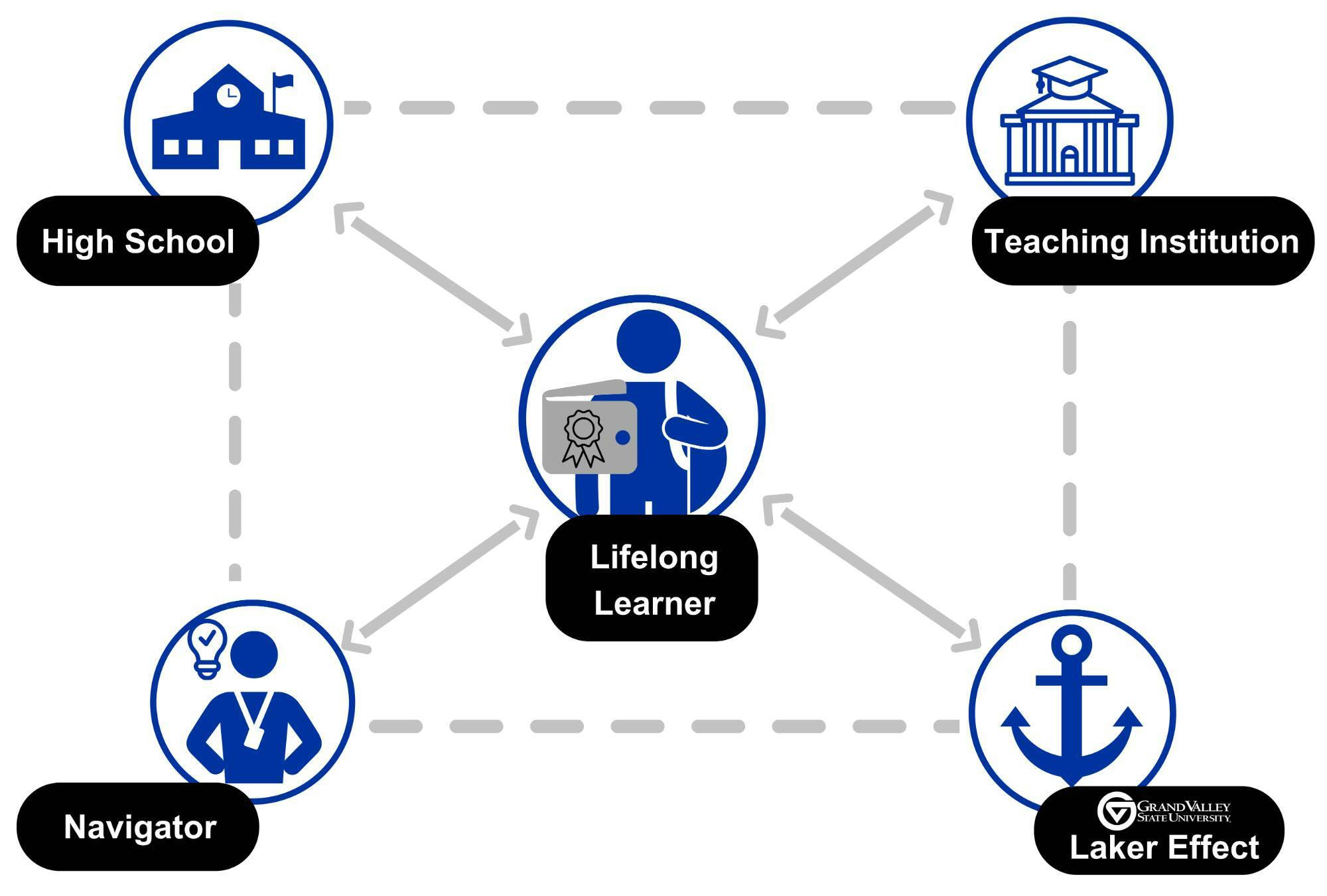
GVPrep uniquely supported students by creating pathways between high schools, teaching institutions, and Grand Valley State University supports.
GVPrep Celebrates the Success of its Inaugural Student Cohort, Winter 2023
GVPrep's winter 2023 cohort consisted of 8 students across 3 high schools in Michigan. These students completed a variety of courses offered by Arizona State University, Indiana Institute of Technology, Ranger College, and Central Community Colleges of Nebraska.
Jayme McWain, an educator at Grand River Preparatory Academy who served as a mentor for her school’s GVPrep students, noted how the program had positively shaped student growth:
“GV Prep offered students a unique way to earn college credit and build skills toward their future. It was great to see kids learn more independence and challenge themselves. Grand Valley did a great job soliciting their feedback and suggestions for the program!”
Mike Irwin, Principal of Grand River Prep Academy, looked forward to another successful semester for students participating in GVPrep programming.
Pictured right: Four Grand River Prep students celebrate a successful semester of GVPrep with Principal Mike Irwin, teacher Jayme McWain, and Director of GVPrep, Meagan Treadway.

Key Benefits
The GVPrep Approach
Dual enrollment programs have long been shown to increase the chances of college enrollment and completion, particularly for underrepresented students. For a number of reasons, however, dual enrollment in Michigan breaks sharply along racial and economic lines: although 86% of districts reported dual-enrollment participation in 2020, only 31% of participating students were classified as “economically disadvantaged” and fewer than 18% were of students of color.
Unlike other dual enrollment programs, GVPrep provided students opportunities for consistent, specialized support and unlocked future learning at a four-year university.

Accessibility and Affordability

Credit Portability and Transfer
Guidance and Navigation

Incentives for Future Learning

GVPrep courses were free for Michigan public school students. GVPrep incurred the cost of classes up front and districts were invoiced midway through the term. All courses were virtual and asynchronous. Both 8-week (accelerated) and 16-week (full-term) courses were offered.
Although these are credits that will show on the GVSU transcript, courses were selected for their wide acceptability at other institutions should those prove to be better destinations for GVPrep students. Courses were taught by faculty at partner institutions.
From the moment of their initial inquiry, students were assigned a dedicated navigator to steer them through the dual enrollment application process. Navigators remained as personalized support throughout the dual enrollment journey and offered support for students' transition to college.
Students who successfully completed a GVPrep course and choose to attend GVSU received a $100 credit to use towards any GVSU expenses. The $30 GVSU application fee was also waived. Students with a family income of less than $50,000 who enrolled as a GVSU undergrad were eligible for the Grand Valley Pledge.
