

Learning Module: 'Infinity Cube' Subtractive Sculpting Activity
'Infinity Cube' Subtractive Sculpting Activity | ArtPrize 2021
Welcome to ArtPrize 2021 at GVSU! We’re excited to host two large sculptures at two different locations on our Pew campus in downtown Grand Rapids: Jason Quigno's Infinity Cube, at L.V. Eberhard Center; and José Marcelino Valdez and Gerson Valdez-Cordòn's Mayan Stelae of King K'ak' Tiliw Chan Topaat at the L. William Seidman Center. Both sculptures are located outdoors and are on view to the public during ArtPrize, September 16 - October 3, 2021.
In this lesson, you’ll get a close look at both works of art, and we’ll take a deep dive into one of them, learning about and exploring the creative process of local artist Jason Quigno.
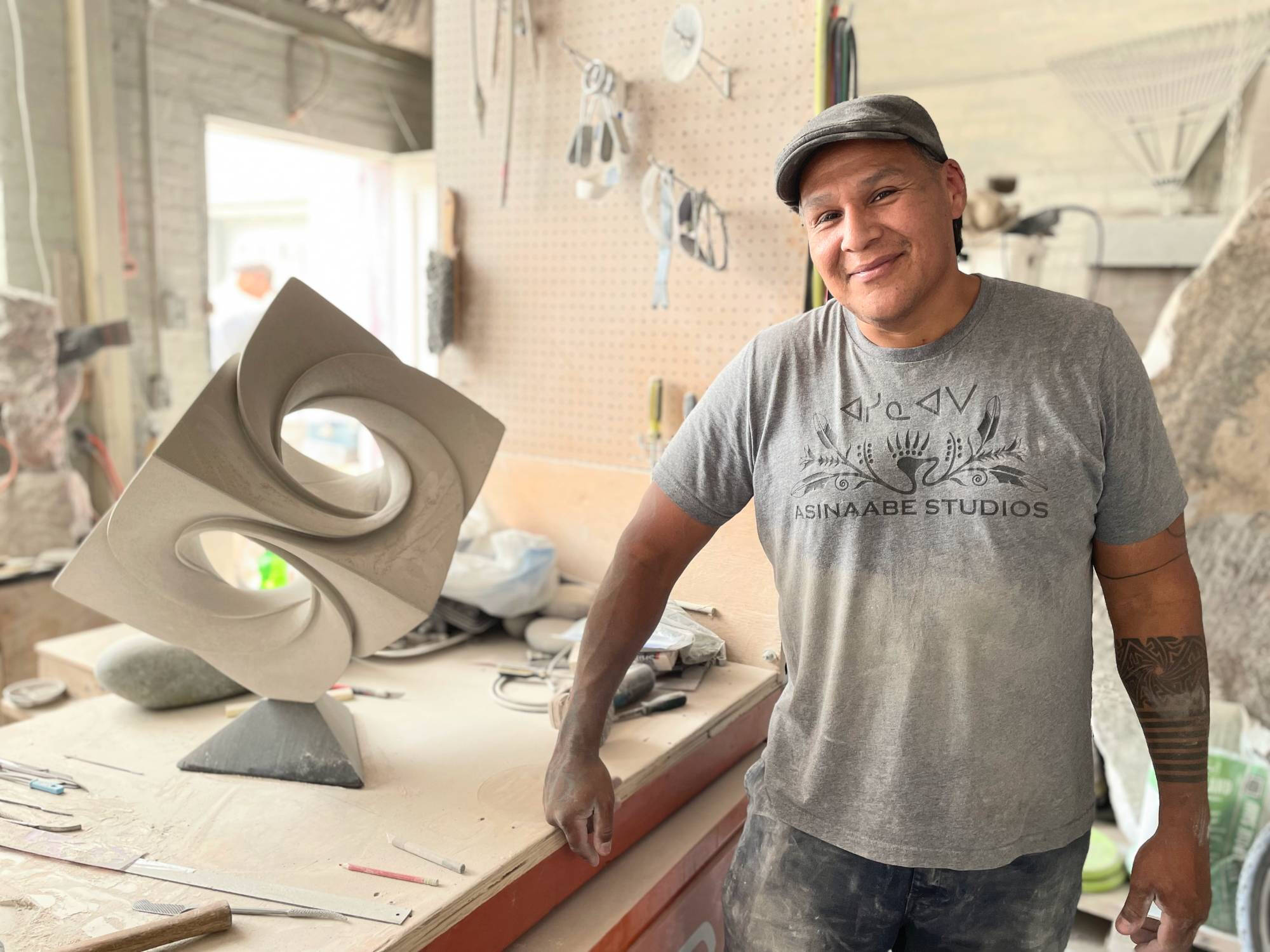
Jason Quigno with a maquette of Infinity Cube at his studio Asinaabe Studios
Key Terms and Concepts
- Subtractive sculpting involves the removal of material from a block through cutting, chiseling, chipping, or scraping away. When artists carve stone, wood, or plaster they usually use a subtractive sculptural process. Subtractive sculpture is the oldest form of sculpture.
- Artists use positive and negative space to create shapes and forms in a subtractive sculpture. Space is the area above, below, between, within and around the main objects in a piece of art. Space is present in both 2D & 3D works of art.
- Positive Space = the shapes or forms (main objects) in an artwork.
- Negative Space = the space that surrounds the main objects. It is the empty or non-interesting space between and around the main objects.
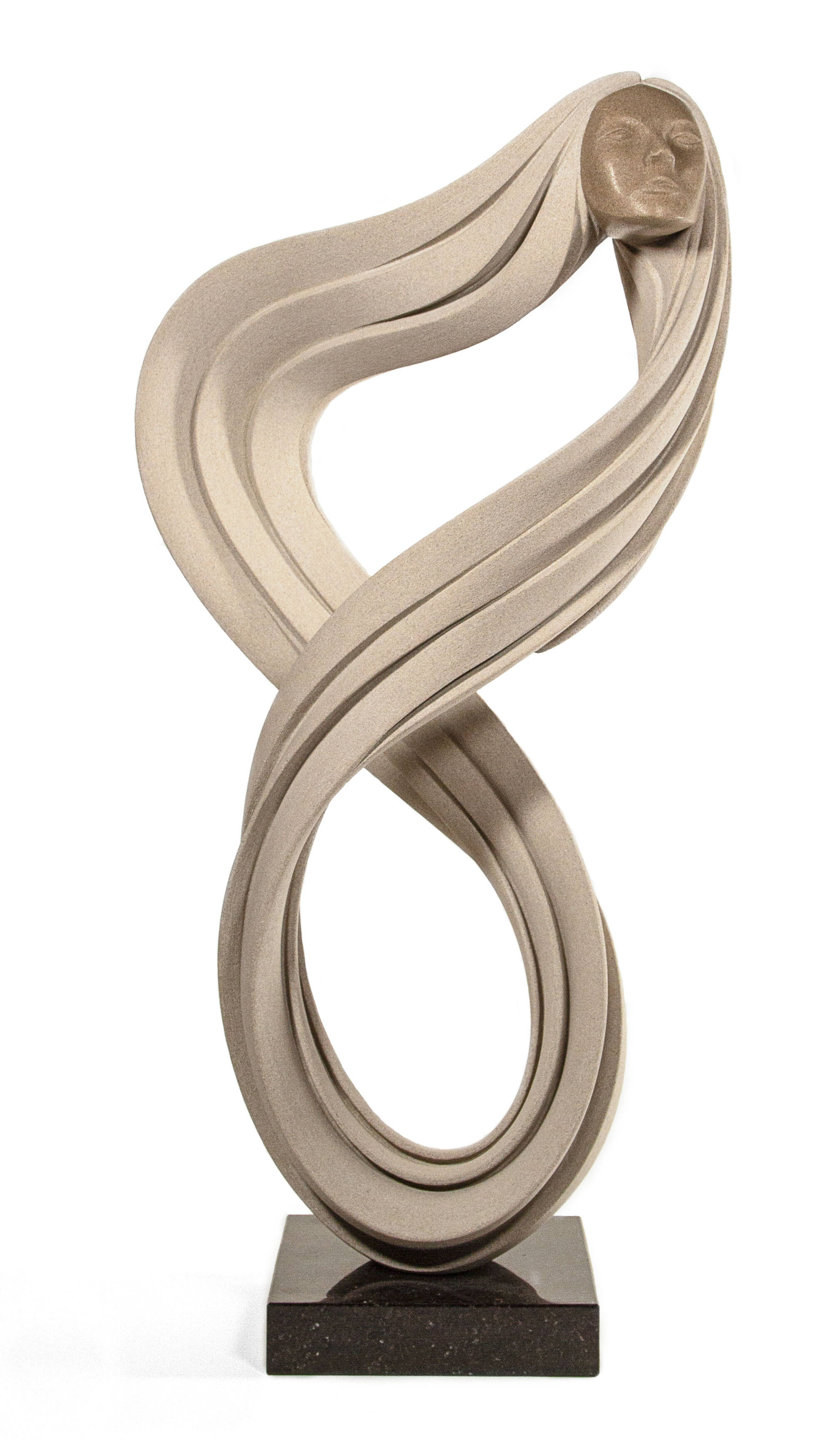
Jason Quigno, Manidoo Nodin (Spirit Wind), Indiana Limestone on Black Granite base, 2020, 2020.24.1.
Subtractive Carving Activity
Gather Your Materials
- 6-sided sketch worksheet
- Pencil
- Ivory bar soap (Ivory soap is softest. Other bar soaps may not be soft enough for younger students to carve)
- Carving tools
- Craft paper, newspaper, or paper towel to cover tables as a drop-cloth
Instructions
- On the 6-sided worksheet, sketch at least two sides of your sculpture. Example; top and front, top and side, etc.
- Trace your sketch onto one or two sides of your bar soap.
- Use the carving tools to remove sections of the bar soap.
- If time allows, have students identify the positive and negative space of their sculptures.
Step-by-step Video Instructions
Play this video to see a demonstration.

A step-by-step overview of soap carving inspired by Jason Quigno's 'Infinity Cube'
Carving Tips
- Abstract designs are easier for younger students
- Try a few different tools, if available
- Go slow and carve away small pieces
- Attempting to carve big chucks may cause the soap to crack or break in half
- If the soap is hard, try holding it in your hands to warm it up
Discussion: Indigenous Art in West Michigan Today
- Before European settlers arrived in Michigan (over 350 years ago) there were many Indigenous tribes living here, and their ancestors still live here today. Three of these groups formed an alliance called the Three Fires Confederacy, also known as the Anishinaabe in their native language (Anishinaabemowin).
- In the mid-1600s, it's estimated that around 100,000 Indigenous people lived in West Michigan.
- Anishinaabeg (plural of Anishinaabe), translates to “People Whence Lowered” or “the Good Humans.”
- The Anishinaabe people include several tribes that share similar languages and customs, including the Ojibwa, Potawatomi, Odawa, Salteaux, and Chippewa.
- Each tribe is different, but they all share three beliefs: 1) Spirits were more powerful than men; 2) Nature—the land, animals, and plants— belonged to everyone, and 3) No one had the right to run another person’s life.
- Prior to colonialization, everyone living in a Native village worked. Women and girls did most of the chores. They tanned (softened) animal skins, wove fishnets, chopped wood, grew crops, and cooked. Men and boys hunted and fished. They made bows and arrows, traps, wooden tools, and canoes.
- From the mid-1600s onward, Native Americans’ way of life was disrupted or erased by European settlers and colonialization. Today, many Indigenous people work hard to preserve and pass on their traditions through gathering together, sharing stories, food, and art.
- *A few traditional Anishinaabe art forms include birch bark weaving and regalia (traditional dress worn at powwows).
- * Anishinaabe artists today create with all sorts of materials and processes, including drawing, painting, beading, weaving, and sculpture.
Discussion Questions
- What do you see?
- What’s going on here?
- What makes you think that?
- What does it mean to be Indigenous?
- What is a tradition?
- What can we learn about Indigenous people today from their artwork?
- How do Indigenous people carry on their traditions today?
More Examples of Indigenous Art
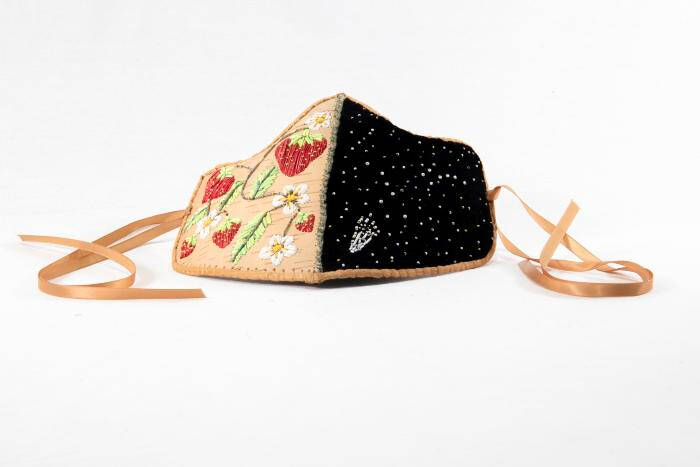
Kelly Church, Breathe in the Beauty of the Day and the Beauty of the Night, birch bark, quills, Rit Dye, thread, velvet, beads, 2021, 2021.22.1.
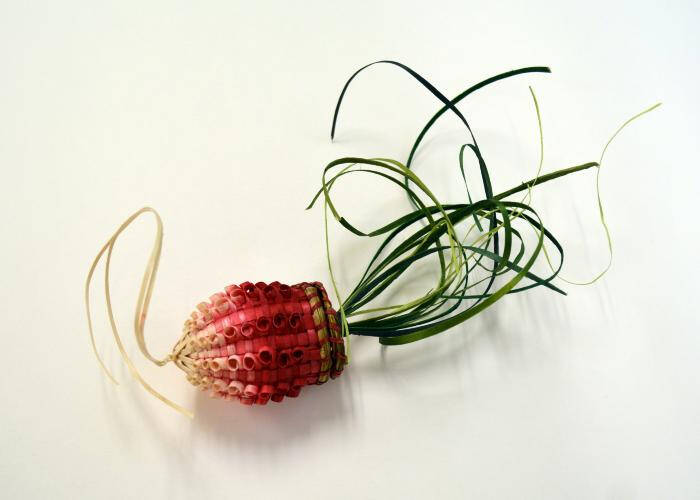
Paula Thorne, Radish, woven Ash and Sweetgrass, 2015.115.2.
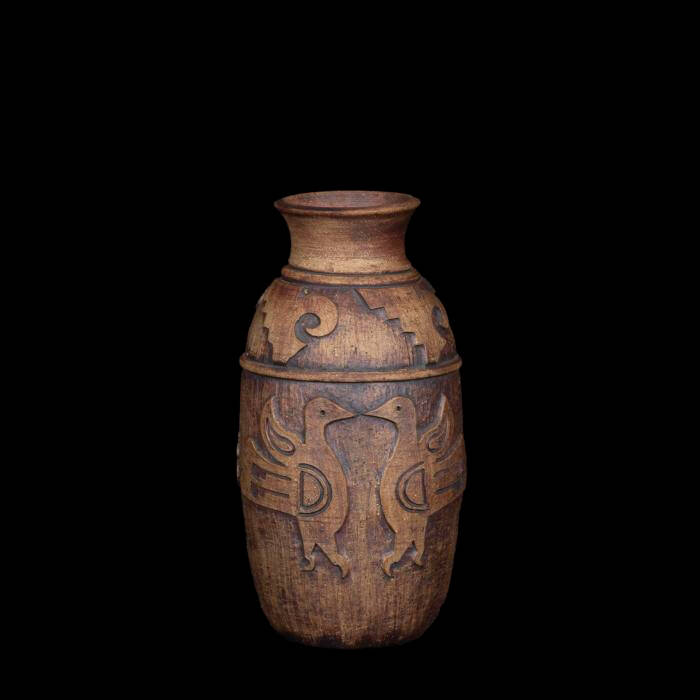
Shirley M. Brauker, Untitled (Vase with Hopi Bird Forms), ceramic, 2023.25.1.
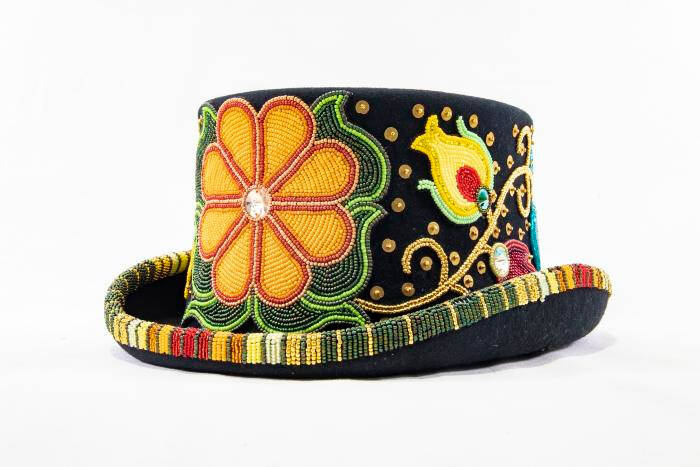
Naawikwegiizhig (Adam Avery), Beaded Top Hat, mixed media, 2021.20.1.
Additional Resources
In 2021, The Art of the People: Contemporary Anishinaabe Artists featured artworks by nationally recognized and early-career Native American artists that combine cultural traditions and imagery with contemporary sensibilities and themes. Organized by the Muskegon Museum of Art and the Grand Valley State University Art Museum with guest curator Jason Quigno (Anishinaabe), this invitational show appears concurrently at the MMA and GVSU. The exhibition incorporated sculpture, painting, ceramics, beadwork, mixed media, and photography, and explored how these artists express their experiences in both traditional and nontraditional media, techniques, and subject matter. Through representational and abstract imagery and design, the artists addressed issues of craft, history, identity, social justice, and popular culture. By exploring and celebrating their past, these artists define who they are today.
Guest curator, Jason Quigno, discusses the exhibition 'The Art of the People: Contemporary Anishinaabe Artists.'