Featured Building: Mary Idema Pew Library
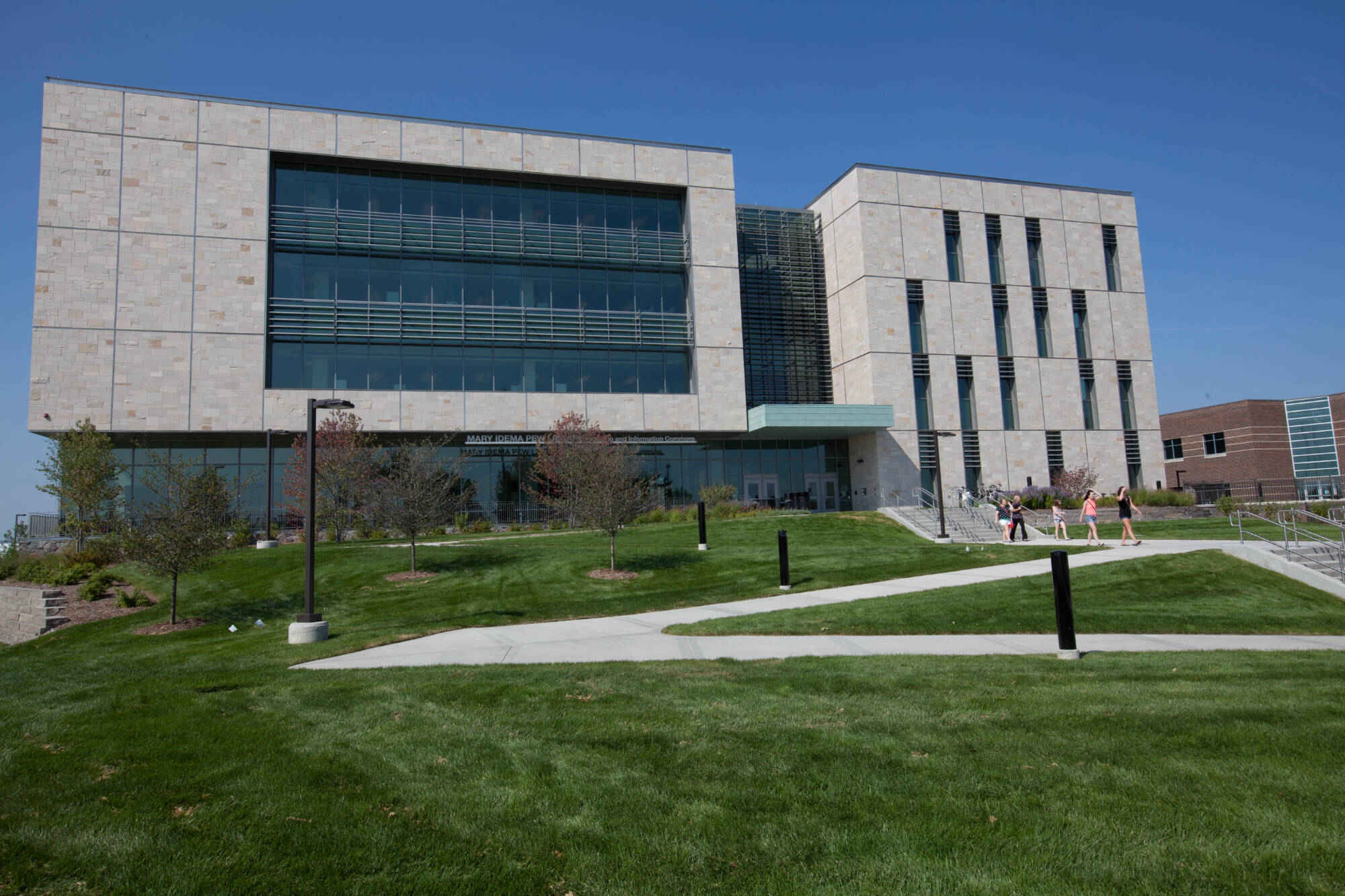
The Mary Idema Pew Library Learning and Information Commons (MIPL) is designed to be the intellectual heart of the Allendale Campus. MIPL is a five-story, 150,000 sq ft. building that opened in June of 2013. MIPL has served our students and community by crafting spaces with their needs in mind and is an integral part of every GVSU student's experience.
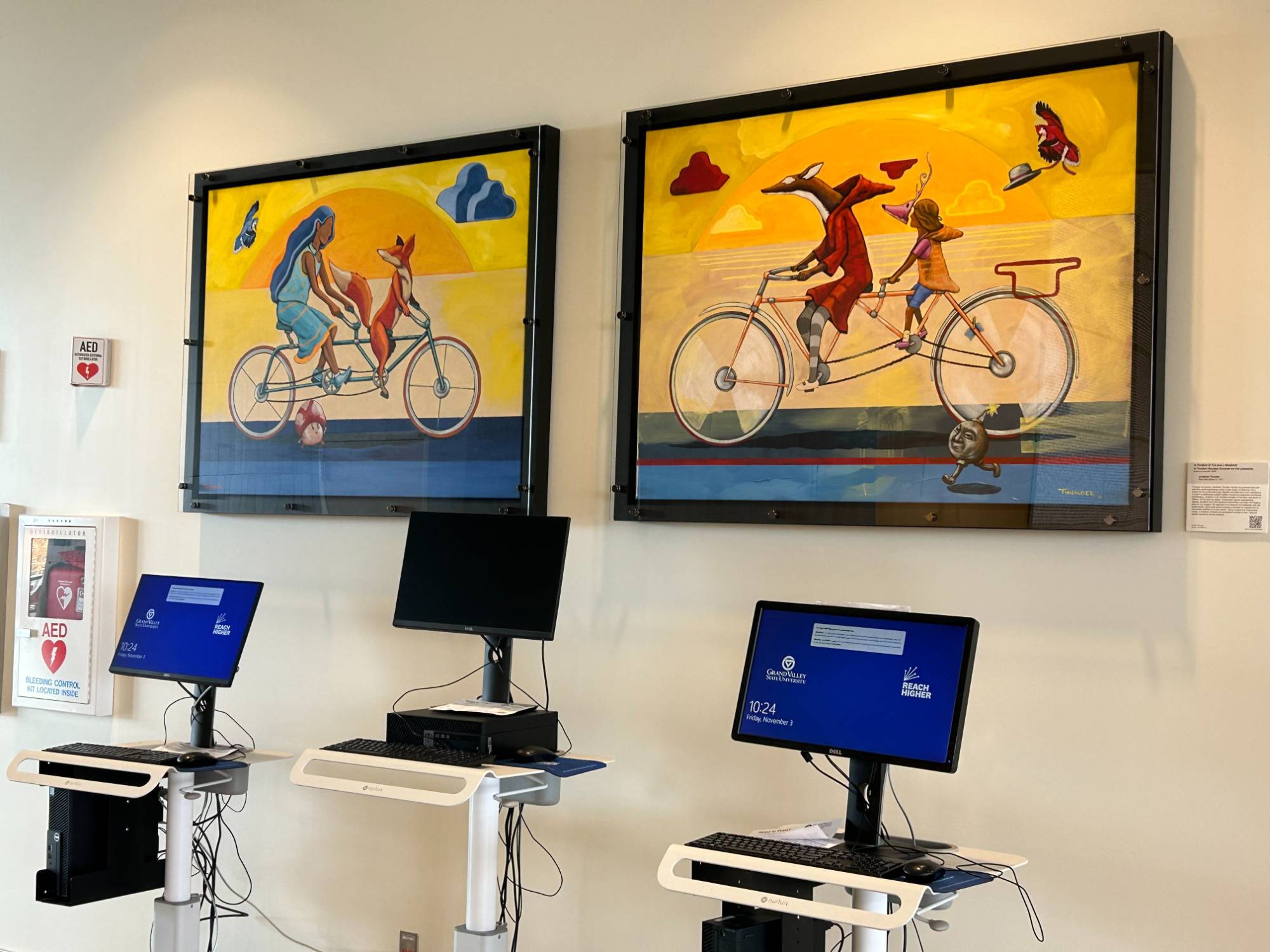
In 2023 the GVSU Art Gallery partnered with the Libraries to refresh artwork displayed in high-traffic areas of MIPL. Each work of art explores a theme or core value held by GVSU. Acute attention was given to fostering environments through works of art that affirm and advance diversity, promote inclusion, and support equity.
"The Libraries are an integral part of the campus community. It is first and foremost a space for our students...The Art Museum and Libraries partnered to showcase works of art that feature representations of people of color as well as a variety of cultural viewpoints. I believe this project aligned and uplifted our commitment of educational equity as well as our University values of inquiry and international perspectives by challenging students to consider a broader world..." - Annie Bélanger, Past Dean of University Libraries
Visual Representation of Our Shared Values
INQUIRY
The GVSU Art Museum believes in and encourages active questioning to improve lives and strengthen communities. Displaying works of art in public spaces provides students with the opportunity to appreciate various forms of self-expression and understand or dispute perceived historical norms, which can lead to creative problem-solving.
INCLUSIVE & EQUITABLE COMMUNITY
We must ensure that works of art on display foster and sustain a sense of belonging, promote diversity and respect, and address systemic issues within our communities.
INNOVATION
Innovation is key to the success of our institution and can be represented in various ways. Creativity is a synonym for innovation. The creative process of producing works of art sparks critical thinking, problem-solving, and risk-taking. Innovation within a work of art can help our community make connections between past and present that otherwise may not have been visible.
INTEGRITY
Integrity drives us to be accountable to ourselves and to our community. It is at the heart of how we at GVSU treat each other in order to advance the common good. The Art Museum often displays works of art that point out the absence of integrity in order to evoke empathy.
INTERNATIONAL PERSPECTIVES
GVSU encourages the understanding of international perspectives. This effort supports the well-being of individuals, groups, and ecosystems that are important locally, nationally, and globally, all of which are interconnected and interdependent.
Explore the Artwork in the Library
First Floor
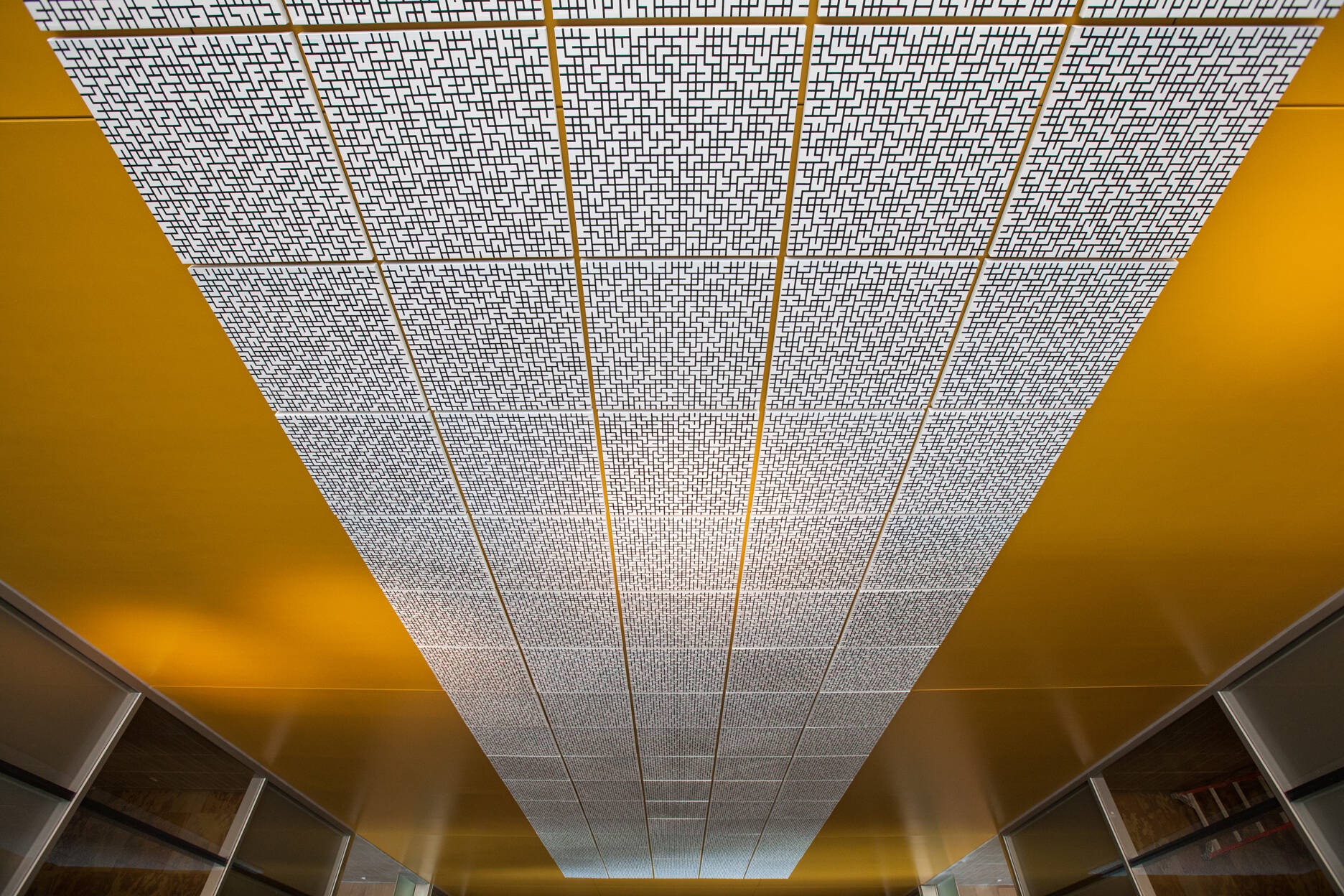
Cheonae Kim, 100 Days, acrylic on canvas, 1998, 2011.18.1.
This piece titled "100 Days" created by Chicago, IL based artist Cheonae Kim can be seen through various levels of the library. Kim states, "My work deals with understanding aspects of the human condition and attempting to elevate the human spirit through line, form, space and color. In my black and white series, I worked with the simplest elements, a horizontal and vertical line. The lines are often combined to make forms, but always on a horizontal and vertical axis. The underlying logic is the basic significance of these two lines. The horizontal line signifies the passive or death. The vertical line signifies the active. A tree grows vertically and when you die you are laid out horizontally."
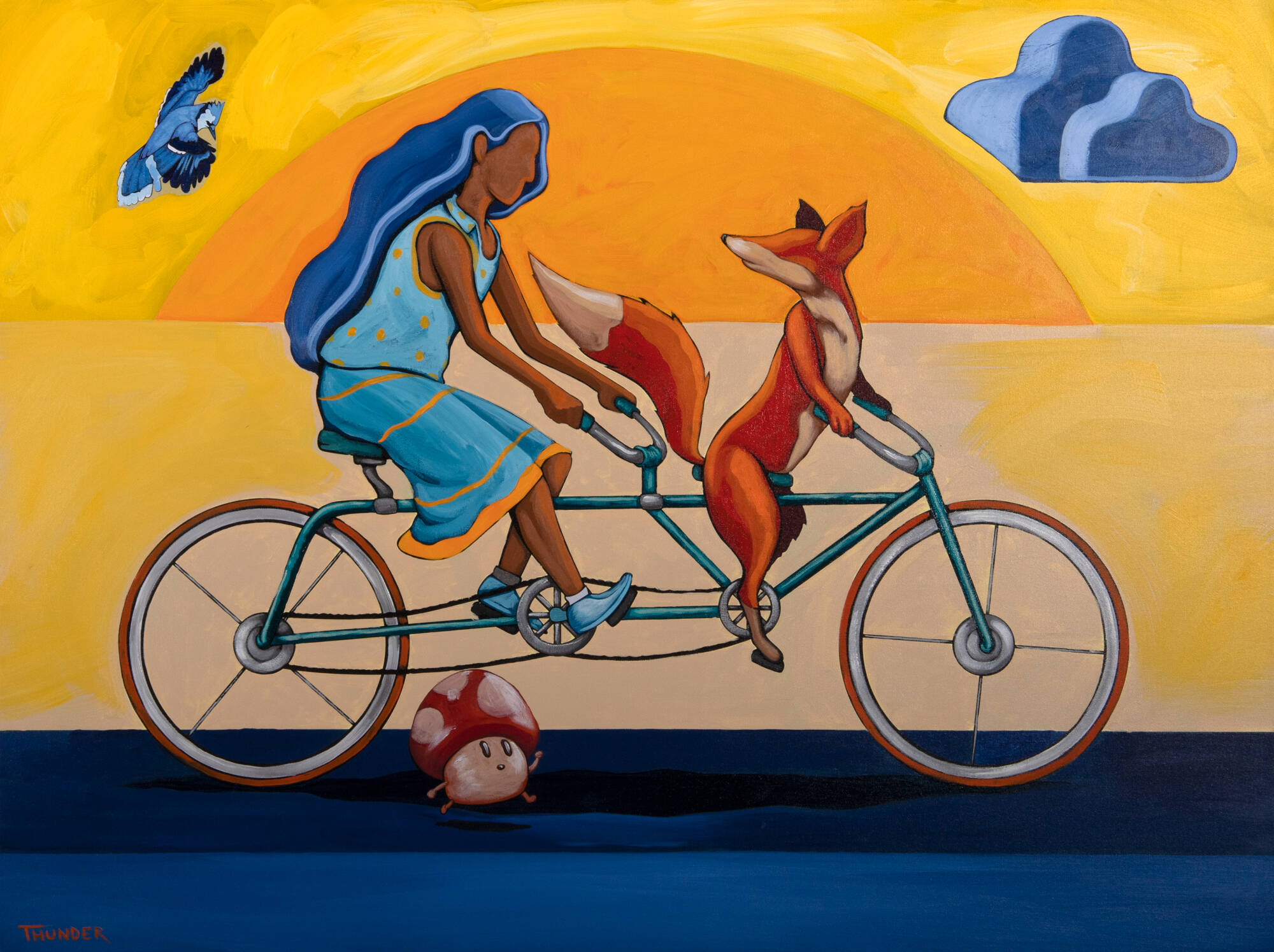
Jonathan Thunder, In Tandem (A Fox and a Bluebird), acrylic on canvas, 2022, 2023.4.1.
Through his artwork, Jonathan Thunder infuses his personal lens with real-time world experiences using a wide range of mediums. He is known for his surreal paintings, digitally animated films and installations in which he addresses subject matter of personal experience and social commentary. Jonathan is an enrolled member of the Red Lake Band of Ojibwe. On his work he states, "Interpretive figures representing identity, situations and socio-political commentary are often the leaping point for my imagery. My approach is to balance the deliberate with the experimental. Each work aims to convey a moment or vignette that is not entirely spelled out to the viewer...Using images that incorporate masks, humanistic animals and animalistic humans is how I discuss identity dynamics among subjects."
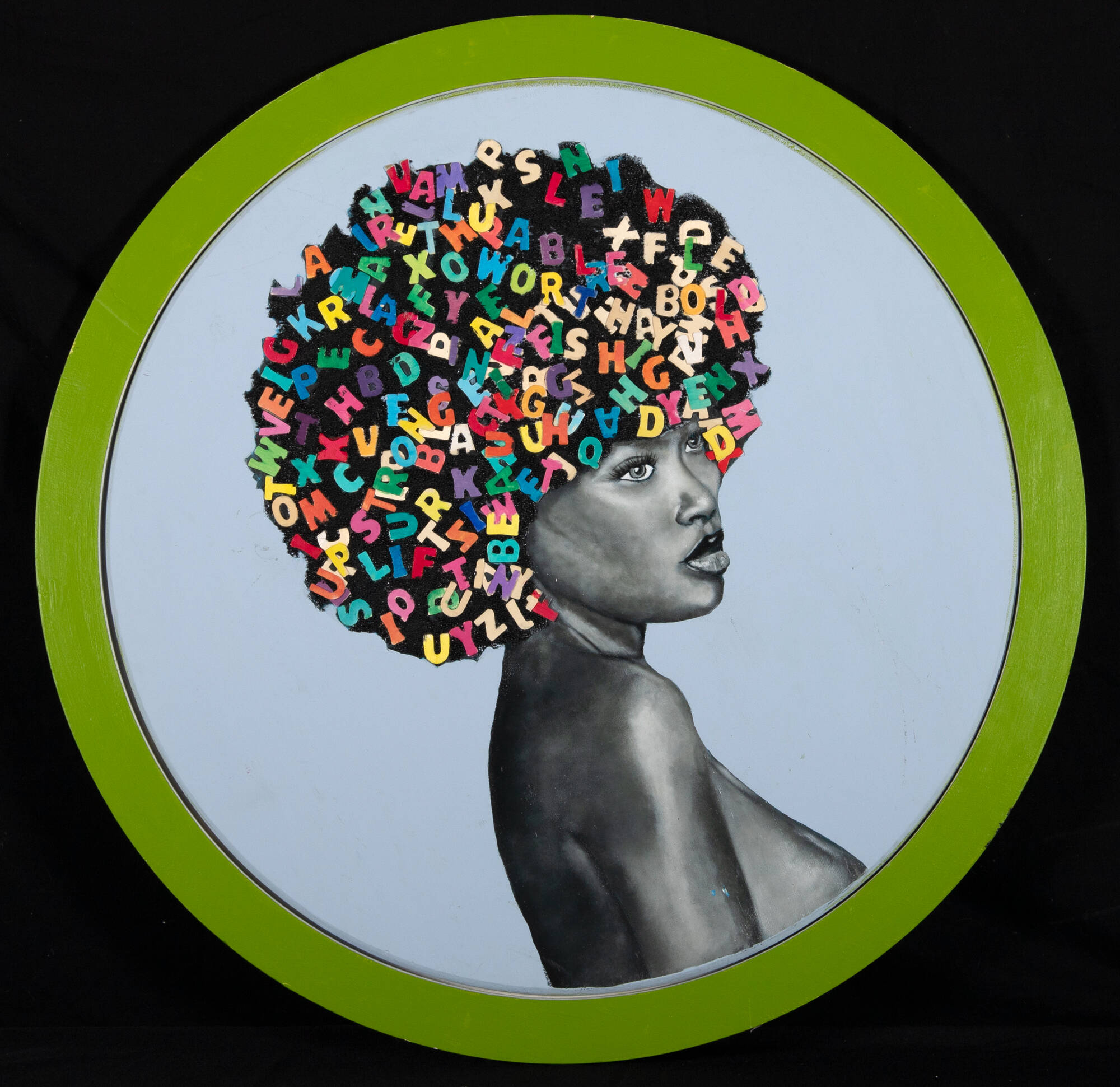
Richard McNeal, She Is, acrylic, wood alphabet, and bead on wood panel, 2023.19.11.
Artwork created by Chicago IL, artist Richard (Rick) McNeal was one of eleven artists featured the GV Art Museum exhibition titled, "Convergence: Cracks in the Glass Ceiling." This exhibit was co-curated by Grand Rapids MUSE GR gallery owners Stephen and Taylor Smith. The work in the exhibit represented the breaking of barriers and pushing of boundaries. The artists engaged directly or indirectly with social and racial justice, and economic issues through vibrant contemporary pieces that include traditional elements of art while blurring the lines between street and contemporary work.
Second Floor
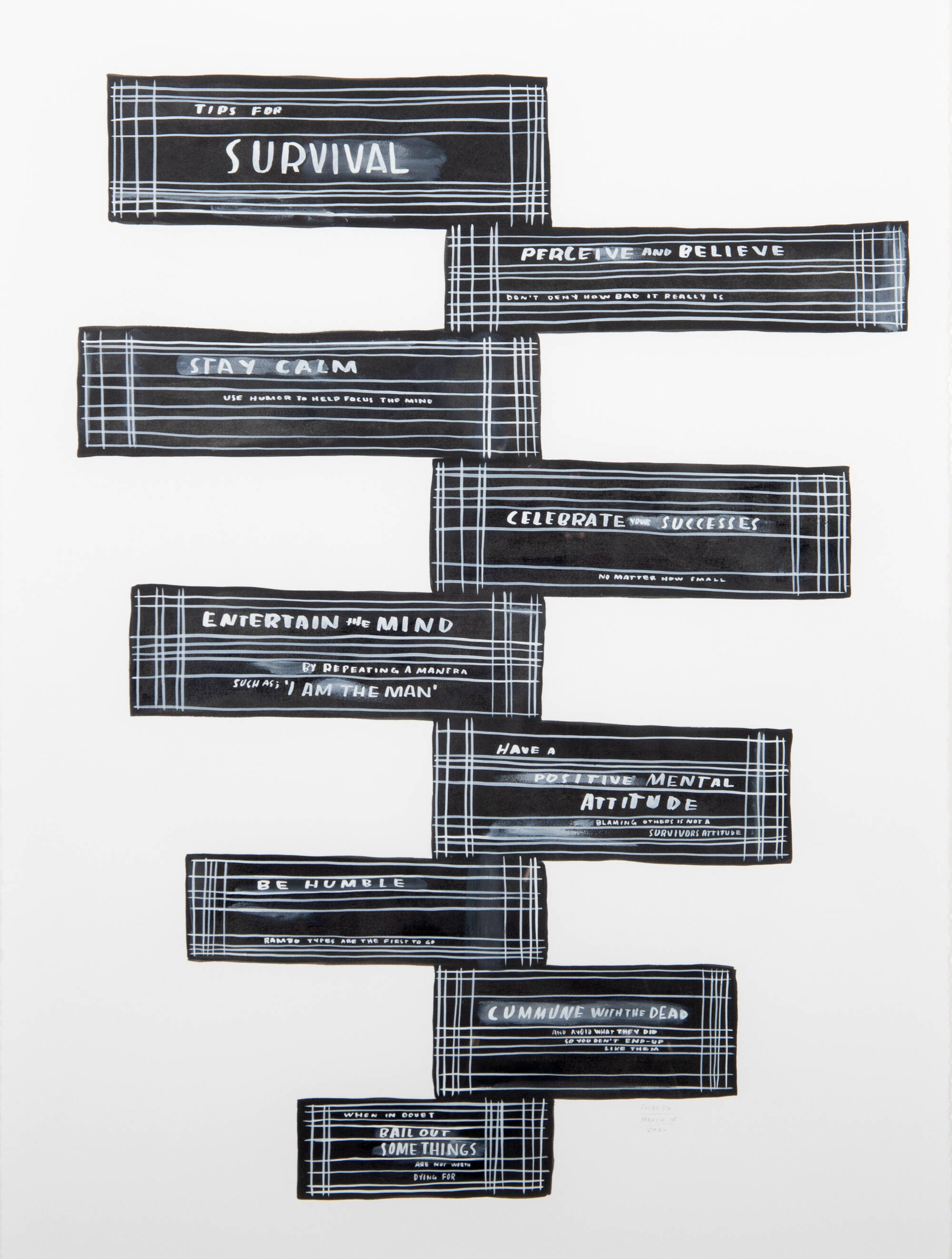
Lora Fosberg, Tips for Survival, India ink and gouache on paper, 2020, 2023.12.1.
Lora Fosberg's piece titled, "Tips for Survival," is almost a step-by-step guide for ones-self inquiry on how to survive. Viewing this work of art allows the viewer a process for evaluating not only their environment but how their actions affect or help to improve their environment.
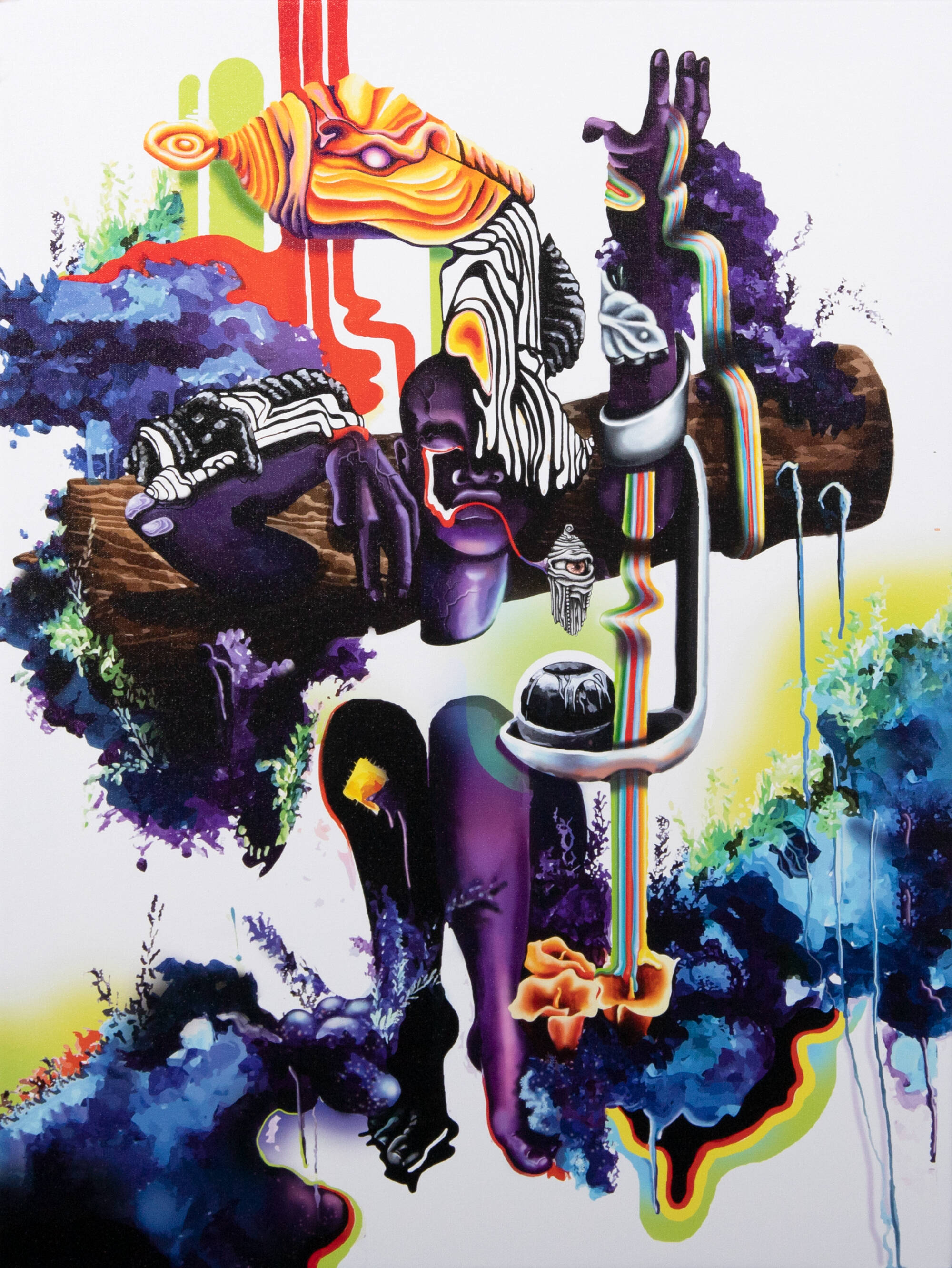
Jasmine Bruce, Release, digital painting, 2019, 2023.19.6.
Jasmine Bruce is a visual artist whose work emphasizes the healing power of creating. Currently based in Grand Rapids, Michigan she obtained her BFA from Grand Valley State University. Her versatile and powerful style tells the story of a universal trauma that plagues the entire human race. This trauma, ancestral and ancient, is a pain that carves deep into the veins beneath the skin and surfaces as blemishes of the Ism: racism, alcoholism, and narcissism. It surfaces as insecurities, anger, abuse, violence, and imbalance. Her work aims to draw out this pain, restoring balance and connection with the inner, outer, and divine self.
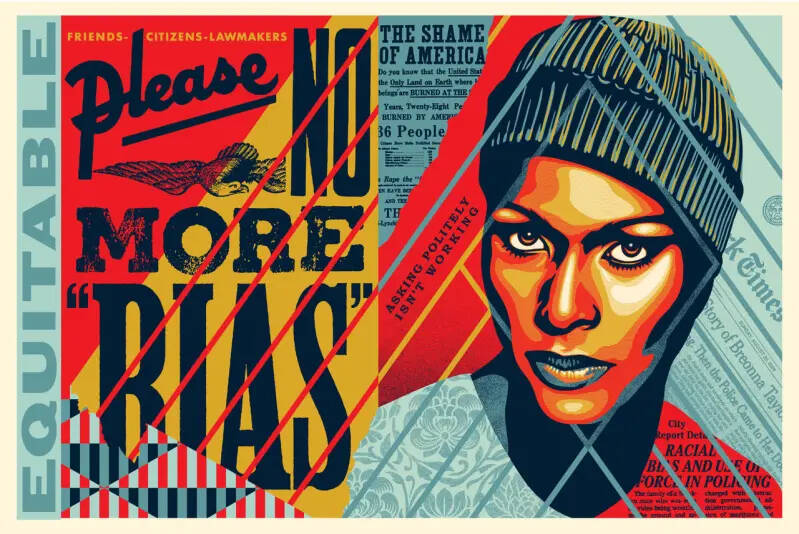
Shepard Fairey, No More Bias, screenprint, 2023, 2023.18.1.
The screenprint, "No More Bias," by Shepard Fairy calls out cultural atrocities.
"Like countless others, I was devastated to see the brutal beating of Tyre Nichols by five Memphis police officers that led to his death. I’ve made many pieces of art touching on racial bias, police brutality, and the combination of racial bias and police brutality...I made this No More Bias print before Tyre’s death but as a comment on similar tragic injustices. The abuse of power in his case is all too familiar and similar..." - Shepard Fairey
Third Floor
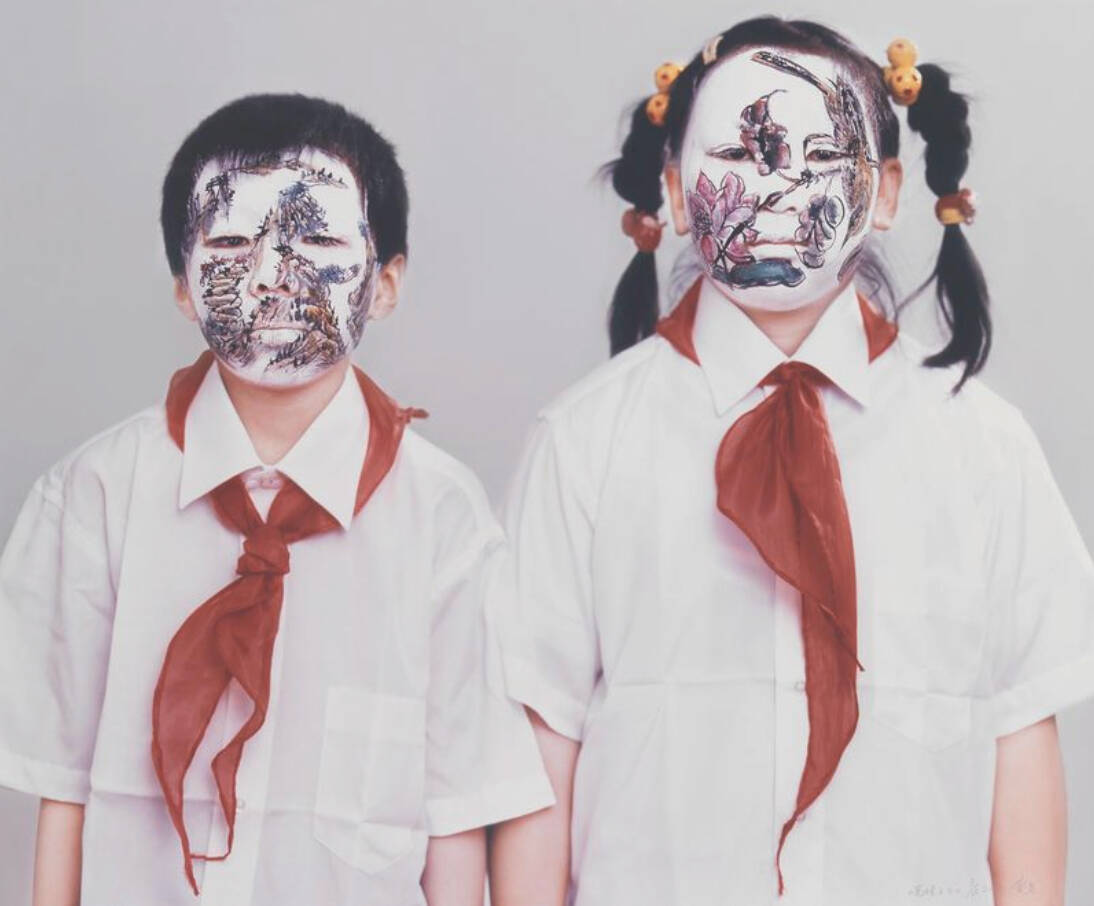
Huang Yan, Brother and Sister, chromogenic print, 2006, 2023.43.4a.
Chinese artist Huang Yan, whose work can be seen on level three of MIPL, evokes the human experience and understanding of family while also calling out the inherent complexities of modern-day China by combining techniques of classical Chinese art with elements from contemporary life and art. Yan's work, like his photographic series titled "Brother and Sister," helps students to question inherent biases and value our similarities in order to appreciate the interconnectedness of our shared human experience.
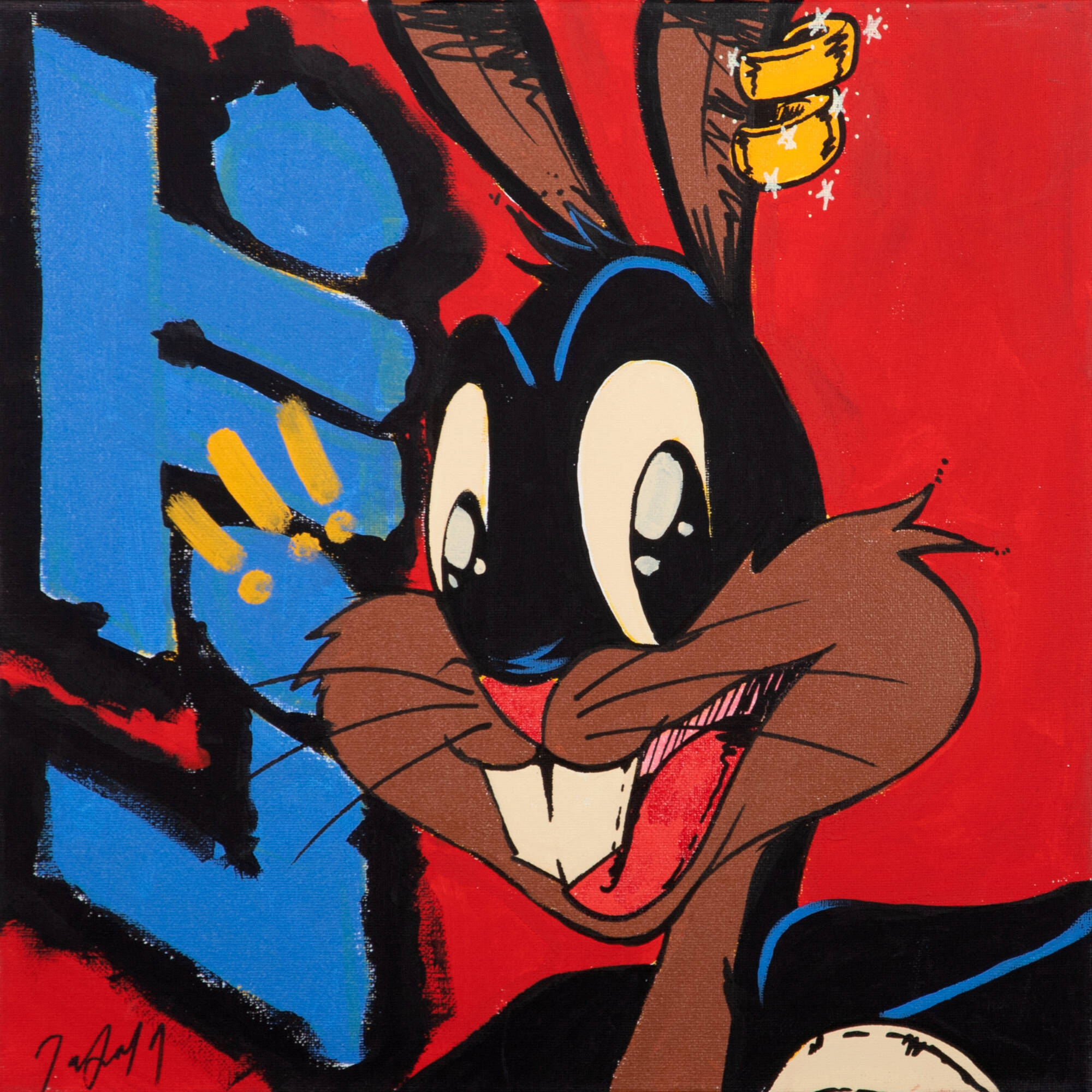
Torrence Jayy, Bugs Bunny Noir, acrylic on canvas, 2022, 2023.19.1.
Found on level three of MIPL is the painting titled, "Bugs Bunny Noir." This piece created by Detroit MI, artist Torrence Jayy depicts Bugs Bunny in a way that gives a sense of belonging to all who grew up watching this cartoon figure. Jayy found a way to reclaim a ubiquitous view of culture by creating an inclusive cartoon-still undeniably recognizable.
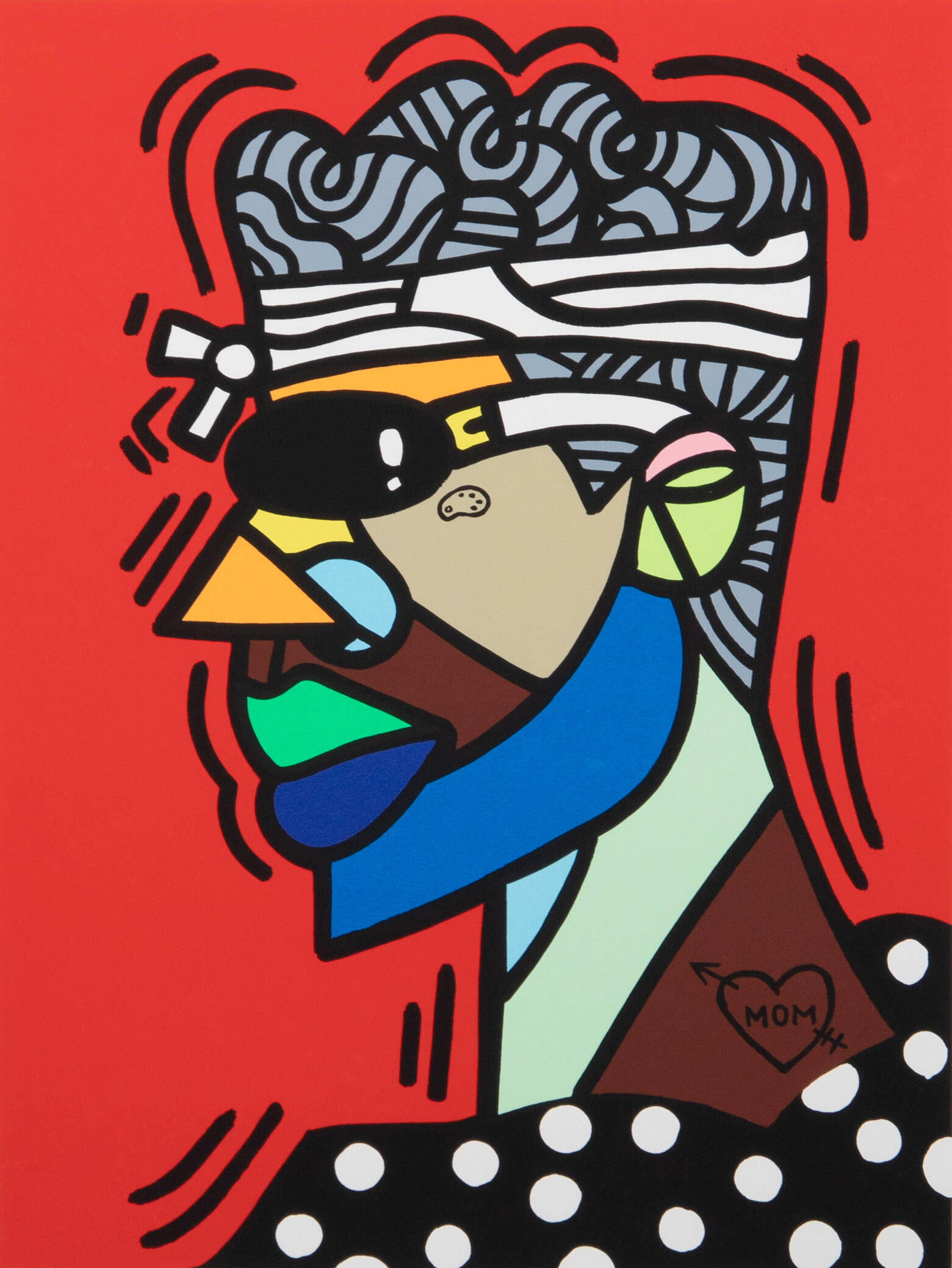
Sheefy McFly, Polka Dot Portrait, 14-color screenprint, 2021, 2023.19.9.
Based in his hometown of Detroit, Michigan, Tashif Turner, better known as “Sheefy McFly,” is a visual artist, muralist, rapper, and DJ, whose artwork and music can be experienced throughout the city. He has quickly become known as a contemporary artist with graffiti-based and counter-culture roots.
As a student at Detroit’s College for Creative Studies, McFly found his visual voice by skillfully bringing together several disparate styles, practices, and traditions. His artwork is heavily influenced by the Neo-Expressionist art movement that portrays recognizable objects, such as the human body, but often in abstract or unexpected ways and vivid colors. Neo-expressionists also used their mediums in raw and emotional ways, an influence found in McFly’s connection to the history of graffiti in Detroit. Throughout McFly’s body of work, there are also influences from Cubism and Abstract Expressionism.
Fourth Floor
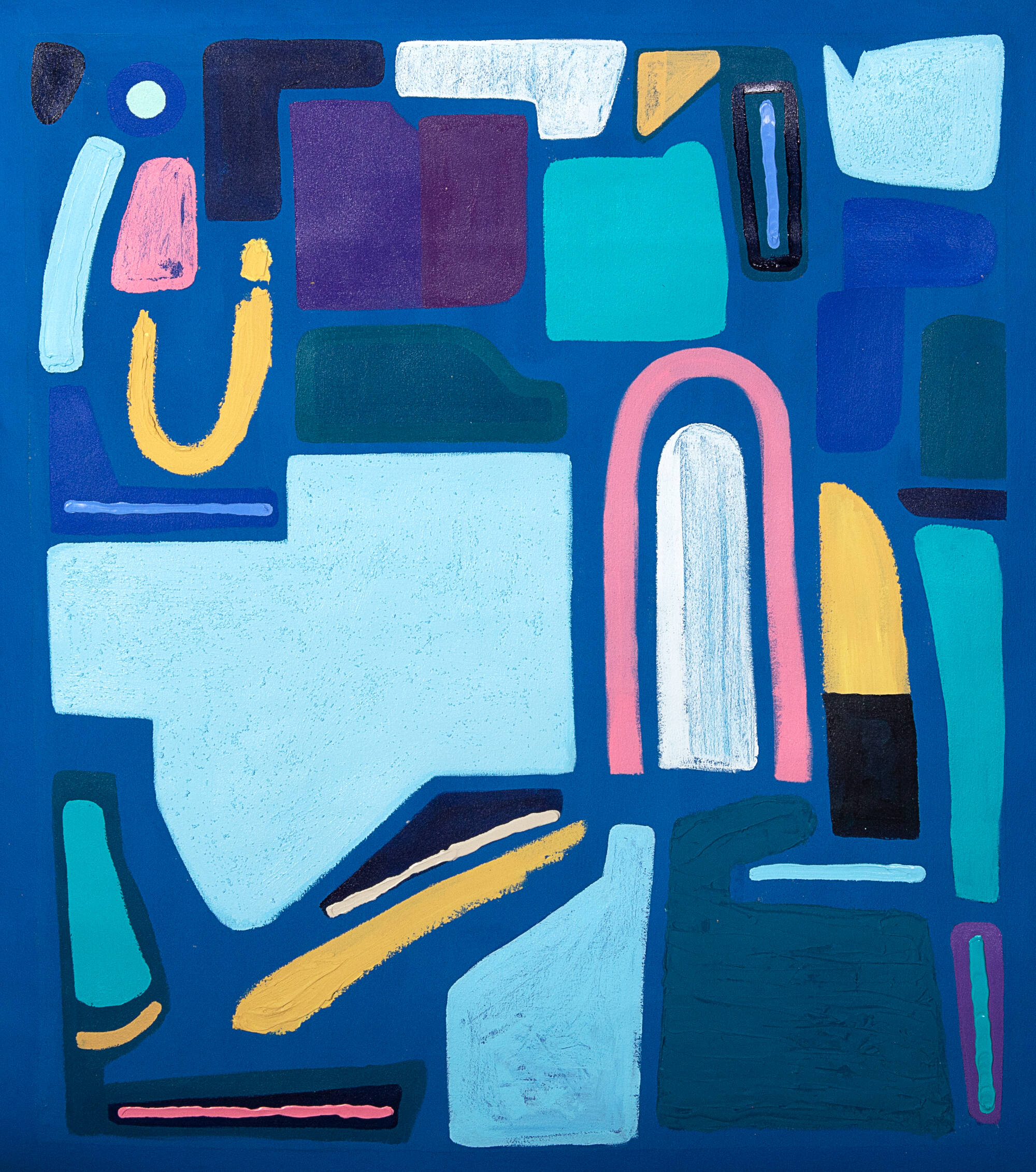
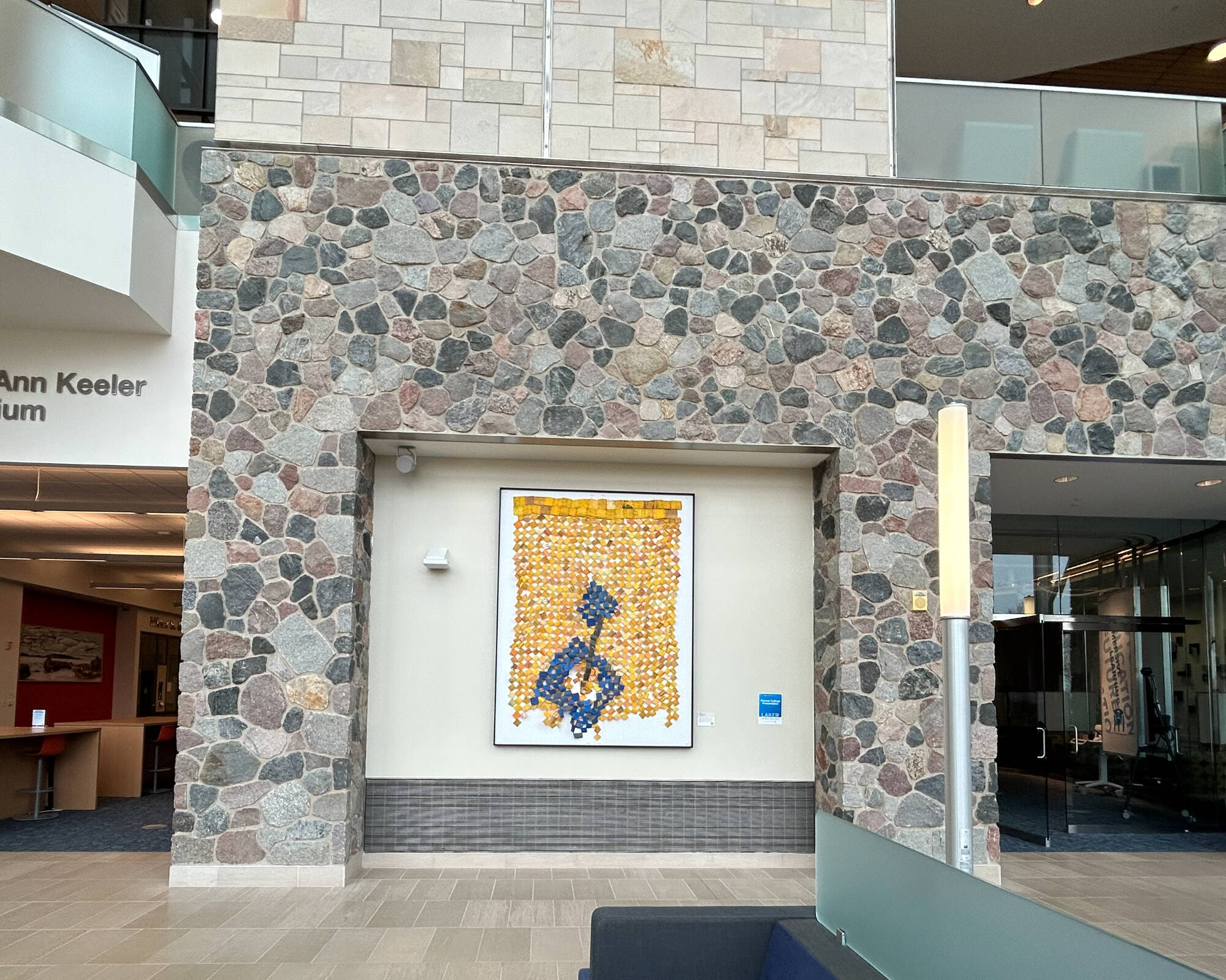
Rosie Lee, Blue Train, mixed media on canvas, 2022, 2023.20.1.
The painting "Blue Train" by contemporary artist Rosie Lee (aka Marcello Pope) bridges the culture of the past to the present. In doing so, he innovates a visual representation that depicts the lack of black voices from the 1950s abstract expressionist movement.
"... I reimagine how color, texture, and movement from a black perspective could provide an ethos of art, spirit, and social activism in the genre. Through color I capture emotions reached in freedom, the freedom of knowing no bounds, no limits, as I layer paint testing its capabilities. To achieve such success requires equal parts experimentation and expertise...Abstraction allows my work to go beyond narratives often placed on black figures and the spaces they occupy." - Rosie Lee
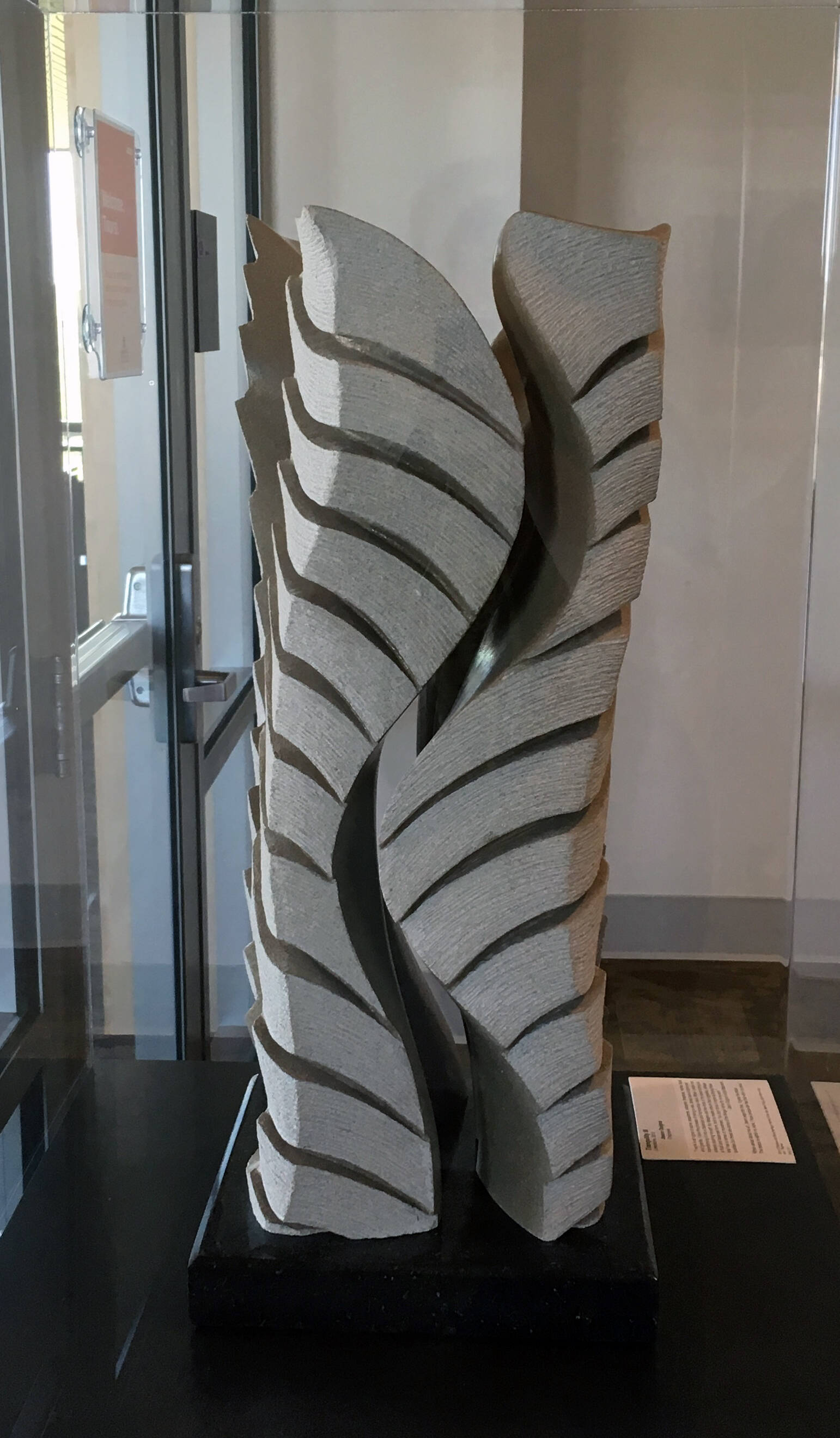
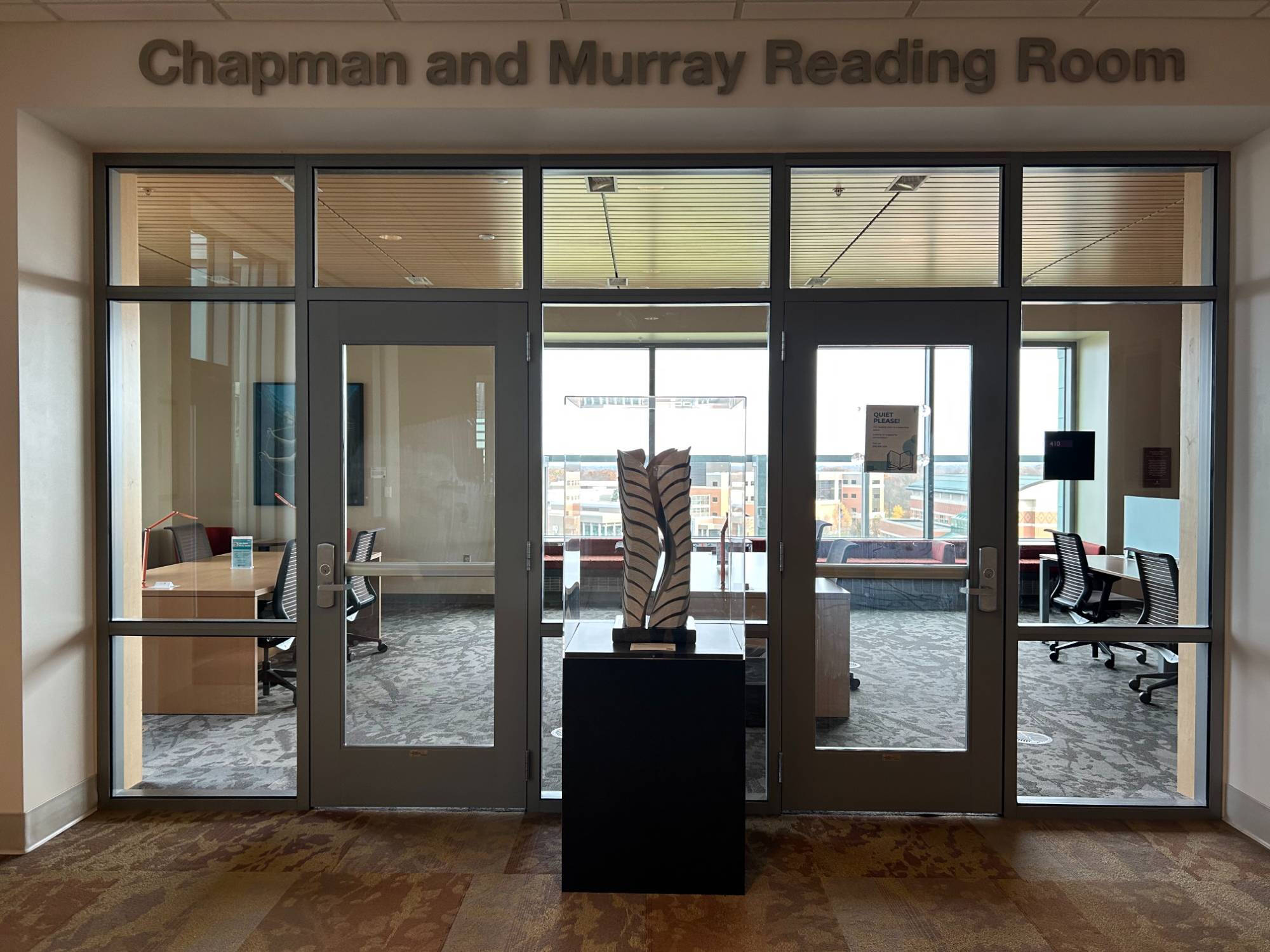
Jason Quigno, Tranquility III, limestone, 2012, 2012.131.1.
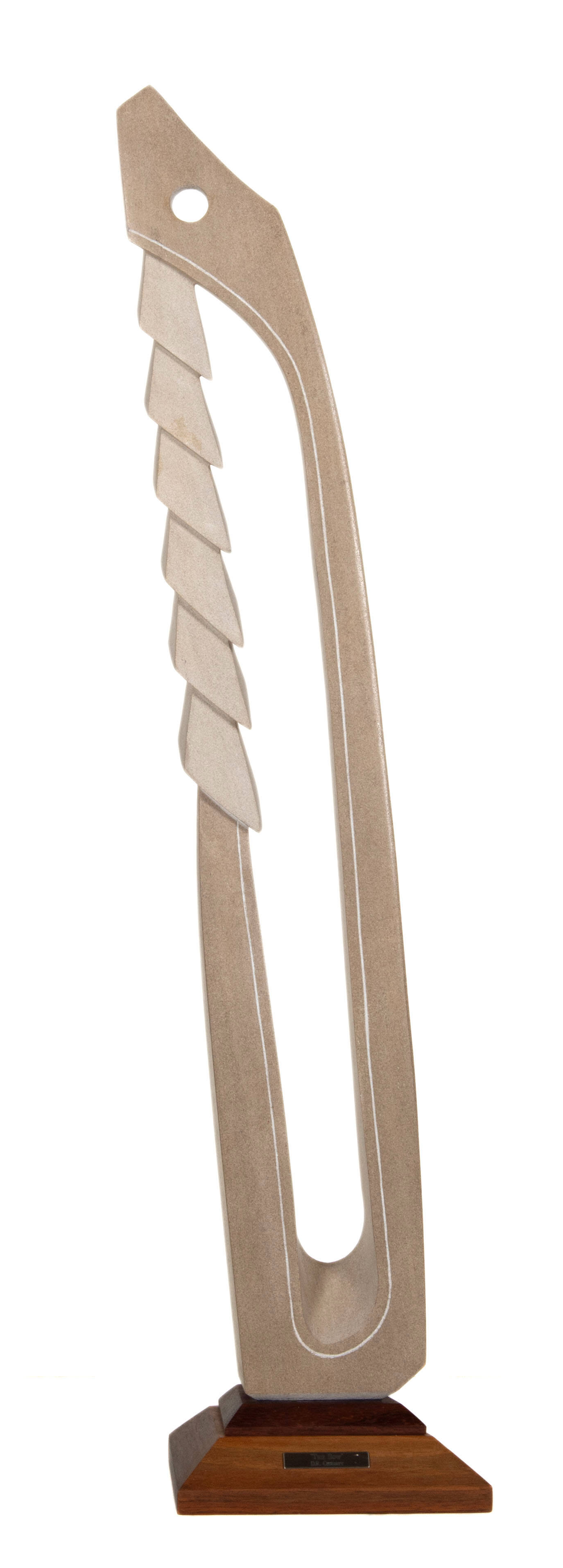
Dennis Christy, Untitled (The Bow), carved stone, 2024.33.1.
Two stone sculptures by Anishinaabe artists Dennis Christy and Jason Quigno reflect a powerful lineage of artistic knowledge shaped through mentorship and shared cultural grounding. Christy, an influential teacher and mentor, guided Quigno in developing both technical skill and a deeper understanding of the spiritual and cultural dimensions of stone carving.
Working in stone—a material tied to permanence, land, and ancestral presence—both artists create forms that embody Anishinaabe values and relationships to the natural world. Presented together, these sculptures honor the transmission of knowledge across generations, demonstrating how mentorship sustains and strengthens Indigenous artistic traditions while allowing for individual expression to emerge.
Virtual Tours of the Mary Idema Pew Library
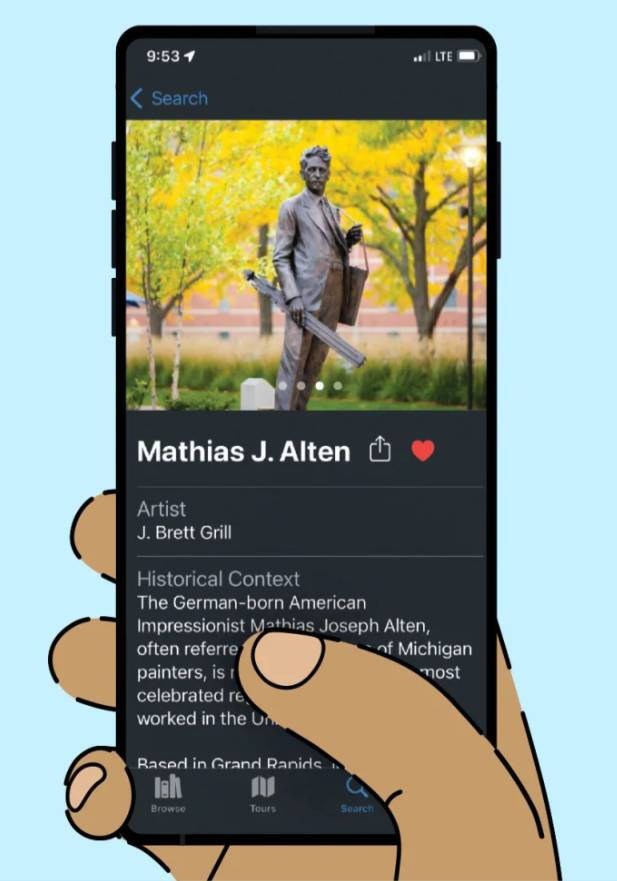
Take a Tour Through the Mary Idema Pew Library with the Art @ GVSU App
The Art at GVSU app is your gateway to the vast and diverse art collection at Grand Valley State University. Whether you're a student, faculty member, or visitor, this app will enrich your understanding and appreciation of the art that surrounds you.
Explore more artwork in the library by taking a curated art tour in the app!