

Exhibit - Mathias J. Alten: An American Artist at the Turn of the Century
George and Barbara Gordon Gallery, 1st Floor, City Campus
Richard M. DeVos Center, Building E, 401 Fulton St W, Grand Rapids, MI 49504
Monday-Friday, 9-5pm; year-round except on days the University is closed (Holidays, Spring Break, Student Fall Break, and between exhibitions).
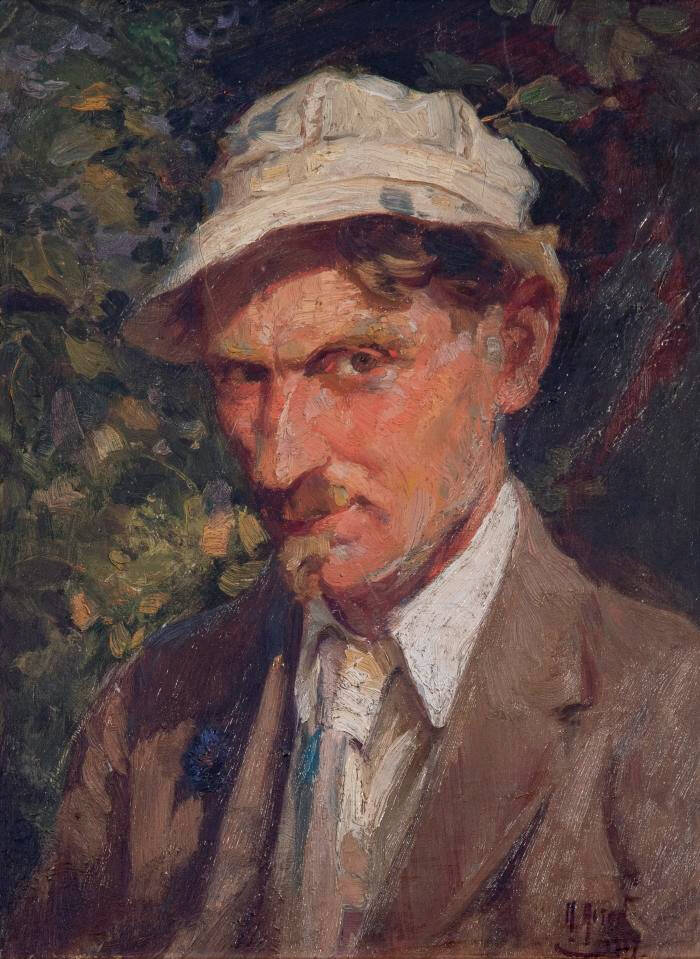
Mathias J. Alten, Self Portrait, oil on canvas, 1917, 2021.86.13
German-born American artist Mathias Joseph Alten (1871-1938) immigrated to the United States in 1889 at the age of seventeen. During this period, the country experienced swift economic and urban growth driven by industrialization and immigration. Alten’s family settled in Grand Rapids, Michigan, a premier furniture manufacturing center and a desirable location for immigrants in the late nineteenth century. Here, amidst a rapidly changing world, Alten went on to establish a family, home, and studio for the entirety of his career.
Like many American painters of the period, Alten was drawn to the major artistic and cultural centers of Europe and the United States. Beginning in 1898 and continuing over the next four decades, he traveled extensively to pursue artistic training, exhibit his work, and engage with fellow artists. Despite his attraction to distant locales and artistic communities, Alten chose to keep his professional home in the same city and state that welcomed his family during the late nineteenth century. As a result, his work was influenced by the landscapes and techniques he discovered abroad, but remained deeply connected to the rural Michigan landscape widely featured in his paintings.
Over his career, Alten created more than 3,000 works of art, initially influenced by the French Barbizon and Dutch Hague Schools and later by the Impressionism movement. His work embraced a fluid style consistent with an Impressionist-inspired brush, and despite the many changes he encountered, his fascination with quiet places and the old way of doing things prevailed. He repeatedly sought out and celebrated traditional laborers and nostalgic settings even as modernization transformed life in the early twentieth century.
Early Work and Study Abroad
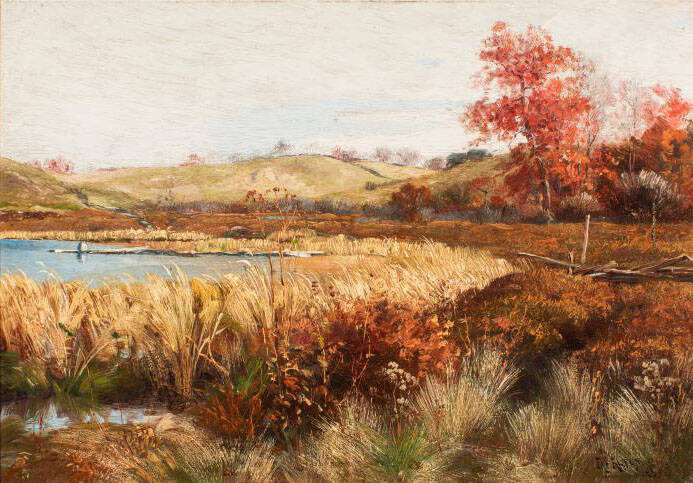
Mathias J. Alten, A Bayou at North Park, oil on board, 1898, 1998.606.1
Mathias J. Alten established himself as an artist and member of the Grand Rapids community following his arrival in 1889. His production as a studio painter increased in the years leading up to the twentieth century as he applied himself to becoming a professional artist. Alten created a variety of landscapes and still lifes, particularly floral arrangements, which were highly detailed and featured a dark color palette.
In 1898, seeking additional training and exposure to the academic rigors at the center of the art world, Alten joined the artists’ pilgrimage to Paris. After applying for his citizenship and passport in early November, he returned to Europe nearly a decade after emigrating from Germany. Alten enrolled at the Académie Julian and later at the Académie Colarossi.
During this trip, Alten also explored Italy, painting and visiting museums in Rome, Florence, Siena, and other cities. In France, he painted landscapes and peasants, especially along the northern coast at Étaples, and visited the Netherlands and Belgium. When he arrived home in September 1899, the world was on the cusp of a new century, and he had been filled with knowledge, experience, and passion for art.
The Netherlands
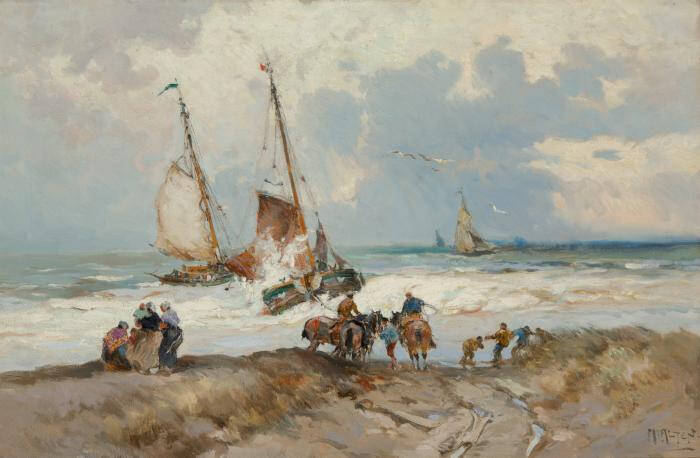
Mathias J. Alten, Rescuing a Boat, oil on canvas,1911, 2014.126.1
In the decades before the turn of the century, a prominent group of artists lived and worked near the Dutch coast in The Hague. Inspired by the French Barbizon school, these artists conveyed atmosphere and mood through subdued colors and the use of grey. Known as the “Hague School,” these painters also responded to the rapid industrialization of society by painting scenes of rural life tinged with longing for simpler times.
Alten traveled to the Netherlands in August of 1910 with his family and student, Norman Chamberlain (1887-1961). He remained for nearly an entire year, producing over 150 works depicting local landscapes and scenes of labor throughout the rural countryside and along the coast of the North Sea. He would have undoubtedly been influenced by the legacy of the Hague School artists, as well as the landscape and climate of the Netherlands.
Spanish Influences
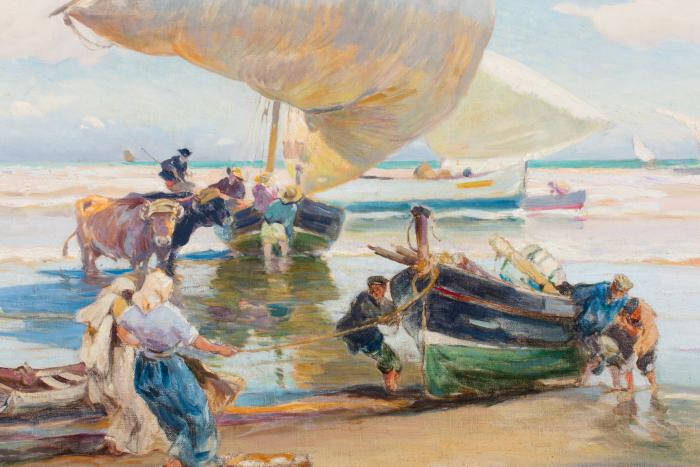
Mathias J. Alten, Windy Day, Cabañal, oil on canvas, ca 1922, 1998.591.1
In 1912, Mathias Alten took the first of a series of trips to Spain that would profoundly influence his career. Although his second visit would be delayed until after the First World War and the lingering economic uncertainty of the 1920-21 Recession, the impact of these Spanish trips was evident in more than just the paintings he produced on location. His color palette, which expanded with his exposure to Impressionism, lightened considerably following his first visit. Increasingly during his second trip in 1922 and final trip in 1928, a vibrant color spectrum and lighter touch were evident in his work.
On every trip Alten took to Spain, he based himself in Cabañal, the small fishing village near Valencia. As in his experience in the Netherlands, Alten sought out an environment with traditional laborers and nostalgic settings. Instead of herring boats and draft horses, sardine boats and oxen took center stage in his brilliant compositions. Alten knew his audience’s tastes. He understood the types of works that appealed to his Michigan clients, and, even with their relatively exotic locales and subject matter, the artist reiterated his interest in showing the old ways of doing things.
Alten's Last Years and Legacy
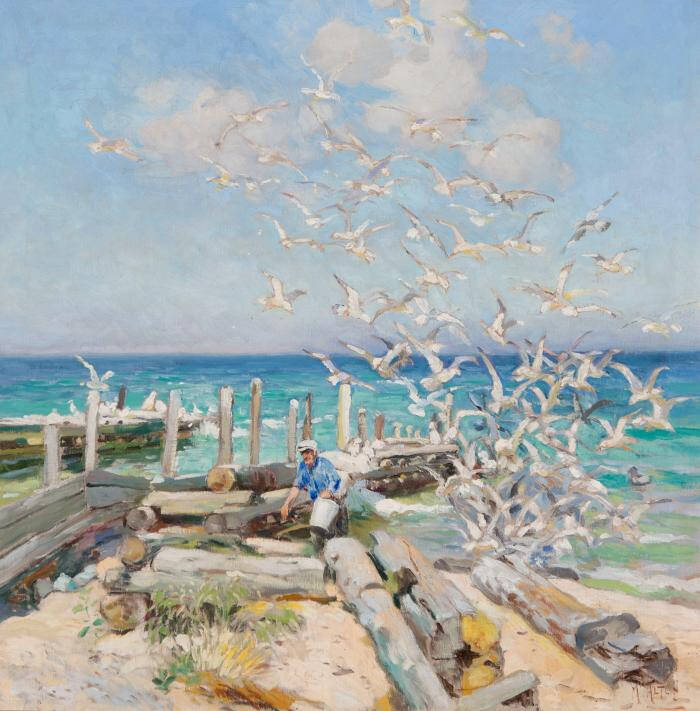
Mathias J. Alten, Gulls of Leland, oil on canvas, 1936, 1998.589.1
Throughout the 1930s, Alten largely kept his travels within the State of Michigan, painting in Leland, Saugatuck, and around Grand Rapids. A trip to Tarpon Springs, Florida, in 1935 was his last major trip outside the state and resulted in over 30 vibrant canvases showcasing the local sponge boats and crews at idle. He returned to paint still lifes of flowers, often near a window in his home, with light filtering through the composition in an impressionistic manner. Alten also created another series of self-portraits, additional portraits, and a series of nudes. In February of 1938, he participated in a three-artist show in Chicago and died of a heart attack in his home at age 67 just a month later.
Over a career spanning four decades, Alten painted more than 3,000 works of art. His commitment to the city and state that welcomed him as an immigrant in 1889 was repeatedly demonstrated in the number of scenes and portraits featuring Michigan landscapes and residents. Alten took advantage of advances in technology and transportation to further his training and career. Amongst a rapidly changing world, he celebrated traditional laborers in rural settings, ignoring rapid modernization in favor of nostalgic scenes. As Grand Rapids’ most celebrated artist, Alten’s views of Michigan record its beauty during the first four decades of the twentieth century and are evidence of an immigrant and artist who found a home there.