

Exhibit - Becoming America: Our Past, Present, and Future at 250
Exhibition Dates: June 25 - December 16, 2026
Lake Ontario Wall Gallery, First Floor, Valley Campus
Lake Ontario Hall, 4023 Calder Drive, Allendale, MI 49401
Exhibition Dates: January 5 - June 25, 2026
DeVos Wall Gallery, First Floor, City Campus
Richard M. DeVos Center, Building B, 401 Fulton St W, Grand Rapids, MI 49504
Open During Building Hours.
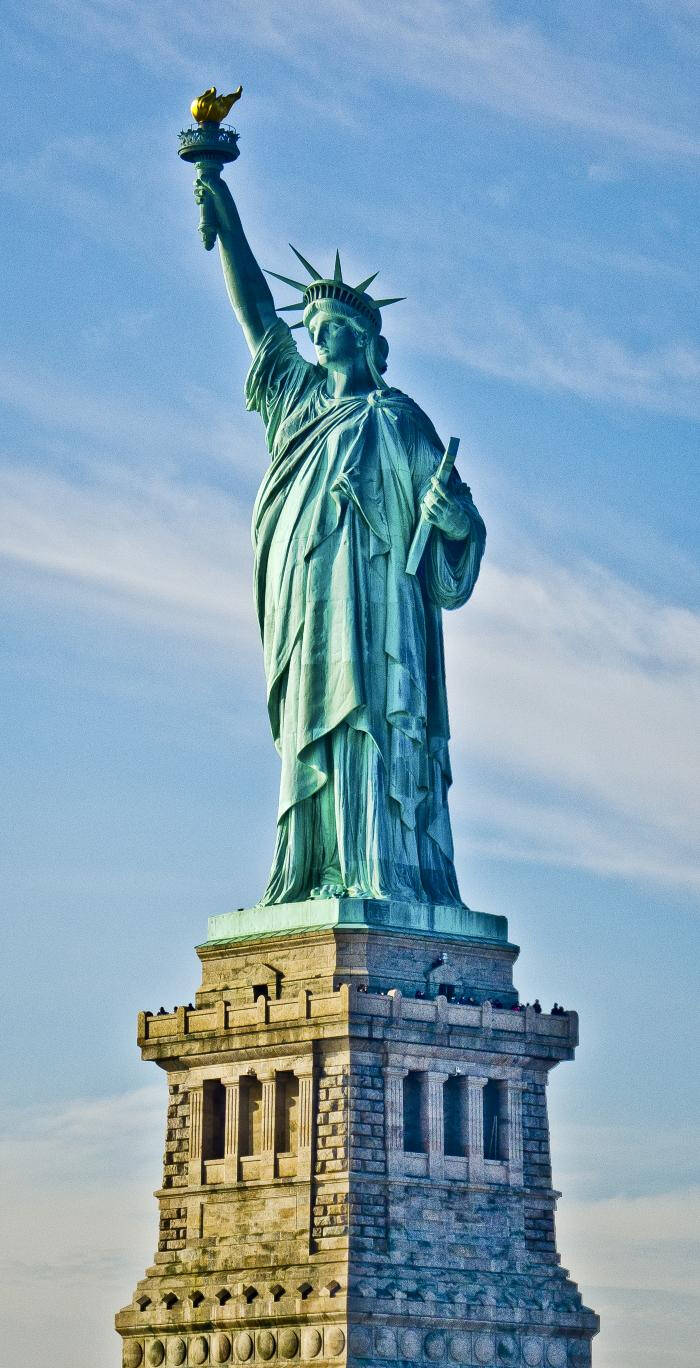
Mohamed Azuz, Statue of Liberty, photograph, 2011, 2016.93.4
Celebrating the 250th anniversary of America, Becoming America: Our Past, Present, and Future at 250 invites visitors to reflect on the nation’s evolving identity. Through a variety of works, the exhibition explores the triumphs, struggles, and transformations that have shaped the American experience. From the heritage of Indigenous cultures and the legacy of America’s founding to the social movements and cultural revolutions that define the present, each piece offers a lens into how America continues to redefine itself.
Other works celebrate the iconic American landscape, as well as the role our flag has played in world events, celebrations, and daily life. Looking forward, contemporary and speculative artworks imagine possible futures—asking what America can become as it grapples with issues of identity, justice, and hope. Together, these works form a powerful dialogue across time, urging us to see the nation not as a fixed story, but as a living, evolving narrative.

Visit America 250 to learn more about the celebration and initiatives around the country.
"On July 4, 2026, our nation will commemorate and celebrate the 250th anniversary of the signing of the Declaration of Independence. The journey toward this historic milestone is an opportunity to pause and reflect on our nation’s past, honor the contributions of all Americans, and look ahead toward the future we want to create for the next generation and beyond."
GRA 250 lists local initiatives celebrating 250 years of America, and 175 years of Grand Rapids.
Indigenous Roots to Present
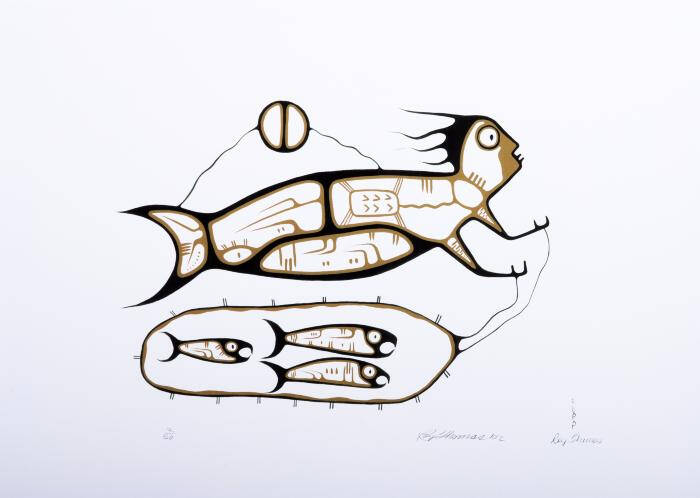
Roy Thomas, Untitled, print, 2002, 2008.267.1
America’s story began long before its founding, rooted in the cultures, languages, and knowledge systems of Indigenous peoples who have lived on this land for thousands of years. Despite efforts to reform and remove these people and their culture, their resilience endures in living communities today, reminding us that the history of this land is far older, richer, and more interconnected than the narratives that followed.
(left) Roy Thomas was a self-taught Anishinaabe artist born in 1949 at Longlac Reserve near Caramat, Ontario, Canada. He was raised by his grandparents, who encouraged him to express himself through art. While listening to his grandmother’s stories, he would draw what he heard with a stick, using sand or snow as his canvas. As he grew older, he replaced the stick with a pencil and a brush. Thomas was renowned for his work as a painter promoting Ojibwe traditions and culture, using symbolism and imagery inspired by legends and pictographs.
Arrival and Founding
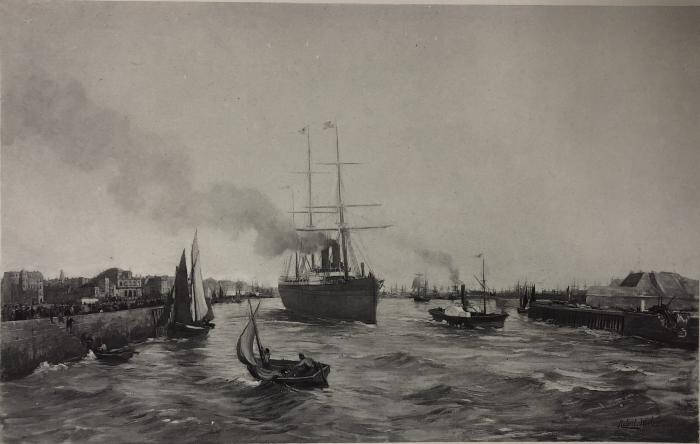
Robert Mols, Departure from Havre for America, lithograph, 1884, 2010.66.27b
The arrival of Europeans in the Americas marked a profound turning point, bringing new conflict and transformation. Early settlers crossed the Atlantic seeking opportunity and freedom, establishing colonies that would eventually spark the founding of the United States in 1776. The nation’s identity continued to evolve long after its founding, shaped by millions who arrived in later generations through places like Ellis Island.
(left) Based on the original painting by Robert Mols, this print by the artist depicts an animated view of the outer harbor of Le Havre in Normandy, France. Founded in 1509, on the site of a fishing village, Le Havre rapidly grew into an important port city, and a major gateway for European migration to America in the 19th and early 20th centuries. This image depicts a steamship leaving port, carrying thousands of Europeans seeking new opportunities in the United States.
Stars and Stripes in Daily Life
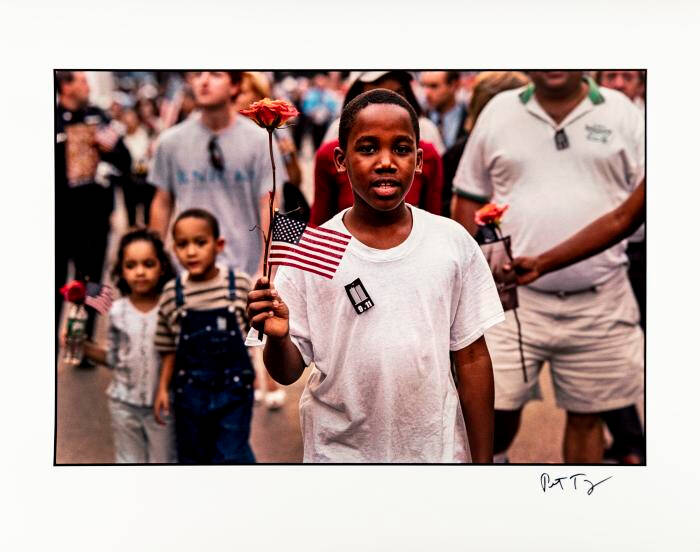
Peter Turnley, Memorial, New York City, Sept. 11, 2002, archival pigment print, 2002, 2020.42.7.
The American flag is seen in many familiar ways—flying above schools and post offices, stitched onto uniforms, or waving from porches and small-town parades. It also appears in moments of celebration, demonstration, and remembrance, a symbol that gathers many meanings at once: pride, protest, memory, and belonging. Our flag reflects not just a nation’s identity, but the diverse experiences of the people who live beneath it.
(left) Peter Turnley’s photographs have been on the cover of Newsweek magazine 43 times. He witnessed the fall of the Berlin Wall and Nelson Mandela’s walk out of prison. He was present at “Ground Zero” in New York City on September 11, 2001, and in New Orleans during the aftermath of Hurricane Katrina. This photograph shows a young boy attending the first anniversary memorial in New York City for the 9/11 attacks. He holds a flower and a small American flag in his hand, alongside others in the crowd behind him.
The American Landscape
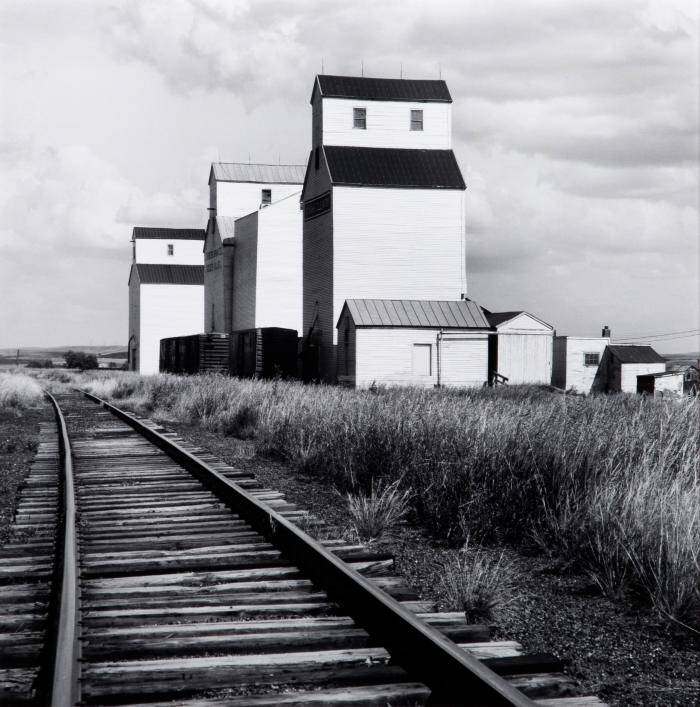
David Plowden, Golden Valley, North Dakota, Silverprint, 1972, 2001.227.1
America’s landscape unfolds in striking contrasts – from the rocky, weathered shores of the East Coast to the expansive horizons and islands of the Pacific. These coasts and the countries to the North and South frame a vast interior with wide-open plains, dense forests, river-carved canyons, and mountains and deserts shaped by centuries. To look across it is to see the vastness and to imagine the traces of all who have lived upon it.
(left) David Plowden's photographs focus on the struggle between civilization and nature, old and new. In his photographs and writing, he explores the beauty, power, light, and significance of these once commonplace icons and vistas, and captures the visual texture of a bygone America on the verge of vanishing.
Struggle for Rights and Freedoms
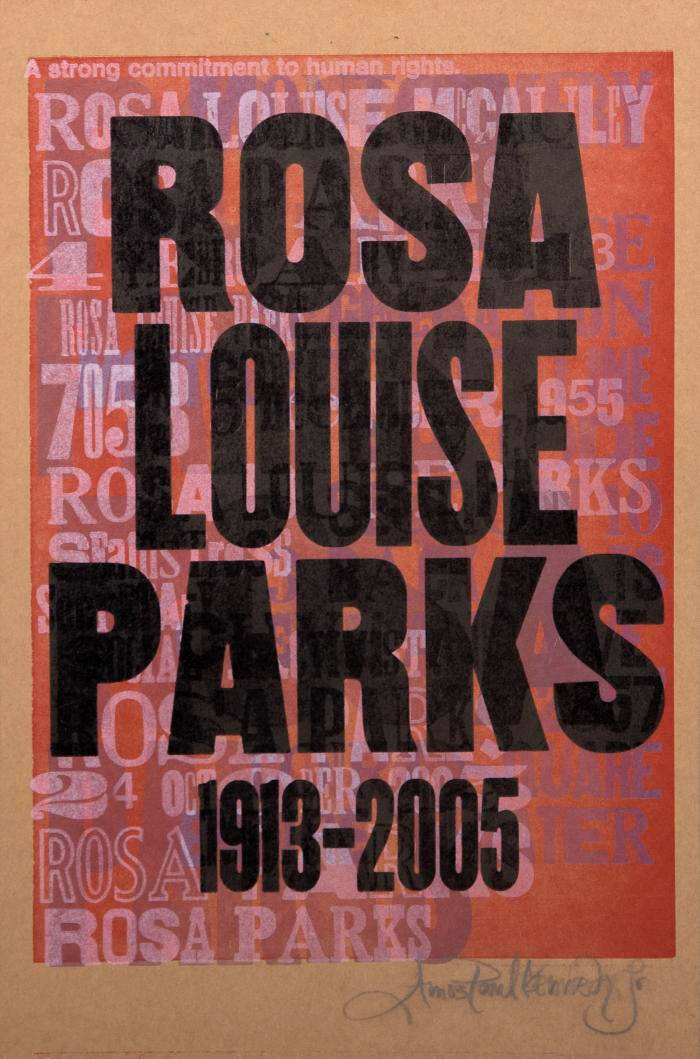
Amos Paul Kennedy Jr., Rosa Louise Parks 1913-2005, screenprint, 2005, 2022.44.2
The American struggle for rights and freedoms is a continuous effort—an unfolding story shaped by people ensuring the nation lives up to its highest ideals. From the fight for independence to abolition, women’s suffrage, and the struggle for civil rights, each generation has challenged the boundaries of who is included in the promise of freedom. Together, these generations remind us that freedom in America is not a finished state, but an ongoing pursuit.
(left) Amos Paul Kennedy Jr. is an American printer, book artist, and papermaker internationally recognized for his type-driven messages of social justice and Black power, emblazoned in rhythmically layered and boldly inked prints made for the masses. Shortly after the death of civil rights activist Rosa Parks in 2005, Kennedy began a print series dedicated to the woman who refused to give up her seat on a bus in Montgomery, Alabama, in 1955.
Our Future
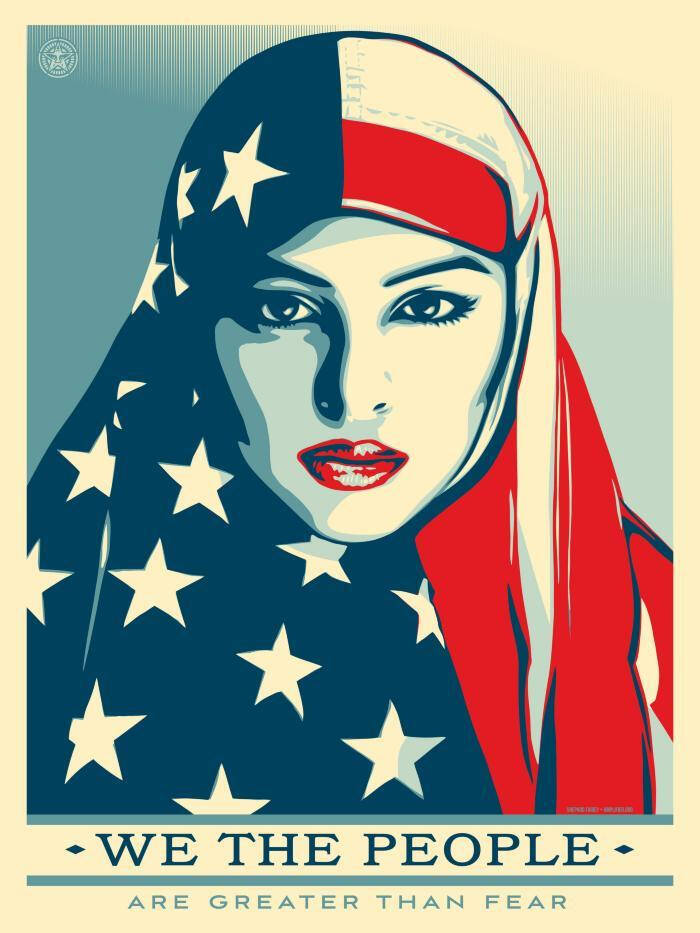
Shepard Fairey, We the Future, Are Greater Than Fear, screenprint, 2017, L22.2024.23
The future of America is still being written. New generations are redefining what it means to belong, expanding the nation’s story to include more voices and lived experiences. Across communities, people are working to strengthen democratic ideals, confront inequities, and protect the landscapes and freedoms they cherish.
(left) The "We the People" campaign aims to restore hope, imagination, curiosity, and creativity into our country’s dialogue. Ridwan Adhami decided to photograph a Muslim woman wearing an American flag as a hijab for the five-year anniversary of 9/11. They stood at the site of the World Trade Center, capturing the iconic image, without knowing just how far it would eventually go. More than a decade later, Adhami and Shepard Fairey reincarnated the image for Amplifier’s We the People campaign.