
News
AWRI secures $1 million NSF grant to advance Great Lakes research
October 03, 2025
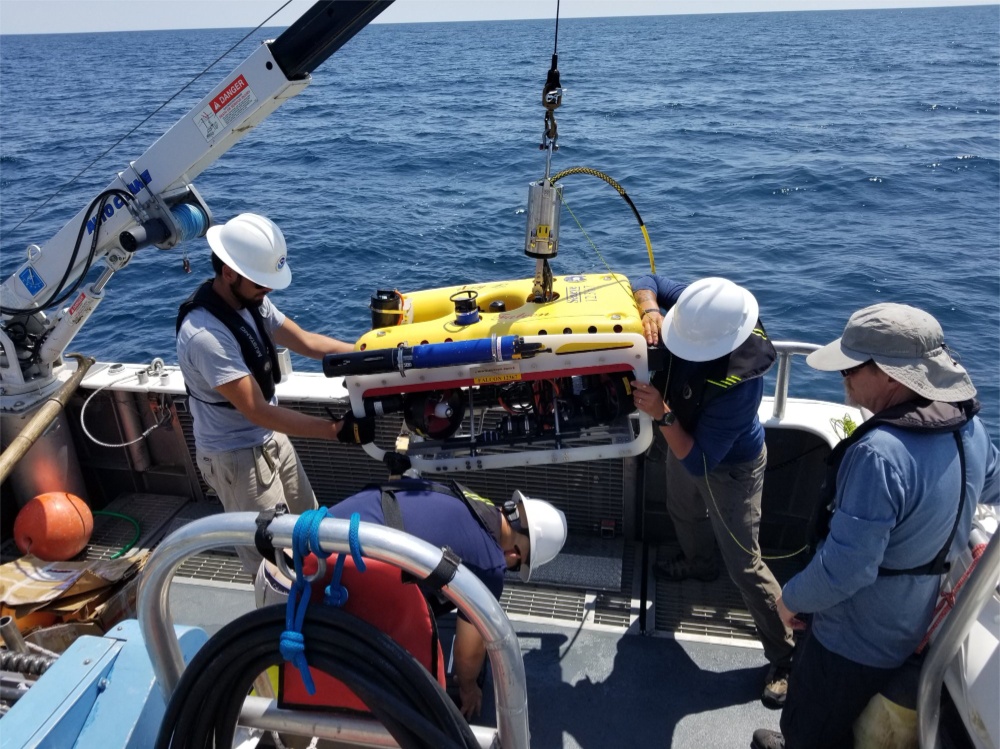
A $1 million grant from the National Science Foundation will support a collaborative effort, involving Grand Valley’s Annis Water Resources Institute, to develop an experiential learning pathway for emerging technologies and strengthen Michigan’s Blue Economy.
The NSF’s Experiential Learning for Emerging and Novel Technologies (ExLENT) grant will fund an initiative that integrates artificial intelligence with autonomous underwater vehicles (AUVs), said Stuart Jones, the AWRI’s executive director. Traverse City’s Northwestern Michigan College and the University of Notre Dame are also partners in the collaborative and will provide key elements to the initiative.
The partnership builds upon NMC’s marine technology program and fleet of underwater AUVs, Notre Dame’s AI and machine learning software and AWRI’s field expertise and experience in freshwater research. Jones said the project’s primary focus, however, is to design and deliver a course to train new AUV pilots as well as retool existing operators.
“The novel piece is integrating artificial intelligence or machine learning, so that we can be more efficient with the deployment of these robots,” said Jones.
“We can deploy these robots underwater to complete tasks and allow them to make decisions based on the conditions that they detect and the different events that they're confronted with.”
Jones said he envisions several applications for the AI-integrated underwater vehicles, such as creating detailed maps of the Great Lakes’ floor, measuring and tracing contaminants or pollutants, or even tracking fish tagged by AWRI staff.
“My dream application would be like a police dog investigating a crime scene, but instead it's a robot,” Jones said. “You can deploy an AUV with some sensors equipped that detect a pollutant, like PFAS, then the robot senses that concentration and follows the trail and sniffs out the source, like a bloodhound.”
Jones added that the AUVs could also be deployed along the Great Lakes’ shorelines to monitor key infrastructure, like bridges and marinas, that are integral to the development of Michigan’s Blue Economy. Michigan’s Blue Economy relies on its extensive network of lakes, rivers and waterways that support economic drivers such as tourism and recreation, manufacturing and shipping, and energy production.
Shannon Owen, GVSU’s director of Northern Michigan programs, said the grant will also drive entrepreneurship among community and economic partners while protecting the state’s water-based economy.
“Research is what everyone in the Traverse City community has been asking for here,” Owen said. “In order to have innovation, in order to bring more funds into this blue economy, we need research.”
The initiative also united regional economic and educational partners — including Northwestern Michigan College, Discovery Pier, Traverse Connect, Michigan Technological University, and 20Fathoms — for a milestone celebration.
Discovery Pier, a nonprofit organization that promotes public engagement with the Great Lakes, broke ground on its $28.9 million facility, the Freshwater Research & Innovation Center, on September 12.
Located on the western edge of Grand Traverse Bay, the 38,000-square-foot center will feature advanced laboratories, business incubation space and pier access for research vessels. Its areas of focus will include autonomous and remote systems, AI, acoustic and observation platforms, water quality technologies and sustainable marine mobility.
By Brian Vernellis