
Innovation Corner
Permanent link for Words of Wisdom for Entrepreneurs on June 28, 2025
In the fast-paced, ever-evolving world of business, timeless principles can offer clarity and direction. Ancient wisdom, from Sun Tzu’s strategies in The Art of War to the U.S. Navy SEALs’ philosophy of “slow is smooth, smooth is fast,” provides a valuable toolkit for entrepreneurs seeking sustainable success. Here’s how age-old advice can translate into practical strategies for business management today.
1. Know Your Enemy and Know Yourself
One of the most widely cited principles in business, derived from Sun Tzu’s The Art of War, is: “If you know the enemy and know yourself, you need not fear the result of a hundred battles.” (source). In today’s terms, “enemy” might be your competitors, the market forces, or even internal challenges within your own business.
Knowing your enemy involves thorough competitive analysis. By studying your competitors' strengths and weaknesses, you can identify opportunities for differentiation. Equally important, however, is self-awareness. As an entrepreneur, understanding your own strengths, weaknesses, and tendencies allows you to make informed decisions and leverage your unique skills. Self-awareness fosters resilience, especially when unexpected challenges arise, and enhances your ability to capitalize on opportunities where competitors may falter.
2. Slow is Smooth, Smooth is Fast
The Navy SEAL mantra, “Slow is smooth, smooth is fast” (source), is particularly relevant for entrepreneurs who feel pressured to move quickly to capture market share. The phrase advises a careful, measured approach, one that prioritizes precision over speed. In business, rushing can lead to costly mistakes and missteps. Instead, taking the time to establish efficient systems and quality processes enables smoother, faster execution in the long run.
By adopting this mindset, entrepreneurs can reduce errors, save resources, and ultimately accelerate their path to growth. For instance, rather than rushing to launch a new product, spend time refining it and ensuring it meets market demands. When the product is ready, its quality and market fit will contribute more to its success than speed ever could.
3. "First, Seek to Understand, Then to Be Understood" – Stephen Covey
Though not ancient, Stephen Covey’s principle from The 7 Habits of Highly Effective People is rooted in classical wisdom. Covey emphasizes that listening and understanding others’ perspectives should come before asserting your own. In business, this applies not only to negotiations but also to client relations and employee management. Prioritizing understanding fosters trust, builds stronger relationships, and lays the groundwork for more effective communication and collaboration. By listening first, entrepreneurs can tailor solutions to actual needs and better align their offerings with customer expectations.
4. "Divide and Conquer" – Julius Caesar
The Roman general Julius Caesar applied “divide and conquer” to warfare, but the principle is equally effective in marketing strategy, particularly in market segmentation. When applied to business, "divide and conquer" means segmenting a broad market into smaller, well-defined groups of customers with specific needs. Instead of trying to serve the entire market with a single approach, entrepreneurs can focus on one or more niche segments, customizing their strategies to resonate with each group.
For example, if a tech entrepreneur is introducing a new productivity app, they might initially target two segments: remote workers and freelancers, tailoring messaging and features to each group's unique needs. By understanding each segment’s challenges—such as work-life balance for remote workers or time management for freelancers—the business can more effectively allocate resources, improve marketing efficiency, and build brand loyalty within each niche before expanding further.
In Conclusion: The Practicality of Ancient Wisdom
Ancient principles continue to hold relevance in today’s entrepreneurial world, from knowing your market and your own capabilities to approaching growth with deliberate, strategic steps. Embracing this wisdom allows entrepreneurs to cultivate discipline, resilience, and insight that drive long-term success. As these age-old insights remind us, sometimes the most effective strategies are those proven through centuries of application.
If you want to dive deeper into these sources, you can explore The Art of War on Goodreads and the SEAL principles on Military.com.
Categories:
entrepreneurship
innovation
management
Posted
by
Thomas Hopper
on
Permanent link for Words of Wisdom for Entrepreneurs on June 28, 2025.
Permanent link for How Lean Start-Up Principles Can Empower Startups on November 1, 2024
Starting a lifestyle business—whether a local consultancy, an online boutique, or a service-based venture—presents unique challenges. Many founders invest significant time and resources before discovering whether their product or service truly meets customer needs. This is where the lean start-up methodology can help lifestyle entrepreneurs build a sustainable, customer-focused business while avoiding unnecessary costs and complexity.
What is the Lean Start-Up Method?
The lean start-up approach shifts focus from detailed business planning to an agile, flexible model built on direct customer feedback. By creating a "minimum viable product" (MVP) and listening closely to early customers, lifestyle entrepreneurs can refine their business offerings and quickly address what works and what doesn’t. Though lean start-up principles are often associated with high-growth tech ventures, they offer particular value for lifestyle businesses by emphasizing a practical, customer-centered development process.
Why Lean Start-Up Works for Lifestyle Businesses
- Direct Customer Input: Rather than investing heavily in features or services based on assumptions, lean start-ups focus on learning from real customers from day one. This approach allows lifestyle business owners to create products that address genuine needs, improving customer satisfaction and retention.
- Flexible and Affordable Model: Lean start-ups use tools like the “business model canvas” to outline hypotheses about their customers and market. As these assumptions are tested, entrepreneurs can make informed decisions without committing substantial resources to a static business plan.
- Efficient Time and Cost Management: By focusing on MVPs and rapid iteration, lean methods help lifestyle entrepreneurs get to market faster with lower upfront costs. This approach is particularly beneficial for businesses with limited resources, ensuring they remain financially nimble and adaptable as the business grows.
Embracing Lean for a Sustainable Lifestyle Business
Incorporating lean principles offers lifestyle business owners the advantage of flexibility, lower risk, and a better fit with customer expectations. By prioritizing experimentation, learning, and agility, lifestyle entrepreneurs can create businesses that are not only sustainable but also responsive to changing customer demands. Adopting lean start-up practices doesn’t mean sacrificing quality; rather, it empowers entrepreneurs to deliver more targeted value to their customers while building a business aligned with their goals and lifestyle.
Steve Blank, the guru of Lean Startup, has more for you at Harvard Business Review.
Categories:
entrepreneurship
innovation
Posted
by
Thomas Hopper
on
Permanent link for How Lean Start-Up Principles Can Empower Startups on November 1, 2024.
Permanent link for Improvise, Adapt, Overcome on April 12, 2024
Entrepreneurs can glean invaluable insights from the Marine Corps Fighting Doctrine's mantra: "Improvise, Adapt, Overcome." In today's dynamic business environment, adaptability is not just beneficial—it's essential. Successful ventures pivot swiftly and innovate to navigate unforeseen challenges.
Improvise
Entrepreneurs often encounter unexpected obstacles that disrupt their plans. As the military adage goes, "No plan survives first contact with the enemy," entrepreneurs must be prepared to deviate from their original strategies. Similar to Marines on the battlefield, they must think creatively, leveraging available resources in unconventional ways to overcome adversity.
Adapt
Adaptability lies at the heart of both military strategy and entrepreneurship. "Slow is smooth, smooth is fast," emphasizing the importance of methodical action even under pressure. In entrepreneurship, staying agile and responsive to changing market dynamics is crucial. Being able to adjust strategies swiftly to new trends and competitive landscapes is key to success.
Overcome
Resilience is paramount in the face of adversity. "Embrace the suck," urging individuals to endure difficult situations without complaint. Entrepreneurs must confront challenges head-on, prioritizing both objectives and the well-being of individuals, as emphasized in "Mission first, people always." By navigating setbacks with determination and grit, entrepreneurs can emerge stronger and more successful.
Conclusion
The Marine Corps mantra illuminates the path to entrepreneurial success. By embracing flexibility, adaptability, and resilience, entrepreneurs can thrive amidst challenges. Channeling the spirit of improvisation, adaptation, and overcoming fosters excellence in entrepreneurship, ensuring ventures not only survive but flourish in the ever-evolving business landscape.
Categories:
entrepreneurship
innovation
management
Posted
by
Thomas Hopper
on
Permanent link for Improvise, Adapt, Overcome on April 12, 2024.
Permanent link for Unveiling the Synergy Between Business Model Canvas and the 4Ps in Product Innovation on March 29, 2024
Two common tools for strategizing and executing business plans are the Business Model Canvas (BMC) and the Marketing Mix, famously known as the 4Ps (Product, Price, Place, and Promotion). While these frameworks are often discussed independently, their overlap can unlock a powerful synergy, enhancing the depth and effectiveness of your business strategy.
The Business Model Canvas, pioneered by Alexander Osterwalder and Yves Pigneur, offers a holistic view of a business model by breaking it down into nine key building blocks: Customer Segments, Value Proposition, Channels, Customer Relationships, Revenue Streams, Key Resources, Key Activities, Key Partnerships, and Cost Structure. This framework serves as a blueprint for understanding how a company intends to create, deliver, and capture value.
The 4Ps framework, introduced by E. Jerome McCarthy, focuses on the essential elements of marketing strategy: Product, Price, Place, and Promotion. It delves into the core components of a marketing plan, guiding businesses in crafting strategies to effectively market their products or services.
While the BMC and the 4Ps might seem distinct at first glance, they converge in several critical areas, particularly concerning product strategy:
-
Product (Part of 4Ps) and Value Proposition (Part of BMC): The product is central to both frameworks. In the 4Ps, product strategy involves decisions regarding product features, branding, and differentiation. Similarly, the Value Proposition block in the BMC encapsulates how a product or service solves a customer's problem or fulfills a need in a unique way. Aligning these two concepts ensures that the product's attributes resonate with the target market's preferences and demands.
-
Price (Part of 4Ps) and Revenue Streams (Part of BMC): Pricing decisions directly impact revenue generation, making the alignment between Price and Revenue Streams crucial. The Price component of the 4Ps framework guides entrepreneurs in setting optimal pricing strategies, considering factors such as costs, competition, and perceived value. Correspondingly, the Revenue Streams block in the BMC outlines how the company monetizes its value proposition. By harmonizing pricing strategies with revenue models, businesses can ensure profitability while delivering value to customers.
-
Place (Part of 4Ps) and Channels (Part of BMC): Place, in the context of the 4Ps, refers to the distribution channels through which products reach consumers. Channels, a key element of the BMC, delineate how a company delivers its value proposition to customers. Integrating these concepts involves selecting the most suitable distribution channels to reach target customers efficiently. Whether through direct sales, online platforms, or intermediaries, aligning Place with Channels optimizes the product's accessibility and enhances the overall customer experience.
-
Promotion (Part of 4Ps) and Customer Relationships (Part of BMC): Promotion encompasses marketing communications activities aimed at raising awareness and driving sales. On the BMC, Customer Relationships elucidate how a company interacts with its customers to cultivate loyalty and satisfaction. By aligning promotional efforts with the desired type of customer relationships (e.g., personal assistance, self-service), businesses can tailor their marketing campaigns to effectively engage with their target audience, fostering long-term relationships and brand advocacy.
In essence, while the Business Model Canvas provides a comprehensive framework for mapping out the various components of a business model, the 4Ps framework offers a focused lens on marketing strategy. By recognizing their intersections and aligning the relevant elements, entrepreneurs can craft cohesive and robust business strategies that resonate with customers, drive value creation, and fuel sustainable growth. Embracing this synergy empowers innovators to navigate the complexities of product innovation and entrepreneurship with clarity and purpose.
Categories:
entrepreneurship
innovation
marketing
Posted
by
Thomas Hopper
on
Permanent link for Unveiling the Synergy Between Business Model Canvas and the 4Ps in Product Innovation on March 29, 2024.
Permanent link for How to Price Your Product: Understanding the Difference Between Price and Cost on March 8, 2024
Understanding Product Pricing: Navigating the Price vs. Cost Conundrum
As entrepreneurs and intrepreneurs venture into the world of product development, they inevitably encounter the question: "How much does it cost?" This seemingly simple query actually warrants a deeper understanding, as it involves distinguishing between price—what the customer pays—and cost—what it takes for you to deliver the product to the customer's hands. Moreover, it's essential to differentiate between current costs and those at scale.
1. Addressing Customer Inquiries: The Price Perspective
When engaging with potential customers, particularly those eager to make a purchase, their primary concern revolves around the immediate price. For them, the question translates to, "What's the price, right now?" It's imperative to have a response ready to validate the market and encourage sales. Initially, pricing should focus on market testing rather than operational efficiency. Aim for a premium price point to gauge market receptivity, keeping in mind that early pricing need not correlate with actual costs.
2. Meeting Investor and Stakeholder Expectations: The Cost at Volume
Conversations with investors or internal stakeholders typically revolve around the cost at volume. While estimating costs at scale may seem daunting, it's feasible with a strategic approach. Rather than pinpointing exact costs for every component, identify the key cost drivers and approximate their expenses at the highest feasible volume. For instance, if you're envisioning mass production of a smartphone, aim for a volume estimate that aligns with market demand while remaining realistic.
3. Illustrating Cost Dynamics: A Practical Example
Consider the scenario of manufacturing smartphones in China and shipping them to the U.S. west coast. Initially, shipping costs per phone may be significant. However, as volumes increase, economies of scale come into play, driving down the per-unit shipping cost substantially. Such insights allow you to provide stakeholders with informed estimates, demonstrating the potential cost reductions at scale.
4. Embracing the Cost-Volume Relationship
The relationship between cost and volume applies universally across products and services. As your operations scale, variable costs become increasingly dominant, leading to lower per-unit expenses. This dynamic underscores the importance of targeting high-value customer segments early on, prioritizing premium pricing over cost-conscious mass markets.
5. Navigating Market Opportunities
While high-value customer segments are often the initial focus for startups, exceptions exist. Certain market opportunities may lie in cost-conscious segments, where underserved customers seek affordable alternatives. By offering lower-margin substitutes with strategic feature adjustments, startups can carve out a niche and gain market share.
In conclusion, mastering the interplay between price and cost is essential for entrepreneurial success. By understanding customer expectations, investor perspectives, and cost dynamics, startups can navigate pricing challenges effectively, paving the way for sustainable growth and profitability.
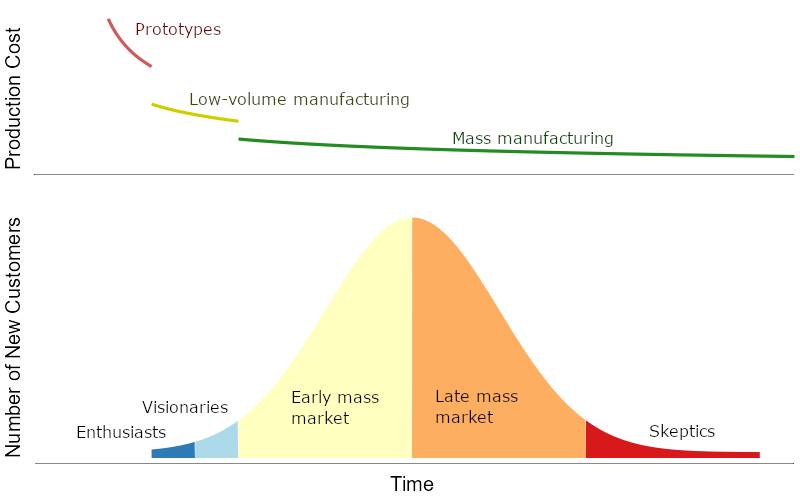
Production costs decrease over time, while market adoption increases, slows, then falls off as markets become saturated and alternatives take over. Which customer group you're talking to will determine which cost model you're using.
Categories:
entrepreneurship
innovation
management
marketing
Posted
by
Thomas Hopper
on
Permanent link for How to Price Your Product: Understanding the Difference Between Price and Cost on March 8, 2024.
Permanent link for Maximizing Market Potential: A Guide for First-Time Entrepreneurs on March 1, 2024
Are you diving into entrepreneurship for the first time, eager to develop a new product or service? Amidst the excitement, it's crucial to understand market dynamics to unlock your venture's true potential. Let's explore how you can navigate market potential effectively and pave the way for sustainable growth.
Understanding Market Segmentation: Demystifying TAM, SAM, and SOM
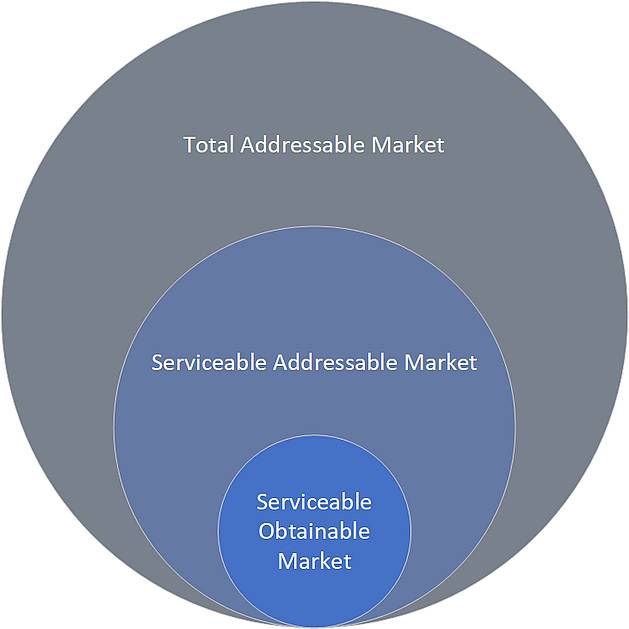
Picture yourself pioneering an innovative inventory management solution tailored for businesses. Your Total Addressable Market (TAM) isn't the entire business landscape but specifically the portion of businesses that could benefit from your solution.
Moving forward, your Serviceable Addressable Market (SAM) is a subset of TAM, representing the portion of businesses within TAM that you can effectively target and serve based on your unique value proposition and business model.
Finally, your Serviceable Obtainable Market (SOM) is the realistic fraction of SAM that you expect to capture as actual sales. This figure evolves over time with strategic adjustments and resource allocation.
Strategies for Sustainable Growth: Realism Over Aspiration
Prioritize bottom-up estimations and realistic projections over lofty aspirations of quick exits. Building a solid foundation and catering to a niche market are your pathways to long-term success and sustainable growth. Remember, success isn't solely about exit magnitude but impact and longevity in the market.
Embracing the Entrepreneurial Journey: Final Thoughts
Navigate market potential with optimism and resilience, viewing challenges as opportunities for growth. By staying true to your vision and executing with precision, you lay the groundwork for a successful venture. Ready to maximize your venture's potential? Let's embark on this journey together.
Unlock Your Venture's Potential Today
Ready to unlock your venture's true revenue potential? Begin by understanding market dynamics and refining your strategies for sustainable growth. Stay focused on your journey and embrace every milestone along the way.
Let's turn your entrepreneurial vision into reality. Reach out to explore how you can optimize market potential for your venture.
Techcrunch has some great advice and insight: Nice try, startup, but that's not your serviceable obtainable market (SOM)
Categories:
entrepreneurship
marketing
Posted
by
Thomas Hopper
on
Permanent link for Maximizing Market Potential: A Guide for First-Time Entrepreneurs on March 1, 2024.
Permanent link for Innovation on February 9, 2024
In today's fast-paced business landscape, the key to success often lies in the ability to innovate quickly and bring products to market faster than the competition. For businesses striving for relevance and growth, an efficient innovation process is not just a luxury; it's a necessity. In this blog, we'll explore strategic approaches and practical tips to help you streamline your innovation process and ensure that your product reaches the market swiftly and successfully.
- Start with a Clear Vision
Before embarking on the innovation journey, it's crucial to have a clear vision of what problem your product solves and who your target audience is. Define your value proposition and ensure that it aligns with market needs. A well-defined vision serves as a guiding light, helping your team stay focused and make informed decisions throughout the development process.
- Embrace Agile Methodology
Agile methodology has become synonymous with rapid innovation. By breaking down the development process into smaller, manageable tasks and regularly reassessing priorities, you can adapt to changes swiftly. This iterative approach allows for continuous improvement, reducing the risk of late-stage changes that could delay your time to market.
- Foster a Culture of Innovation
Innovation is not solely the responsibility of the R&D department; it should be ingrained in the entire organizational culture. Encourage cross-functional collaboration, reward creative thinking, and create an environment where employees feel empowered to share their ideas. A culture of innovation promotes a collective mindset that can significantly speed up the product development process.
- Conduct Rapid Prototyping
Waiting until the final stages to test your product can be a costly mistake. Rapid prototyping allows you to gather valuable feedback early in the process, enabling you to make necessary adjustments swiftly. By incorporating user feedback throughout development, you reduce the likelihood of major overhauls later on, saving both time and resources.
- Utilize Technology and Automation
Leverage technology to automate repetitive tasks, streamline workflows, and enhance collaboration. Project management tools, communication platforms, and collaborative software can significantly increase efficiency. Automation not only accelerates processes but also minimizes the risk of human error, ensuring that your product development stays on track.
- Build Strategic Partnerships
Collaborating with external partners can provide access to valuable resources and expertise, accelerating the development process. Whether it's forming strategic alliances, outsourcing specific tasks, or leveraging existing networks, partnerships can help you overcome challenges and bring your product to market faster.
- Prioritize Minimal Viable Product (MVP)
Instead of waiting for a fully polished product, focus on delivering a Minimal Viable Product (MVP) that addresses the core needs of your target audience. Launching an MVP allows you to gather real-world feedback, validate assumptions, and make necessary adjustments before investing in extensive features. This approach not only accelerates time to market but also reduces the risk of building a product that misses the mark.
To borrow from management guru Peter Drucker, businesses have only two core functions, and innovation is one of them. By incorporating these strategies into your innovation process, you can position your business as a dynamic force in your industry, delivering products to market faster and staying ahead of the competition. Remember, the key lies not only in developing groundbreaking ideas but also in executing them swiftly and efficiently. Embrace innovation, foster a culture of agility, and watch your business thrive in the ever-evolving landscape of today's market.
Categories:
entrepreneurship
innovation
management
Posted
by
Thomas Hopper
on
Permanent link for Innovation on February 9, 2024.
Permanent link for Why Startups Fail (and what you can do about it) on January 19, 2024
New product and service launches fail for many reasons. When the company is a startup, it's not just the product or service that fails, but the whole company. If you know what to watch out for, though, you can greatly increase your chances of success.
One of the main reasons that founders give is insufficient funding; that they run out of cash. This is often the last problem that a startup faces before shuttering, but it's almost always a symptom of deeper problems.
There have been multiple studies on this, such as this Harvard study, published in 2021, and CB Insights' separate study, also published in 2021. Both studies found that the top reasons for failure include
- No market need, also described as insufficient customer discovery and demand validation;
- Not having the right team, generally as a result of lacking industry experience;
- Poor planning and execution, usually encountered as either over-optimistic plans or as the adoption of strategies that lead to higher cash burn rates than can be absorbed by available funding.
What can you do to bolster your chances of success
- Study and understand your target customers;
- Clearly define the problem you are solving for them in terms they have expressed;
- Validate demand for a solution;
- Build a founding team with both the right attitudes (the willingness to learn and to work in multiple rolls) and the right experience;
- Know your financials and plan for sustainable both development and growth.
StartupGrind has more good advice.
Categories:
entrepreneurship
management
Posted
by
Thomas Hopper
on
Permanent link for Why Startups Fail (and what you can do about it) on January 19, 2024.
Permanent link for Build Your MVP on January 5, 2024
Launching a new product is an exhilarating journey that demands careful planning, strategic thinking, and a deep understanding of your target audience. To fully understand your target audience, you have to put product in their hands. Rather than spending time and money building the better mousetrap, it's best to start with the creation of a Minimum Viable Product (MVP), a crucial step that can make or break your venture. How do you build a winning MVP?
-
Define Your Core Value Proposition: Before diving into development, it's essential to clearly define your product's core value proposition. What problem does it solve? How does it meet the needs of your target audience? The answers to these questions will guide the development of your MVP and ensure it addresses the most critical aspects of your product.
-
Identify Key Features: An MVP is not about including every possible feature but about focusing on the essential functionalities that demonstrate the product's value. Identify the features that directly contribute to solving the core problem. This laser focus ensures a quicker development process and allows you to gather valuable feedback sooner.
-
Keep It Simple and User-Friendly: Simplicity is key when creating an MVP. A clean and intuitive user experience not only attracts users but also allows them to understand and use your product effortlessly. Avoid unnecessary complexities, and prioritize a seamless user experience to encourage user engagement.
-
Build Rapid Prototypes: Prototyping is a powerful tool in the MVP development process. Rapid prototypes act as a tangible representation of your product, helping you identify potential issues early on and to iterate quickly as you learn what works and what does not.
-
Embrace Iterative Development: The MVP is not a one-time effort but a process of continuous improvement. Embrace an iterative development approach, releasing small updates and improvements based on user feedback. This not only keeps your product aligned with user needs but also demonstrates a commitment to ongoing enhancement. The frequency of updates and amount of development that goes into each iteration will depend critically the economics of developing, producing and testing prototypes.
-
Collect User Feedback: User feedback is the lifeblood of a successful MVP. Release your product to a select group of users, gather their feedback, and use it to refine and enhance your offering. Leverage feedback loops to continuously optimize your product based on real-world user experiences.
-
Measure and Analyze: Implement analytics tools to track user behavior and engagement. This data provides valuable insights into how users interact with your product, allowing you to make data-driven decisions. Metrics such as user retention, conversion rates, and user satisfaction are crucial indicators of your MVP's success.
-
Prepare for Scalability: While the focus is on building a minimum viable product, it's crucial to plan for scalability. Choose a robust architecture that can grow with your user base. Anticipate potential challenges associated with increased demand and have a roadmap for scaling your infrastructure accordingly.
Building a Minimum Viable Product is an exciting and transformative phase in the product development journey. By staying focused on your core value proposition, embracing simplicity, iterating based on user feedback, and planning for scalability, you set the foundation for a successful product launch. Remember, the MVP is not the end but the beginning of a journey toward creating a product that truly meets the needs of your audience.

Categories:
entrepreneurship
innovation
Posted
on
Permanent link for Build Your MVP on January 5, 2024.
Permanent link for Boost Your Small Business Success on December 15, 2023
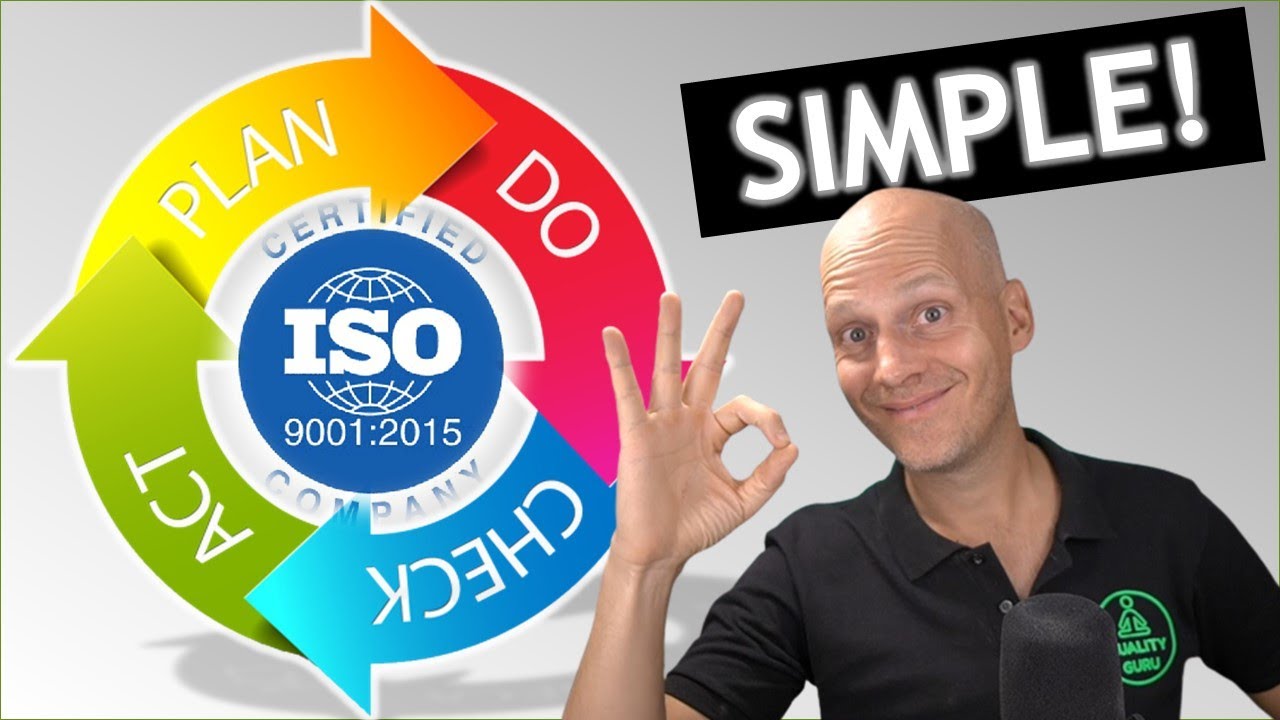
Starting a small, bootstrapped business is no small feat, and ensuring consistent quality in your products or services is crucial for long-term success. One effective way to achieve this is by incorporating elements of the ISO 9001 standard into your business processes. ISO 9001 is an internationally recognized quality management standard that can guide you to developing better, more consistent business processes, delivering better and more consistent results to your customers. Here are some practical tips for small business owners to implement key aspects of ISO 9001.
- Understand Customer Needs and Expectations:
ISO 9001 emphasizes a customer-centric approach. Start by clearly understanding your customers' needs and expectations. Engage with them through surveys, feedback forms, and social media to gather valuable insights. Use this information to tailor your products or services to meet their requirements more effectively.
- Establish a Quality Policy:
Define a quality policy that aligns with your business objectives. Clearly communicate this policy to your team and ensure everyone understands their role in maintaining quality. A well-defined quality policy provides a framework for decision-making and helps in consistently delivering high-quality outcomes.
- Implement Documented Processes:
Documenting your processes is a fundamental step in ISO 9001. Create clear, step-by-step procedures for key business activities, such as product development, customer service, and order fulfillment. This documentation serves as a reference for employees and helps maintain consistency, especially as your business grows.
- Set and Monitor Key Performance Indicators (KPIs):
Identify key performance indicators that align with your business goals and customer expectations. Regularly monitor these KPIs to track your business's performance and identify areas for improvement. This data-driven approach will enable you to make informed decisions and continuously enhance your processes.
- Train and Empower Your Team:
Invest in training programs to ensure that your team understands the importance of quality and is equipped with the necessary skills to meet customer expectations. Empower employees to take ownership of their roles and contribute to the overall quality objectives of the business.
- Regularly Conduct Internal Audits:
Internal audits are a proactive way to identify potential issues and ensure compliance with established processes. Regularly review your documented procedures and conduct internal audits to identify areas for improvement. This continuous improvement cycle is integral to the ISO 9001 framework.
- Encourage a Culture of Continuous Improvement:
Foster a culture of continuous improvement within your organization. Encourage employees to suggest improvements and innovations in processes. Implement a feedback loop that allows for the timely review and incorporation of valuable suggestions, leading to a more agile and adaptive business.
Conclusion:
Implementing ISO 9001 principles in your small, bootstrapped business can be a game-changer. By focusing on customer needs, documenting processes, monitoring performance, and fostering a culture of continuous improvement, you can deliver better, more consistent results to your customers. ISO 9001 is not just a certification; it's a mindset that can help your business thrive in a competitive landscape while building a reputation for excellence. Embrace these tips, and watch your small business grow with a commitment to quality.
Categories:
entrepreneurship
management
Posted
by
Thomas Hopper
on
Permanent link for Boost Your Small Business Success on December 15, 2023.