Padnos Public Engagement Lecture on Jewish Learning
The Stuart and Barbara Padnos Foundation has provided a gift to the Frankel Center for Judaic Studies to establish the Padnos Engagement on Jewish Learning fund. The initiative, which commenced in 2020, facilitates annual public educational activities in Jewish Studies throughout the State of Michigan with a focus on the western part of the state. This event is held in partnership with the Jean & Samuel Frankel Center for Judaic Studies at the University of Michigan (opens in new window).

Divine Bodies, Human Questions: How Ancient Jews and Christians Imagined God
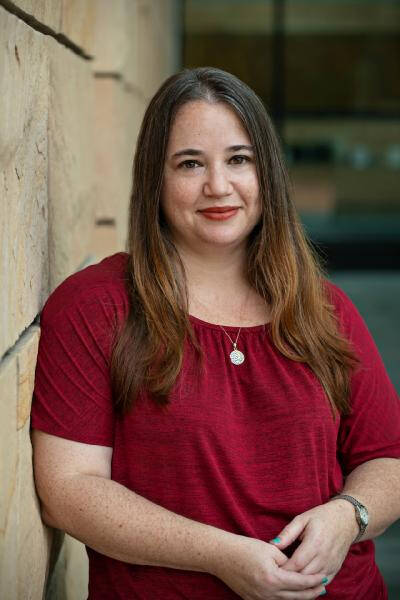
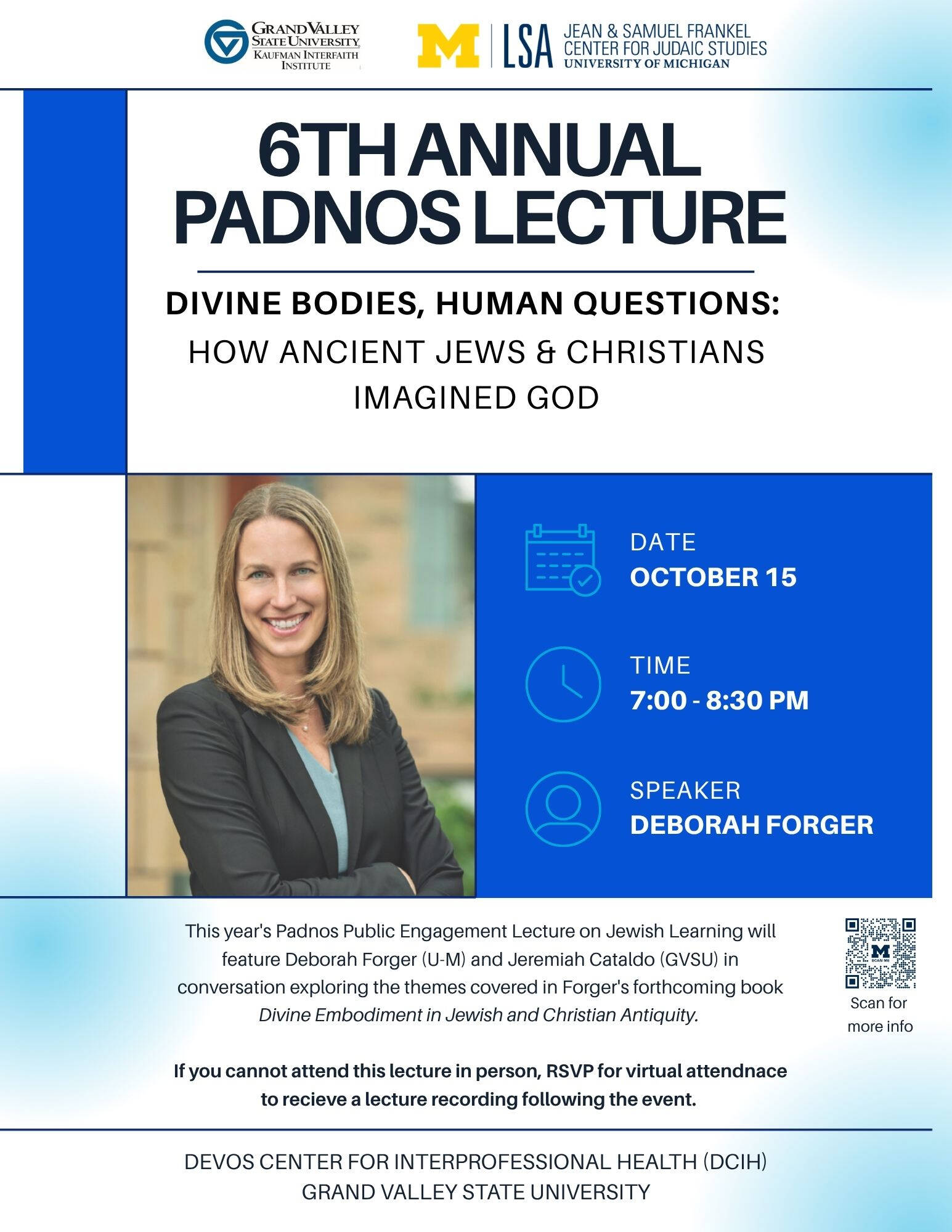
This year's Padnos Public Engagement Lecture on Jewish Learning, held in partnership with the Jean & Samuel Frankel Center for Judaic Studies at the University of Michigan, will feature University of Michigan Professor Deborah Forger and GVSU Professor Jeremiah Cataldo in conversation exploring the themes covered in Forger's forthcoming book Divine Embodiment in Jewish and Christian Antiquity.
We hope you will join us for a lively conversation followed by a dessert reception.
Thursday, October 15 | 7-8:30pm | Devos Center for Interprofessional Health (DCIH) | GVSU Health Campus | Grand Rapids, MI
Land, Language, and People: Arab and Jewish Imagination in the Late Ottoman Empire
The 5th Annual Padnos Public Engagement Lecture on Jewish Learning featured Mostafa Hussein, Assistant Professor, University of Michigan
Drawing from his book, Hebrew Orientalism: Jewish Engagement with Arabo-Islamic Culture in Late Ottoman and British Palestine, Dr. Hussein explored how Jewish writers in late Ottoman and British Mandate Palestine utilized Arabo-Islamic culture. In the decades before the establishment of a Jewish state in 1948, native and immigrant Jews in Palestine mediated between Jewish and Arab cultures while navigating their evolving identities as settler colonists. Hebrew Orientalism challenges the conventional view that Hebrew thinkers were dismissive of Arabo-Islamic culture, revealing how they both adopted and adapted elements of it that enhanced their aims.
The conversation between Dr. Hussein and GVSU Professor Eric Covey was facilitated by Frankel Center's Interim Director for 2025-26, Deborah Dash Moore.

How Women Changed American Religion: A Jewish Perspective
The 4th Annual Padnos Public Engagement Lecture on Jewish Learning featured Karla Goldman, Sol Drachler Professor of Social Work, School of Social Work, and Professor of Judaic Studies, College of LS&A
“Women’s history is American religious history," as historian Ann Braude has famously claimed. The Padnos Lecture explores how American Judaism has been shaped by general societal expectations for women's religious behavior and by new active roles Jewish women took on within their religious institutions. Major changes that took place included the restructuring of synagogue architecture with the removal of the women’s gallery, the redefinition of community through women’s volunteerism, and the introduction of women's religious leadership, which also challenged conventional theology. Historically and today, American Judaism -- in dialogue with American society and other models of religious practice -- has constantly evolved and transformed in an effort to match the ever-moving target of gendered expectations for religious behavior and practice.
Abrahamic Vernaculars: Rivals Thinking Together
The 3rd Annual Padnos Public Engagement Lecture on Jewish Learning featured Rebecca Scharbach Wollenberg, Ph.D., Assistant Professor of Judaic Studies, University of Michigan.
Contemporary media often emphasizes the competitive nature of the Abrahamic monotheisms. This is not entirely unjustified. Relations between Jews, Christians, and Muslims have certainly included their share of religious wars, theological polemic, and oppression. Yet there is also another side to the Abrahamic coin. Even in the midst of communal rivalry, Jewish, Christian and Muslim practitioners have often turned to each other to think through religious concepts, elucidate a shared sense of sacred history, and enrich their ritual practices. From the development of shared ritual practices surrounding childbirth to ecumenical medieval study groups, this talk explores historical moments when Jews, Christians, and Muslim have done their religious thinking together.
Remnants of a Mighty Nation: Jews Through the Eyes of American Christians
The 2nd Annual Padnos Public Engagement Lecture on Jewish Learning featured Dr. Julian Levinson, Samuel Shetzer Professor of American Jewish Studies, University of Michigan.
What is it like to belong to a religious minority? For Jews in the United States, there have been countless challenges as well as unexpected benefits from living among a Christian majority. While some individual Christians have been highly critical of Jews for their beliefs and practices, others have been deeply respectful of Jews for being the original “chosen people,” for preserving the Hebrew language, and for maintaining traditions going back to the Bible. This talk will focus on the ways Jews were perceived in nineteenth-century America, when the origins of present-day Christian-Jewish relations were established. It will trace the formation of views that are still prevalent today, including the evangelical fascination with Israel. It will also consider how Jews have shaped their own identities in relation to the broader Christian environment.
When Patronage Was Matronage
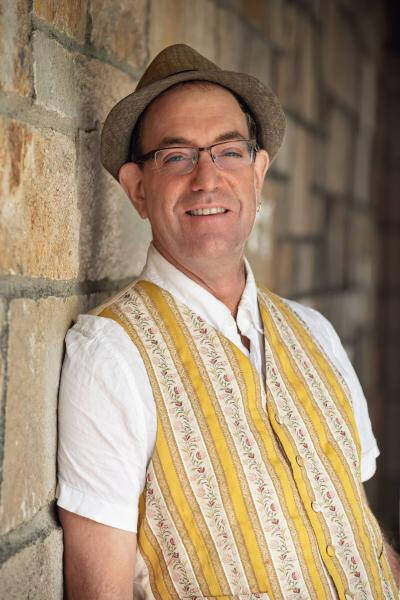
The First Annual Padnos Public Engagement Lecture on Jewish Learning featured Dr. Shayna Sheinfeld, Frankel Institute Fellow, University of Michigan, and Honorary Research Fellow, Sheffield Institute for Interdisciplinary Biblical Studies (SIIBS).
From the beginning of his ministry, women were followers of Jesus. While his followers came from every strata of life, women were essential for the financial and social support that this early Jewish movement saw. The Gospel of Mark mentions Mary Magdalene and Salome who provided for Jesus; Luke talks about Martha who hosts Jesus and his disciples in her home; in Acts, Lydia welcomes the apostle Paul and his cohort to her home where they stay while in Thyatira. These women were not unusual, however, in their active financial and social support of causes they were committed to. This talk will explore and contextualize these women among other Jewish women as possessors of capital and as active actors in the social, political, and religious world in which they lived.